| Myth | Reality |
|---|---|
| Cab-less trucks are just a marketing gimmick with no engineering rationale. | Removing the cab genuinely improves sensor coverage, aerodynamics, and manufacturing cost once no human ever needs to occupy that space. |
| Any driverless truck is basically the same thing as a cab-less truck. | Most autonomous trucking programs today still use retrofitted conventional cabbed trucks; purpose-built cab-less vehicles are a distinct and much smaller category. |
| Cab-less trucks are close to replacing retrofitted autonomous trucks industry-wide. | Cab-less vehicles cannot fall back to a human driver if regulation tightens, which will likely keep them confined to defined, monitored routes for years yet. |
The Argument: Cab-less Is the Honest Endpoint, Not a Publicity Stunt
For a decade, autonomous trucking has meant taking a conventional cabbed truck, the same silhouette that has hauled freight since diesel engines took over from horses, and bolting a sensor suite onto it. Lidar pods on the roof, radar behind the grille, cameras mounted where a driver’s mirrors used to be, and a computer stack crammed behind the seats that nobody sits in once the software takes over. This retrofit approach has dominated the industry, from established players validating highway autonomy to newer entrants running pilot freight lanes, and it made sense as a starting point: it let developers test autonomous driving software on a vehicle platform regulators, insurers, and freight customers already understood, with a human safety driver ready to grab the wheel the moment the system faltered.
My argument in this piece is that the retrofit era was always a transitional phase, not the destination, and that a small number of companies now building trucks with literally no cab, no windshield, no driver seat, and no steering wheel have correctly identified where the technology is actually headed. A cab exists to protect and inform a human driver. Remove the requirement for a human to ever occupy that space, and the cab becomes dead weight: wasted aerodynamic drag, wasted structural mass, wasted manufacturing cost, and a design compromise that constrains where sensors can go and how the vehicle can be shaped. If you are confident enough in your autonomy stack to run dock-to-dock freight with nobody on board, ever, the honest engineering conclusion is to stop building a place for that nobody to sit.
Who Is Actually Building Cab-less Trucks
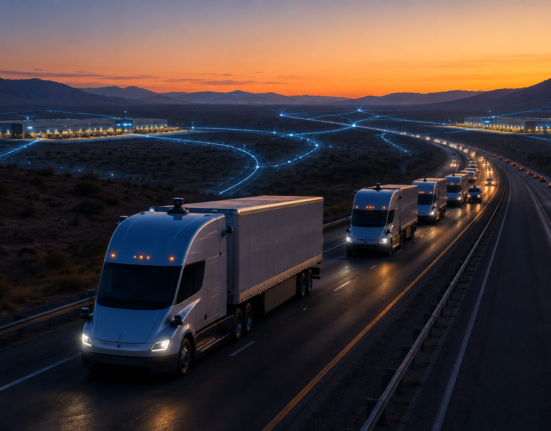
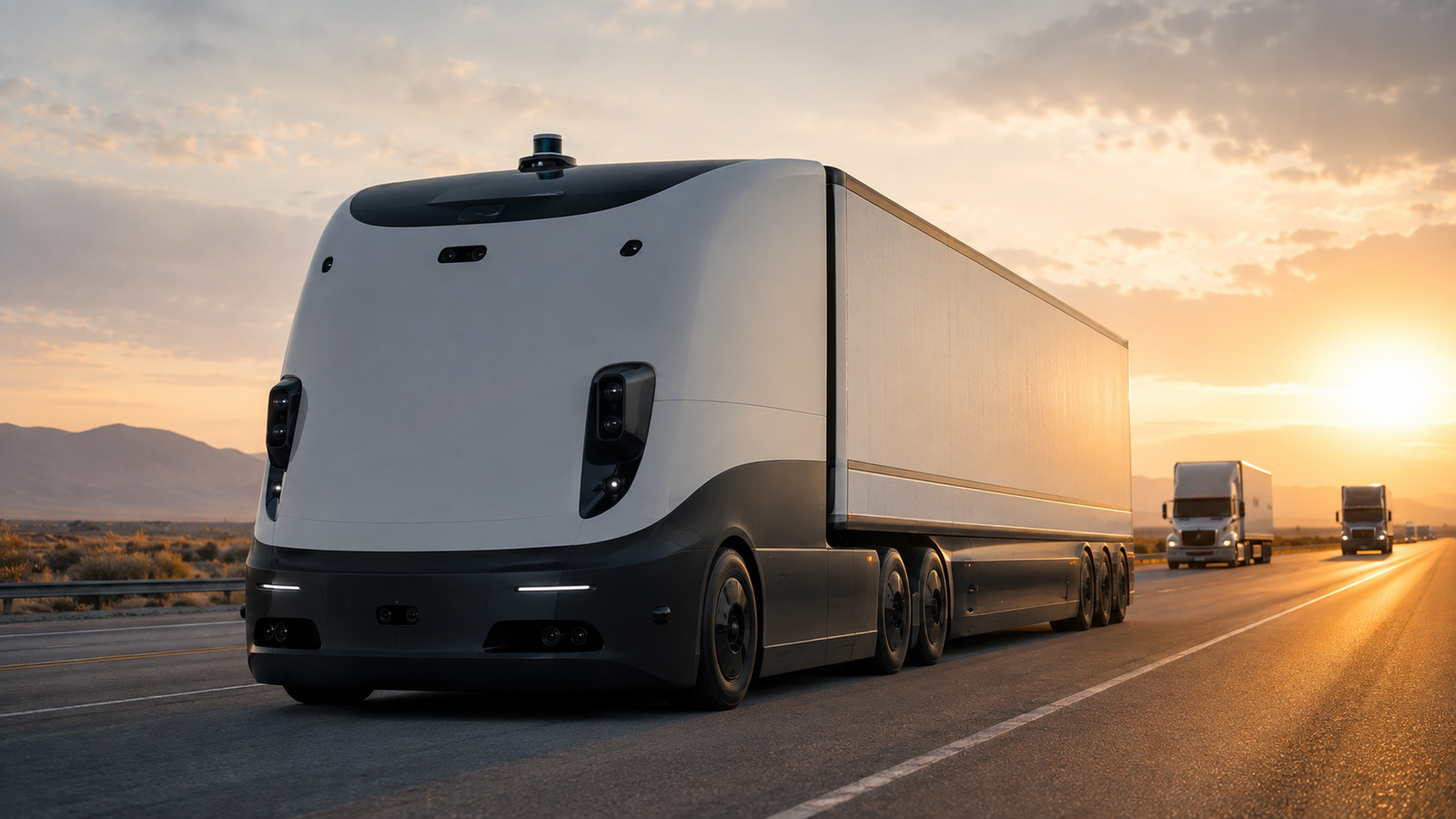
The clearest example of purpose-built cab-less design is Humble, a San Francisco freight startup that emerged from stealth in 2026 with a fully electric, cabless freight hauler carrying no front cab, no windshield, and no driver seat at all, raising twenty-four million dollars in seed funding to pursue it. The vehicle’s cabless shape enables full three-hundred-sixty-degree sensor coverage using cameras, radar, and lidar arranged around the entire vehicle rather than clustered where a human driver’s forward-facing view would otherwise dictate placement, and it is built specifically around standard forty-foot and fifty-three-foot intermodal shipping containers, operating dock-to-dock rather than attempting to replicate a general-purpose truck’s flexibility.
Einride, the Swedish freight technology company, has pursued a parallel and in some ways more mature version of the same idea with its Pod vehicle. The Pod has no driver’s cab at all and is remotely monitored by a human Remote Pod Operator rather than carrying anyone on board, and Einride has already completed what it describes as the world’s first cabless, fully autonomous border crossing, taking a shipment from Sweden into Norway with no human physically present in the vehicle and clearing electronic customs without intervention. Perhaps most significantly for the American market, Einride’s AET vehicles received approval from the National Highway Traffic Safety Administration to operate on U.S. public roads, marking the first time a purpose-built autonomous electric truck with no onboard driver has received permission to use public roads in the United States.
| Company | Vehicle | Notable Milestone |
|---|---|---|
| Humble | Humble Hauler | Emerged from stealth in 2026 with $24M seed funding for a cabless electric freight hauler |
| Einride | Einride Pod | First cabless, fully autonomous cross-border delivery (Sweden to Norway) and NHTSA approval for U.S. roads |
Why These Companies Are Not Simply Copying Retrofit Autonomy
What distinguishes Humble and Einride from the retrofit camp is not just the absence of a cab but the design philosophy that follows from that absence. Because there is no requirement to preserve sightlines, headroom, or ergonomic space for a human occupant, engineers are free to reshape the entire front of the vehicle around sensor coverage and aerodynamics rather than around a windshield. The Humble Hauler’s design deliberately supports full sensor coverage around the vehicle rather than the forward-weighted sensor arrangement a retrofitted cab imposes, and Einride’s Pod configuration, in its stated specifications, carries up to eighteen pallets and roughly sixteen tonnes of cargo within a footprint shaped entirely around freight and battery packaging rather than a driver’s compartment.
Figure: Retrofit Versus Purpose-Built Sensor Coverage
A comparison diagram shows a conventional retrofitted autonomous truck with sensor pods clustered on the roof and mirrors of a human-designed cab, leaving blind zones directly behind and beside the cab structure, next to a purpose-built cabless truck with sensors distributed evenly across a rounded, cab-free front section providing continuous three-hundred-sixty-degree coverage with no structural blind spots.
The Counterargument: Betting Everything on an Unproven Category
A fair opinion piece has to sit with the strongest version of the opposing case, and here it is: cab-less trucks are a bet on regulatory and public acceptance moving faster than history suggests it will, and betting a company’s entire product line on a vehicle category that cannot legally carry a fallback human driver is a much riskier proposition than the retrofit approach’s incremental path. Retrofitted autonomous trucks can always, in principle, put a safety driver back in the seat if a regulator, an insurer, or a nervous customer demands it. A cab-less truck has no seat to put anyone in. If a jurisdiction pauses driverless trucking approvals, or if a high-profile incident triggers a moratorium, retrofit fleets can revert to human-driven or supervised operation overnight. Cab-less fleets cannot revert to anything; they simply stop moving.
That regulatory exposure is not hypothetical. Public pushback against driverless trucking has already surfaced in California, where labor and safety advocates have organized against permitting driverless freight trucks on public roads, reflecting the same anxieties that have complicated robotaxi rollouts in dense urban environments. A purpose-built cab-less vehicle amplifies this political friction rather than softening it, because its very appearance, a truck front with no windshield at all, is a visceral, immediately legible symbol of automation that is far more provocative to a skeptical public and a skeptical legislature than a truck that merely happens to be driving itself while still looking like a truck a person could drive.
Common mistake
Commentary on this space frequently treats “cab-less” and “autonomous” as synonyms, assuming any driverless truck initiative is racing toward a cab-less end state. In reality most autonomous trucking programs today, including large, well-funded highway pilot programs, remain committed to retrofitted conventional truck platforms specifically because that path preserves a human-driver fallback option that regulators and freight customers still expect during this transitional period.
Engineering and Regulatory Implications
Beyond the philosophical argument, cab-less design creates concrete engineering and regulatory questions that retrofit autonomy mostly sidesteps. Crash safety standards for commercial trucks were written around the assumption of an occupied cab and have not been comprehensively rewritten for a vehicle that will never carry a person in that space; regulators have to decide whether existing frontal crash requirements even apply in their current form, or whether an entirely new certification category is needed. Roadside inspection and law enforcement interaction protocols assume an officer can flag down a truck and speak to a driver; a cab-less vehicle needs a remote communication channel that satisfies the same practical function without a physical human present to hand over paperwork or answer questions at a weigh station.
There is also a manufacturing dimension that favors incumbents less than it might first appear. Established truck manufacturers have decades of tooling, supply chains, and dealer service networks built around conventional cabbed platforms, and retrofitting that platform with an autonomy stack leverages existing manufacturing scale. A cab-less vehicle requires an entirely new chassis architecture, which is precisely why the companies pursuing it are venture-backed newcomers rather than the established truck manufacturers who have the most to lose from a wholesale platform change and the least incentive to abandon amortized cabbed-truck tooling.
| Implication Area | Retrofit Approach | Cab-less Approach |
|---|---|---|
| Crash safety certification | Uses existing occupant-based standards | Requires new no-occupant certification framework |
| Roadside enforcement | Officer can still interact with a cab, even if empty | Needs remote communication protocols entirely |
| Manufacturing base | Leverages existing OEM tooling and dealer networks | Requires new-built chassis and service infrastructure |
| Public perception | Visually resembles a familiar truck | Visually signals automation, inviting more scrutiny |
The Self Drive Act and the Federal Question
Legislative movement matters enormously to which design philosophy wins. A unified federal framework for autonomous trucking, introduced in the United States in early 2026, aims to replace today’s patchwork of state-by-state rules with a single national standard, and how that framework treats occupant-free vehicle categories will materially determine whether cab-less designs can scale nationally or remain confined to isolated pilot corridors. Until that kind of federal clarity exists, cab-less operators are effectively betting on favorable rulemaking arriving before their capital runs out, a timing risk retrofit operators face to a much lesser degree since their vehicles already resemble something regulators know how to certify.
Insurance underwriting adds another layer of uncertainty that rarely makes it into breathless coverage of cab-less demos. Commercial trucking insurers price policies based on decades of claims history tied to conventional, human-driven, cabbed vehicles, and a purpose-built vehicle with no occupant, no conventional crash structure precedent, and no driving record to actuarially model represents a genuinely novel underwriting problem. Early cab-less fleets are likely to carry higher premiums, more restrictive route and weather conditions written into their coverage, or both, until enough claims and operational data accumulate for insurers to price the risk with confidence rather than caution. That cost pressure compounds the capital-runway risk facing cab-less startups, since it raises the operating cost per mile at exactly the stage when these companies most need to demonstrate a viable unit economics story to investors and freight customers alike.
What Worked: Constrained, Defined Routes Before General Freight
What worked
Einride’s approach of proving cabless autonomy on a defined, monitored cross-border route with a remote operator on standby, rather than attempting unconstrained general freight from day one, produced a genuine operational and regulatory milestone that built the credibility needed for subsequent approvals like NHTSA’s authorization for U.S. public roads.
My Position: A Real Endpoint, Arriving Slower Than Its Advocates Claim
Taking a clear position: cab-less design is the more honest, more efficient long-term architecture for freight that genuinely never needs a human on board, and the aerodynamic, sensor-coverage, and manufacturing-cost arguments in its favor are sound engineering, not marketing dressing. But the counterargument’s regulatory and political risks are real enough that cab-less design will not become the industry default on the timeline its most enthusiastic advocates suggest. The more likely path over the next several years is a slower, dual-track evolution: retrofitted autonomous trucks continue to carry the bulk of near-term freight volume on defined highway corridors because they preserve a human-fallback option regulators still want during this trust-building period, while cab-less vehicles prove themselves first on tightly scoped, monitored routes, exactly the pattern Einride has followed, before expanding as legislation like a federal autonomous trucking framework matures and public comfort catches up to the engineering.
The premature-bet critique is not wrong about timing, but it mistakes a slower rollout for a wrong destination. Removing a cab that will never hold a human is not a stunt; it is what confident, mature autonomy eventually looks like once you stop hedging the design around a driver who is never coming back. The companies betting on cab-less design today are early, and some of them will run out of runway before regulation and public sentiment catch up. That does not make the architecture wrong. It makes the bet risky, which is a different thing entirely, and a distinction worth holding onto rather than collapsing into a simple yes-or-no verdict on the category.
Frequently Overlooked Factors in the Cab-less Debate
- No fallback occupantA cab-less vehicle cannot revert to human-driven operation if regulation tightens, unlike a retrofitted truck that can always seat a safety driver again.
- Visceral public signalA truck front with no windshield is an immediately legible symbol of automation that invites more political scrutiny than a conventional-looking autonomous truck.
- Remote operator infrastructureCab-less fleets depend on a remote monitoring and intervention layer that itself needs redundancy, connectivity, and its own safety case.
- Roadside enforcement gapExisting traffic stop and weigh-station protocols assume a person to interact with, a gap cab-less operators must solve through remote communication systems.
- Manufacturing lock-inEstablished truck makers have deep incentives to stay on cabbed platforms, leaving cab-less innovation concentrated among venture-backed new entrants.
- Labor and union responseDriver and logistics labor organizations have already mobilized against driverless freight trucks in some states, a dynamic that will shape the pace of cab-less approvals as much as the technology itself.
Glossary
- Cab-less truck
- A purpose-built freight vehicle designed from the outset with no cab, windshield, steering wheel, or driver seat, intended to operate with no human ever on board.
- Retrofitted autonomous truck
- A conventional, human-designed cabbed truck platform onto which autonomous driving sensors and computing have been added.
- Remote Pod Operator
- A human role, used by companies like Einride, that monitors and can remotely intervene in a cab-less vehicle’s operation without being physically on board.
- Dock-to-dock operation
- A freight model in which a vehicle travels directly between two fixed loading and unloading points rather than making multiple flexible stops.
- Self Drive Act
- Proposed U.S. federal legislation introduced in 2026 intended to establish a unified national framework for autonomous vehicle and trucking regulation.
Key Takeaways
- Cab-less trucks are purpose-built driverless vehicles with no cab, windshield, or seat at all, distinct from retrofitted autonomous versions of conventional trucks.
- Humble and Einride are the clearest examples currently pursuing purpose-built cab-less freight vehicles, each with real operational and regulatory milestones in 2026.
- Removing the cab enables full sensor coverage and aerodynamic gains that a retrofitted cab structurally cannot match.
- Cab-less vehicles cannot fall back to a human driver if regulation or public sentiment turns against driverless operation, unlike retrofitted trucks.
- Public and labor pushback against driverless trucking is already visible in some U.S. states, adding real political risk to the cab-less bet.
- A unified federal framework for autonomous trucking will materially determine how quickly cab-less designs can scale beyond pilot corridors.
- The most likely near-term outcome is a dual-track industry, with retrofit trucks carrying most volume while cab-less vehicles prove themselves on defined routes first.
FAQs
What makes a truck “cab-less” rather than just autonomous?
A cab-less truck is purpose-built from the ground up with no cab structure, windshield, steering wheel, or driver seat at all. An autonomous truck that keeps these features but simply does not use them, because software rather than a person is driving, is a retrofitted design, not a cab-less one.
Which companies are building cab-less freight trucks?
Humble, a San Francisco startup, unveiled a fully electric cab-less freight hauler in 2026 with $24 million in seed funding. Einride, a Swedish freight technology company, has developed the cab-less Einride Pod and completed the first fully autonomous cab-less cross-border delivery, later gaining NHTSA approval to operate on U.S. public roads.
Why would removing the cab actually matter for autonomy?
A cab exists to protect and inform a human driver. Once no human ever occupies that space, the cab becomes wasted aerodynamic drag, structural weight, and manufacturing cost, and it constrains sensor placement to where a human-designed cab allows rather than where full vehicle coverage would ideally place them.
What is the biggest risk of the cab-less design bet?
Cab-less vehicles cannot carry a fallback human driver if regulators tighten rules or public sentiment turns against driverless trucking, unlike retrofitted autonomous trucks that can always revert to human-driven or supervised operation.
Has any cab-less truck actually operated on public roads?
Yes. Einride’s cab-less Pod completed a fully autonomous, driverless border crossing from Sweden to Norway, and separately received approval from the U.S. National Highway Traffic Safety Administration to operate on American public roads.
Is there public opposition to cab-less or driverless freight trucks?
Yes, opposition has already emerged in some U.S. states, including organized pushback in California from labor and safety advocates concerned about driverless freight trucks operating on public roads, echoing similar tensions seen around robotaxi deployments.
How does proposed federal legislation affect cab-less trucking?
A unified federal framework for autonomous trucking, introduced in the United States in 2026, would replace a fragmented state-by-state regulatory patchwork with a single national standard, and how it treats no-occupant vehicle categories will significantly affect whether cab-less designs can scale nationally.
Will cab-less trucks replace retrofitted autonomous trucks?
Not quickly. The more likely path is a dual-track industry where retrofitted trucks continue carrying most near-term freight volume because they preserve a human-fallback option, while cab-less vehicles prove themselves on defined, monitored routes before expanding as regulation and public acceptance mature.
References
- Fortune, “Exclusive: Startup Humble Debuts Cabless Autonomous Truck Targeting $900 Billion U.S. Freight Industry”
- TruckingInfo, “Autonomous Start-Up Humble Announces Cabless Autonomous Electric Hauler”
- Truck News, “Humble Emerges From Stealth With Cabless Autonomous Electric Hauler, $24M Backing”
- Clean Trucking, “Humble Unveils Autonomous Cabless EV Truck for Freight”
- Einride, “Einride Achieves World-First Cabless Electric Autonomous Border Crossing”
- InsideEVs, “Einride Pod Cabless Truck Granted NHTSA Approval for US Roads”
- New Atlas, “Einride’s Pod Autonomous Truck Moves Toward Commercial Availability”
- Chattanooga Times Free Press, “This Startup Wants to Bring Driverless Freight Trucks to California’s Roads, but Drivers Are Pushing Back”
For related coverage in this cluster, see our deep dive on autonomous rail and digital coupling systems, the road-network context in middle-mile autonomous trucking, how ports are automating in autonomous yard trucks and port automation, and the differences between autonomous mobile robots and AGVs. Readers interested in the urban side of automated logistics may also want our piece on robotic micro-fulfilment in urban retail.