| Myth | Reality |
|---|---|
| Adding more robots always increases throughput. | Beyond a facility’s coordination capacity, additional robots increase congestion and can reduce net throughput due to traffic conflicts. |
| Collision avoidance sensors alone prevent traffic jams. | Sensors prevent physical collisions but do nothing to prevent deadlocks, where robots block each other in a circular dependency with no sensor-level solution. |
| A simple first-come-first-served rule is enough at intersections. | Dense fleets require reservation tables that plan several steps ahead, or first-come-first-served rules create cascading delays at high-traffic junctions. |
| Centralized traffic control always scales best. | Purely centralized systems become a computational bottleneck at large fleet sizes; most production systems use a hybrid of centralized planning and decentralized local negotiation. |
Why Traffic Management Becomes the Bottleneck, Not the Robots
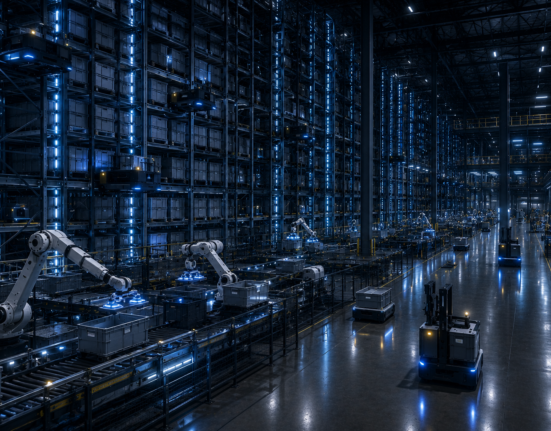
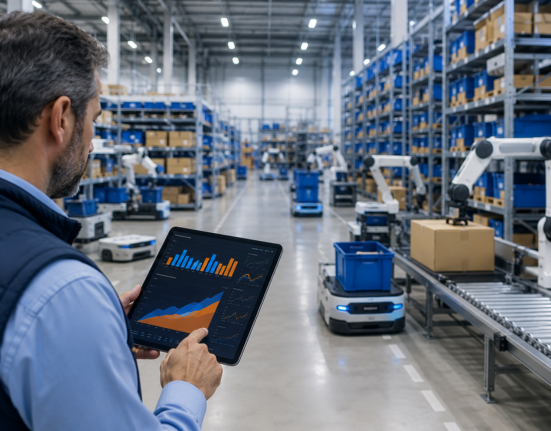
As covered briefly in our broader look at smart warehouse infrastructure trends, robots coordinating their paths to avoid traffic jams is one small piece of the future-warehouse picture. This article goes much deeper: dense warehouses running dozens to hundreds of Autonomous Mobile Robots (AMRs) and Automated Guided Vehicles (AGVs) through narrow, shared aisles face a coordination problem that is fundamentally different in kind, not just scale, from managing a handful of robots. When fleet size grows, the limiting factor on throughput stops being the speed or capability of individual robots and becomes the traffic management architecture coordinating all of them at once.
This is a technical deep dive into how that coordination actually works: intersection reservation systems, deadlock avoidance algorithms, dynamic re-routing, and congestion prediction, along with the architectural tradeoffs between centralized and decentralized control that determine whether a system scales gracefully or collapses under its own traffic load.
The Core Problem: Shared, Constrained Space
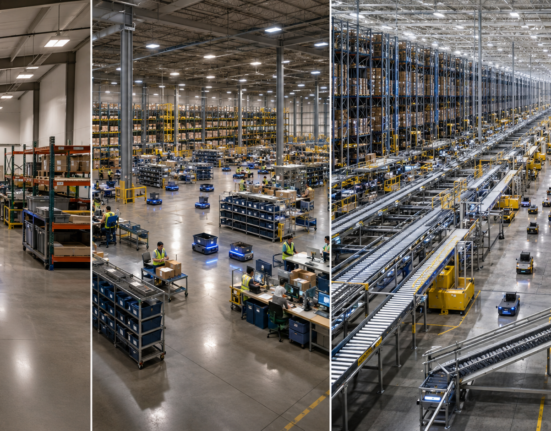
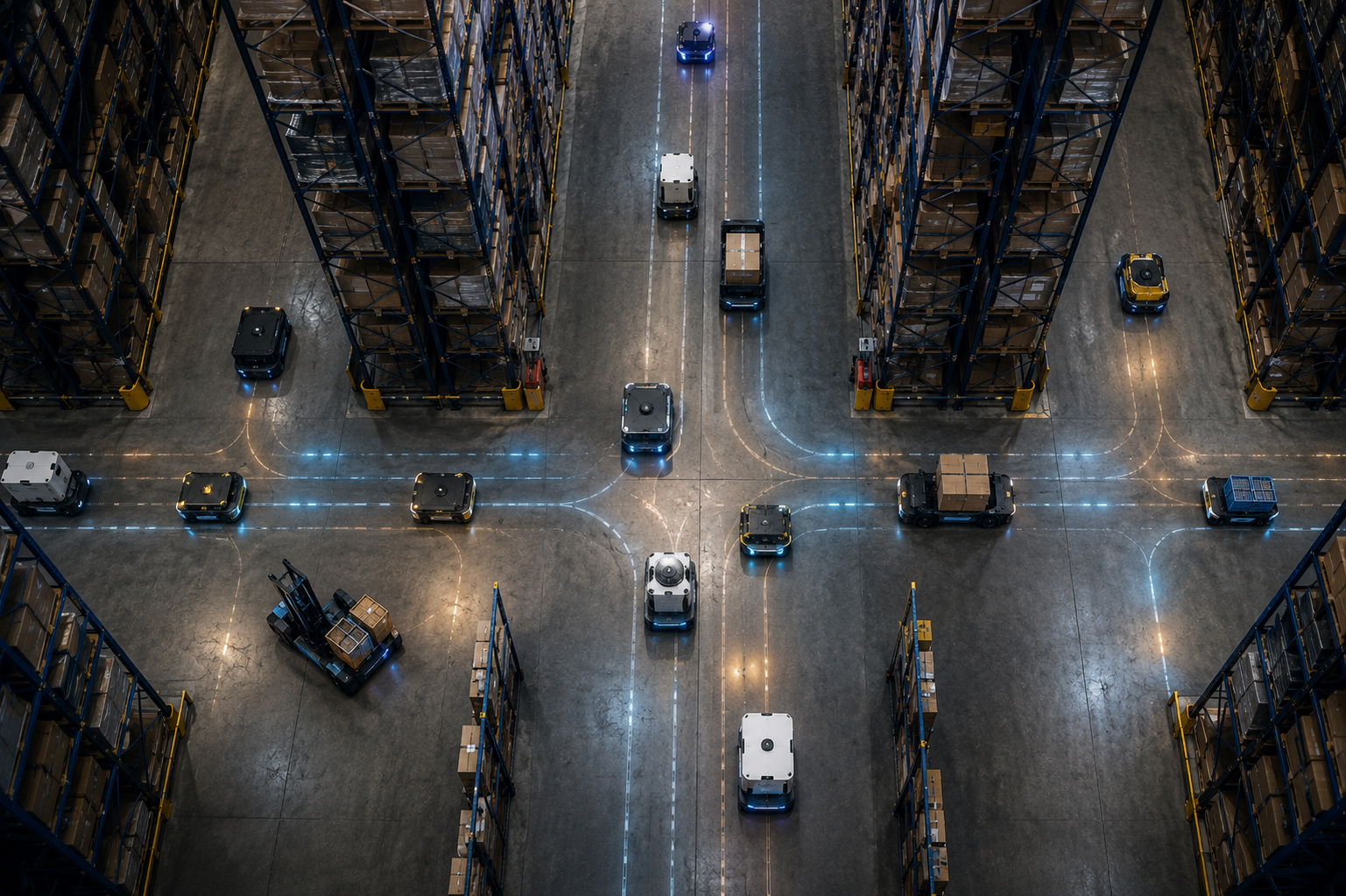
A warehouse aisle is a shared, constrained resource. Unlike a road network with multiple lanes and alternate routes, many warehouse aisles are barely wide enough for a single robot, meaning two robots approaching from opposite directions cannot simply pass each other. Multiply this by dozens or hundreds of robots simultaneously executing pick, transport, and replenishment tasks, and the traffic management system has to solve, continuously and in real time, a problem that combinatorially explodes with fleet size: who goes first, who waits, who reroutes, and how to guarantee that no combination of “wait” decisions ever produces a permanent standstill.
Intersection Reservation Systems
The foundational technique used across most modern multi-robot traffic systems is the intersection reservation table, conceptually borrowed from air traffic control and railway signaling. Rather than letting robots negotiate right-of-way locally and reactively, the fleet management system maintains a reservation table that assigns each robot a specific time window to occupy each segment of the path network, including intersections. A robot is only permitted to enter an intersection if its reservation for that time slot is confirmed; otherwise, it is instructed to wait, slow down, or take an alternate path before it ever reaches the conflict point.
Research on this approach has shown that improved A* pathfinding algorithms incorporating traffic rules and reservation tables enable efficient multi-robot path planning in warehouse logistics environments while maintaining reliable collision avoidance, even as the number of simultaneously active robots grows. The reservation table approach works because it converts a real-time negotiation problem, which is expensive and error-prone, into a scheduling problem, which can be solved and verified in advance.
| Approach | How It Works | Main Limitation |
|---|---|---|
| Reactive local negotiation | Robots detect each other and negotiate right-of-way at the moment of conflict | Slower, higher collision risk, does not prevent deadlock |
| Centralized reservation table | A central planner assigns time-slot reservations for every path segment in advance | Computationally expensive at very large fleet sizes |
| Hybrid reservation + local fallback | Central reservations for main routes, local negotiation for edge cases | Requires careful design to avoid conflicting authority between layers |
Deadlock Avoidance: The Problem Sensors Cannot Solve
A deadlock occurs when a set of robots reach a state where each is waiting for another to move, forming a circular dependency that no individual robot can resolve on its own, even with perfect collision-avoidance sensors. A classic example: four robots approach a four-way intersection simultaneously, each waiting for the robot to its right to go first, and none moves. Collision-avoidance sensors are the wrong tool for this problem entirely, because there is no collision about to happen; the robots are simply stuck.
Research on multi-robot scheduling has proposed introducing dedicated non-stop areas at intersections based on the dynamics of vehicle movement, specifically designed to break the circular-wait conditions that cause deadlock. Other approaches build deadlock detection directly into the path-planning algorithm, using graph-theoretic techniques to identify when a proposed set of robot movements would create a cycle of mutual waiting before any robot is actually dispatched, and rejecting or reordering that plan in advance.
Common mistake
Facilities frequently deploy collision-avoidance sensors and assume traffic problems are solved, without implementing separate deadlock-detection logic, then discover during a live pilot that robots occasionally freeze in place indefinitely at busy intersections with no collision ever occurring.
Distributed vs Centralized Path Planning
There are two broad architectural philosophies for coordinating multi-robot fleets, and most production systems today use some blend of the two. A fully centralized system computes optimal paths and reservations for every robot in the fleet from a single planning engine, which guarantees globally optimal or near-optimal outcomes but becomes a computational bottleneck as fleet size grows, since the planning problem’s complexity increases sharply with the number of simultaneously active robots and the density of the path network.
A fully decentralized system lets each robot plan its own path and negotiate locally with nearby robots, which scales more gracefully in computational terms but sacrifices global optimality and requires more sophisticated local negotiation protocols to avoid deadlock and starvation, where a robot repeatedly loses right-of-way to others and never completes its task. Distributed planning approaches with asynchronous execution and local navigation have been studied specifically for the multi-agent pickup-and-delivery problem that characterizes warehouse fulfillment, aiming to combine the scalability of decentralized execution with enough coordination to avoid the worst outcomes of pure local negotiation.
Figure: Centralized vs Decentralized Coordination Tradeoff
A conceptual tradeoff diagram: as fleet size increases along the horizontal axis, a purely centralized system’s computation time grows steeply, while a purely decentralized system’s coordination quality (measured by collision and deadlock incidents) degrades gradually. Most production fleets operate in the middle band, using centralized planning for main traffic arteries and decentralized negotiation for local, low-stakes conflicts.
Dynamic Re-Routing Around Congestion
Beyond preventing collisions and deadlocks, a mature traffic management system actively predicts and routes around congestion before it forms, rather than simply reacting once a bottleneck appears. Recent research on congestion mitigation path planning for large-scale multi-agent navigation in dense environments has focused specifically on this predictive layer: modeling how robot density will evolve along candidate paths over the next planning horizon, and steering a portion of the fleet away from routes that are about to become congested, even if those routes currently look clear.
This predictive rerouting is what separates systems that merely avoid collisions from systems that actually maintain high throughput under load. A facility running at 70 percent of its theoretical maximum robot density needs congestion prediction to avoid a cascading slowdown that a purely reactive system would only notice after the bottleneck has already formed and started to compound.
| Traffic Management Layer | Primary Function | Failure Mode If Absent |
|---|---|---|
| Collision avoidance sensors | Prevent physical contact between robots | Physical collisions and near-misses |
| Intersection reservation | Assign right-of-way at shared path segments | Chaotic negotiation, unpredictable delays |
| Deadlock detection | Prevent circular-wait standstills | Robots freeze indefinitely with no collision |
| Congestion prediction | Proactively reroute around forming bottlenecks | Reactive-only response, cascading slowdowns |
Physical Constraints in Real Warehouse Layouts
Algorithmic elegance runs into physical reality quickly in warehouse deployments. Research on deadlock prevention and multi-agent path finding for massive fleet AGV systems has specifically highlighted the need to account for physical constraints such as vehicle turning radius, aisle width, and charging station placement, none of which are abstract graph-theory concerns but very concrete limits on which theoretical solutions are actually implementable on a given warehouse floor. A path-planning algorithm that assumes robots can turn in place, for instance, will produce invalid plans for vehicles that require a wider turning radius, so any production deadlock-avoidance system must be tuned to the specific fleet’s physical characteristics rather than applied as a generic algorithm.
What worked
Facilities that mapped their aisle network as a directed graph with realistic turning-radius and minimum-following-distance constraints before deploying a fleet management system caught infeasible path-planning assumptions in simulation, well before they caused live deadlocks on the warehouse floor.
Roadmap Annotation and Deadlock-Free Navigation Design
An emerging complementary approach to purely algorithmic deadlock avoidance is annotating the warehouse’s roadmap itself with structural rules that make certain deadlock configurations impossible by design, rather than merely detecting and resolving them at runtime. This includes designating one-way segments in the busiest aisles, building in passing bays at strategic points wide enough for two robots to pass safely, and structuring the path network as a set of loops rather than dead-end branches wherever the physical layout allows it. This kind of roadmap-level design reduces the computational burden on the real-time planning layer because fewer conflict scenarios are even possible in the first place.
- Passing bay placementWidened sections at strategic points in narrow aisles let one robot yield to another without either having to fully reverse or reroute.
- Charging station contentionCharging docks are shared resources just like aisles and need their own reservation logic to prevent robots queuing indefinitely for a free slot.
- Priority weighting by taskTime-sensitive tasks, such as replenishing a pick station about to run empty, often need priority weighting in the reservation system over lower-urgency transport tasks.
- Fleet heterogeneityMixed fleets of AMRs and AGVs with different speeds, turning radii, and stopping distances complicate reservation-table math and require per-vehicle-type parameters.
- Simulation before deploymentRunning the planned fleet size and layout through a digital-twin simulation surfaces deadlock and congestion scenarios before they occur on the live floor.
- Graceful degradationA well-designed traffic system should slow the fleet down gradually as density approaches capacity rather than failing abruptly into gridlock.
How This Connects to Fleet Scaling Decisions
Operators considering whether to scale up a mixed AMR and AGV fleet should understand that the traffic-management architecture, not the individual robot specifications, is usually the limiting factor on how many additional units a facility can add before throughput gains flatten or reverse. This is directly relevant to the flexibility differences discussed in our comparison of AMRs and AGVs, since a facility’s choice of vehicle type affects how predictable and therefore how easy to schedule its traffic patterns are.
Glossary
- Intersection reservation table
- A scheduling structure that assigns each robot a specific time window to occupy a given path segment or intersection, preventing conflicting simultaneous claims.
- Deadlock
- A state in which a group of robots are each waiting for another robot to move, forming a circular dependency with no possible resolution without external intervention.
- Multi-agent path finding (MAPF)
- The algorithmic problem of computing collision-free and deadlock-free paths for multiple robots operating in a shared environment simultaneously.
- Congestion prediction
- A planning technique that forecasts how robot density will evolve along candidate routes and proactively reroutes traffic before bottlenecks form.
- Digital twin simulation
- A virtual model of a warehouse’s physical layout and robot fleet used to test traffic management logic before deploying it in the live facility.
Key Takeaways
- Traffic management architecture, not individual robot capability, becomes the limiting factor on throughput as fleet size grows in dense warehouses.
- Intersection reservation tables convert real-time negotiation into a scheduling problem, reducing collisions and unpredictable delays.
- Deadlock avoidance requires dedicated algorithms and roadmap design, since collision sensors alone cannot detect or resolve circular-wait standstills.
- Most production systems use a hybrid of centralized planning for main routes and decentralized negotiation for local conflicts.
- Congestion prediction proactively reroutes robots around forming bottlenecks rather than reacting only after a slowdown appears.
- Physical constraints such as turning radius and aisle width must be built into path-planning algorithms, not treated as abstract graph problems.
- Simulating fleet size and layout in a digital twin before deployment surfaces deadlock scenarios before they cause live disruptions.
FAQs
What is the biggest challenge in coordinating large robot fleets in warehouses?
The biggest challenge is that traffic management architecture, not individual robot speed or capability, becomes the limiting factor on throughput as fleet size grows. Shared, narrow aisles create a combinatorial coordination problem that requires reservation systems, deadlock avoidance, and congestion prediction working together.
How do intersection reservation systems work in warehouse robotics?
Intersection reservation systems assign each robot a specific time window to occupy a given path segment or intersection, similar to air traffic control. A robot can only enter an intersection if its reservation is confirmed, converting a real-time negotiation problem into a schedulable, verifiable planning problem.
Why can’t collision-avoidance sensors alone prevent robot traffic jams?
Collision-avoidance sensors prevent physical contact but cannot detect or resolve deadlocks, where a group of robots are each waiting for another to move in a circular dependency. No collision is imminent in a deadlock, so sensor-based systems have no mechanism to recognize or break the standstill.
What is a deadlock in multi-robot warehouse navigation?
A deadlock is a state where a set of robots are each waiting for another robot to move, forming a circular dependency that leaves all of them stuck indefinitely. Resolving deadlocks requires dedicated detection algorithms or roadmap designs that make such circular-wait conditions structurally impossible.
Is centralized or decentralized traffic control better for warehouse robots?
Neither is universally better. Centralized systems produce more globally optimal outcomes but become computationally expensive at large fleet sizes, while decentralized systems scale more easily but sacrifice some coordination quality. Most production systems use a hybrid, applying centralized planning to main routes and decentralized negotiation for local conflicts.
What is congestion prediction in warehouse robot fleets?
Congestion prediction is a planning technique that forecasts how robot density will evolve along candidate paths over an upcoming time horizon and proactively reroutes some robots away from routes that are about to become congested, rather than waiting for a bottleneck to form and reacting afterward.
Does adding more robots to a warehouse always increase throughput?
No. Beyond a facility’s coordination capacity, adding more robots increases traffic conflicts and congestion, which can reduce net throughput rather than increase it. Throughput gains depend on the traffic management architecture’s ability to handle the added coordination complexity, not just on adding more units.
How does aisle width affect multi-robot traffic management?
Narrow aisles that only fit one robot at a time force strict sequencing of traffic and increase the importance of reservation systems and passing bays. Wider aisles or roadmap designs that include dedicated passing points reduce the frequency of conflicts the traffic management system needs to resolve.
References
- IEEE Xplore, “Multi-Robot Scheduling for Deadlock Avoidance Using Nonstop Areas”
- Wiley Engineering Reports, “Path Planning Approaches in Multi-Robot System: A Review”
- arXiv, “Congestion Mitigation Path Planning for Large-Scale Multi-Agent Navigation in Dense Environments”
- arXiv, “Distributed Planning with Asynchronous Execution with Local Navigation for Multi-agent Pickup and Delivery Problem”
- ScienceDirect, “Deadlock Prevention and Multi Agent Path Finding Algorithm Considering Physical Constraint for a Massive Fleet AGV System”
- Taylor and Francis Online, “Autonomous Mobile Robot Travel Under Deadlock and Collision Prevention Algorithms by Agent-Based Modelling in Warehouses”
For related reading, see our comparison of AMRs versus AGVs for understanding fleet vehicle tradeoffs, how warehouse automation ROI is affected by fleet scaling decisions, how robotic picking accuracy interacts with fleet throughput, and how facilities approach autonomous yard trucks and port automation for coordinating vehicles beyond the four walls of the warehouse.