| Attribute | Conventional Automated Warehouse | True Dark (Lights-Out) Warehouse |
|---|---|---|
| Onsite staffing during shifts | Pickers, forklift drivers, floor supervisors present | Near zero floor staff; remote monitoring only |
| Lighting requirement | Full facility lighting for human safety | Minimal or no lighting in the automated zones |
| Picking method | Goods-to-person or manual pick with automation assist | Robotic arms or fully automated piece picking |
| Exception handling | Humans resolve jams, damaged items, mis-picks in real time | Automated recovery routines, humans intervene remotely or on a delayed shift |
| Operating hours | Limited by shift patterns and labour availability | 24 hours a day, 7 days a week |
What “Lights-Out” Actually Means in 2026
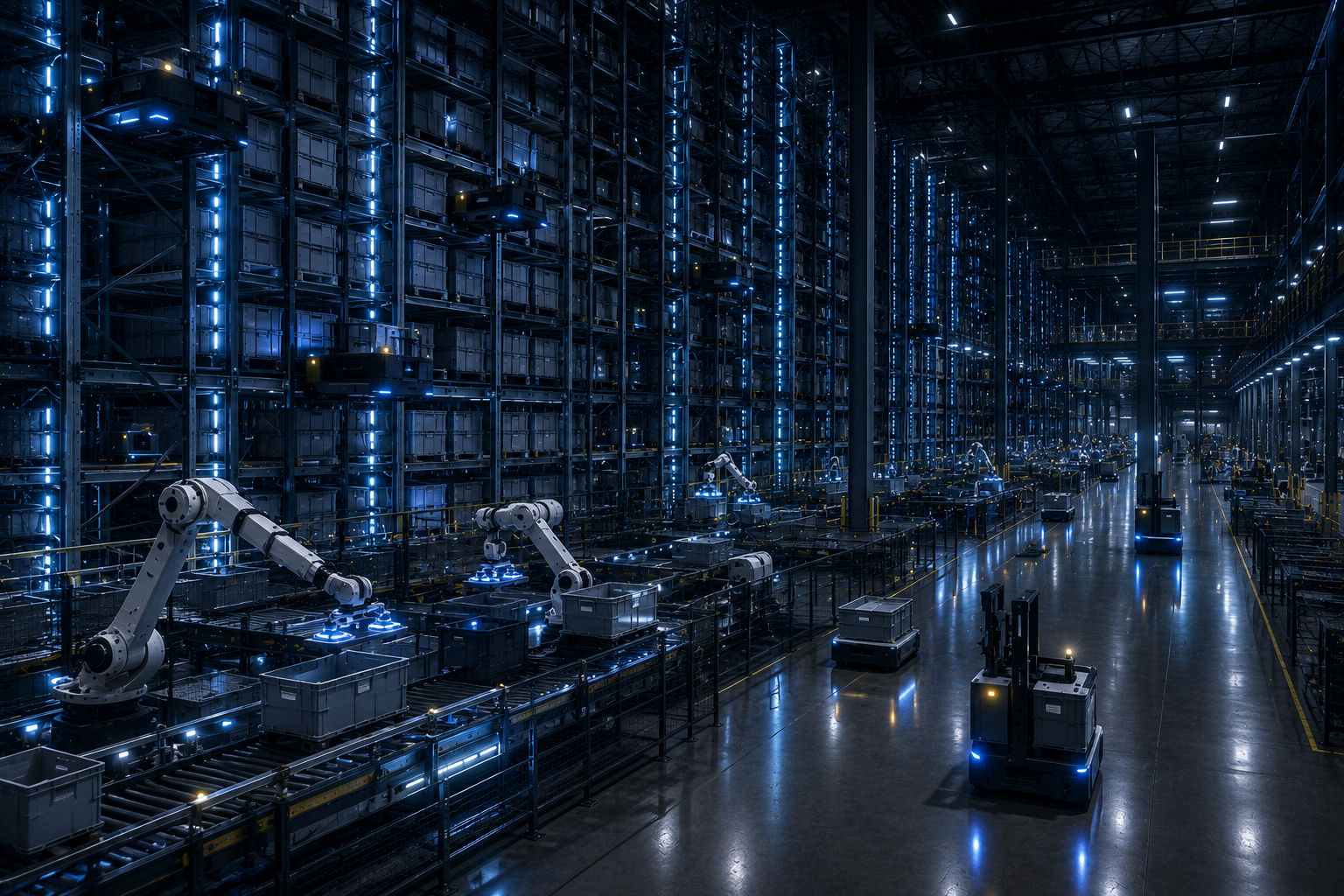
The phrase “dark warehouse” conjures an image of an empty building humming along in total darkness, goods flowing from dock door to delivery van without a single human hand touching them. That image is not entirely wrong, but it oversimplifies a spectrum of automation maturity that most of the industry is still climbing. A genuinely lights-out fulfilment centre eliminates onsite labour from the core storage-to-pick-to-pack cycle, which also removes the need for full-facility lighting, climate comfort systems tuned for people, and many of the safety systems designed around human movement through aisles.
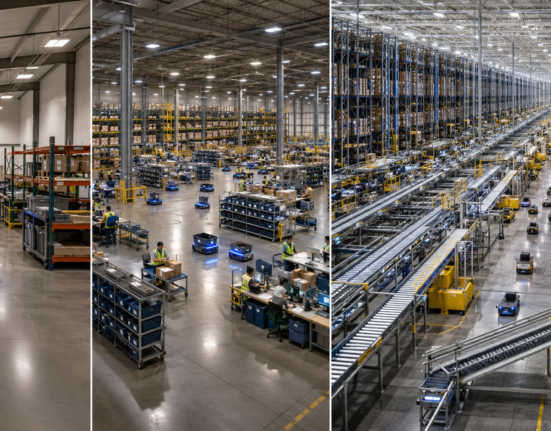
In practice, “lights-out” is best understood as a continuum rather than a binary switch. At one end sit conventional automated warehouses that use conveyors and pick-to-light systems but still rely on hundreds of workers per shift. In the middle are hybrid facilities where robots handle 70 to 90 percent of movements but humans remain on site for exception handling, replenishment of odd-shaped SKUs, and final quality checks. At the far end are the rare facilities that have pushed automation deep enough that the building can, for stretches of time, operate with no one physically present in the automated zones at all.
This distinction matters because a great deal of marketing language uses “dark warehouse” loosely to describe any highly automated distribution centre. This piece focuses specifically on that far end of the spectrum: the technology stack required to get there, the operators who have actually pulled it off (even partially), and the economics that determine whether going fully dark is worth the capital outlay. It also matters for planning purposes, since a facility that is genuinely dark has different fire code, insurance, network redundancy, and workforce requirements than one that merely looks impressive on a trade show floor. For a broader view of how dark warehouses fit alongside other 2026 warehouse infrastructure trends such as digital twins and AI-orchestrated labour, see our overview of smart warehouse infrastructure trends for 2026.
The Technology Stack That Makes a Warehouse Dark
No single robot makes a warehouse lights-out. It takes a stack of interlocking systems, each removing a different category of human task, all coordinated by software that can make second-by-second decisions without waiting for a supervisor’s sign-off.
Automated Storage and Retrieval Systems (AS/RS)
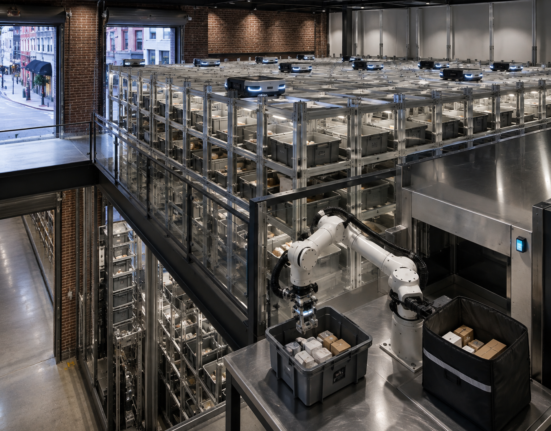
AS/RS technology forms the structural backbone of most dark warehouse projects. Cube-based storage systems such as AutoStore and Ocado’s grid use dense stacks of bins accessed by grid robots that travel across the top of the storage cube, lifting bins up to ports where they meet a human or robotic picker. Aisle-based shuttle systems, by contrast, use vertical lifts and horizontal shuttles running on rails inside conventional racking, delivering totes or pallets to a pick face. Both approaches share a key property: they eliminate the need for a person to walk the aisles, which is what allows the storage zone itself to run dark even when a pick-and-pack zone nearby still has people in it.
Robotic Picking and Piece-Level Automation
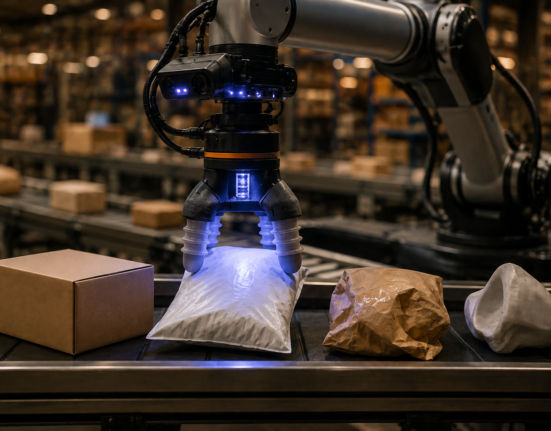
The hardest problem in warehouse automation has always been picking a single item out of a bin and placing it into an order tote without damaging it. Vision-guided robotic arms fitted with vacuum, pinch, or hybrid grippers have made significant strides on regular, rigid SKUs such as boxed goods, bottles, and canned items, but they still struggle with deformable packaging, loose produce, and highly irregular assortments. This is the single biggest reason full lights-out operation remains rare: even facilities with excellent AS/RS and transport automation frequently still station people at pick stations because robotic picking accuracy on a full retail catalogue has not yet reached the reliability level needed to remove humans entirely. Our deep dive on robotic picking accuracy benchmarks covers this gap in more detail.
Autonomous Forklifts and Indoor Transport
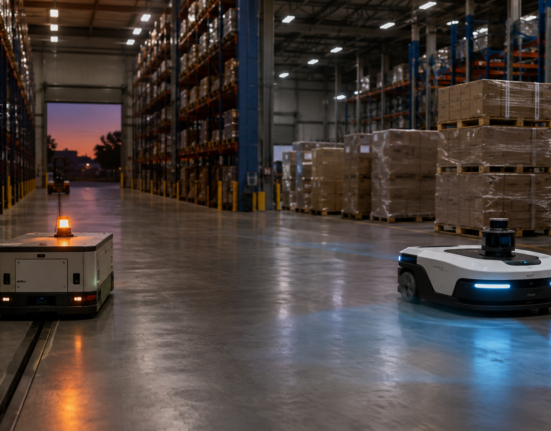
Moving pallets between dock doors, storage zones, and staging areas without a driver requires autonomous forklifts equipped with lidar, 3D cameras, and safety-rated obstacle detection. These vehicles handle bulk pallet movement, replenishment of the AS/RS infeed, and outbound staging. Autonomous mobile robots (AMRs) handle lighter, more flexible transport tasks such as ferrying totes between pick zones and pack stations. The distinction between AGVs following fixed paths and AMRs navigating dynamically matters a great deal for how a facility is laid out; our comparison of autonomous mobile robots versus AGVs walks through the trade-offs operators weigh when choosing between the two.
Software: Warehouse Execution Systems and Digital Twins
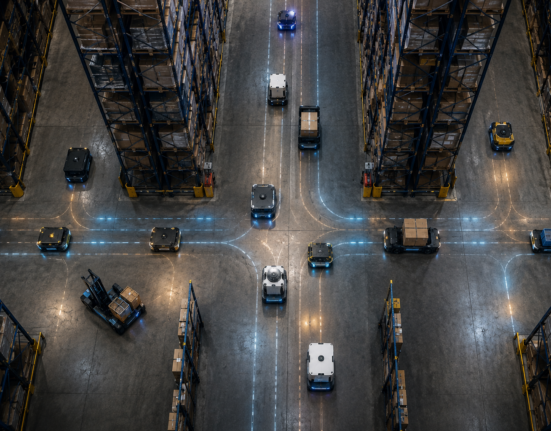
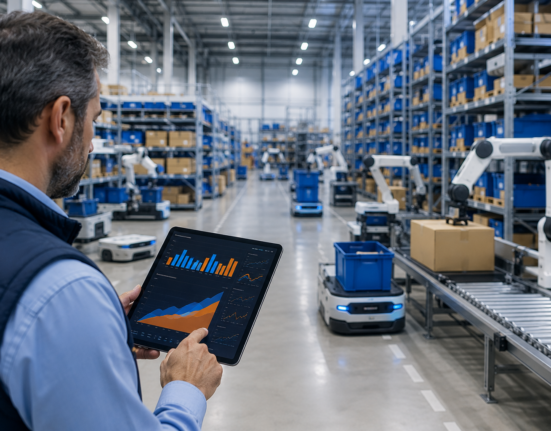
None of the hardware above functions as a dark warehouse without an orchestration layer. Warehouse execution systems (WES) sit between the warehouse management system and the physical equipment, sequencing thousands of concurrent robot and shuttle movements to keep throughput high while avoiding gridlock. Increasingly, operators run a live digital twin of the facility, a real-time simulated mirror of every rack slot, shuttle position, and order queue, so that software can pre-empt congestion and reroute traffic before a jam happens rather than after. Coordinating dozens or hundreds of independent mobile units in a dense automated footprint is its own discipline; see our coverage of multi-robot traffic management in dense warehouses for how operators avoid deadlock at scale.
Network, Power, and Safety Infrastructure
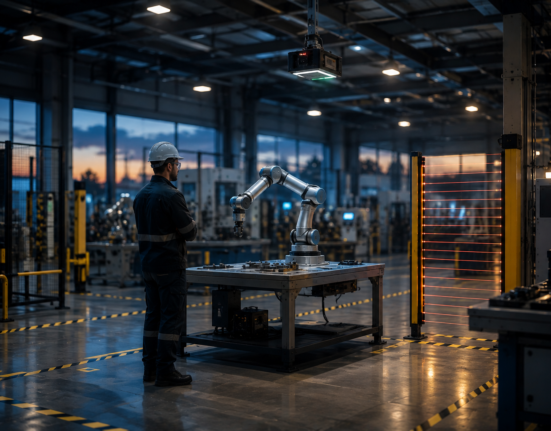
A dark facility places unusual demands on its underlying infrastructure. Wireless networks must maintain sub-second latency for hundreds of moving robots simultaneously, since a dropped connection can strand a shuttle mid-aisle with no human nearby to move it manually. Power systems need redundant feeds and uninterruptible supplies because a facility with no one on site cannot simply flip a breaker back on. Safety systems shift from human-centric designs, guardrails, light curtains, emergency stop pull cords, toward machine-centric designs such as geofenced zones, redundant collision sensors, and automated lockout routines that isolate a fault without requiring a person to walk the floor and confirm it is safe.
Real Facilities: Who Has Actually Gone Dark
Despite years of “lights-out warehouse” headlines, the number of facilities that have achieved genuinely unmanned operation across a full shift, rather than just heavy automation with people still present, remains small. The table below separates marketing claims from what has actually been reported in trade press and operator disclosures as of mid-2026.
| Facility / Operator | Automation Depth | Status as of 2026 |
|---|---|---|
| Ocado customer fulfilment centres (UK and international) | Grid-based AS/RS handles nearly all storage and retrieval; picking stations still staffed | Highly automated but not fully unstaffed; Ocado has pivoted toward smaller store-based automation after several US partner sites with Kroger were closed |
| Symbotic-automated distribution centres (Walmart and other retail partners) | Robotic pallet and case handling largely autonomous in the automated zone | Automated zones run with minimal staff; facility-wide lights-out has not been publicly claimed |
| Chinese e-commerce mega-hubs (JD.com, select Cainiao sites) | Robotic sorting, AGV transport, and automated racking cover a large share of volume | Some zones reported to run unmanned overnight; full-facility claims are difficult to independently verify |
| Automotive parts and industrial distribution centres using shuttle AS/RS | Narrow SKU range (uniform boxed parts) suits full robotic handling well | Among the closest to genuine end-to-end lights-out because SKU uniformity removes the hardest picking problems |
The pattern that emerges is consistent: the closer a warehouse gets to a narrow, uniform, rigid-packaging product range, the closer it can get to true lights-out operation. Broad retail assortments with irregular SKUs, soft packaging, and produce remain the hardest environments to fully de-staff, which is why grocery and general merchandise fulfilment, despite being the most publicised use case, is also the slowest to achieve genuine end-to-end automation. The Ocado-Kroger experience is instructive here: even one of the most sophisticated grid-based systems in the world still required staffed picking stations, and when the underlying grocery volumes did not materialise as projected, the economics of the whole facility unravelled well before the lights-out question even came into play.
Anatomy of a Dark Warehouse Order Cycle
An inbound pallet is unloaded by an autonomous forklift, scanned, and fed into a shuttle-based AS/RS. When an order arrives, the WES calculates the fastest retrieval path, a shuttle delivers the storage tote to a robotic pick cell, a vision-guided arm identifies and picks the SKU, an AMR carries the completed order tote to an automated pack station, and a robotic palletiser builds the outbound load for an autonomous yard vehicle. A human supervisor monitors the entire sequence remotely and is paged only when the system flags an exception it cannot resolve on its own.
The Economics of Going Fully Lights-Out
Operators do not chase dark warehouse status for its own sake; they chase it because, at sufficient scale and volume predictability, the total cost of ownership can beat a labour-heavy model. But the capital intensity is severe, and the payback period depends heavily on throughput volume, real estate cost, and local labour rates.
| Cost Factor | Conventional Manual/Hybrid DC | Fully Automated Dark Facility |
|---|---|---|
| Initial capital expenditure | Lower; racking, conveyors, WMS software | Substantially higher; AS/RS, robotic arms, WES, redundant power and networking |
| Ongoing labour cost | Largest single operating expense, rises with overtime and turnover | Sharply reduced; concentrated in a small technical and maintenance team |
| Energy cost profile | Lighting and HVAC sized for human comfort across the whole floor | Lower lighting and comfort HVAC load, offset by higher continuous equipment power draw |
| Sensitivity to labour market | High; wage inflation and turnover directly hit margins | Low; largely insulated from local wage shocks once operational |
| Typical payback horizon | Not applicable; incremental spend | Multi-year, generally justified only above a high and stable volume threshold |
The clearest economic case for full automation appears where three conditions hold at once: extremely high and predictable order volume, a tight local labour market that makes staffing expensive or unreliable, and a product range narrow enough that robotic picking can be trusted. Where any one of those three is missing, the payback math tends to favour a hybrid model instead, which explains why most “dark warehouse” projects in practice end up as heavily automated but still partially staffed facilities. Readers evaluating a specific automation investment should also weigh our broader framework for calculating warehouse automation ROI, since the same volume and labour-market variables that decide dark warehouse feasibility apply to any automation tier.
Why Full Lights-Out Remains Rare
Three structural barriers keep the fully dark warehouse a niche rather than a norm. First, robotic picking still cannot match human dexterity and judgment across an unconstrained SKU catalogue, especially for damaged packaging, mixed-case picking, and produce. Second, regulatory and insurance frameworks in most jurisdictions still assume a human presence for fire safety, emergency response, and equipment failure recovery, which pushes operators to keep a skeleton crew on site even when the automation could technically run unattended. Third, demand volatility, promotional spikes, returns processing, and seasonal SKU changes, is much easier for a flexible human workforce to absorb than for a fixed robotic system tuned to a specific throughput profile.
None of this means the trend is stalling. It means the realistic 2026-2027 trajectory is incremental: more zones within a facility going dark one at a time (first bulk storage, then transport, then narrow-SKU picking), rather than entire buildings flipping to lights-out in one step.
Workforce Transition and the Human Role That Remains
Even in the most automated dark warehouse projects announced to date, human roles have not disappeared; they have shifted upstream and outward. Floor-level picking and driving jobs decline sharply in a lights-out zone, but demand rises for robotics technicians who maintain and repair the automated equipment, controls engineers who tune the WES and digital twin models, and remote operations staff who monitor exception queues across multiple sites from a centralized control room. This shift changes the skills profile of a distribution centre workforce far more than it changes the total headcount curve in the near term, since a facility large enough to justify full automation still needs a technical bench roughly proportional to its equipment footprint. Operators that have handled this transition well tend to retrain existing staff into technician and monitoring roles rather than simply eliminating positions, both because it preserves institutional knowledge of the facility and because the labour market for experienced robotics maintenance technicians remains tight relative to demand.
Common mistake
Operators and vendors alike often describe any warehouse with a high robot count as “lights-out” in marketing materials, even when hundreds of workers remain on site for picking and exception handling. Treating automation density as equivalent to true unstaffed operation leads planners to underestimate the labour budget and overestimate near-term energy savings when building a business case.
What worked
Facilities that succeeded in pushing furthest toward genuine lights-out operation did so by narrowing scope first: automating a single, high-volume, uniform-SKU category (such as automotive parts or case-packed grocery staples) completely, rather than attempting to automate an entire mixed retail catalogue at once. Depth on a narrow slice beat breadth across everything.
Frequently Overlooked Factors
- Thermal managementRemoving human occupants changes HVAC design entirely; equipment-focused climate control can run at different temperature and humidity setpoints, which changes energy costs in ways rarely modelled upfront.
- Fire suppression redesignSprinkler and suppression systems calibrated for human evacuation timelines must be redesigned around dense automated racking and combustible packaging loads.
- Network and power redundancyA dark facility has no human fallback if a network switch or control server fails, so redundant power and communications paths become mission-critical rather than optional.
- Maintenance windowsContinuous 24/7 operation leaves little slack for scheduled maintenance, forcing operators to build predictive maintenance programs rather than relying on downtime windows.
- Remote exception queuesEven a lights-out facility needs a human escalation path; the design of that remote monitoring queue determines how quickly rare faults get resolved before they cascade.
- Insurance and liability termsInsurers price unstaffed automated facilities differently, and coverage terms can materially change the total cost calculation used to justify the investment.
Glossary
- AS/RS (Automated Storage and Retrieval System)
- A category of automated equipment, including shuttles, cranes, and grid robots, that stores and retrieves inventory without manual handling.
- Warehouse Execution System (WES)
- Software that sits between the warehouse management system and physical automation, sequencing real-time equipment movements to optimize throughput.
- Goods-to-person picking
- A picking method where automation brings inventory to a stationary picker or robotic arm, rather than a person walking to the inventory.
- Digital twin
- A continuously updated virtual model of a physical facility used to simulate, predict, and optimize operations in real time.
- Cube storage system
- A dense storage architecture, such as the AutoStore grid, in which bins are stacked in a cube and accessed from above by robots.
Key Takeaways
- A true dark warehouse eliminates onsite human labour from the full storage-to-pack cycle, not just from a single zone.
- Very few facilities worldwide have achieved genuine end-to-end lights-out operation; most highly automated sites remain hybrid.
- Robotic picking accuracy on broad, irregular SKU catalogues is the single biggest technical barrier to going fully dark.
- Narrow, uniform-SKU operations such as automotive parts distribution are closer to true lights-out than general retail.
- The economic case depends on high predictable volume, tight labour markets, and manageable SKU variability all being present together.
- Fire safety, insurance, and regulatory frameworks still generally assume some human presence, which slows full de-staffing.
- The realistic near-term path is zone-by-zone automation rather than a single leap to a fully unstaffed building.
FAQs
What is the difference between a dark warehouse and a highly automated warehouse?
A highly automated warehouse uses robotics extensively but still employs on-site staff for picking, exceptions, or supervision. A true dark warehouse removes onsite human labour from the entire storage-to-pack cycle, allowing the automated zones to operate without lighting or continuous staffing.
Are there any warehouses that are fully lights-out today?
Very few facilities have achieved genuine end-to-end lights-out operation. Narrow-SKU industrial distribution centres using shuttle-based AS/RS come closest, while broad retail and grocery fulfilment centres remain hybrid because robotic picking cannot yet match human accuracy on irregular products.
Why can’t robots pick every item in a warehouse yet?
Robotic grippers still struggle with deformable packaging, loose produce, and highly irregular shapes that vary in weight, texture, and fragility. Vision systems have improved significantly, but reliability across a full retail catalogue has not reached the level needed to remove human pickers entirely.
How much does it cost to build a fully automated dark warehouse?
Capital costs are substantially higher than a conventional distribution centre because of AS/RS equipment, robotic arms, and orchestration software, though exact figures vary by facility size and equipment mix. The investment is generally only justified at high, stable order volumes where labour savings offset the added capex over several years.
What happened to Ocado and Kroger’s automated warehouses?
Kroger closed several robotic warehouses built with Ocado, including sites in Maryland, Wisconsin, and Florida, and cancelled a planned facility in North Carolina, receiving a payment from Ocado as part of the wind-down. Ocado has since shifted focus toward smaller, store-based automation formats.
Do dark warehouses need any staff at all?
Yes, even the most automated facilities keep a small technical and maintenance team along with a remote monitoring function that handles exceptions the automation cannot resolve on its own. The goal is to remove routine floor labour, not all human involvement.
What industries are best suited to lights-out fulfilment?
Industries with narrow, uniform, rigid-packaging product ranges, such as automotive parts, case-packed grocery staples, and industrial components, are best suited because robotic picking performs most reliably on predictable, standardised items.
How does a dark warehouse affect fire safety and insurance?
Fire suppression systems must be redesigned around dense automated racking and combustible packaging without relying on human evacuation timelines, and insurers typically price unstaffed automated facilities differently, which materially affects the total cost of the project.
References
- BEUMER Group, “What is a lights-out warehouse?”
- Supply Chain Connect, “The Lights-Out Warehouse: A Feasibility Study or a Costly Dream?”
- Mecalux, “Lights-out warehouse: the pinnacle of industrial automation”
- Manufacturing.net, “Lighting the Path to Dark Warehouses”
- AMCS, “The dark side: lights-out logistics”
- KION Group, “Dark Warehouse and Lights-out Warehouse in practice”
- Mobile Industrial Robots, “The Rise of Dark Warehouses: A Glimpse Into the Future of Logistics”
- AJOT, “Kroger and Ocado: A turning point for automated fulfillment”
- Retail Technology Innovation Hub, “Here’s why Ocado is the most valuable technology play in grocery, retail, and logistics right now”
- Supply Chain Digital, “Top 10: Automated Warehouses”