| Operator | Reported throughput | Regulatory status |
|---|---|---|
| Zipline | Over 1 million cumulative deliveries and more than 100 million autonomous miles flown | FAA Part 135 certified; holds a BVLOS waiver covering specific locations through early 2028 |
| Wing (Alphabet) | Over 400,000 commercial drone deliveries globally | FAA Part 135 certified operator |
| Amazon Prime Air | Reportedly processing over 5,000 deliveries per week across active sites | FAA Part 135 certified, expanded after additional FAA approval |
| UPS Flight Forward / DroneUp / Causey Aviation Unmanned | Smaller but growing operational volumes at specific sites | Hold FAA Part 135 certification alongside the operators above |
Why Regulation, Not Technology, Is the Real Bottleneck
Our earlier overview of drones and automated logistics for last-mile delivery covered aerial delivery drones as one piece of a broader last-mile logistics picture. This piece goes narrower and deeper: what it actually takes to get a Beyond Visual Line of Sight, or BVLOS, drone delivery operation legally approved in the United States, and what the real, reported delivery volumes look like once an operator clears that bar. The short version is that the hardware has been ready for years; the regulatory pathway is what has determined the pace of the industry’s growth.
By early 2026, drone delivery has quietly shifted from a demonstration technology into regulated, revenue-generating infrastructure in a handful of markets, with a small number of operators logging hundreds of thousands of autonomous flights. The global drone delivery market is projected to reach roughly $4.2 billion in 2026, growing at close to 38 percent annually, but that growth is concentrated almost entirely among operators who have cleared the specific regulatory hurdles described below.
The BVLOS Approval Mechanics
Flying a delivery drone beyond the operator’s direct line of sight is the single hardest regulatory bar to clear in US drone delivery, because the default rule under Part 107 assumes the operator can see the aircraft at all times. To deliver packages at any meaningful scale, an operator needs to combine two separate regulatory tracks:
- Part 135 air carrier certification, the same category of certificate used by charter airlines, which authorizes an operator to carry property for compensation. This is a five-phase certification process covering everything from operations manuals to maintenance programs to crew training, and it applies to the drone operation as a commercial carrier, not just to the aircraft itself.
- A BVLOS waiver or exemption, granted on top of Part 135 certification, that specifically authorizes flight beyond the operator’s visual line of sight at defined locations. As of early 2026, this remains a waiver-based system rather than a standardized rule, meaning each new market or route often requires its own approval rather than a single blanket authorization.
Only six US operators held Part 135 air carrier certification as of early 2026: Wing, UPS Flight Forward, Amazon Prime Air, Zipline, Causey Aviation Unmanned, and DroneUp. Holding that certificate is necessary but not sufficient – each operator still needs location-specific BVLOS authorization before flying commercial routes without visual observers along the flight path.
| Approval stage | What it authorizes | Typical timeline |
|---|---|---|
| Part 107 waiver (basic BVLOS, over people, or night ops) | Limited, narrowly scoped exceptions to standard visual-line-of-sight drone rules | Often a few months; reported costs commonly run $5,000 to $10,000 per waiver |
| Part 135 air carrier certification | Authorization to carry property for compensation as a commercial air carrier | A long, multi-phase process; reported costs commonly run $50,000 to $200,000 |
| Location-specific BVLOS exemption | Authorization to fly delivery routes beyond visual line of sight at defined sites without visual observers | Complex cases, such as cargo delivery, commonly take 12 to 24 months and often require pilot programs |
The layered approval stack for a commercial BVLOS delivery route
A working delivery route sits at the top of three stacked approvals: Part 107 exception waivers at the base, Part 135 air carrier certification in the middle, and a location-specific BVLOS exemption or waiver at the top authorizing the actual route. Losing or failing to renew any one layer removes the operator’s ability to fly that specific route, even if the other two remain valid.
What Real Throughput Looks Like Once Approval Clears
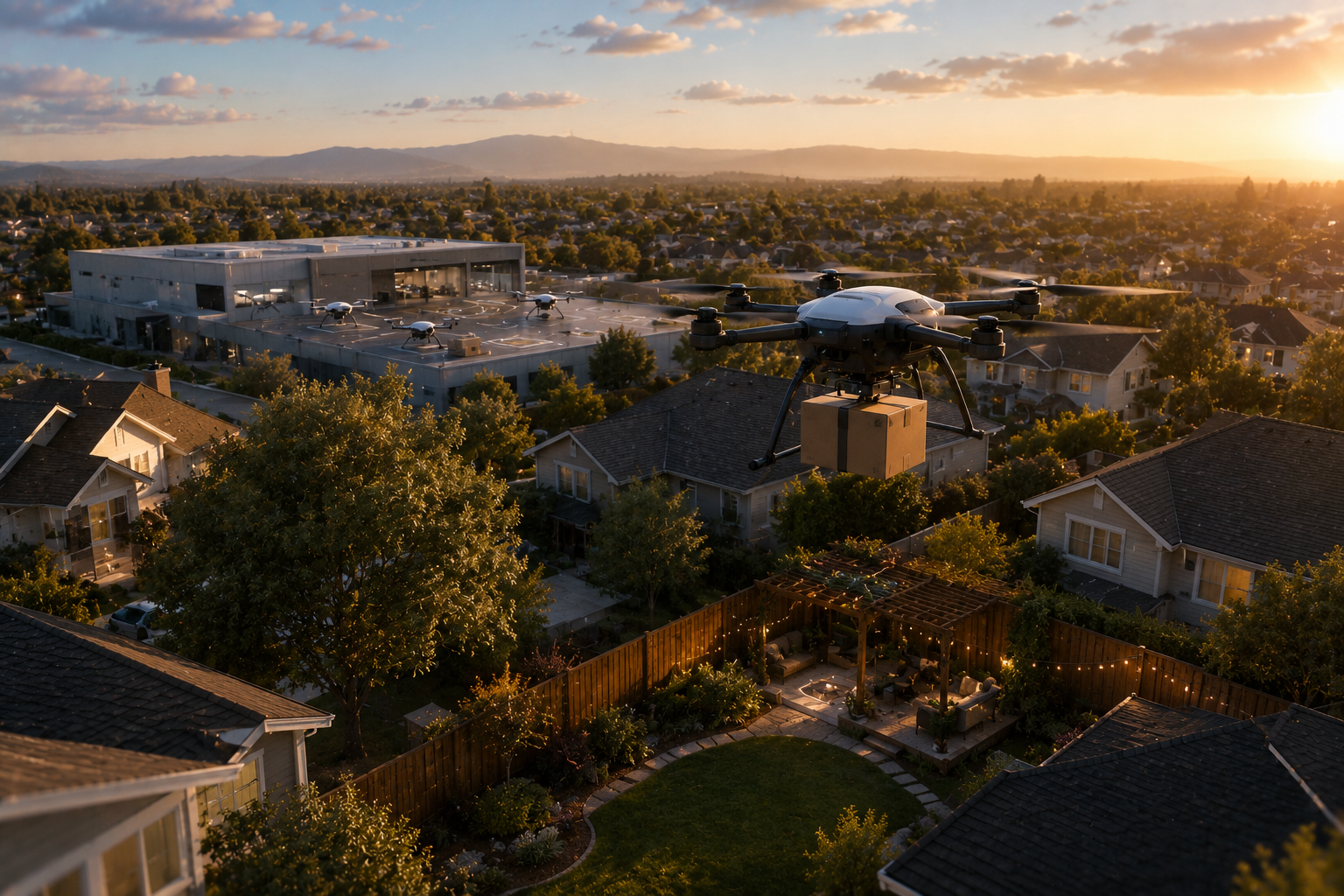
The reported delivery volumes from operators who have cleared the BVLOS approval stack are large enough to treat drone delivery as functioning logistics infrastructure rather than a pilot demonstration, at least in the specific markets where they operate. Zipline has passed one million cumulative deliveries and more than 100 million autonomous miles flown across its global operations. Wing has completed more than 400,000 commercial drone deliveries. Amazon Prime Air has reported processing over 5,000 deliveries per week across its currently active sites, following expanded FAA approval for its operations.
These numbers matter because they establish a real, reported baseline for per-operator throughput rather than a projected or marketing figure – useful context when evaluating claims from newer entrants or when modeling what a specific market’s delivery volume might realistically look like once local approval is secured.
Per-Flight Economics: What Drives the Cost of a Delivery
The per-flight economics of drone delivery are shaped directly by the same regulatory structure described above. Certification costs are largely fixed, one-time investments – Part 135 certification reportedly runs $50,000 to $200,000, and individual Part 107 waivers commonly run $5,000 to $10,000 – which means operators need enough delivery volume at a given site to amortize those costs before per-flight economics become favorable. This is a major reason the market remains concentrated among a small number of operators: the fixed regulatory cost of entry is high relative to the per-flight revenue of a single small-package delivery, and it only becomes economical at meaningful scale and flight frequency.
Beyond the certification costs, per-flight economics depend on route density, battery and airframe amortization, ground infrastructure such as launch and recovery pads, and the staffing model required at each site, which varies depending on how much of the operation still requires human oversight under the specific waiver in place. Operators with a higher density of delivery points per flight hour, and routes that do not require a dedicated visual observer at every site, report materially better per-flight economics than lower-density or observer-dependent operations.
Where the Regulatory Path Is Headed
The FAA is developing rules for routine BVLOS operations, expected to be finalized in the 2026 to 2027 timeframe, intended to replace the current waiver-based approach with a standardized regulatory framework. If finalized as expected, this would meaningfully simplify expansion into new markets by removing the need for a fresh, location-specific waiver process for every new route, which is currently the single biggest friction point slowing the industry’s geographic growth. Until that rule is finalized, expansion will likely continue to follow the current pattern: a small number of Part 135 certified operators incrementally adding waiver-approved markets one at a time.
Common mistake
Assuming that Part 135 certification alone means an operator can fly BVLOS delivery routes anywhere. Certification authorizes the operator as a commercial air carrier, but each specific delivery route still needs its own location-specific BVLOS waiver or exemption, and losing that location-specific approval halts operations at that site even though the underlying Part 135 certificate remains valid.
What worked
Treating the reported throughput figures from Part 135 certified operators like Zipline and Wing as the realistic baseline for per-operator delivery volume when evaluating market entry timelines, rather than relying on projected figures from operators who have not yet cleared the full BVLOS approval stack at a given location.
Frequently Overlooked Details in BVLOS Drone Delivery
- Visual observer dependencySome approved routes still require a human visual observer at points along the flight path, which caps throughput and adds labor cost even after BVLOS approval is granted.
- Airspace deconfliction requirementsOperating near controlled airspace or other aircraft traffic often adds separate coordination requirements on top of the core BVLOS waiver.
- Weather and detect-and-avoid certificationApproval frequently depends on certified detect-and-avoid technology performing reliably across a range of weather conditions, not just in clear-sky test flights.
- Waiver renewal riskLocation-specific waivers have defined expiration dates, and renewal is not guaranteed, creating an ongoing compliance dependency rather than a one-time approval event.
- Local and state-level permittingFederal FAA approval does not automatically clear local noise, land-use, or airspace permitting requirements, which can independently delay or block a route.
Glossary
- BVLOS (Beyond Visual Line of Sight)
- Drone operation beyond the point where the remote pilot can see the aircraft directly, requiring specific regulatory waivers or exemptions to conduct legally in the United States.
- Part 135 air carrier certification
- An FAA certification category authorizing an operator to carry property for compensation, historically used by charter airlines and now required for scaled drone delivery.
- Part 107
- The FAA’s baseline small unmanned aircraft rule, which assumes visual-line-of-sight operation unless a specific waiver is granted for exceptions like BVLOS, night flight, or flight over people.
- Detect-and-avoid system
- Onboard or ground-based technology that allows a drone to identify and avoid other aircraft or obstacles without a human observer maintaining visual contact.
- Visual observer
- A person stationed along a drone’s flight path to maintain visual contact with the aircraft, often required under limited waivers before full BVLOS authorization is granted.
Key Takeaways
- Drone delivery’s growth bottleneck in 2026 is regulatory approval, not the underlying flight or navigation technology.
- Only six US operators held FAA Part 135 air carrier certification as of early 2026: Wing, UPS Flight Forward, Amazon Prime Air, Zipline, Causey Aviation Unmanned, and DroneUp.
- Part 135 certification and location-specific BVLOS waivers are separate approvals; both are required, and losing either halts operations at a given site.
- Zipline has passed one million cumulative deliveries and over 100 million autonomous miles; Wing has completed more than 400,000 deliveries; Amazon Prime Air reports over 5,000 deliveries per week at active sites.
- High fixed regulatory costs, reportedly $50,000 to $200,000 for Part 135 certification alone, concentrate the market among a small number of well-capitalized operators.
- A standardized FAA BVLOS rule expected around 2026 to 2027 would replace the current waiver-based system and could significantly accelerate geographic expansion.
- Visual observer requirements, waiver renewal risk, and local permitting can constrain throughput even after an operator clears the federal BVLOS approval stack.
FAQs
What does BVLOS mean in drone delivery?
BVLOS stands for Beyond Visual Line of Sight, meaning the drone operates farther than the point where its remote pilot can see it directly, which requires specific FAA waivers or exemptions beyond the standard visual-line-of-sight drone rules.
Which companies currently hold FAA Part 135 certification for drone delivery?
As of early 2026, six US operators hold Part 135 air carrier certification: Wing, UPS Flight Forward, Amazon Prime Air, Zipline, Causey Aviation Unmanned, and DroneUp, though each still needs separate location-specific BVLOS approval to operate a given route.
How many deliveries have major drone operators actually completed?
Zipline has passed one million cumulative deliveries and more than 100 million autonomous miles flown, Wing has completed over 400,000 commercial deliveries, and Amazon Prime Air reports processing more than 5,000 deliveries per week across its active sites.
How long does it take to get BVLOS approval for drone delivery?
Simple Part 107 waivers can take a few months, but complex BVLOS operations like cargo delivery commonly require 12 to 24 months and often need pilot programs or test sites before full location-specific approval is granted.
Why hasn’t drone delivery scaled faster if the technology already works?
The primary bottleneck is regulatory: Part 135 certification and location-specific BVLOS waivers are expensive and slow to obtain, concentrating the market among a small number of well-capitalized operators rather than technology limitations.
Will drone delivery BVLOS rules change soon?
The FAA is developing standardized rules for routine BVLOS operations expected to be finalized in 2026 to 2027, which would replace the current waiver-based approach and could significantly simplify expansion into new markets.
What factors most affect the cost of an individual drone delivery flight?
Per-flight economics depend heavily on amortizing fixed certification costs across delivery volume, route density, whether a route still requires a human visual observer, and ground infrastructure such as launch and recovery pads at each site.
Where can I read a broader overview of drone delivery in last-mile logistics?
Our companion article on drones and automated logistics for last-mile delivery covers aerial delivery drones within the wider context of last-mile logistics strategy, complementing the regulatory and throughput focus of this piece.
- Federal Aviation Administration, “Package Delivery by Drone (Part 135)”
- About Amazon, “Amazon Drones: Prime Air Expands Drone Deliveries After FAA Approval”
- Robotomated, “Drone Delivery Market 2026: Operators, Regulation, and the Path to Scale”
- Global Brands Magazine, “Drone Delivery Hits 1 Million: Why 2026 Beats the Wait”
- UAV Coach, “BVLOS: The Future of Commercial Drone Ops”
- The Drone U, “Drone Delivery Services in 2026: Companies, Costs, and Where It’s Live”
For related coverage in this series, see middle-mile autonomous trucking, autonomous yard trucks and port automation, cab-less freight networks, and autonomous rail and digital coupling systems.