| Myth | Reality |
|---|---|
| Digital Automatic Coupling is mainly about saving time during coupling. | DAC’s bigger payoff is automated brake testing and continuous data links, which eliminate hours of manual wagon-by-wagon brake checks and enable real-time train health monitoring. |
| Freight trains will be fully driverless within a few years once DAC rolls out. | DAC is a prerequisite, not a finish line; fully driverless long-haul freight (GoA4) remains a distant prospect even in the most advanced pilot programs, with shunting and yard automation arriving first. |
| Automated Train Operation for freight is the same technology as for metro or urban rail. | Freight ATO must handle vastly longer, heavier, more variable-length trains on mixed-traffic networks shared with passenger services, which is a much harder control problem than fixed, short, homogeneous metro consists. |
Why Coupling Is the Bottleneck for Rail Automation
Rail freight has quietly remained one of the least automated major transport modes for over a century, and the reason is mechanical rather than digital. Most of the world’s freight wagons still connect to one another using manual coupling systems that require a worker to walk between cars, physically attach a coupling hook or screw link, and connect separate air hoses for the braking system by hand. This single mechanical bottleneck has capped how far rail automation can go, because no amount of clever software in a control center can compensate for the fact that assembling or splitting a train still requires a human being to walk the length of the train, lean between wagons, and manually attach hardware that has changed little since the 19th century.
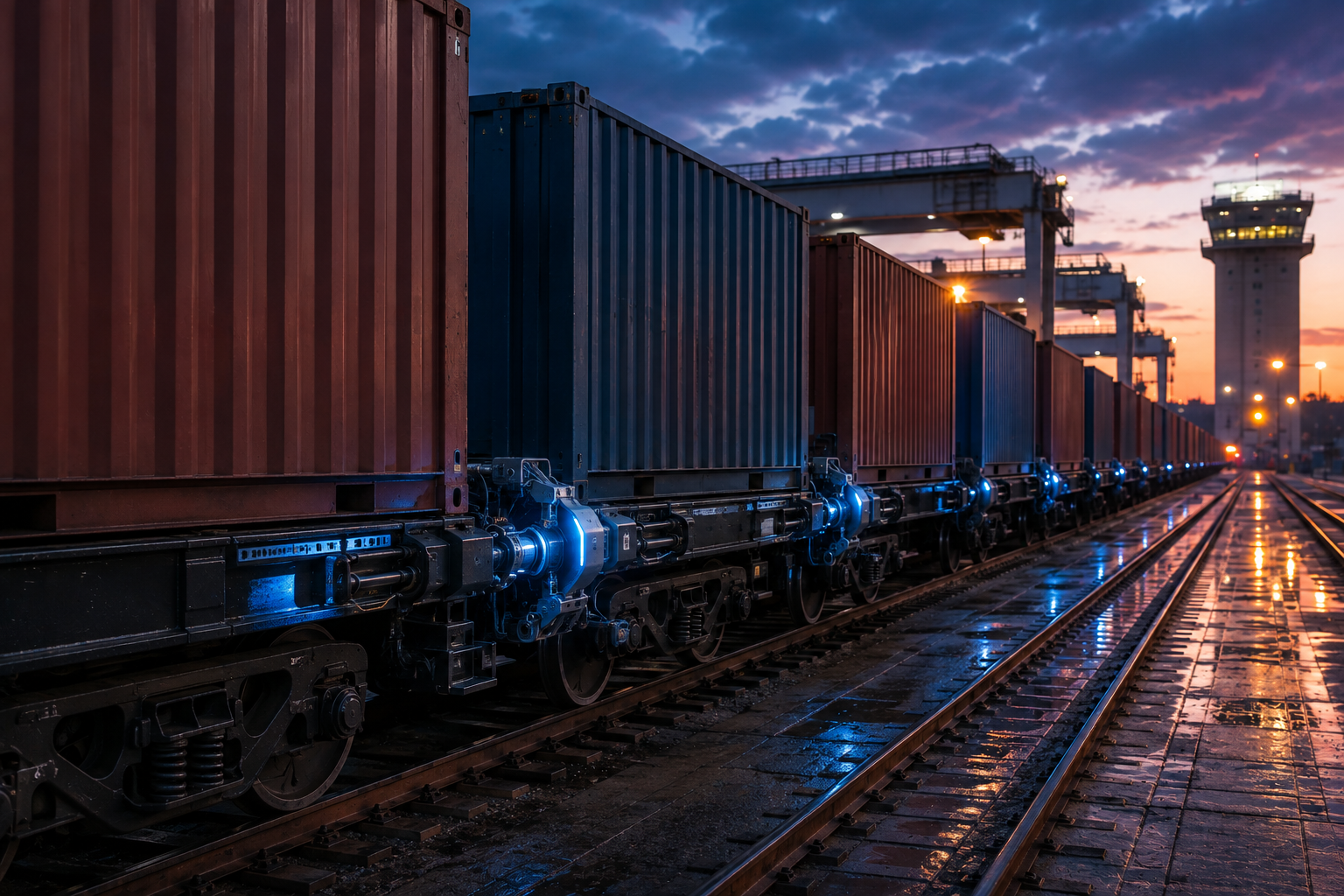
Digital Automatic Coupling, universally shortened to DAC, is the technology now being rolled out across European freight networks specifically to remove that bottleneck. A DAC-equipped wagon connects to its neighbor automatically: mechanical coupling, pneumatic brake lines, and electrical power and data lines all join in one motion, typically completed in a matter of seconds rather than the many minutes a manual brake test and coupling sequence takes today. That single change cascades into everything else this article covers, because once wagons can connect and disconnect without manual labor, and once every wagon carries a live data connection, a huge range of automation and monitoring capabilities become possible for the first time.
What Digital Automatic Coupling Actually Does
A DAC coupler head combines three previously separate connections into a single automatic mechanism. The mechanical coupling handles the physical pulling and buffing forces between wagons, replacing the traditional screw coupling and buffer arrangement still standard on much of the European freight fleet. The pneumatic connection automatically joins the brake pipe, the line that carries compressed air used to apply and release the train’s brakes, without a worker manually screwing hose couplings together. The electrical and data connection is the newest element, giving every wagon a continuous power supply and a digital communication link running the length of the train.
That data link is arguably the more transformative half of DAC, even though the mechanical coupling gets most of the public attention. With a digital backbone running through every wagon, operators can run automated brake tests that check the integrity of the entire train’s braking system electronically in a fraction of the time a manual walk-the-train inspection takes. Sensors on individual wagons can report axle temperature, brake wear, load weight, and door or hatch status back to the locomotive and to a control center in real time, rather than only being checked during scheduled yard inspections.
| Coupling Element | Manual Screw Coupling | Digital Automatic Coupling (DAC) |
|---|---|---|
| Mechanical connection | Worker manually attaches screw link and buffers | Automatic mechanical latch on contact |
| Brake pipe connection | Worker manually joins air hoses | Automatic pneumatic connection |
| Data and power link | None | Continuous digital data and power bus |
| Typical coupling time per join | Several minutes, walking required | A few seconds, no walking required |
| Brake test method | Manual wagon-by-wagon inspection | Automated electronic brake test |
The European DAC Rollout
Europe’s rail freight sector has organized the most advanced push toward DAC standardization anywhere in the world, coordinated through Europe’s Rail and national rail infrastructure managers alongside wagon owners, freight operators, and coupler manufacturers. The effort has moved from laboratory prototypes to commercial demonstration trains running in revenue service, with a defined technical standard intended to let wagons from different owners and different countries couple to one another interchangeably, which is essential given how much European freight rolling stock crosses borders and changes hands between leasing companies during its operating life.
The scale of the challenge is not primarily technical anymore; it is logistical and financial. Retrofitting or replacing coupling hardware across a freight wagon fleet numbering in the hundreds of thousands of units across Europe requires an enormous coordinated capital investment and a migration strategy that avoids stranding older, non-DAC wagons unable to couple to newer DAC-equipped ones during the transition period. Industry programs have been explicit that the fleet-wide transition will take years, structured around interim mixed-fleet operation before DAC becomes the continent-wide standard.
Figure: The DAC Coupling Sequence Compared to Manual Coupling
A side-by-side sequence diagram contrasts a manual coupling operation, showing a worker walking between wagons to attach a screw coupling and separate air hoses over several minutes, against a DAC coupling operation, showing two wagon coupler heads meeting and automatically latching mechanical, pneumatic, and data connections in one motion within seconds.
Automated Train Operation Grades for Freight
Automated Train Operation, or ATO, is measured using a Grade of Automation scale running from GoA0 through GoA4, originally developed for urban and metro rail but increasingly referenced in freight automation planning as well. GoA0 describes conventional operation with no automation support at all. GoA1 introduces automatic train protection that can intervene on safety grounds but leaves driving to a human. GoA2 adds automated acceleration and braking under human supervision, with the driver still present and responsible for starting the train, closing doors, and handling emergencies. GoA3 removes the need for a qualified driver in the cab but still requires an onboard staff member able to handle emergencies and passenger-facing tasks. GoA4 is full driverless operation with no staff on board at all.
Freight ATO development is following a different path than passenger and metro ATO, and for structural reasons rather than mere caution. Metro systems typically run short, fixed-length, homogeneous trains on dedicated, grade-separated tracks with no level crossings and no mixed freight or passenger traffic to negotiate. Freight trains vary enormously in length, weight, and braking characteristics from one working to the next, often share track with passenger services and are subject to the signaling and speed restrictions that entails, and must operate over open, ungraded track that includes level crossings, wildlife, and unpredictable trackside conditions. That combination makes higher GoA levels dramatically harder to achieve safely for freight than for a closed metro loop.
| GoA Level | Description | Current Freight Rail Status |
|---|---|---|
| GoA1 | Automatic train protection, human drives | Widely deployed on major freight corridors |
| GoA2 | Automated acceleration/braking, human supervises | In active pilot and early rollout on select freight lines |
| GoA3 | No driver required, staff on board for emergencies | Demonstrated in test environments, not yet in freight revenue service |
| GoA4 | Fully driverless, no staff on board | Demonstrated for shunting and yard moves; long-haul freight still a distant prospect |
Where GoA4 Is Actually Being Tested Today
The nearest-term real-world application of the highest automation grade is not a driverless train speeding across the country at full line speed, but far more contained operations: automated shunting, yard marshalling, and stabling moves conducted at low speed within a controlled depot or test center environment. These moves are lower risk because they happen at low speed, in a bounded area, without the open-track hazards a long-haul freight service faces. Programs testing fully automated, driverless train preparation and shutdown, along with automated trips from a siding to a station platform, are explicitly framing this as a proving ground for the harder problem of open-line automated operation, not as the end state itself.
Separately from centrally coordinated ATO programs, a different category of freight automation has emerged: self-propelled, battery-electric freight wagons that carry their own propulsion and control systems rather than being hauled by a conventional locomotive. These units are being positioned for shorter industrial and regional freight moves, guided by onboard computing and communications, and represent a parallel track toward autonomy that does not depend on retrofitting an entire national coupler standard first.
Common mistake
Coverage of rail automation frequently conflates Digital Automatic Coupling with driverless train operation, treating DAC rollout announcements as evidence that driverless freight trains are imminent. DAC is an enabling infrastructure layer, automating the physical connection and data link between wagons; it does not by itself remove the locomotive driver, and full GoA4 open-line freight operation remains a separate, much harder, and much later milestone.
Automatic Train Control and Signaling Foundations
Higher grades of freight ATO depend on a modern signaling foundation, and in Europe that foundation is the European Train Control System, commonly abbreviated ETCS, layered under the broader European Rail Traffic Management System. ETCS Level 2 provides continuous, cab-based movement authority information to the train rather than relying solely on trackside signals a driver must visually observe, which is a prerequisite for any meaningful automated train operation above GoA1. Freight-specific ATO development is explicitly building on top of ETCS Level 2 rather than inventing a parallel signaling standard, which matters because it means freight automation inherits the same interoperability goals that ETCS was designed to deliver across national borders.
North American freight railroads have followed a differently structured path, built around Positive Train Control, a federally mandated safety overlay designed primarily to prevent train-to-train collisions, over-speed derailments, and unauthorized incursions into work zones, rather than to directly enable driverless operation. Positive Train Control and similar digital safety systems provide much of the same underlying data infrastructure, precise train location, speed, and braking curve information, that a future ATO layer would need, and major North American freight railroads have signaled plans to expand digital safety system coverage across thousands of additional route miles as part of broader digitization strategies, even without an explicit near-term driverless freight mandate.
Self-Propelled Wagons and Distributed Propulsion
A parallel and increasingly commercially active branch of rail freight automation dispenses with the traditional single-locomotive-hauling-many-wagons model altogether. Self-propelled freight wagons integrate battery-electric propulsion, sensors, and control electronics directly into the wagon chassis, allowing individual cars or small consists to move independently under their own power and guidance rather than waiting for a full train and locomotive to be assembled. This model is particularly suited to shorter industrial sidings, regional freight moves, and situations where assembling a full conventional train would be inefficient for the volume of freight being moved.
Commercial interest in this category has grown quickly. Contracts and partnerships between established rail freight subsidiaries and specialist self-propelled wagon manufacturers have emerged in multiple markets during 2026, signaling that incumbent operators view distributed propulsion as a complement to, not a replacement for, conventional locomotive-hauled DAC-equipped trains. The two approaches solve different problems: DAC and centralized ATO scale up efficiency and automation for large, conventional freight trains, while self-propelled wagons offer flexible, smaller-scale automation for use cases where a full train consist does not make operational sense.
- Distributed propulsion: individual wagons carry their own motors and batteries, removing dependency on a single locomotive for the entire consist.
- Flexible consist size: self-propelled units can move as a single car or a small group, better matching variable freight volumes on regional lines.
- Reduced yard dwell time: cars that can reposition themselves reduce the shunting labor and locomotive availability constraints that slow down conventional yard operations.
- Independent sensing and control: onboard computing allows each unit to manage its own braking, speed, and diagnostics rather than relying entirely on a lead locomotive.
What Worked: Staged Rollouts Over Big-Bang Conversion
What worked
European DAC programs that prioritized interoperable technical standards and staged, mixed-fleet transition planning ahead of mass hardware deployment avoided the trap of stranding non-compatible wagons mid-rollout, and demonstration trains running in actual revenue service proved the technology under real operating conditions before committing to fleet-wide capital investment.
Economic and Safety Case for Automation
The business case for DAC and freight ATO rests on several compounding efficiencies rather than any single dramatic saving. Automated brake testing alone removes a substantial chunk of the dwell time freight trains currently spend in yards undergoing manual inspection, and shorter dwell time translates directly into higher asset utilization for both wagons and the yard infrastructure they occupy. Continuous digital monitoring of axle temperatures, brake wear, and load status enables predictive maintenance that catches developing faults before they cause an in-service failure or, in the worst case, a derailment, shifting maintenance from a fixed schedule to a condition-based model.
Labor economics matter as well, though this is a more sensitive dimension of the conversation than pure efficiency metrics suggest. Reducing the need for staff to physically walk trains for coupling and brake inspection changes staffing requirements at yards and terminals, and rail unions in multiple markets have raised concerns about the pace and governance of this transition, a dynamic mirrored in the parallel debate over driverless trucking discussed elsewhere in this cluster. Rail operators generally frame the transition as redeploying staff toward higher-value monitoring and exception-handling roles rather than net headcount elimination, though the actual outcome will depend heavily on how quickly automation scales relative to overall freight volume growth.
Frequently Overlooked Factors in Rail Automation Planning
- Fleet interoperabilityA DAC standard only delivers its full value once enough of the fleet is converted that wagons from different owners can reliably couple to one another across the network.
- Mixed-fleet transition periodOperators need adapter couplers or dedicated marshalling strategies to handle trains that mix legacy and DAC-equipped wagons during the multi-year rollout.
- Signaling prerequisiteHigher automation grades depend on continuous cab-based signaling like ETCS Level 2, not on coupling technology alone.
- Level crossings and open trackFreight ATO must contend with hazards metro systems never face, which is why yard and shunting automation is arriving well before open-line driverless operation.
- Workforce transition planningAutomated coupling and inspection change staffing needs at yards, and unresolved labor questions can slow deployment as much as any technical hurdle.
- Cross-border wagon ownershipMuch of the European freight fleet is leased and moves across national borders, making a single interoperable standard far more valuable than a fragmented national approach.
Glossary
- Digital Automatic Coupling (DAC)
- A coupler system that automatically joins the mechanical, pneumatic brake, and electrical data connections between two rail wagons in a single motion.
- Grade of Automation (GoA)
- A standardized scale from GoA0 to GoA4 describing how much of train operation is automated, from no automation to fully driverless.
- ETCS Level 2
- A continuous, cab-based train control standard that transmits movement authority directly to the train rather than relying only on trackside signals.
- Positive Train Control (PTC)
- A North American mandated digital safety overlay designed to prevent collisions, over-speed derailments, and unauthorized track incursions.
- Self-propelled wagon
- A freight rail car with its own onboard propulsion, sensors, and control electronics, able to move independently without a separate locomotive.
Key Takeaways
- Digital Automatic Coupling removes the manual coupling and brake-hose bottleneck that has limited rail freight automation for over a century.
- DAC’s data and power link is as important as its mechanical function, enabling automated brake tests and continuous wagon health monitoring.
- Europe’s DAC rollout is a coordinated, multi-year, interoperable standard effort, not a single company’s product launch.
- Automated Train Operation for freight follows GoA0 through GoA4, but freight faces harder conditions than metro rail, including mixed traffic and open track.
- GoA4 is currently being proven in low-speed shunting and yard environments, not in open-line long-haul freight operation.
- Self-propelled, battery-electric wagons offer a parallel automation path for shorter and more flexible freight moves.
- Higher automation grades depend on modern signaling foundations like ETCS Level 2 or Positive Train Control, not on coupling technology alone.
FAQs
What is Digital Automatic Coupling in rail freight?
Digital Automatic Coupling, or DAC, is a coupler technology that automatically joins the mechanical connection, pneumatic brake lines, and electrical data and power lines between two freight wagons in one motion, replacing manual screw couplings and hand-connected air hoses used on most of today’s freight fleet.
Why does DAC matter more than just saving coupling time?
DAC’s continuous data link enables automated electronic brake testing and real-time monitoring of axle temperature, brake wear, and load status across an entire train, replacing time-consuming manual wagon-by-wagon inspections and enabling predictive maintenance that was not previously possible.
Are freight trains going to be fully driverless soon?
Not in the near term for long-haul open-line operation. The highest automation grade, GoA4, is currently being demonstrated for low-speed shunting, yard marshalling, and stabling moves in controlled test environments, while fully driverless operation across open track at line speed remains a much more distant goal.
What is the difference between GoA levels in train automation?
GoA0 through GoA4 describe increasing automation, from no automation support at GoA0, through automatic protection and supervised automated driving at GoA1 and GoA2, to no onboard driver at GoA3, and fully driverless operation with no staff on board at GoA4.
What signaling technology supports automated train operation?
In Europe, ETCS Level 2 provides continuous cab-based movement authority information that automated train operation depends on. In North America, Positive Train Control provides a comparable digital safety layer, though it was designed primarily to prevent collisions and over-speed derailments rather than to directly enable driverless operation.
What are self-propelled freight wagons?
Self-propelled freight wagons carry their own battery-electric propulsion, sensors, and control systems, letting individual cars or small groups move independently without a separate locomotive, making them well suited to shorter industrial and regional freight moves.
How long will the transition to DAC-equipped freight fleets take?
Industry programs describe a multi-year, staged transition, since hundreds of thousands of wagons across Europe would need new coupling hardware, and operators must manage a mixed-fleet period where DAC and legacy-coupled wagons operate on the same network simultaneously.
What are the labor implications of rail freight automation?
Automated coupling and brake testing reduce the need for staff to physically walk trains for inspection, which has raised workforce transition concerns among rail unions. Operators generally describe the shift as redeploying staff toward monitoring and exception handling rather than immediate net headcount reduction.
References
- Europe’s Rail, “Digital Automatic Coupling (DAC): The Backbone for Full Digital Rail Freight Train Operations in Europe”
- Global Railway Review, “Digital Automatic Couplers: The Revolution of European Railways”
- GATX, “Digital Automatic Coupling (DAC): Status Update and Next Steps”
- SNCF Group, “Digital Automatic Coupling for Freight Transport”
- Voith, “Digital Automatic Coupler”
- Digitale Schiene Deutschland, “AutomatedTrain: Concepts and System Components for Driverless Trains”
- Digitale Schiene Deutschland, “Automatic Train Operation”
- Railway News, “What is Automatic Train Operation – ATO in Railways?”
This piece is part of our ongoing coverage of autonomous freight infrastructure. For the road-based counterpart to rail automation, see our companion deep dive on cab-less freight networks and purpose-built driverless trucks. Readers tracking the broader logistics automation cluster may also want middle-mile autonomous trucking, autonomous yard trucks and port automation, future smart warehouse infrastructure, and our technical deep dive on robotic micro-fulfilment in urban retail.