| Myth | Reality |
|---|---|
| Wire-free means the mower has no idea where your lawn ends. | Wire-free mowers still enforce a hard boundary — they just use RTK satellite positioning or onboard cameras and LiDAR instead of a buried signal to define it. |
| GPS-based mowers are always more accurate than wire. | Buried wire is still the most consistently accurate option at roughly 2 inches of boundary tolerance; RTK is close but can drift under heavy tree canopy, and camera systems vary the most with lighting. |
| A bigger battery always means a bigger lawn coverage. | Coverage depends more on cutting width, slope handling, and mapping efficiency than raw battery size — two mowers with similar batteries can differ by 30 percent or more in area mowed per charge. |
| Camera-based mowers are the future and wire is obsolete. | Camera systems still struggle with shadows, murky light, and seasonal grass color changes, so many 2026 buying guides still recommend wire or RTK for reliability in mixed weather. |
Why Boundary Technology Is the Real Dividing Line
Every robot lawn mower comparison eventually comes down to one question that has nothing to do with brand loyalty: how does the machine know where your lawn stops? That single design decision — buried wire, RTK GPS, or camera-based vision — determines install time, ongoing reliability, weather resilience, and ultimately how much of your yard actually gets mowed on a given day. Marketing copy tends to bury this distinction under blade count and app screenshots, but real-world testing from outlets like Consumer Reports and Reviewed consistently shows boundary technology is the single biggest predictor of user satisfaction.
This comparison focuses on the three boundary approaches on the market in 2026, backs them with real testing data on mowing performance, and breaks down what you actually get at each price tier — because a $900 mower and a $5,500 mower are not competing for the same yard.
Buried Wire: The 25-Year Standard
Boundary wire has been the default robot mower technology for roughly a quarter century, and it earns that longevity through sheer consistency. A low-voltage wire is buried one to three inches underground (or pinned to the surface temporarily during setup) around the lawn perimeter and around any exclusion zones — flower beds, ponds, play areas. The mower’s onboard sensor detects the wire’s electromagnetic field and reverses or turns before crossing it.
The strength of wire is that it does not care about weather, satellite visibility, or lighting. Rain, fog, overcast skies, and thick tree cover have zero effect on how well the mower reads the boundary. Testing consistently puts wire-based boundary accuracy at around two inches, tighter than either wireless alternative. The tradeoff is installation labor: burying wire around an average residential lot typically takes four to twelve hours, and a nicked or corroded wire is still the single most common maintenance call for wire-based systems.
RTK GPS: Wireless Precision at a Premium
RTK, or Real-Time Kinematic positioning, pairs satellite GPS with a fixed reference base station installed somewhere on the property. The base station corrects for satellite signal drift in real time, giving the mower centimeter-level positioning without any wire in the ground. You draw the boundary in an app instead of burying anything, which is why RTK setups typically take fifteen to thirty minutes compared to wire’s half-day-plus commitment.
RTK’s real advantage shows up after installation, not during it: boundary changes are instant. Adding a new flower bed or reshaping a play area is a few taps in an app rather than digging up and re-burying wire. The catch is cost — RTK systems typically carry a $500 to $1,500 premium over comparable wire models — and accuracy can soften under heavy tree canopy, where satellite signal reception weakens.
Camera-Based Vision: The Wire-Free Promise and Its Limits
The newest boundary approach skips both wire and satellite reference stations in favor of onboard cameras, sometimes paired with LiDAR, that visually map the lawn and recognize its edges the way a self-driving car reads a road. In principle this is the most flexible system: no digging, no base station, and boundaries that can adapt to a lawn that visibly changes shape.
In practice, camera-based systems are the least predictable of the three. Lighting is the weak point — shadows from trees or fences, dawn and dusk glare, wet or frost-covered grass, and even seasonal changes in how the lawn’s color reads to the camera can all throw off boundary recognition. Reviewers testing these systems in 2026 still describe them as promising but the least consistent choice for anyone who wants a “set it and forget it” mower.
| Boundary Technology | Typical Accuracy | Install Time | Price Premium | Weather Resilience |
|---|---|---|---|---|
| Buried wire | ~2 inches | 4-12 hours | None (baseline) | Excellent in all conditions |
| RTK GPS | Centimeter-level, drifts under canopy | 15-30 minutes | +$500 to $1,500 | Good, weaker under thick tree cover |
| Camera / vision | Variable, lighting-dependent | 20-45 minutes | Comparable to RTK | Weakest in shadow, glare, and dusk/dawn light |
Real-World Mowing Performance Data
Specs on a box rarely match what a mower does on an actual slope with actual obstacles. Independent test runs in 2026 give a clearer picture of how boundary technology and hardware combine in practice.
- A budget LiDAR-based model rated for a quarter acre mowed for two hours and used 85 percent of its battery to complete just 54 percent of the lawn in one test run, illustrating how advertised acreage figures can be optimistic.
- A mid-range model rated for 0.75 acres completed its mowing run in one hour fifty-two minutes using 52 percent of battery capacity — a far more comfortable margin.
- A premium RTK-equipped model rated up to six acres finished a small 0.1-acre test task in one hour twenty minutes using only 34 percent of its battery, showing the efficiency gap between entry-level and flagship hardware.
| Model Tier (Tested) | Rated Coverage | Time to Complete Test Task | Battery Used |
|---|---|---|---|
| Budget LiDAR model | 0.25 acre | 2 hours (54% of lawn done) | 85% |
| Mid-range LiDAR model | 0.75 acre | 1 hr 52 min (full lawn) | 52% |
| Premium RTK model | Up to 6 acres | 1 hr 20 min (0.1-acre task) | 34% |
How the Three Boundary Systems See Your Lawn
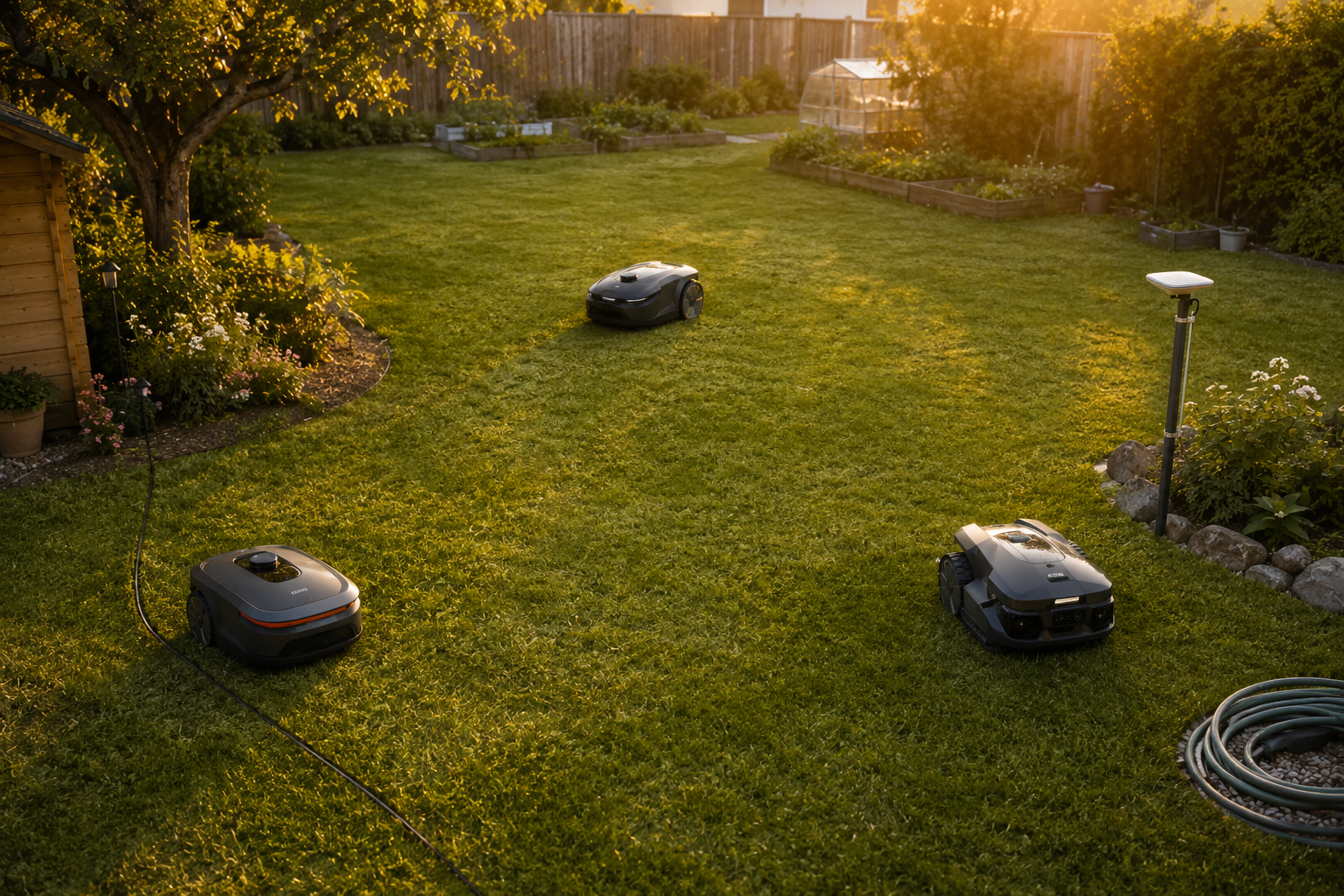
A wire-based mower reads a buried electromagnetic loop like a fence it can feel. An RTK mower reads GPS coordinates corrected by a base station like a fence drawn on an invisible map. A camera-based mower reads visual edges — grass line, curb, mulch bed — the way a human eye would, which is exactly why changing light throws it off more than the other two.
Price Tiers: What You Actually Get at Each Budget
Budget Tier ($800 to $1,200)
Entry-level models in this range typically rely on LiDAR or basic vision mapping rather than RTK, cover small lawns under a quarter acre comfortably, and often fall short of advertised coverage figures on sloped or irregularly shaped yards. They are a reasonable entry point for small, simple, flat lawns but not for anything with mixed terrain.
Mid-Range Tier ($1,200 to $2,600)
This is where most buyers land. Mid-range mowers add stronger obstacle avoidance, better slope handling, and coverage up to about 0.75 to 1 acre. Some models in this band now offer RTK as an option rather than a standard feature, letting buyers pay only for the precision they need.
Premium Tier ($2,600 and up)
Premium models bundle RTK GPS as standard, support multi-acre properties, and increasingly ship as modular platforms where the mowing deck is one attachment among several (snow, leaf, or sweeping modules on the same base unit). At the very top of the market, flagship RTK systems rated for several acres show the efficiency gains of better navigation software layered onto premium hardware.
Common mistake
Buying strictly to the manufacturer’s advertised acreage rating. Test data shows budget models frequently fall well short of their rated coverage on a single charge, especially on sloped or obstacle-heavy lawns. Size down one tier from your actual lawn area, or confirm independent test results before assuming a mower rated for your exact square footage will finish the job in one charge.
What worked
Reviewers who got the most consistent results paired RTK-based mowers with properties that had at least partial open sky exposure, and reserved camera-only systems for small, well-lit, obstacle-light lawns rather than heavily wooded or irregularly shaped yards. Hybrid setups that combine RTK with a supplementary camera for close-in obstacle detection scored best across mixed test conditions.
Frequently Overlooked Factors
- Tree canopy densityHeavy canopy weakens both satellite reception for RTK and lighting consistency for cameras — wire remains the safest choice under dense trees.
- Exclusion zone complexityLawns with many flower beds, ponds, or play structures favor RTK’s app-based boundary editing over wire’s physical re-digging.
- Slope percentageManufacturer slope ratings are measured under ideal traction; wet grass on a rated maximum slope often causes wheel slip regardless of boundary technology.
- Base station placementRTK base stations need a clear view of open sky; mounting one under an eave or near a tall fence quietly degrades accuracy across the whole lawn.
- Firmware update cadenceCamera-based navigation improves substantially through software updates, so a unit’s real-world performance six months after launch can differ meaningfully from initial reviews.
- Wire corrosion over seasonsBuried wire connectors are the most common multi-year failure point; budget in occasional splice repairs rather than treating wire as maintenance-free.
- Multi-zone lawnsProperties split by a driveway or path need a mower and boundary system that explicitly supports multiple disconnected zones, a feature not all budget models include.
- Winter storage requirementsRTK base stations and camera sensors are more weather-sensitive in storage than a buried wire loop, which needs no seasonal removal.
Glossary
- RTK (Real-Time Kinematic)
- A GPS correction technique that uses a fixed local base station to reduce satellite positioning error from meters down to centimeters.
- Boundary wire
- A low-voltage wire buried or pinned around a lawn’s perimeter that emits a signal the mower detects to avoid crossing.
- Exclusion zone
- A defined area within the lawn boundary, such as a flower bed or pond, that the mower is programmed to avoid entirely.
- LiDAR mapping
- A laser-based sensing method that builds a spatial map of the lawn and obstacles, often used alongside or instead of cameras.
- Base station
- The fixed reference unit in an RTK system that transmits correction signals to the mower to maintain positioning accuracy.
Key Takeaways
- Boundary technology, not brand or blade count, is the biggest factor separating robot mower experiences.
- Buried wire remains the most weatherproof and accurate option at roughly 2 inches of tolerance, but costs 4-12 hours to install.
- RTK GPS installs in 15-30 minutes and allows instant app-based boundary edits, at a $500-1,500 premium and reduced accuracy under heavy canopy.
- Camera-based vision is the most flexible on paper but the least consistent in shadow, glare, and low light.
- Advertised acreage ratings routinely overstate real-world coverage per charge, especially at the budget tier.
- Mid-range mowers in the $1,200-$2,600 band cover most typical residential needs without RTK’s full price premium.
- Pairing RTK with supplementary camera-based obstacle detection produced the most consistent results across mixed test conditions.
FAQs
Which robot mower boundary technology is most accurate?
Buried wire remains the most consistently accurate boundary technology, holding roughly two inches of tolerance regardless of weather or lighting. RTK GPS comes close, offering centimeter-level accuracy in open sky, but can lose precision under heavy tree canopy where satellite signals weaken.
Is RTK GPS worth the extra cost over a wire-based mower?
RTK is worth the premium if your lawn has complex or changing exclusion zones, since boundary edits become app-based instead of requiring re-digging wire. For a simple, stable lawn shape, wire delivers comparable accuracy at a lower price with no satellite dependency.
Do camera-based robot mowers work well in shade?
Camera-based mowers are the most sensitive of the three boundary technologies to shadow and inconsistent lighting. Reviewers in 2026 still rate them as the least predictable option for yards with significant tree cover, dusk mowing schedules, or seasonal light changes.
How long does it take to install a robot lawn mower’s boundary system?
Buried wire installation typically takes four to twelve hours depending on lawn size and complexity. RTK and camera-based systems install in fifteen to forty-five minutes since there is no wire to bury, only a base station or initial mapping run to complete.
Why did my robot mower not finish mowing my whole lawn?
Advertised acreage ratings are often tested under ideal flat, obstacle-free conditions. Real-world tests show budget models can use over 80 percent of battery capacity while covering barely half the rated lawn area, especially on sloped or irregular terrain.
What price range should I expect for a robot lawn mower in 2026?
Budget models start around $800 to $1,200 for small, flat lawns. Mid-range mowers covering up to roughly an acre run $1,200 to $2,600. Premium RTK-equipped models for multi-acre properties start above $2,600 and can exceed $5,000 for flagship modular systems.
Can I switch a wire-based mower to RTK later?
Generally no — boundary technology is built into the mower’s sensor hardware and cannot be retrofitted between wire and RTK. This makes the initial boundary technology decision effectively permanent for that unit’s lifespan.
Does slope rating on a robot mower reflect real-world performance?
Slope ratings are typically measured under ideal dry-traction conditions. Wet grass on a lawn at its rated maximum slope frequently causes wheel slip regardless of which boundary technology the mower uses, so buying with a margin below the rated maximum slope is safer.
References
- Reviewed, “14 Best Robot Lawn Mowers: Tested in Real Yards by Us of 2026”
- Consumer Reports, “3 Best Robotic Lawn Mowers of 2026, Expert-Tested and Reviewed”
- Lawnmowers.com, “Boundary Wire vs GPS Robotic Mowers: Which Wins in 2026?”
- Lymow, “RTK vs Wire: Which Robot Mower Setup Is Easier?”
- Gardeners’ World, “The Best Robot Lawn Mowers for 2026, as Tested by Our Experts”
- TheRoboWire, “How Robot Mowers Work: Wire vs GPS vs RTK Navigation Explained”
For readers looking at robotics beyond the lawn, see our coverage of autonomous robotic harvesting systems, our breakdown of agricultural robotics ROI for mid-size farms, and our look at autonomous weeding and precision spraying systems. If you are building out a broader smart-home robotics setup, our guides to home robots heading into 2027 and personal robot assistants cover the categories that increasingly share a driveway with the mower.