| Attribute | Traditional Regional Warehouse | Robotic Micro-Fulfilment Center |
|---|---|---|
| Typical footprint | 300,000 to 1,000,000+ sq ft | 5,000 to 30,000 sq ft |
| Location | Suburban/exurban land, cheap real estate | Urban infill, back of store, converted retail |
| Order-to-pick time | Hours (batch picking, truck routing) | 2 to 6 minutes (robotic retrieval) |
| Primary automation | Conveyor sortation, forklifts | Cube storage grids, shuttles, robotic arms |
| Delivery radius served | 50 to 300 miles | 1 to 3 miles |
What a Robotic Micro-Fulfilment Center Actually Is
A robotic micro-fulfilment center, often shortened to MFC, is a small, highly automated storage and order-assembly facility placed deliberately close to where people live and shop. Instead of a single mega-warehouse sitting an hour outside a metro area, retailers are now installing dozens of compact automated cubes inside existing real estate: the back third of a grocery store, a shuttered department store, a parking structure basement, or a purpose-built infill site squeezed between other buildings. The defining characteristic is not size alone but density of automation per square foot. A traditional stockroom might hold a few thousand SKUs on static shelving; a robotic MFC can store tens of thousands of SKUs in a fraction of the space by stacking inventory into a three-dimensional grid and letting robots do the reaching, lifting, and sorting that human pickers would otherwise do by walking aisles.
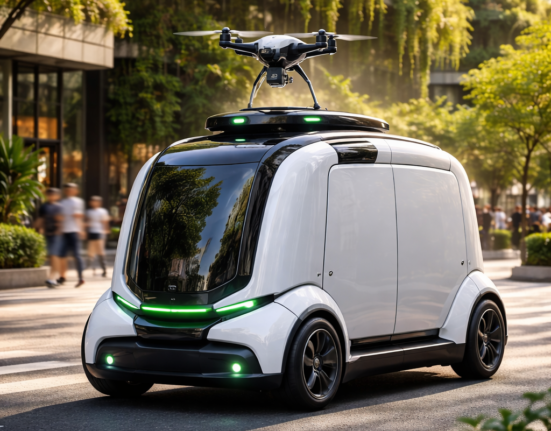
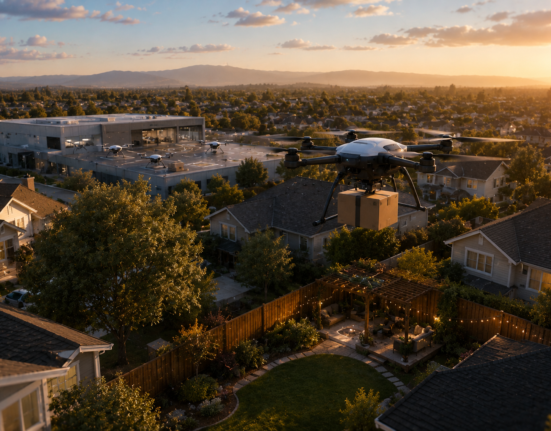
This piece is a dedicated technical deep dive into the machinery and systems that make micro-fulfilment work at the scale retailers now require. For the broader last-mile delivery context in which MFCs sit as one tactic among several, our companion article on solving the last-mile delivery problem covers drones, sidewalk robots, and autonomous vans as the “final half-mile” that picks up where the MFC leaves off. Here, we stay inside the four walls.
The Core Hardware: Compact AS/RS Grids
The heart of almost every robotic micro-fulfilment center is a cube-based automated storage and retrieval system, or AS/RS. Rather than aisles of shelving with a picker walking between them, inventory is held in stackable bins arranged in a dense three-dimensional grid, sometimes only a few bin-widths wide but many bins tall. Small robotic carriers travel across the top of the grid on rails, or in some designs move within the grid itself on vertical and horizontal axes, lowering a grabber mechanism down through the top of the stack to lift the target bin to the surface.
Two grid architectures dominate current deployments. The first is a top-grid design, where robots ride a rail system across the roof of the cube and drop a lift line down between bins to retrieve the target, then carry it laterally to a port where a human or a picking arm removes items. This approach favors extremely dense storage because there is no need for internal aisles, but retrieval time increases when a target bin sits beneath several others, since those bins must be temporarily relocated first. The second architecture uses independent robotic shuttles that travel within the structure itself along X, Y, and Z axes, retrieving a bin directly rather than digging through a stack. This trades some storage density for more predictable retrieval times, which matters when a retailer is promising delivery within a fixed window.
Both approaches share a practical advantage over conventional shelving: a facility that would need 30,000 square feet of aisles and racking to store a given catalog can often fit the same catalog into 8,000 to 13,000 square feet once the vertical cube is used properly. That compression is what makes it economically possible to site fulfilment inside expensive urban real estate rather than cheap land far from customers.
Grid Density and Bin Counts in Practice
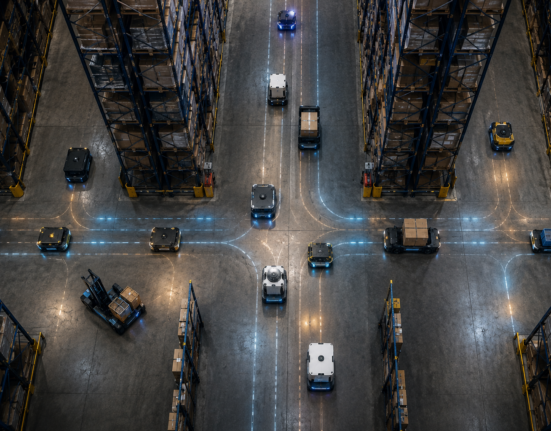
Operators sizing a new site typically work backward from expected daily order volume to a required bin count, then from bin count to footprint. A single mid-size grid installation can hold on the order of tens of thousands of bins within a footprint smaller than a suburban supermarket, with retrieval robots numbering in the dozens working the same grid simultaneously without collision, coordinated by a central traffic controller that assigns lanes and timing slots the way an air traffic controller assigns runway slots to aircraft.
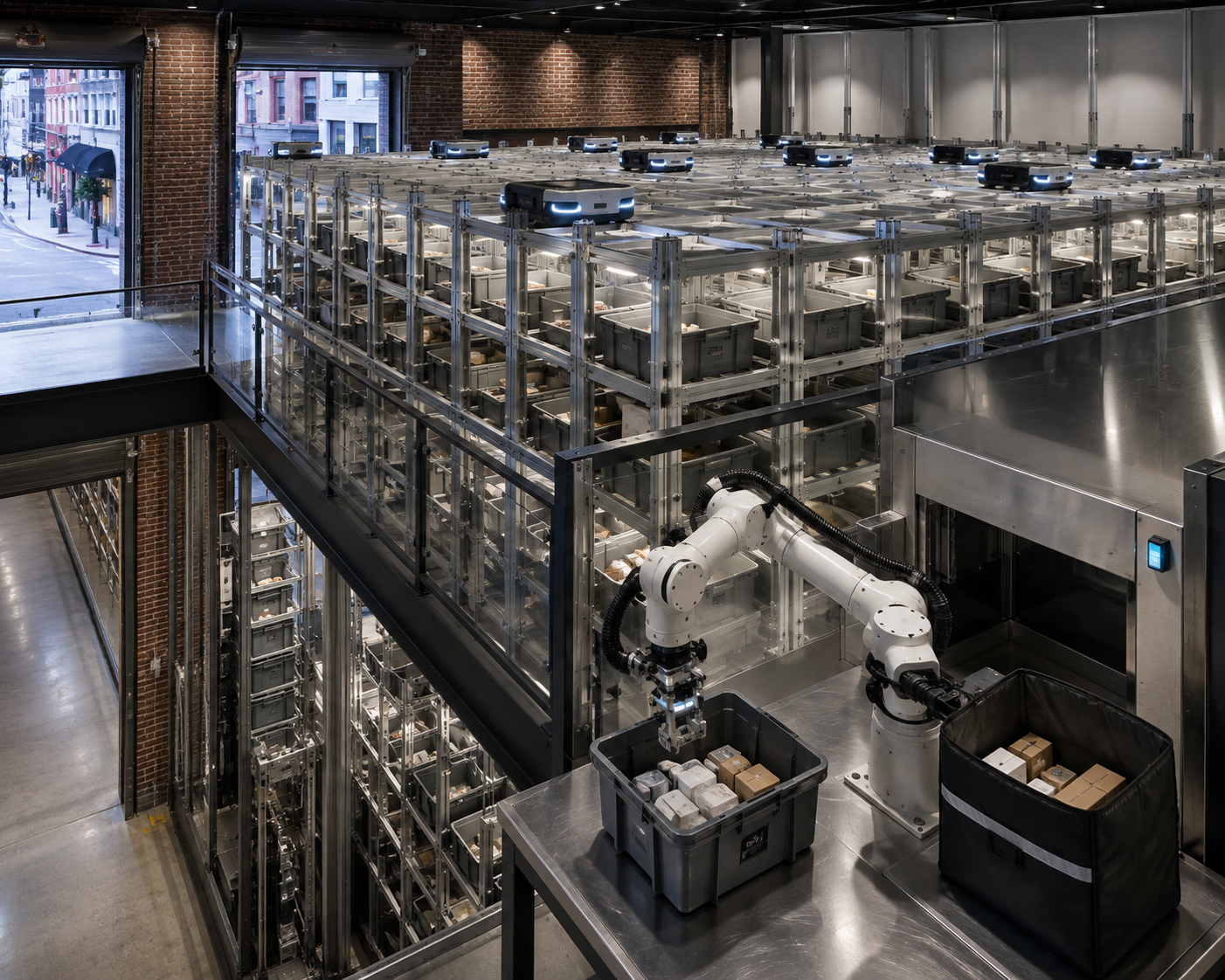
Figure: Anatomy of a Converted Urban Micro-Fulfilment Cell
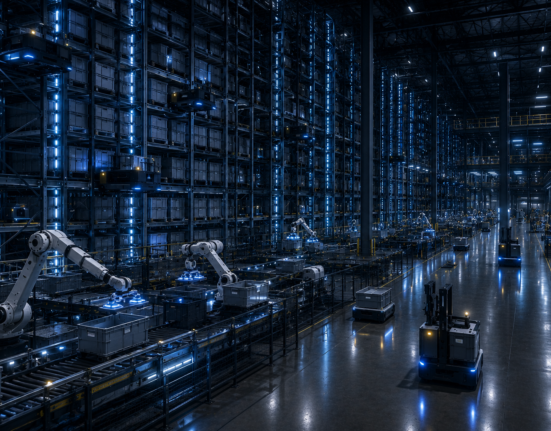
A cutaway view of a single MFC module shows the top-grid robot layer, the vertical bin storage cube beneath it, port openings where bins are lifted to workstation height, a robotic picking arm stationed at the pack bench, and a compact loading dock sized for cargo bikes, delivery robots, and last-mile vans rather than full-size tractor trailers.
Robotic Picking Arms in Tight Spaces
Storage density solves half the problem. The other half is getting individual items out of a bin and into a customer’s order bag without a human doing every single pick, and this is where robotic picking arms have made the fastest recent progress. Picking a single stock-keeping unit that might be a soft bag of produce, a rigid box, an odd-shaped bottle, or a loose bundle of items remains one of the hardest manipulation problems in all of robotics, harder in many ways than the storage and retrieval logistics around it.
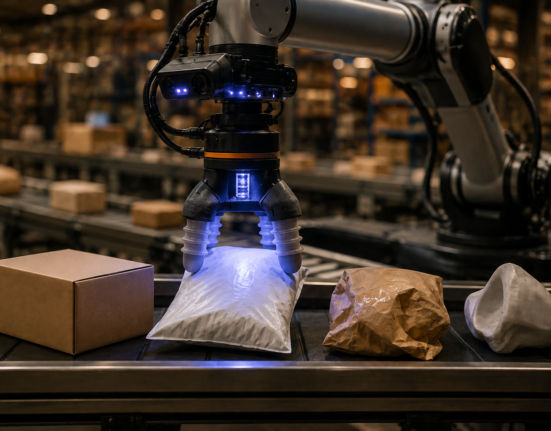
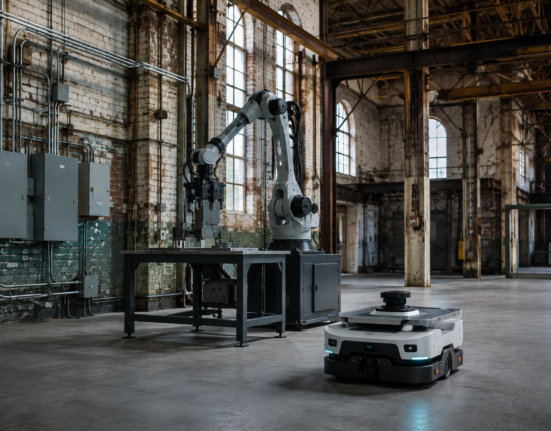
Modern picking arms deployed in micro-fulfilment settings typically combine a multi-axis robotic arm, a vision system that classifies the item and its orientation inside the tote, and a compliant end effector, often a soft or vacuum-based gripper, that can adjust its grip force to avoid crushing produce while still securing denser packaged goods. Because MFCs operate in a much smaller footprint than a regional warehouse, these arms are usually installed at fixed pack stations fed by the AS/RS ports, rather than roaming the floor. A bin arrives at the port, the arm or a human-robot hybrid station identifies and extracts the ordered quantity, and the bin returns to storage while the picked item continues toward packing.
Full robotic arm picking still struggles with the long tail of irregular SKUs: delicate bakery items, loose deli goods, and mixed multi-packs remain difficult to automate reliably. The practical answer most operators have converged on is a hybrid pick model, where robotic arms handle standardized, well-behaved SKUs (canned goods, bottled beverages, boxed goods) while human associates handle the residual difficult categories at an ergonomic pick station where the robot has already brought the bin to them, eliminating the walking time that dominates labor cost in a manual warehouse.
| Pick Method | Best Suited SKUs | Typical Cycle Time per Pick |
|---|---|---|
| Fully robotic arm pick | Boxed, bottled, rigid uniform packaging | 2 to 4 seconds |
| Human-at-station hybrid pick | Produce, bakery, mixed multi-packs | 3 to 6 seconds |
| Manual walk-and-pick (legacy) | Any, but inefficient at scale | 20 to 45 seconds including travel |
Dark Store Conversions: Turning Retail Space Into Robotic Infrastructure
A significant share of new micro-fulfilment capacity is not built from scratch but retrofitted into existing retail shells, commonly called dark store conversions because the space no longer serves walk-in shoppers and the lights, from a merchandising standpoint, go dark. A struggling department store anchor, an oversized supermarket with excess square footage, or a shuttered big-box unit can be structurally repurposed: reinforcing floor loading for a storage cube, adding dedicated power and network infrastructure for robotics, and carving out a small vehicle bay for delivery pickup where a loading dock did not previously exist.
Conversions carry real engineering constraints that a greenfield warehouse does not. Ceiling heights in older retail buildings often were not designed for a tall storage cube, which caps achievable density. Column spacing designed for retail aisles can conflict with the grid geometry a robotic system wants. Floor slabs built for foot traffic and shelving loads may need reinforcement to support the point loads of a dense automated grid plus its contents. Electrical service sized for lighting and refrigeration cases is frequently inadequate for robotics, requiring a service upgrade. Despite these constraints, conversion remains attractive because the alternative, acquiring and permitting new urban industrial land, is far slower and far more expensive in dense city cores where such land barely exists.
Siting Economics: Why Proximity Beats Scale
The economic logic for placing automation close to dense urban demand inverts the traditional warehousing calculus. Classic distribution strategy chases the lowest cost per square foot and the largest possible building, accepting a longer, costlier last-mile leg in exchange for cheap land and bulk efficiency. Micro-fulfilment accepts a much higher real estate cost per square foot, often several multiples of what suburban industrial space costs, in exchange for collapsing delivery distance to a mile or two. That collapse changes vehicle economics dramatically: a delivery that would require a multi-stop truck route from a distant depot becomes a single short hop from a nearby MFC, achievable by a cargo bike, a small electric van, or a sidewalk robot instead of a full-size delivery vehicle.
The siting decision therefore becomes a density and catchment calculation rather than a pure cost-per-square-foot calculation. Retailers model population density, order frequency, and average basket size within a one to three mile radius, then work out whether the incremental real estate premium is offset by faster fulfilment, higher order volume captured through faster delivery promises, and reduced last-mile transportation cost per order. In sufficiently dense catchments, the math tends to favor several smaller automated MFCs distributed across a metro area over one large regional warehouse, even though the smaller sites individually cost more per square foot to build out.
Common mistake
Retailers frequently size a micro-fulfilment center’s robotic capacity for average daily order volume rather than peak-hour demand, then discover the AS/RS and picking arms cannot clear the queue during dinner-hour grocery rushes or weekend peaks, forcing manual overflow picking that erases the labor savings the automation was installed to capture.
Software Orchestration: The Layer That Makes the Robots Useful
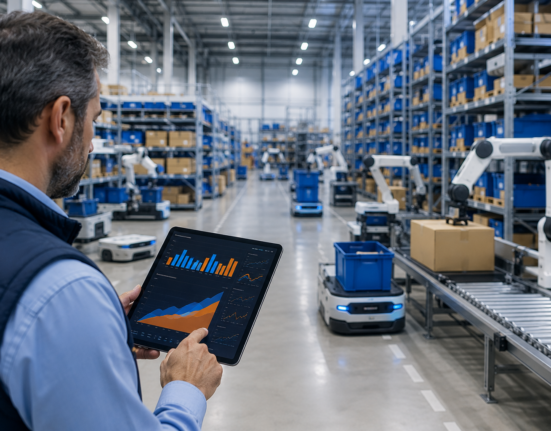
None of the hardware above functions without a warehouse execution system sitting above it, sequencing which bin a robot fetches next, which pack station receives it, and how the whole facility reprioritizes when a rush order needs to jump the queue. This orchestration layer typically integrates three functions: inventory management that tracks exact bin contents in real time, a robot fleet controller that assigns tasks and prevents collisions on the grid, and an order-sequencing engine that batches and re-batches picks to minimize total robot travel across the facility.
Because MFCs promise delivery windows measured in minutes rather than hours, the sequencing engine has to solve a much tighter optimization problem than a traditional warehouse management system. A regional distribution center can batch orders over a multi-hour wave and optimize at leisure; a micro-fulfilment center receiving continuous order flow throughout the day must re-optimize its pick queue essentially every few seconds as new orders and rush requests arrive, while simultaneously managing bin restocking so popular SKUs never sit exhausted at the bottom of a queue.
| Software Layer | Function | Typical Update Frequency |
|---|---|---|
| Inventory management system | Tracks bin-level stock and expiry | Real time, per transaction |
| Robot fleet controller | Task assignment, collision avoidance, charging cycles | Sub-second |
| Order sequencing engine | Batches picks, prioritizes rush orders | Continuous re-optimization |
Facility Design Trade-offs Specific to Small Footprints
Designing automation for 10,000 square feet forces compromises that a 500,000 square foot warehouse never has to consider. Aisle width, grid height, staging area size, and even robot charging infrastructure all compete for the same scarce square footage, and every decision to add storage density typically subtracts from throughput capacity or staging space, and vice versa.
- Grid height versus ceiling constraints: converted retail buildings frequently cap achievable cube height well below what a purpose-built facility could support, limiting total storage capacity per square foot of floor space.
- Staging area versus storage area: every square foot dedicated to order staging and packing is a square foot not available for storage cube, forcing operators to balance SKU breadth against pick-and-pack throughput.
- Robot fleet size versus aisle and port congestion: adding more retrieval robots increases throughput only up to the point where robots begin queuing at shared ports, after which additional robots yield diminishing returns.
- Charging infrastructure footprint: battery-powered shuttles and picking arms need charging or battery-swap stations that consume floor space and cannot be sited in the middle of the storage cube.
Cold Chain and Perishables Inside the Grid
Grocery-focused micro-fulfilment adds a further wrinkle absent from general merchandise MFCs: temperature zoning. A single small facility often needs ambient, chilled, and frozen zones simultaneously, each requiring its own insulated sub-enclosure within the grid and its own robotic hardware rated for the temperature range, since standard actuators and batteries do not perform reliably at deep-freeze temperatures without additional engineering.
What Worked: Hybrid Pick Models in Grocery Deployments
What worked
Grocery-focused MFC operators that paired robotic bin retrieval with a human final-pick station, rather than chasing full end-to-end robotic arm picking on day one, hit stable throughput targets faster and with fewer costly manipulation failures on soft or irregular produce, while still capturing the bulk of the labor savings from eliminating walking time.
Frequently Overlooked Factors in Micro-Fulfilment Planning
- Power infrastructureRobotic grids and charging stations often need a full electrical service upgrade that converted retail buildings were never wired to support.
- Noise and vibrationDense robotic grids operating above residential or mixed-use floors can trigger noise complaints and require vibration isolation not needed in standalone warehouses.
- Curbside accessA facility with perfect internal automation still fails if the surrounding street cannot support frequent short-dwell pickups by vans, bikes, and delivery robots.
- SKU rationalizationCramming a full supercenter catalog into a small cube rarely works; successful sites trim assortment to the SKUs that actually drive urban rapid-delivery demand.
- Restock cadenceSmall on-site inventory buffers mean MFCs need far more frequent replenishment trips than a large regional warehouse, shifting cost into the middle mile.
- Fallback labor planningEven highly automated sites need a trained human contingency team on shift for robot faults, since a single stalled shuttle can block an entire grid lane.
Glossary
- AS/RS
- Automated Storage and Retrieval System, a robotic structure that stores and retrieves inventory bins without manual shelving access.
- Dark store
- A retail location converted to fulfil online orders only, with no walk-in shopping floor open to the public.
- Goods-to-person
- A fulfilment design where automation brings inventory to a stationary picker rather than having the picker walk to the inventory.
- Pick station
- A fixed workstation, staffed by a robotic arm or a human, where items are removed from a retrieved bin and placed into an order container.
- Catchment radius
- The geographic area around a fulfilment site within which delivery is considered economically and operationally viable.
- Cube storage
- A dense three-dimensional grid storage method that stacks bins vertically and horizontally to maximize inventory per square foot.
Key Takeaways
- Robotic micro-fulfilment centers compress warehouse automation into 5,000 to 30,000 square foot urban footprints, far smaller than regional distribution centers.
- Cube-based AS/RS grids, whether top-grid rail robots or internal XYZ shuttles, are the core hardware enabling dense storage in a small space.
- Robotic picking arms handle standardized SKUs well but still struggle with irregular items like produce, making hybrid human-robot pick stations the practical norm.
- Dark store conversions face real constraints around ceiling height, floor loading, column spacing, and electrical capacity that greenfield builds avoid.
- Siting economics favor proximity to dense demand over cheap land, inverting traditional warehouse location logic.
- Software orchestration, particularly real-time order sequencing, is as critical to throughput as the physical robotics itself.
- Cold chain zoning, power upgrades, and curbside access are frequently underestimated planning requirements for urban automation projects.
FAQs
What is the difference between a micro-fulfilment center and a dark store?
A dark store is any retail location repurposed to serve only online orders, without walk-in shoppers. A micro-fulfilment center is a specific type of dark store, or a component within one, that uses dense robotic storage and retrieval hardware rather than simple manual shelving to speed up order picking.
How much floor space does a robotic micro-fulfilment center typically need?
Most deployments range from about 5,000 to 30,000 square feet, compared to hundreds of thousands of square feet for a regional distribution center. The exact size depends on catalog breadth, order volume, and how much vertical cube height the building allows.
Can robotic arms fully replace human pickers in micro-fulfilment centers?
Not yet for most catalogs. Robotic arms handle rigid, uniform packaging reliably, but irregular items like produce, bakery goods, and mixed multi-packs remain difficult to grip consistently, so most operators use a hybrid model pairing robotic retrieval with a human final pick station.
Why do retailers convert existing stores instead of building new warehouses?
Urban industrial land suitable for new warehouse construction is scarce and slow to permit in dense city cores. Converting underused retail space, even with structural retrofit costs, is typically faster and positions the facility exactly where delivery demand is concentrated.
What is the biggest technical constraint when converting a retail store into an MFC?
Ceiling height is often the limiting factor, since it directly caps how tall a storage cube can be built and therefore how much inventory density the site can achieve. Floor load capacity and available electrical service are close behind.
How fast can a robotic micro-fulfilment center assemble an order?
Well-tuned facilities typically retrieve and assemble a multi-item order within two to six minutes from the automated grid, compared to tens of minutes to hours for a manually picked order from a large distribution center.
Do micro-fulfilment centers handle frozen and refrigerated goods?
Grocery-focused sites commonly build separate ambient, chilled, and frozen zones within the same small footprint, each requiring insulated enclosures and temperature-rated robotics, since standard actuators and batteries do not perform reliably in deep-freeze conditions.
How do micro-fulfilment centers connect to last-mile delivery?
Once an order is picked and packed, it is handed off at a small loading bay to a cargo bike, compact electric van, or delivery robot for the final short trip to the customer, since the MFC’s proximity to demand shortens that leg to a mile or two rather than a full cross-town route.
References
- Datex Corp, “Micro-Fulfillment Centers”
- Tompkins Solutions, “Micro-Fulfillment Centers: The Future of Urban Logistics and Faster Delivery”
- KNAPP, “Micro Fulfillment Solutions for Online Food Retail Urban Logistics”
- Modern Materials Handling, “Answering the Call for Micro-Fulfillment”
- The Spoon, “Micro-Fulfillment Robot Specialist Fabric Raises $200M on $1 Billion Valuation”
- Retail Technology Innovation Hub, “Tesco Preps Attabotics Partnership to Install Micro-Fulfillment Systems for Online Grocery Orders”
- Asian Robotics Review, “Micro-Fulfillment: Market Growth Forecast”
For related coverage in this cluster, see our companion pieces on smart warehouse infrastructure of the future, the economics behind warehouse automation ROI, how robotic picking accuracy is measured and improved, and the licensing models covered in robotics-as-a-service automation. Readers interested in how these urban nodes connect to national freight networks may also want our deep dives on autonomous rail and digital coupling systems and middle-mile autonomous trucking.