| Myth | Reality |
|---|---|
| Autonomous yard trucks are experimental prototypes, not real deployments. | APM Terminals Maasvlakte II in Rotterdam already runs a fleet of a dozen autonomous Terberg yard tractors with Level 4 driving technology, expanding toward thirty units by early 2027. |
| Port automation only means bigger cranes. | Modern port automation is a full stack: automated stacking cranes, driverless yard tractors, and terminal operating software that sequences thousands of container moves per day. |
| Automated terminals eliminate all port jobs. | Roles shift toward remote crane operation, fleet monitoring, and maintenance rather than disappearing outright, though headcount on the yard floor does fall substantially. |
| Automation only works at brand-new “greenfield” ports. | Operators are retrofitting existing terminals, such as Maasvlakte II’s yard expansion, with autonomous tractors and automated cranes without rebuilding the whole facility. |
What Port Automation Actually Covers in 2026
“Port automation” is often used as a catch-all term, but in a working container terminal it refers to three distinct layers working together. The first is quay-side automation: ship-to-shore cranes that load and unload vessels, increasingly assisted by remote operators or semi-autonomous control. The second is yard-side automation: automated stacking cranes (ASCs) and autonomous yard trucks that move containers between the quay, the storage blocks, and the landside gate. The third is the software layer: terminal operating systems (TOS) and AI-driven optimisation engines that sequence every crane lift and truck movement to avoid bottlenecks. This piece focuses on the second and third layers, the yard trucks and terminal automation software, since that is where the most significant and verifiable 2026 deployments are happening.
Container terminals are an unusually good fit for autonomous vehicles compared with public roads. Yards are fenced, private property with no pedestrians or oncoming traffic, routes between the quay and storage blocks are highly repeatable, and the terminal operating system already knows in advance exactly which container needs to move where and when. This combination of structured environment and predictable routing is why yard automation has matured faster than autonomous trucking on public highways.
The Technology Behind Autonomous Yard Operations
Automated Stacking Cranes and Rail-Mounted Gantries
Automated stacking cranes run on fixed rails within a storage block, lifting containers into and out of stacks without an onboard operator. They communicate directly with the terminal operating system, receiving a job list of container moves and executing them in sequence, occasionally handing off to a remote human operator for edge cases such as a misaligned container or a sensor fault.
Autonomous Yard Trucks and Terminal Tractors
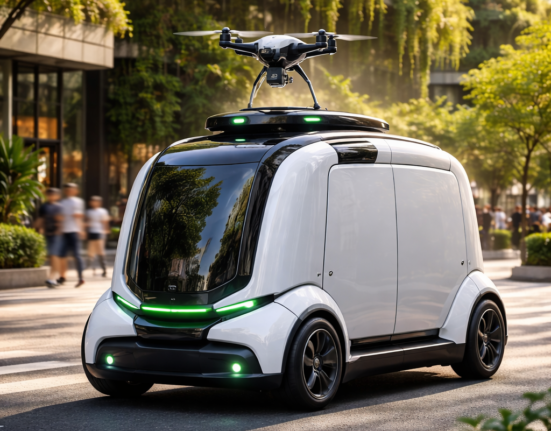
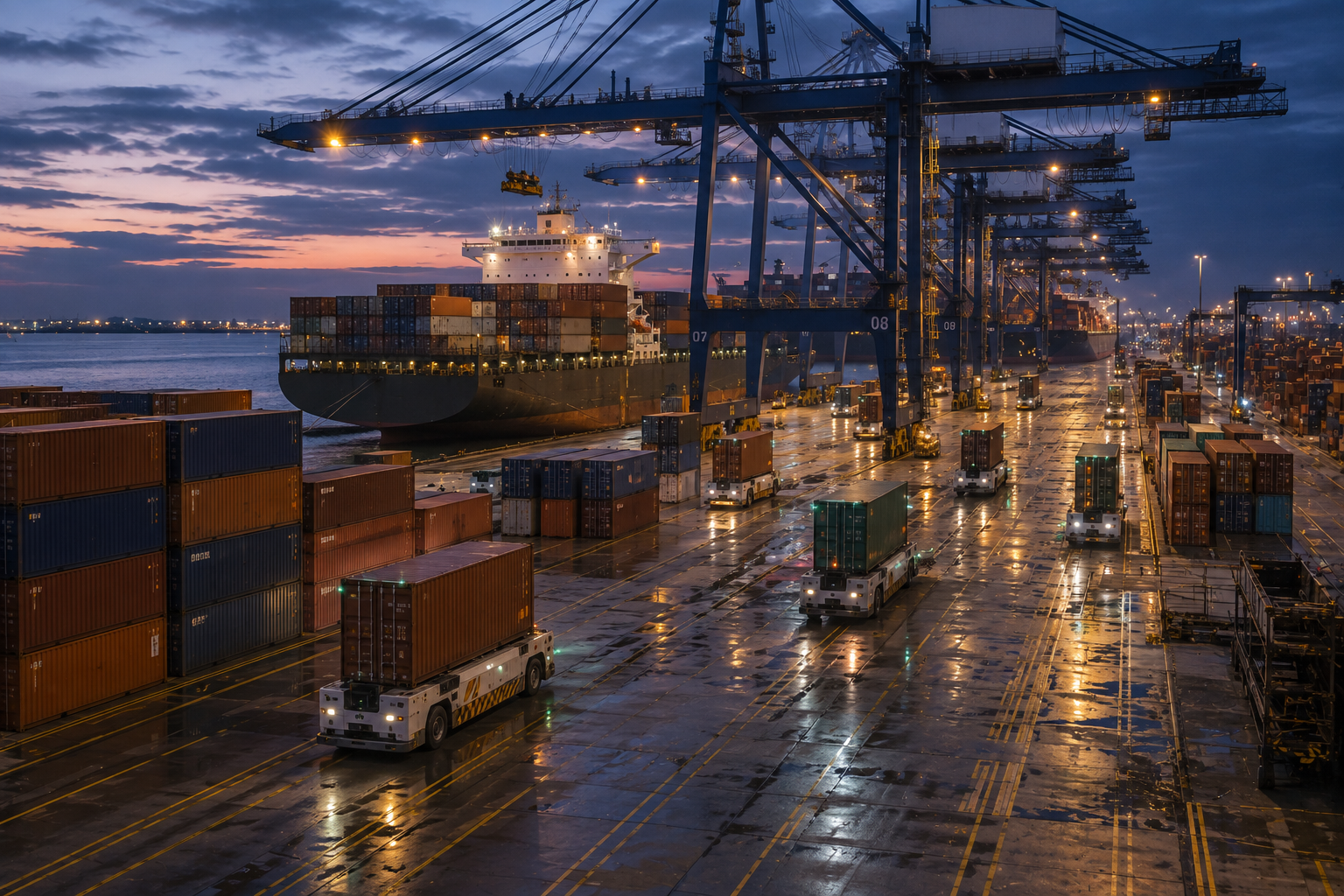
Autonomous yard trucks, sometimes called terminal tractors or yard hostlers, ferry containers on chassis or bomb-carts between the quay cranes and the storage yard. Newer designs such as the Qomolo Q-Truck dispense with a driver’s cab entirely, since there is no legal requirement for a human occupant within a fenced private terminal. These cabless tractors can carry loads up into the tens of tonnes, run on electric drivetrains with battery-swap stations that avoid lengthy charging downtime, and operate continuously across shifts without driver fatigue or shift-change delays. Because these vehicles are purpose-built without a cab, they represent one of the clearest real-world examples of the broader shift toward cab-less freight networks in logistics.
Terminal Operating Systems and AI Orchestration
The software coordinating all of this is arguably more important than any single vehicle. A modern terminal operating system ingests vessel schedules, gate appointments, and yard capacity in real time, then generates a moving sequence of crane lifts and truck dispatches designed to minimise container reshuffling and truck idle time. AI-driven prediction models increasingly forecast cargo volume and berth congestion days in advance, letting terminals pre-position containers and staff before a surge hits. This orchestration challenge closely parallels the coordination problem faced by indoor robot fleets in warehouses; the same deadlock-avoidance principles used in dense warehouse automation, covered in our piece on robotics-as-a-service automation models, apply to yard fleets operating under subscription and managed-service contracts.
Real-World Deployments: Who Is Actually Running Automated Yards
Unlike some automation categories where pilots outnumber production deployments, container terminal automation has a well-documented list of operating facilities. The table below summarises the leading examples as of 2026.
| Port / Terminal | Automation in Place | Notable Detail |
|---|---|---|
| Port of Rotterdam, APM Terminals Maasvlakte II | Autonomous Terberg YT203EV yard tractors with Level 4 driving technology from Embotech | Twelve tractors operating, with the fleet expected to reach thirty units by early 2027 |
| Tuas Mega Port, Singapore | Fully automated terminal with electric AGVs coordinated by AI fleet management | One of the largest greenfield fully automated container terminal projects in the world |
| Yangshan Deepwater Port, China | Automated stacking cranes and driverless container trucks across large sections of the terminal | Widely cited as among the most automated terminals globally |
| Port of Los Angeles | Autonomous container trucks paired with the AI-driven Port Optimizer platform | Optimizer software predicts cargo volumes and manages trucking flow across the wider port complex |
The common thread across these deployments is that automation adoption tracks closely with new construction or major expansion projects rather than retrofits of aging terminals in place. Rotterdam’s Maasvlakte II, for instance, was built as an expansion specifically designed around automated operations, which made introducing autonomous tractors far more straightforward than it would be at an older, layout-constrained terminal.
Beyond these flagship examples, terminal operators across the Middle East, South Korea, and the US Gulf Coast have announced expansion plans that include automated stacking cranes and driverless yard tractors as standard features of new berth construction, rather than optional add-ons evaluated after the fact. This shift signals that automation has moved from an experimental differentiator to a baseline expectation for any newly built container terminal competing for major shipping line contracts, much as automated sortation and robotic picking have become baseline expectations in large-scale parcel distribution centres.
Container Flow Through an Automated Yard
A ship-to-shore crane lifts a container from a vessel and sets it onto an autonomous yard tractor waiting at the quay. The tractor, guided by the terminal operating system, drives the container to its assigned storage block, where an automated stacking crane lifts it into position. When a landside truck arrives to collect the container, the sequence reverses: the ASC retrieves the box, an autonomous tractor carries it to the gate lane, and the terminal system verifies the handoff electronically before the truck departs, with no yard staff required to touch the container at any step.
Performance and Throughput Gains
The main commercial argument for port automation is throughput per crane and reduced dwell time, since container terminals earn revenue on volume moved and are penalised heavily for vessel delays.
| Metric | Traditional Manual Terminal | Fully Automated Terminal |
|---|---|---|
| Crane productivity | Roughly 38 to 40 container moves per hour | Up to around 58 container moves per hour, about 50 percent higher |
| Yard truck availability | Limited by driver shifts, breaks, and turnover | Near-continuous operation with battery-swap stations replacing long charging stops |
| Weather and visibility sensitivity | Manual crane and truck operations slow significantly in fog, high wind, or darkness | Sensor-based systems maintain more consistent operating tempo, though extreme weather still triggers safety holds |
| Emissions per unit moved | Diesel yard tractors generate substantial local emissions | Electric autonomous tractors can cut CO2 output by tens of tonnes per unit per year under green electricity |
These productivity gains explain why terminal operators facing capacity constraints, rather than land availability, increasingly choose automation upgrades over simply building new berths. A 50 percent uplift in crane throughput can defer or eliminate the need for an entirely new terminal expansion, which is a capital-intensive and multi-year undertaking.
The Economics of Automating a Container Yard
Port automation carries a different economic profile than warehouse automation because the assets involved, cranes, rail infrastructure, and yard tractors, are extremely long-lived and the volumes moved are enormous even at a mid-size facility. Capital costs for converting a yard to automated stacking cranes and driverless tractors run into the hundreds of millions of dollars for a full terminal, but the labour savings compound over decades of operation, and the throughput gains directly increase revenue capacity without requiring more physical land. Terminals also gain schedule reliability, since automated yards are less exposed to labour disputes, driver shortages, or shift-coverage gaps that can stall a manual yard overnight. The trade-off is a heavier upfront reliance on software vendors and a longer commissioning period, since a terminal operating system needs extensive tuning against the specific yard layout before autonomous tractors can run at full tempo.
Automated Ports and Intermodal Rail Connections
Container terminals rarely operate in isolation; most high-volume ports sit at the head of an intermodal chain that hands containers off to rail networks for long inland journeys. As yard automation has matured, terminal operators have increasingly pushed to automate that rail handoff as well, using automated gantries to load double-stack rail cars directly from the automated stacking crane blocks without a manual crane operator bridging the gap. This reduces a step that has historically been a throughput bottleneck, since rail loading schedules are tightly fixed and any delay in getting containers from ship to railcar can cascade into missed train slots. The same digital coupling and remote-coordination principles used to link rail cars automatically are covered in more depth in our piece on autonomous rail and digital coupling systems, which explores how automated freight rail is converging with port and yard automation to remove manual handoffs across the entire inland leg of a container’s journey.
How Port Yard Automation Compares to Middle-Mile Trucking
It is worth distinguishing yard automation from the separate, and in some ways more difficult, challenge of autonomous trucking on public roads once a container leaves the port gate. Yard tractors operate exclusively within a fenced, private, GPS-mapped terminal at low speed, which is a fundamentally easier environment than the mixed public highway traffic that hub-to-hub middle-mile autonomous trucks must navigate. That said, the two categories are increasingly linked commercially: several port operators are piloting programs where an autonomous yard tractor hands a container directly to a driverless middle-mile truck waiting just outside the gate, removing a manual drayage step entirely. Our dedicated look at middle-mile autonomous trucking regulation and economics covers the regulatory and commercial state of that adjacent, road-going leg of automated freight in detail.
The economic logic that justifies port automation echoes a pattern seen elsewhere in logistics automation: high, predictable volume moving through a fixed, structured environment is what makes the capital investment pay off, the same condition that determines whether a distribution centre can justify going fully unstaffed. Readers interested in that parallel across warehouse operations can see our deep dive on fully lights-out warehouse automation for how the same volume-and-structure logic applies indoors.
Weather, Safety, and Redundancy in Automated Yards
Ports face harsher and more variable operating conditions than most indoor automation environments, with salt air, high wind loads on tall cranes, and seasonal storm exposure all factoring into equipment design. Automated stacking cranes and yard tractors are engineered with wider environmental tolerances than typical warehouse robotics, but severe weather events still trigger automated safe-hold protocols that pause crane and tractor movement until conditions clear, similar in principle to how a manually operated terminal would suspend crane lifts in a high-wind advisory. Redundancy planning is also more elaborate than in a single building: a terminal operating system outage or a network fault affecting one yard block should not be able to halt the entire terminal, so mature deployments segment the yard into independently operable zones that can continue functioning even if another zone’s automation degrades.
Challenges That Still Slow Full Automation
Three friction points recur across nearly every automation project. Labour relations are the most visible: dockworker unions in many countries have resisted automation projects that they view as a direct threat to jobs, and several major automation rollouts have been delayed or scaled back following labour disputes. Cybersecurity is a growing concern, since a terminal operating system that controls hundreds of cranes and tractors is a high-value target, and an outage or breach can halt an entire port rather than a single lane. Finally, mixed-traffic edge cases, a manually driven maintenance vehicle entering an automated zone, a container improperly latched, severe weather, still require human judgment, which is why even the most automated terminals retain a remote operations centre staffed around the clock.
Common mistake
Terminal operators sometimes assume that installing autonomous yard trucks alone will deliver the throughput gains seen at flagship automated ports. Without a terminal operating system tuned to sequence crane lifts and truck dispatches together, autonomous vehicles simply idle waiting for jobs, and the promised productivity uplift never materialises.
What worked
Rotterdam’s phased rollout, starting with a modest fleet of a dozen autonomous tractors and scaling toward thirty over several years, allowed the terminal operating system and safety protocols to be validated at low risk before committing to full-yard automation, rather than attempting a single big-bang cutover.
Frequently Overlooked Factors
- Battery-swap infrastructureElectric yard tractors depend on dedicated swap stations to avoid long charging downtime; underinvesting in swap capacity quietly caps fleet utilisation no matter how many tractors are purchased.
- Gate and landside integrationAutomation gains inside the fence can be undone if landside truck gates and appointment systems are not modernised in parallel, creating a bottleneck at the terminal boundary.
- Remote operator ergonomicsStaff monitoring multiple automated cranes and tractors from a control room face a different kind of fatigue than physical operators, and this workload is frequently underestimated in staffing plans.
- Vessel scheduling volatilityAutomated yards perform best against predictable vessel arrival windows; schedule disruptions upstream in the shipping network can strand automation gains at the berth.
- Cybersecurity segmentationTerminal operating systems need network segmentation between operational technology and corporate IT, since a single compromised system can halt crane and tractor operations across the entire yard.
- Labour transition planningTerminals that negotiate retraining and redeployment paths with unions ahead of automation rollouts encounter far less operational disruption than those that treat labour relations as an afterthought.
Glossary
- Automated Stacking Crane (ASC)
- A rail-mounted crane that stores and retrieves containers within a yard block without an onboard human operator.
- Terminal Operating System (TOS)
- Software that manages and sequences every container movement across a port terminal, from vessel unloading to gate exit.
- Yard tractor / terminal tractor
- A vehicle that hauls container chassis between the quay, storage yard, and gate; increasingly built without a driver’s cab for autonomous operation.
- Ship-to-shore crane
- The large quay-side crane that lifts containers directly on and off a docked vessel.
- Dwell time
- The total time a container spends within a terminal between arrival and departure, a key efficiency metric for port operators.
Key Takeaways
- Port automation in 2026 spans three layers: quay cranes, yard-side automation, and terminal operating software, working together.
- Real deployments already exist, including autonomous yard tractors at Rotterdam’s Maasvlakte II and fully automated yards at Singapore’s Tuas Mega Port.
- Cabless yard tractors such as the Qomolo Q-Truck represent one of the clearest production examples of driverless freight vehicles anywhere in logistics.
- Automated terminals can lift crane productivity by roughly 50 percent compared with manual operations.
- Fenced, private, low-traffic yards make container terminals easier to automate than public roads, which explains the faster maturity here than in over-the-road trucking.
- Labour relations and cybersecurity, not the core robotics, are now the primary friction points slowing further rollouts.
- Phased automation rollouts that validate software and safety at small scale outperform attempts at a single full-yard cutover.
FAQs
What is port automation robotics?
Port automation robotics refers to the combination of automated stacking cranes, driverless yard trucks, and AI-driven terminal operating systems that move containers between ships, storage yards, and landside gates with minimal human operators on the yard floor.
Are autonomous yard trucks actually operating at real ports today?
Yes. APM Terminals Maasvlakte II at the Port of Rotterdam operates autonomous Terberg yard tractors with Level 4 driving technology, and Singapore’s Tuas Mega Port runs a fully automated terminal using AI-orchestrated automated guided vehicles.
Why are container yards easier to automate than public roads?
Container yards are fenced, private property with no pedestrians or oncoming traffic, and routes between the quay and storage blocks are highly repeatable and known in advance by the terminal operating system, removing much of the unpredictability that complicates autonomous driving on public roads.
How much do automated terminals improve crane productivity?
Fully automated terminals can handle up to around 58 container moves per crane per hour, roughly 50 percent more than the 38 to 40 moves per hour typical of traditional manually operated cranes.
What is a cabless yard truck?
A cabless yard truck, such as the Qomolo Q-Truck, is an autonomous terminal tractor built without a driver’s cab since no human occupant is legally required within a fenced private port terminal, allowing a fully purpose-built autonomous design.
Do automated ports eliminate dockworker jobs?
Automation reduces yard-floor driving and crane-operating roles, but it also creates demand for remote crane operators, fleet monitoring staff, and maintenance technicians. Total job counts fall, but the transition is a shift in role type rather than a complete elimination of port employment.
What has slowed wider adoption of port automation?
Labour union resistance to automation projects, the cybersecurity risk of centralising yard control in a single terminal operating system, and the difficulty of retrofitting automation into older, layout-constrained terminals are the main factors slowing broader rollout.
How do electric autonomous yard trucks handle charging?
Many operators use dedicated battery-swap stations that exchange a depleted battery for a charged one in a few minutes, avoiding the long downtime of standard charging and keeping autonomous tractor fleets operating near continuously across shifts.
References
- Port Technology International, “Port of Rotterdam gains new autonomous yard trucks”
- Port Strategy, “Autonomous Yard Trucks in Rotterdam”
- StreetDrone, “Kramer Group, StreetDrone and Terberg Launch Autonomous Yard Trucks in the Port of Rotterdam”
- Robotics and Automation News, “Automated port and terminal operations: how robotics is reshaping global trade infrastructure”
- Greater Houston Port Bureau, “The Rise of AI and Automation in Global Port Operations”
- Westwell Lab, “Smart Port Automation Solutions Demonstrated at TOC 2026”
- Westwell Lab, “How Autonomous Trucks Are Transforming Port Container Operations”
- ITF-OECD, “Container Port Automation: Impacts and Implications”