| State | Driverless Trucking Status (2026) | Key Detail |
|---|---|---|
| Texas | Fully driverless commercial operation permitted | TxDMV began accepting commercial automated vehicle authorization applications in 2026, with rules fully enforceable from May 28, 2026 |
| Arizona | Fully driverless commercial operation permitted | One of the earliest states to allow driverless testing and commercial freight movement |
| California | Heavy-duty permit pathway newly formalised | California DMV adopted new rules in April 2026 creating a structured permit path for autonomous vehicles over 10,001 pounds |
| Nevada | Currently permitted, but under legislative review | Lawmakers have debated a bill that would require a human operator in large driverless trucks and buses |
| Florida | Fully driverless commercial operation permitted | Counted among the small group of states with an active legal framework for driverless freight |
What “Middle-Mile” Means and Why It Fits Autonomy Well
Freight logistics is generally split into three legs: the first mile (moving goods from a factory or port to a regional hub), the middle mile (moving goods between hubs, distribution centres, or fulfilment centres, usually along fixed highway corridors), and the last mile (final delivery to a store or customer’s door). Middle-mile routes are typically repeatable, point-to-point, and run at highway speed on well-mapped interstate corridors, which makes them structurally easier to automate than last-mile delivery through unpredictable urban streets or long-haul routes that vary constantly with freight demand. Our companion piece on solving the last-mile delivery problem covers that harder, more variable end of the network in detail; this piece focuses specifically on the hub-to-hub middle segment where commercial autonomous trucking has actually gained traction in 2026.
The appeal of the middle mile is straightforward: a truck running the same lane between the same two facilities every day does not need to handle the long tail of edge cases that a delivery van encounters weaving through a residential neighbourhood, nor the unpredictable routing of a long-haul truck picking up loads across dozens of different origins and destinations. This is exactly why the current wave of commercial deployments concentrates on fixed corridors rather than general-purpose driving anywhere a human trucker might go.
Active Commercial Routes and Named Deployments
Four companies operate commercial autonomous freight services on US public roads in 2026, each with a different approach to the middle-mile problem.
| Company | Approach | 2026 Milestone |
|---|---|---|
| Aurora Innovation | Long-haul and middle-mile highway corridors, driver-out operation | Over 250,000 driverless miles with zero system-attributed collisions across 10 routes, including Dallas-Houston, Fort Worth-El Paso, El Paso-Phoenix, Fort Worth-Phoenix, and Dallas-Laredo |
| Gatik | Middle-mile retail and consumer goods logistics, short repeatable box routes | First company in North America to run fully driverless trucks at commercial scale, completing 60,000 orders incident-free with roughly 600 million dollars in contracted revenue |
| Kodiak AI | Industrial and energy-sector freight, plus long-haul corridors | Doubled its driverless fleet to 20 trucks with Atlas Energy Solutions and introduced triple-trailer capability |
| Bot Auto | Hub-to-hub freight network operations | Partnered with Ryan Companies for humanless freight runs between Dallas and Houston |
The single most cited commercial partnership of 2026 is the multi-year agreement PepsiCo signed with Gatik in June to deploy fully autonomous middle-mile freight operations across PepsiCo’s North American logistics network, moving goods between distribution centres and retail locations on fixed, pre-mapped routes. This deal is significant because it moves autonomous middle-mile trucking from a logistics-industry pilot into a mainstream consumer packaged goods supply chain, run at production scale rather than as a proof of concept.
A Typical Middle-Mile Autonomous Corridor
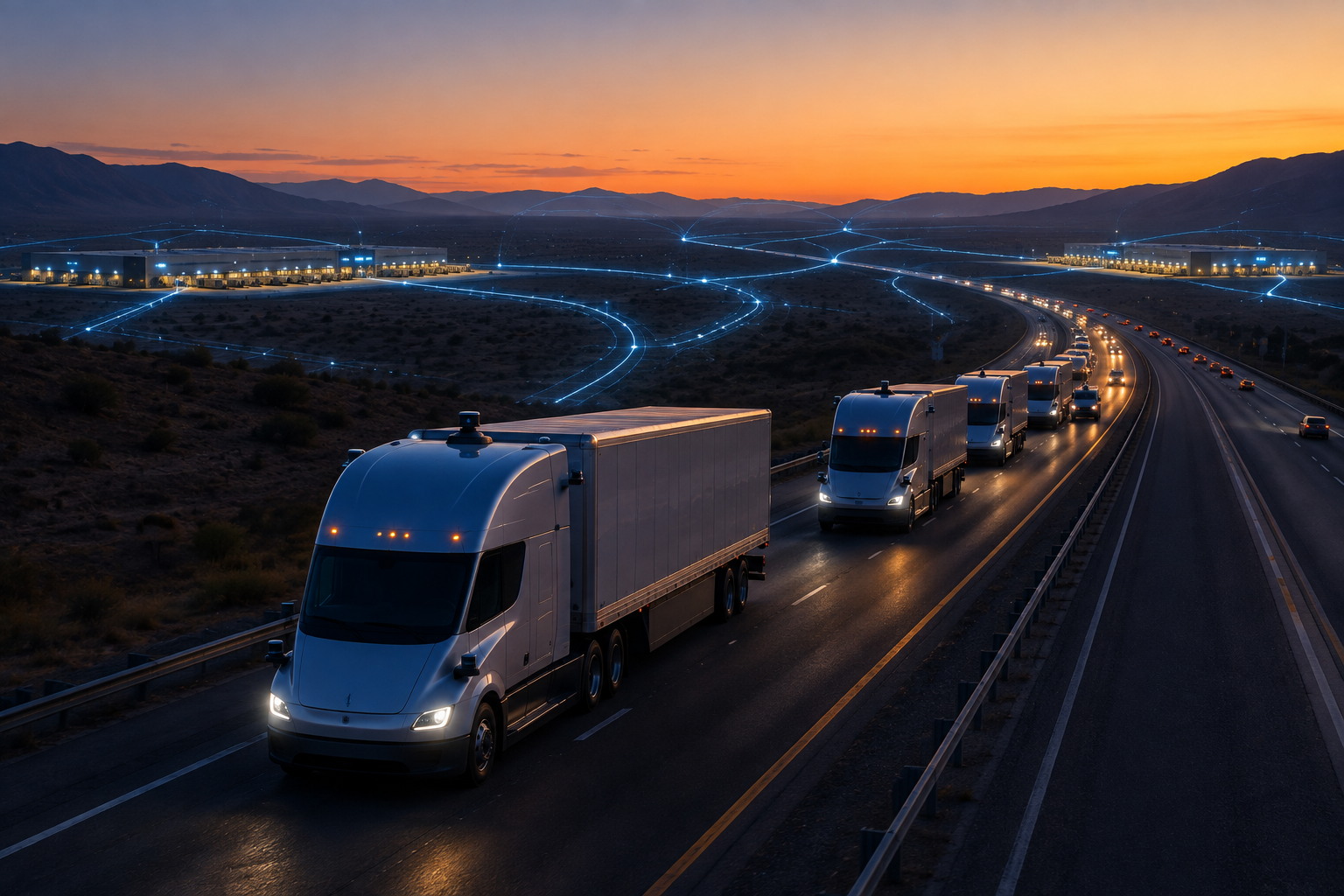
An autonomous tractor departs a distribution hub, merges onto a mapped interstate corridor with a pre-validated operational design domain, and travels a fixed distance to a second hub, where a human yard team, or an autonomous yard tractor, handles the trailer swap. The truck can then either return empty or with a pre-staged load, repeating the same lane continuously across a 24-hour cycle without the rest breaks and hours-of-service limits that apply to a human driver.
The Unit Economics of Middle-Mile Autonomy
The commercial case for autonomous middle-mile trucking rests on three linked levers: eliminating driver cost and shortage exposure, raising asset utilisation by removing hours-of-service limits, and improving fuel efficiency through consistent, computer-optimised driving behaviour.
| Economic Factor | Human-Driven Truck | Autonomous Middle-Mile Truck |
|---|---|---|
| Hours-of-service limits | 11 hours driving within a 14-hour on-duty window, then mandatory rest | No fatigue-based limit; operation can continue near-continuously subject to maintenance and weather |
| Example corridor transit time | The roughly 1,000-mile Fort Worth to Phoenix corridor takes 2 or more days under human hours-of-service rules | The same corridor completes in approximately 15 hours of continuous driving |
| Largest single cost line | Driver wages and benefits, typically the largest operating expense for a for-hire carrier | Driver cost eliminated on the automated leg; cost shifts to remote monitoring, maintenance, and technology licensing |
| Driving consistency and fuel use | Varies with individual driver habits, braking, and speed choices | Computer-optimised acceleration and braking can reduce fuel consumption compared with average human driving |
| Revenue potential per truck | Capped by legal driving hours per day | Reported potential to more than double revenue per truck on long, repeatable lanes by running near-continuously |
These figures explain why the earliest profitable middle-mile deployments cluster on long, simple, high-volume corridors rather than short urban routes: the value of removing hours-of-service limits scales with distance, so a 1,000-mile lane like Fort Worth to Phoenix captures far more economic benefit from continuous operation than a 50-mile regional run would. It also explains why companies like Gatik, focused on shorter, high-frequency middle-mile box routes for retail replenishment, emphasise order volume and reliability metrics instead, since their economic case rests more on eliminating driver scheduling friction across many short repeatable trips than on long-haul hours-of-service arbitrage.
Beyond the headline corridors, a growing number of regional carriers are testing shorter middle-mile lanes of 200 to 400 miles connecting secondary distribution hubs, a segment that has received less press attention than the marquee Sun Belt corridors but may ultimately represent a larger share of total middle-mile freight volume once driverless permits extend beyond the current handful of permissive states. These shorter lanes trade some of the hours-of-service economic advantage seen on 1,000-mile runs for faster fleet turnaround and more frequent revenue cycles per truck, suggesting that the eventual shape of the middle-mile autonomous trucking market will likely include a mix of long marquee corridors and a much larger base of shorter, higher-frequency regional lanes.
Regulation: A Patchwork, Not a National Framework
Despite the commercial momentum, there is still no unified federal framework governing autonomous trucking in the United States; regulation is proceeding state by state, corridor by corridor, and permit by permit. Texas has emerged as the most permissive environment, with the Texas Department of Motor Vehicles opening a formal commercial automated vehicle authorization process in 2026 that requires operators to certify roadworthiness, equip vehicles with required recording devices, and demonstrate the ability to reach a minimal risk condition if the system fails. California has moved more cautiously but meaningfully, adopting new rules in April 2026 that, for the first time, create a structured DMV permit pathway for heavy-duty autonomous vehicles over 10,001 pounds. Nevada illustrates the instability in this patchwork: it currently permits driverless trucks, but state lawmakers have debated legislation that would require a human operator in large automated vehicles, which would reverse the state’s permissive stance if passed. A carrier planning a multi-state middle-mile network in 2026 must design routes around this shifting, state-specific legal map rather than assuming uniform rules apply coast to coast.
How Middle-Mile Compares to Last-Mile and Long-Haul
It is worth being precise about where middle-mile autonomy sits relative to its two neighbouring categories, since the terms are frequently blurred in casual coverage. Last-mile delivery, covered in depth in our companion piece on solving the last-mile delivery problem, involves navigating unmapped residential streets, unpredictable parking, and direct interaction with consumers, none of which apply to a hub-to-hub highway run. Long-haul trucking covers highly variable, often one-off routes across the full national network, which requires a much broader operational design domain than a fixed, pre-validated middle-mile corridor. Middle-mile sits between the two: enough scale and highway-speed operation to capture meaningful economic benefit, but enough route repeatability and predictability to make near-term commercial deployment realistic. This is also why the physical handoff infrastructure matters so much; the trailer swaps and yard movements at each end of a middle-mile corridor increasingly rely on the same class of automation covered in our look at autonomous yard trucks and port automation, since a driverless highway truck is only as efficient as the hub operation that loads and unloads it.
The broader shift toward cabless, purpose-built autonomous truck designs, rather than retrofitted conventional trucks with a driver’s seat left empty, is also reshaping vehicle economics on these routes; see our coverage of cab-less freight networks for how removing the cab entirely changes both vehicle cost and design freedom. Some corridor operators are also exploring rail as a complementary middle-mile mode for the longest, highest-volume lanes, an approach detailed in our piece on autonomous rail and digital coupling systems.
Financing Models: Autonomous Trucking as a Service
Few carriers are buying autonomous driving systems outright the way they might buy a conventional truck. Instead, the dominant commercial model in 2026 looks much closer to a managed service: the autonomous driving technology provider retains ownership of the software stack and often the sensor hardware, charging carriers or shippers on a per-mile or subscription basis rather than a one-time purchase. This mirrors the pricing evolution already seen in warehouse robotics, where operators increasingly rent capability rather than purchase hardware outright; our detailed comparison of robotics-as-a-service pricing models breaks down the per-unit, subscription, and outcome-based structures that are now spreading from indoor robotics into autonomous freight. For a shipper such as PepsiCo, this arrangement converts a large uncertain capital outlay into a predictable operating cost tied directly to freight volume, which is one reason enterprise shippers have moved from pilot agreements to multi-year commercial contracts faster than many analysts expected.
This financing shift also changes who bears the risk of a route’s operational design domain becoming invalid, for instance if a highway is rebuilt or a new intersection changes traffic patterns along a validated corridor. Under a service model, the technology provider generally absorbs the cost of remapping and revalidation, while the carrier’s cost exposure is limited to the contracted per-mile rate. This allocation of risk has made carriers considerably more willing to commit to long-term middle-mile automation contracts than they would be if they had to buy and maintain the automated driving system themselves.
Safety Record and the Road to Public Trust
Every commercial deployment discussed above shares one feature that regulators and the public have specifically demanded: a public, verifiable safety record. Aurora’s repeated emphasis on its driverless mileage total alongside a zero system-attributed collision count is not incidental marketing; it is the primary evidence regulators in states such as Texas and California use to evaluate whether to expand permit programs. Gatik’s claim of 60,000 orders completed incident-free serves the same function for its retail-focused middle-mile model. This transparency matters because a single serious, well-publicised incident involving a driverless truck could trigger the kind of rapid legislative reversal already under discussion in Nevada, where lawmakers have debated mandating a human operator in large autonomous vehicles. Fleet operators evaluating a middle-mile autonomy contract in 2026 increasingly ask not just about a provider’s technology capability, but about its accumulated safety mileage, its incident disclosure practices, and its relationships with state regulators, since all three factors now directly affect how durable a given corridor’s legal permission is likely to be over a multi-year contract term.
Common mistake
Fleet planners sometimes treat “autonomous trucking” as a single uniform capability and assume a driverless system validated on one corridor can be redeployed anywhere. In practice, each operational design domain is validated for a specific mapped route, weather profile, and traffic pattern, so expanding to a new corridor requires fresh mapping and validation rather than a simple software toggle.
What worked
Aurora’s phased corridor expansion, starting with the Dallas-Houston lane and adding new routes only after each prior corridor had accumulated a substantial driverless mileage record with zero system-attributed collisions, allowed the company to scale its network to 10 routes without a single high-profile safety incident undermining public and regulatory confidence.
Frequently Overlooked Factors
- Operational design domain limitsEvery autonomous truck is certified for a specific route, weather range, and traffic condition; operators frequently underestimate how much remapping and validation a new corridor requires.
- Trailer and hub handoff frictionThe economic gains of driverless highway running can be eroded if the yard operations at each end of the corridor still rely on slow manual trailer swaps.
- Insurance and liability frameworksInsurers are still developing actuarial models specific to driverless freight, and coverage terms vary significantly by state and by operator’s safety track record.
- Weather-triggered fallback protocolsSevere weather such as heavy snow or dense fog can trigger a minimal risk condition that pulls a truck off its route, and fleets need contingency capacity to cover those gaps.
- Cross-state regulatory divergenceA corridor that crosses a state line can suddenly encounter a different permit regime, which is why most 2026 commercial routes stay within permissive states such as Texas and Arizona.
- Public and driver-workforce perceptionTrucking industry labour groups closely track driverless mileage and safety records, and a single high-profile incident could shift public and legislative sentiment quickly regardless of the broader safety data.
Glossary
- Middle mile
- The freight segment moving goods between hubs, distribution centres, or fulfilment centres, typically along fixed highway corridors, distinct from first-mile and last-mile legs.
- Operational design domain (ODD)
- The specific set of conditions, route, weather, traffic, and infrastructure, under which an autonomous vehicle’s driving system is validated to operate safely.
- Hours-of-service (HOS) rules
- Federal regulations limiting how many hours a human commercial driver may drive and remain on duty before a mandatory rest period.
- Minimal risk condition
- A safe state, such as pulling over or stopping, that an autonomous vehicle’s system achieves automatically if it detects a fault it cannot resolve while driving.
- Driver-out operation
- Commercial autonomous trucking with no human safety driver in the vehicle, as opposed to earlier testing phases that kept a human in the cab as a backup.
Key Takeaways
- Middle-mile autonomous trucking, hub-to-hub highway freight, has moved from pilot to real commercial operation in 2026 on fixed, mapped corridors.
- Aurora, Gatik, Kodiak, and Bot Auto each run driver-out commercial freight services today, together logging hundreds of thousands of driverless miles.
- The Fort Worth to Phoenix corridor completes in about 15 hours driverless versus 2 or more days for a human driver under hours-of-service rules.
- Only a handful of US states, led by Texas and Arizona, currently permit fully driverless commercial trucking, with California recently opening a formal heavy-duty permit pathway.
- There is no unified federal framework; regulation proceeds state by state and even faces reversal risk, as seen in Nevada’s legislative debate.
- The strongest unit economics appear on long, repeatable, high-volume corridors where removing hours-of-service limits captures the most value.
- Middle-mile automation depends heavily on yard and hub handoff efficiency, not just the highway driving segment itself.
FAQs
What is middle-mile autonomous trucking?
Middle-mile autonomous trucking refers to driverless trucks moving freight on fixed, repeatable highway routes between distribution hubs or fulfilment centres, distinct from last-mile delivery to consumers and from open-ended long-haul freight across varying origins and destinations.
Which US states currently allow fully driverless trucks?
As of 2026, Texas, Arizona, Nevada, Florida, and California allow some form of fully driverless commercial trucking, though Nevada’s permissive stance faces legislative review and California’s framework for heavy-duty vehicles was only formalised in April 2026.
What companies are actually running driverless middle-mile freight today?
Aurora Innovation, Gatik, Kodiak AI, and Bot Auto all operate commercial driver-out freight services on US public roads in 2026, with Aurora alone logging over 250,000 driverless miles across 10 routes.
How much faster is an autonomous truck on a long corridor?
On the roughly 1,000-mile Fort Worth to Phoenix corridor, an autonomous truck completes the run in approximately 15 hours of continuous driving, compared with 2 or more days for a human driver operating under federal hours-of-service limits.
What is the PepsiCo and Gatik partnership?
In June 2026, PepsiCo and Gatik announced a multi-year commercial agreement to deploy fully autonomous middle-mile freight operations across PepsiCo’s North American logistics network, moving goods between distribution centres and retail locations on fixed routes.
Why is the middle mile easier to automate than last-mile delivery?
Middle-mile routes run on well-mapped highway corridors between the same two points repeatedly, avoiding the unpredictable residential streets, parking, and pedestrian interactions that make last-mile delivery automation a much harder unmapped problem.
What is the biggest economic driver of middle-mile autonomy?
Removing federal hours-of-service limits is the single largest economic driver, since it allows a truck to operate near-continuously on a long corridor rather than being capped at 11 hours of driving within a 14-hour window, directly raising revenue potential per vehicle.
Is there a single national law governing autonomous trucking in the US?
No. Autonomous trucking regulation in the US is a state-by-state patchwork, with permissive states like Texas and Arizona leading adoption, California only recently formalising a heavy-duty vehicle permit pathway, and some states like Nevada debating rules that could restrict driverless operation.
References
- Aurora Innovation, “Aurora Expands Driverless Trucking Service from Fort Worth to El Paso”
- Heavy Duty Trucking, “Aurora Adds 1,000-Mile Driverless Run from Fort Worth to Phoenix”
- ACT News, “Aurora Expands Driverless Operations, Surpasses 100,000 Miles”
- Dallas Innovates, “Houston’s Bot Auto Partners With Ryan on Humanless Freight Runs Between Dallas and Houston”
- Kavout, “Why Has Texas Become the Epicenter for Autonomous Trucking”
- The Robot Report, “Aurora begins driverless commercial trucking in Texas”
- Gatik, “Exploring Middle-Mile Autonomous Trucking”
- US Compliance Services, “Autonomous Trucking Is No Longer Hypothetical: Why California’s New Rules Matter”
- Tech.co, “Which States Allow Self-Driving Trucks on the Road Today?”
- Land Line Media, “Autonomous truck rules move forward at statehouses”