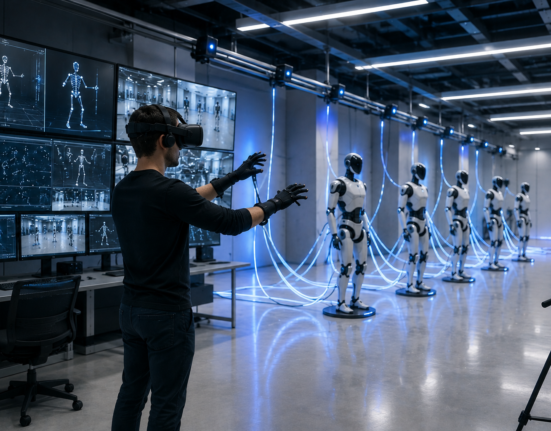
| Approach | How Legs, Torso, and Arms Are Treated | Handles Contact-Rich Tasks? |
|---|---|---|
| Sequential control (older approach) | Balance is stabilized first, then arm motion is planned separately on top of a fixed stance | Poorly, breaks down under unexpected contact forces or load shifts |
| Whole-body control (current standard) | Legs, torso, and arms are optimized together in a single control cycle, sharing the same force and balance constraints | Well, can redistribute force across the whole body when contact changes unexpectedly |
| Learned whole-body policies (emerging) | A single neural network policy outputs coordinated whole-body commands, trained via reinforcement learning or imitation | Increasingly well, especially for contact-rich, hard-to-model tasks |
Why a Humanoid Cannot Treat Balance and Manipulation Separately
Early humanoid control architectures often split the problem into two loosely connected layers: a locomotion controller kept the robot standing or walking, and a separate manipulation controller planned arm motion assuming the base was fixed and stable. That separation works fine for simple, low-force tasks performed from a static stance. It breaks down the moment a task involves real physical contact with the world, because every contact force an arm applies to an object also acts back on the robot’s torso and, through the torso, on its feet and its balance.
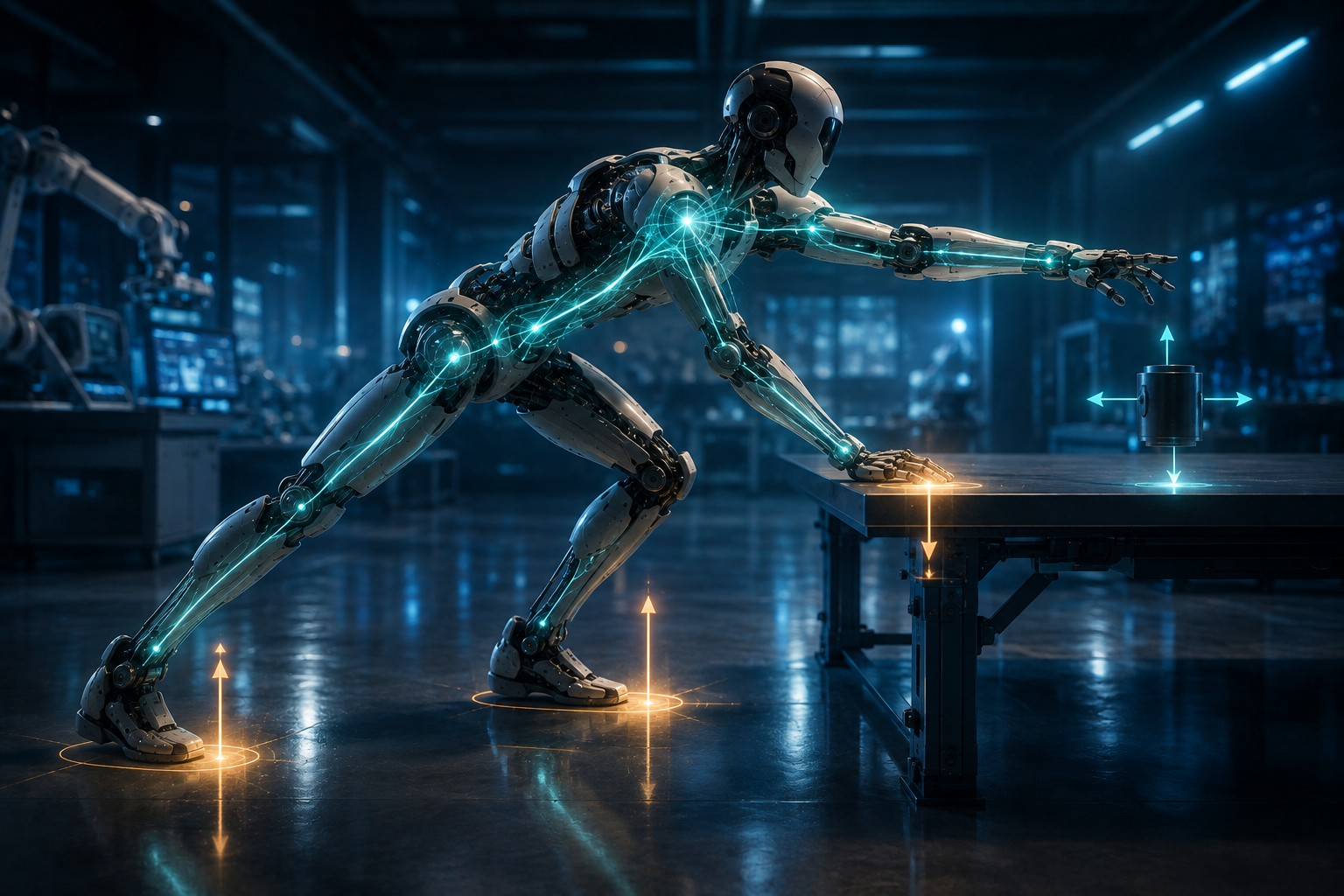
Consider a robot leaning one hand on a table while reaching across it with the other arm. The leaning hand is now bearing part of the robot’s weight, changing the load on its legs and shifting its center of mass. If the arm and leg controllers do not share information about this in real time, the robot either fails to lean convincingly, wastes energy fighting itself, or, in the worst case, loses balance entirely when the contact force changes unexpectedly. Whole-body control exists to solve exactly this problem: it treats the entire kinematic chain, from feet to fingertips, as one coupled system to be optimized together.
The Core Technique: Quadratic Programming for Whole-Body Control
The dominant classical approach to whole-body control formulates the problem as a constrained optimization solved at high frequency, commonly using quadratic programming (QP). At each control cycle, the controller takes in the robot’s current state, desired task objectives such as “keep the hand at this position” or “keep the center of mass over the support polygon,” and physical constraints such as joint limits, torque limits, and contact-friction limits, and solves for the joint commands that best satisfy all objectives simultaneously, prioritized by a task hierarchy.
This is why whole-body control is often described as solving balance and manipulation “in the same breath” rather than in sequence: the QP solver does not first decide a stance and then plan an arm motion on top of it. It decides joint torques for the legs, torso, and arms all at once, subject to the constraint that the whole system must remain dynamically stable and within its physical limits.
| Control Layer | What It Optimizes | Typical Update Rate |
|---|---|---|
| Whole-body QP solver | Joint torques across legs, torso, and arms simultaneously, subject to balance and contact constraints | 500 to 1,000 Hz |
| Task-space trajectory planner | Desired hand, foot, and torso trajectories over a short time horizon | 50 to 200 Hz |
| High-level skill or policy layer | Which task to perform next and its overall goal, often driven by a learned policy or symbolic planner | 1 to 10 Hz |
Contact-Rich Tasks: Where Whole-Body Control Actually Gets Tested
“Contact-rich” describes any task where the robot’s success depends on managing forces at multiple points of physical contact simultaneously, not just tracking a position in free space. Leaning on a table while reaching, catching a dropped tool without letting it slip, bracing against a wall while pushing a heavy cart, or recovering balance after an unexpected shove while carrying a tray of objects are all contact-rich tasks. Each one requires the controller to reason jointly about where the robot is touching the world, how much force is being exchanged at each contact, and how that force is distributed through the rest of the body.
Example: Leaning While Reaching
When a humanoid places one hand on a table to extend its reach with the other arm, whole-body control must solve several things at once: how much of the robot’s weight to transfer onto the supporting hand, how to adjust hip and knee angles to keep the center of mass balanced given that new support point, and how to keep the supporting hand from slipping given the friction available at that contact. None of these can be solved by the arm controller or the leg controller alone; they are coupled through the shared physics of the robot’s single rigid body.
Example: Catching Balance While Carrying a Load
If a humanoid carrying a tray is bumped or steps on an uneven surface, its whole-body controller must redistribute joint torques across both legs and, often, the arms holding the tray, within milliseconds, to avoid a fall while also minimizing spillage or drop of the carried object. This requires the balance-recovery objective and the object-stability objective to be solved together rather than the balance system simply overriding the arms without regard for what they are holding.
One Controller, Many Contacts
A humanoid figure is shown with force-vector arrows at four simultaneous contact points, both feet on the floor and one hand braced on a table edge, with a single shared optimization loop illustrated as a looping arrow connecting all four contact points back to a central torso node, representing how whole-body control solves for all contact forces together rather than one limb at a time.
The Rise of Learned Whole-Body Policies
Alongside classical QP-based whole-body control, 2025 and 2026 have seen rapid growth in learned whole-body control policies, where a neural network is trained, often through reinforcement learning in simulation or imitation learning from human demonstration, to directly output coordinated whole-body commands. Recent research has demonstrated policies that perform contact-rich manipulation of large, unwieldy objects such as water jugs and boxes using only proprioceptive and tactile feedback, without relying on precise object-pose tracking, an approach sometimes called blind whole-body manipulation.
These learned approaches are particularly well suited to tasks that are difficult to model analytically, such as the exact friction behavior between a robot’s palm and an irregular object, because the policy can learn the relevant dynamics implicitly from experience rather than requiring an engineer to write down an explicit physical model. Distributed tactile sensing across large areas of a robot’s body, not just its fingertips, is increasingly used to feed these policies, allowing multi-contact motions where a robot might brace an elbow or forearm against a surface as part of a coordinated whole-body strategy.
Classical Control Versus Learned Policies: Where Each Excels
- Classical QP-based control offers strong guarantees around stability and constraint satisfaction, making it preferable for safety-critical balance recovery where a predictable, verifiable response matters most.
- Learned whole-body policies excel at tasks with complex, hard-to-model contact dynamics, such as manipulating soft or irregularly shaped objects, where handcrafting an explicit physical model would be impractical.
- Hybrid architectures, increasingly common in 2026 research, use a learned policy to propose whole-body motions that are then filtered or corrected by a classical QP layer enforcing hard safety constraints.
Why This Matters Beyond the Lab
Whole-body control is the difference between a humanoid that can only perform pre-scripted motions from a fixed stance and one that can improvise physical solutions to real-world problems, such as bracing against a shelf to reach a high object, or using its torso to help catch a slipping box before it hits the floor. As humanoids move from controlled demonstration environments into warehouses, factories, and homes, contact-rich, whole-body competence becomes the practical bottleneck separating a robot that looks impressive in a video from one that survives a full shift of unpredictable physical interaction.
Common mistake
Assuming that a robot’s balance controller and manipulation controller can be developed and tuned independently and simply combined later. Because every contact force an arm applies acts back on the whole body’s balance, treating locomotion and manipulation as separate problems produces controllers that fight each other or fail outright the moment real contact forces appear.
What worked
Research and engineering teams that adopted a shared whole-body optimization formulation from the start, rather than bolting a manipulation layer onto an existing balance controller, saw far more robust performance on contact-rich tasks like leaning, bracing, and load-carrying, because the same solver handled trade-offs between balance and task objectives consistently rather than resolving conflicts through ad hoc overrides.
Frequently Overlooked Aspects of Whole-Body Control
- Contact schedulingDeciding when and where a robot should make or break contact with its environment, such as when to place a supporting hand, is itself a planning problem that whole-body controllers must solve alongside force distribution.
- Friction uncertaintyReal surfaces rarely have precisely known friction coefficients, so robust whole-body controllers must plan for a margin of error rather than assuming a single exact friction value.
- Torque saturationEvery actuator has a maximum torque it can deliver, and whole-body controllers must prioritize which objectives to sacrifice first when a task demands more torque than the hardware can provide simultaneously across all joints.
- Sensing latencyTactile and force feedback used in whole-body control loops introduces small delays that can meaningfully affect stability during fast, high-force contact events if not explicitly compensated for.
- Whole-body versus task-space trade-offsPrioritizing balance too heavily can make a robot overly conservative and unable to complete a manipulation task, while prioritizing the manipulation task too heavily risks instability, so tuning this trade-off is a central design decision.
Glossary
- Whole-body control
- A control approach that coordinates a robot’s legs, torso, and arms as one unified system, optimizing balance and manipulation objectives simultaneously rather than sequentially.
- Quadratic programming (QP)
- A mathematical optimization method used by classical whole-body controllers to solve for joint torques that best satisfy multiple weighted objectives subject to physical constraints, at high update rates.
- Contact-rich task
- Any task whose successful completion depends on managing forces at multiple points of physical contact with the environment simultaneously, rather than simply tracking a position in free space.
- Support polygon
- The region on the ground, and any other contact surfaces, within which a robot’s center of mass must remain projected in order to stay balanced.
- Blind whole-body manipulation
- A manipulation approach relying solely on proprioceptive and tactile feedback, without tracking the precise pose of the object being manipulated, often achieved through learned control policies.
Key Takeaways
- Whole-body control treats a humanoid’s legs, torso, and arms as one coupled system rather than solving balance and manipulation separately.
- Classical whole-body controllers commonly use quadratic programming to solve for joint torques across the entire body at update rates of 500 to 1,000 Hz.
- Contact-rich tasks, such as leaning on a table while reaching or catching balance while carrying a load, are the practical proving ground for whole-body control.
- Learned whole-body policies, trained via reinforcement or imitation learning, are increasingly used for tasks with hard-to-model contact dynamics.
- Hybrid architectures that combine learned policies with classical safety-constrained control layers are an emerging best practice as of 2026.
- Treating balance and manipulation as independent problems is a common design mistake that fails as soon as real contact forces are introduced.
- Contact scheduling, friction uncertainty, and torque saturation are frequently overlooked engineering details that determine real-world robustness.
FAQs
What is whole-body control in humanoid robotics?
Whole-body control is a control approach that coordinates a humanoid’s legs, torso, and arms simultaneously as one unified system, rather than treating balance and manipulation as separate problems, allowing the robot to manage contact-rich tasks that require force coordination across its entire body.
Why can’t balance and manipulation be controlled separately?
Because every contact force an arm applies to the world also acts back on the robot’s torso and legs through shared physics, changing its center of mass and balance requirements. Solving these independently causes controllers to fight each other or fail outright during real contact events.
What is quadratic programming used for in this context?
Quadratic programming is the classical optimization method used to solve, at high update rates of roughly 500 to 1,000 Hz, for the joint torques across a humanoid’s whole body that best satisfy balance, task, and physical constraints simultaneously, rather than sequentially.
What counts as a contact-rich task?
A contact-rich task is any activity where success depends on managing forces at multiple simultaneous points of contact with the environment, such as leaning on a table while reaching, bracing against a wall, or catching balance while carrying an object, rather than simply moving to a target position.
How do learned whole-body policies differ from classical control?
Learned whole-body policies use neural networks trained through reinforcement or imitation learning to directly output coordinated whole-body commands, which can capture complex, hard-to-model contact dynamics that would be impractical to hand-engineer in a classical quadratic-programming controller.
What is blind whole-body manipulation?
Blind whole-body manipulation refers to controlling a robot’s contact-rich manipulation using only proprioceptive and tactile feedback, without tracking the precise position and orientation of the object being handled, an approach increasingly demonstrated by learned control policies.
Why do hybrid control architectures matter?
Hybrid architectures combine a learned policy’s ability to handle complex contact dynamics with a classical quadratic-programming layer’s strong safety and stability guarantees, letting engineers get the benefits of learned flexibility without giving up verifiable constraint satisfaction during balance-critical moments.
What is the support polygon and why does it matter for whole-body control?
The support polygon is the region on the ground and any other contact surfaces within which a robot’s center of mass must stay projected to remain balanced; whole-body controllers must continuously track and respect this region while also satisfying manipulation task objectives.
References
- Science Robotics, “Learning contact-rich whole-body manipulation with example-guided reinforcement learning”
- Advanced Intelligent Systems (Wiley), “Real-Time Control of a Humanoid Robot for Whole-Body Tactile Interaction”
- arXiv, “Whole-body Multi-contact Motion Control for Humanoid Robots Based on Distributed Tactile Sensors”
- arXiv, “WT-UMI: Tactile-based Whole-Body Manipulation via Force-Supervised Contact-Aware Planning”
- PatSnap, “Whole-body control for humanoid robot locomotion”
- arXiv, “Load-Aware Locomotion Control for Humanoid Robots in Industrial Transportation Tasks”
For a look at how reinforcement learning trains locomotion and control policies more broadly, see our companion coverage of reinforcement learning applications in robotics. On the hardware side that whole-body controllers must work within, see our analysis of battery and actuator limits in bipedal robots. For the manipulation side of contact-rich tasks specifically, see our deep dive on dexterous manipulation. On how these control policies get trained safely before deployment, see our piece on sim-to-real transfer, and on the models that translate perception and language into whole-body action, see vision-language-action models. For broader foundation-model approaches to robot control, see robot foundation models explained, and for the economics of deploying capable general-purpose machines like these, see our piece on general-purpose robots versus purpose-built machines.