| Myth | Reality |
|---|---|
| Battery runtime is mainly a software efficiency problem | Runtime is capped primarily by cell energy density (roughly 150-250 Wh/kg for standard lithium-ion) and thermal dissipation limits, not algorithm quality |
| Solid-state batteries will simply double runtime within a couple of years | Solid-state cells promising 400-520 Wh/kg exist in labs, but industrial-scale production for robots is not expected before 2027-2030, and mass-volume supply chains are further out still |
| A bigger battery pack is a straightforward fix | Bigger packs add weight, which increases the torque and power every joint actuator must produce just to move the extra mass, a feedback loop researchers call the “weight paradox” |
| Actuators can just be made stronger indefinitely | Higher continuous torque increases heat generation, and heat dissipation in a human-sized frame is a harder problem than raising peak torque output |
An Opinion, Stated Plainly
The industry consensus, repeated in most coverage of humanoid robots including our own broader overview of the 2035 humanoid workforce, is that today’s roughly 4-hour runtime will stretch to a comfortable 8-12 hour shift by the early 2030s. Having worked through the underlying battery chemistry, thermal engineering, and actuator physics involved, I do not think that projection holds up as stated. It is achievable only if the industry quietly redefines what “runtime” means, leaning on hot-swappable packs, fast charging, and reduced-intensity task profiles rather than a genuine doubling or tripling of continuous high-output battery life from chemistry improvements alone. This piece lays out the physics behind that skepticism.
The Energy Density Ceiling, in Real Numbers
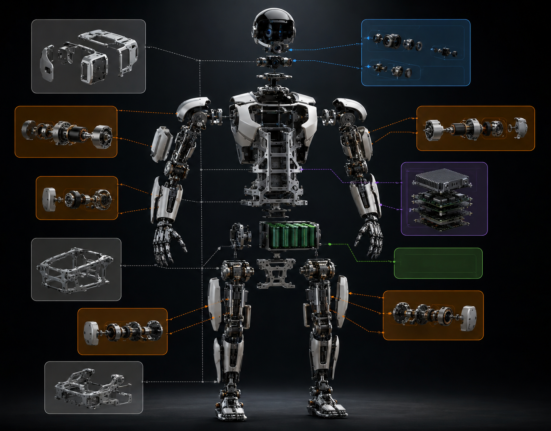
Current humanoid robots overwhelmingly use high-nickel lithium-ion chemistries, specifically NMC or NCA cells, chosen over cheaper lithium iron phosphate (LFP) precisely because they deliver the high energy density and high discharge rates that dozens of simultaneous joint motors require. Reported cell-level energy density for these packs runs roughly 150-250 Wh/kg, with some premium cells reaching 250-300 Wh/kg under favorable conditions. Battery capacities in most deployed humanoids sit under 2 kWh, constrained by the available volume and weight budget inside a human-sized frame.
That density ceiling is not a temporary engineering oversight; it is close to the practical limit of conventional lithium-ion chemistry after three decades of incremental improvement. The chemistry everyone is banking on to change this equation is solid-state batteries, which lab prototypes suggest can reach 400-520 Wh/kg. But industry forecasting from SNE Research projects the entire global humanoid robot battery market at only about 1.37 GWh by 2030, with solid-state cells contributing a mere 0.04 GWh of that in 2030, growing to a much larger 76.1 GWh only by 2040. Read plainly, that means solid-state batteries are expected to remain a rounding error in actual humanoid robot production through the end of this decade, not the mainstream power source the 2030s runtime projections implicitly assume.
| Battery Metric | Current Lithium-Ion (2026) | Solid-State (Lab/Early Projection) |
|---|---|---|
| Energy density | 150-250 Wh/kg (up to ~300 Wh/kg premium cells) | 400-520 Wh/kg |
| Continuous discharge rate | 3C-5C | Generally improved, exact figures still maturing |
| Peak discharge rate | Exceeding 10C, up to 20C for actuator surges | Under active development |
| Expected industrial-scale robot production | Already mainstream | Earliest plausible window 2027-2030; meaningful volume later |
| 2030 projected market share (by GWh) | Dominant | Approximately 0.04 GWh of a 1.37 GWh total market |
Why Runtime Cannot Simply Scale With a Bigger Pack
The intuitive fix, just add more battery, runs into a feedback loop that the industry press has started calling the “weight paradox”: a larger battery pack adds mass to the robot’s torso, and every one of that robot’s leg and hip actuators must now produce more torque to walk, balance, and lift the same payload, which in turn draws more current and generates more heat, which in turn requires either a bigger cooling system (more mass) or accepting reduced peak performance. Bigger batteries do not scale runtime linearly; a meaningful share of any added energy capacity is consumed simply moving the added battery weight itself.
This is fundamentally different from, say, an electric car, which can absorb a larger battery pack across a much bigger chassis and four wheels bearing the load. A bipedal robot must carry, balance, and dynamically counteract every added kilogram through two legs performing constant, active balance corrections, a mechanically unforgiving environment for simply “adding more battery.”
The Actuator Side: Torque Density Meets Thermal Reality
Joint actuators face a parallel physics problem. Modern humanoid actuators rely on high-reduction-ratio gearing, most commonly strain wave (harmonic) gears offering reduction ratios up to 100:1 in a compact package, paired with motors capable of instantaneous current rates of 5C-15C and peaks reaching 20C to deliver the torque spikes needed for dynamic movements like recovering from a stumble or lifting a load.
The bottleneck is not how much peak torque a motor can theoretically produce, it is how much continuous, sustained torque it can produce without overheating. Thermal management is widely described as the primary bottleneck for continuous torque density in humanoid actuators: better heat dissipation lets engineers push higher peak currents through a smaller motor for short bursts, but a human-sized frame concentrates heat from actuators, onboard compute, and the battery pack into a small enclosed volume, raising the real risk of thermal derating, where the robot must automatically reduce its own output to avoid damaging its motors, or in worst cases thermal runaway.
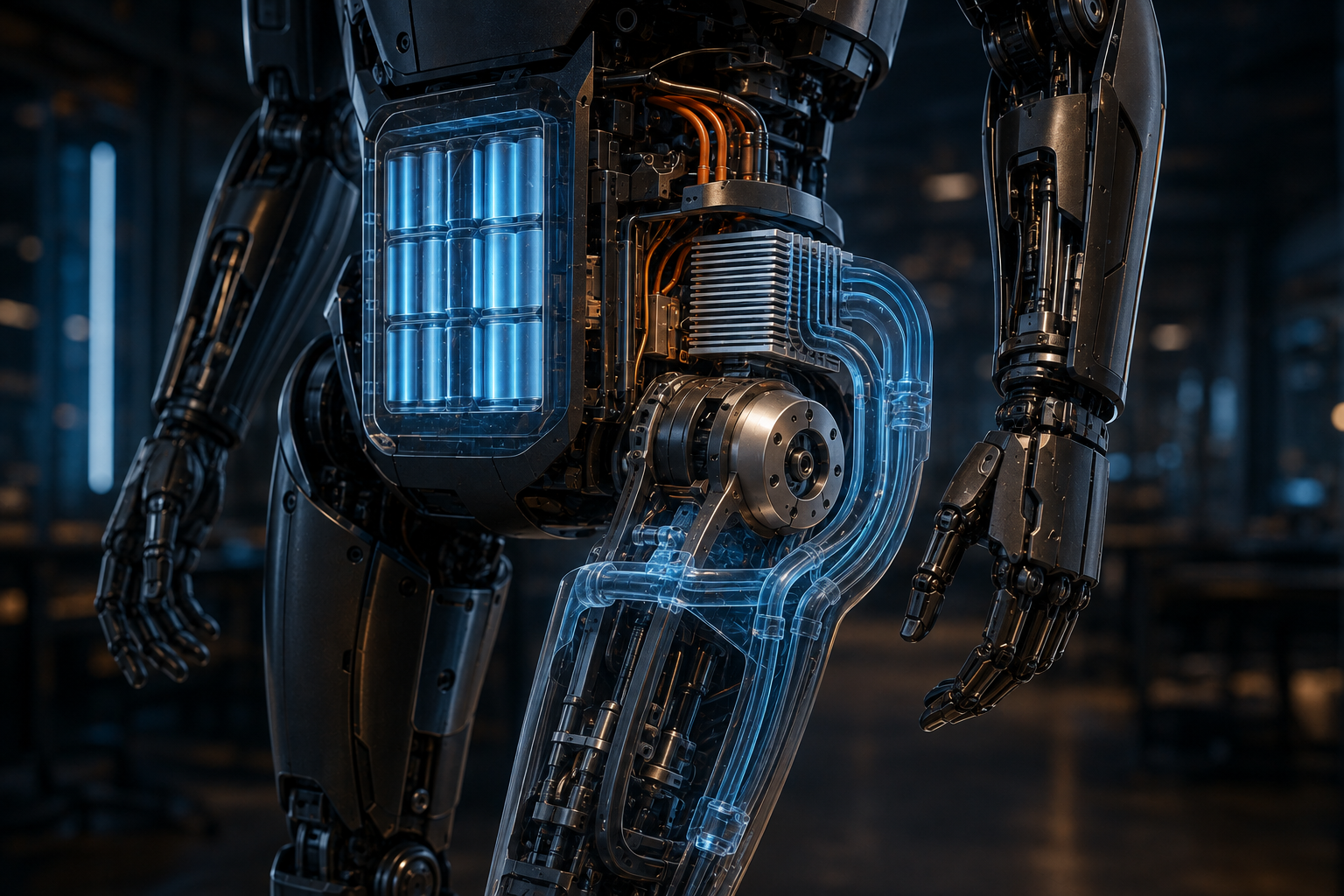
Figure: The Heat-Torque Tradeoff Inside a Humanoid Hip Joint
A cutaway diagram would show a strain wave gear actuator packed into a hip joint roughly the size of a human fist, with a heat map overlay showing temperature climbing from blue (cool) at idle to red (hot) during a sustained lifting motion. The diagram illustrates that the actuator’s continuous-duty torque rating is set by how fast that red zone can be cooled back down, not by the motor’s theoretical peak torque number quoted in a spec sheet.
Duty Cycles: Why “8-Hour Shift” Undersells the Problem
A human warehouse worker’s 8-hour shift is not 8 hours of maximum physical exertion; it includes walking at moderate pace, brief lifts, and long stretches of lower-intensity activity. Humanoid robot runtime figures, including the widely cited roughly 4-hour figure for machines like Boston Dynamics’ electric Atlas, are typically measured under a specific duty cycle assumption that may not match a real facility’s actual task intensity. A robot performing continuous high-torque lifting will drain its pack and heat its actuators far faster than one performing light tote-carrying, the kind of task most current warehouse pilots (as covered in our deployment data comparison) are deliberately scoped around, not by coincidence.
Common mistake
Treating a single published runtime figure, such as “4 hours,” as a fixed constant that will simply extend to “8-12 hours” with a better battery. Runtime is a function of task intensity, ambient temperature, and payload, not a fixed property of the robot; a battery that doubles energy density will not double runtime under heavier workloads, because thermal derating and current draw scale with the task, not just the pack.
What worked
Agility Robotics’ operational approach of running a 2:1 fleet ratio (two robots working while one charges) rather than promising unrealistic single-unit runtime is a pragmatic, physics-respecting way to deliver continuous station coverage today. It treats the battery ceiling as an operations problem to engineer around rather than a marketing number to inflate.
What Would Actually Need to Be True for 8-12 Hours by the Early 2030s
For the optimistic industry runtime projection to hold as a genuine continuous-duty figure, rather than an average across light and heavy tasks, several things would need to happen roughly simultaneously: solid-state or comparable next-generation cells would need to reach mass industrial-scale production years ahead of the 2027-2030 window most battery analysts currently forecast; actuator thermal management would need a parallel breakthrough, since a bigger battery alone does nothing for an overheating hip motor; and total robot mass would need to stay flat or fall even as battery capacity grows, reversing the weight paradox rather than feeding it.
None of these are impossible. But stacking three separate hard engineering problems, one of which (mass-scale solid-state production) has its own multi-year industrial ramp-up curve, into a single decade is a much heavier lift than the one-line “batteries will get better” framing usually applied to this projection.
| What the Optimistic 2030s Projection Requires | Current Trajectory |
|---|---|
| Mass-scale solid-state battery production | Earliest industrial ramp cited as 2027-2030; meaningful GWh volume not until the 2030s-2040s |
| Actuator thermal management breakthrough | Incremental gains from better heat sinks and materials; no publicly documented step-change yet |
| Flat or falling total robot mass despite bigger batteries | Currently moving in the opposite direction as more sensors, compute, and dexterous hands are added |
| Runtime figure that reflects real, mixed-intensity duty cycles | Most published runtime figures are best-case, not worst-case, task assumptions |
The More Likely Path: Operational Workarounds, Not Chemistry Miracles
My honest read is that the industry will hit something that looks like “8-12 hour coverage” by the early 2030s, but largely through hot-swappable battery packs, fast-charge docking, and fleet ratios rather than any single battery pack lasting 8-12 hours of continuous high-intensity work on one charge. That is a legitimate engineering solution, and it is already how GXO and Agility deliver continuous station coverage today. But it is a meaningfully different claim than “the robot’s battery will last three times longer,” and conflating the two, as some industry messaging does, oversells the pace of pure battery chemistry progress relative to what operational engineering is actually delivering.
- Energy density versus power densityA cell can be optimized for how much energy it stores (density) or how fast it can release it (power); humanoid robots need both simultaneously, which is a harder chemistry problem than either alone.
- C-rateThe discharge rate relative to a battery’s capacity; humanoid actuators demand peak rates up to 20C during dynamic movements, far higher than typical consumer electronics.
- Thermal deratingThe automatic reduction of a motor’s output to prevent overheating, an invisible performance ceiling rarely mentioned in published runtime or torque specifications.
- The weight paradoxAdding battery capacity adds mass, which increases the actuator torque and current needed to move that mass, partially offsetting the runtime gain the bigger battery was meant to deliver.
- Duty cycle assumptionsPublished runtime numbers describe a specific task-intensity profile, not a universal constant; real deployments doing heavier lifting than a published test will see meaningfully shorter runtime, a factor worth weighing against total cost of ownership when planning a fleet.
Where This Leaves the 2035 Projections
I am not arguing bipedal robots will remain stuck at 4 hours forever. Battery chemistry, thermal materials, and actuator design are all improving. But the specific, oft-repeated claim of an 8-12 hour full-shift runtime by the early-to-mid 2030s deserves more scrutiny than it typically gets, because it requires stacking multiple independent hard-engineering breakthroughs on a compressed timeline. The more defensible, if less exciting, forecast is that effective coverage will improve mainly through fleet and charging operations engineering, with genuine single-charge battery runtime improving more modestly, perhaps to somewhere in the 5-7 hour range for realistic mixed-duty work by 2030, not the full 8-12 hour figure quoted as an achieved fact.
- Energy density
- The amount of energy a battery stores relative to its weight, typically measured in watt-hours per kilogram (Wh/kg); the primary ceiling on how much runtime a given battery pack weight can deliver.
- C-rate
- A measure of how fast a battery can be charged or discharged relative to its total capacity; humanoid actuators require high C-rates to deliver sudden bursts of torque.
- Strain wave gear (harmonic drive)
- A high-reduction-ratio gear mechanism, offering ratios up to 100:1 in a compact form factor, widely used in humanoid robot joints to multiply motor torque.
- Thermal runaway
- An uncontrolled rise in temperature within a battery or motor that can lead to component failure or, in extreme cases, fire, and is a key safety limit on how hard a system can be pushed.
- Weight paradox
- The engineering feedback loop in which adding battery mass to extend runtime increases the torque and power the robot’s actuators must produce simply to move that added mass.
Key Takeaways
- Current humanoid battery packs run roughly 150-250 Wh/kg energy density using high-nickel lithium-ion cells, a figure close to the practical limit of mature lithium-ion chemistry.
- Solid-state batteries promising 400-520 Wh/kg exist in labs, but industrial-scale production for robots is not forecast before 2027-2030, with meaningful market volume even later.
- SNE Research projects the total humanoid battery market at only 1.37 GWh by 2030, with solid-state cells contributing a mere 0.04 GWh of that, undercutting assumptions that solid-state will soon dominate.
- Adding battery mass triggers a “weight paradox,” since heavier packs demand more actuator torque just to move the added weight, partially offsetting runtime gains.
- Thermal management, not peak torque capability, is the primary limit on sustained actuator output in a human-sized frame.
- Published runtime figures like “4 hours” reflect a specific task-intensity assumption, not a fixed constant that scales linearly with better batteries.
- The more realistic path to 8-12 hour effective coverage runs through hot-swap packs, fast charging, and fleet ratios, not a pure tripling of single-charge battery life by chemistry alone.
FAQs
Why can’t humanoid robots just use bigger batteries for longer runtime?
A bigger battery adds weight, and that added weight increases the torque every leg and hip actuator must produce to walk and balance, a feedback loop known as the weight paradox. A meaningful share of the extra energy capacity is consumed simply moving the added battery mass, so runtime does not scale linearly with pack size.
What is the current energy density of humanoid robot batteries?
Most humanoid robots use high-nickel lithium-ion cells (NMC or NCA chemistry) with energy density roughly in the 150-250 Wh/kg range, with some premium cells reaching up to about 300 Wh/kg, a figure close to the practical ceiling of mature lithium-ion technology.
When will solid-state batteries fix humanoid robot runtime?
Not soon at meaningful scale. Industry forecasts from SNE Research project the entire humanoid battery market at only 1.37 GWh by 2030, with solid-state cells contributing just 0.04 GWh of that, with significant volume not expected until well into the 2030s or 2040s.
What actually limits how much torque a humanoid actuator can produce?
Continuous sustained torque is limited by thermal management, not peak motor capability. A human-sized frame concentrates heat from actuators, compute, and battery into a small volume, and motors must automatically reduce output (thermal derating) once they approach unsafe operating temperatures.
Is the widely cited 4-hour runtime figure a fixed number?
No. Published runtime figures reflect a specific assumed task intensity. A robot performing continuous heavy lifting will drain its battery and heat its actuators faster than one performing light tote-carrying, so real-world runtime varies significantly by workload.
Will humanoid robots realistically reach 8-12 hour runtime by the early 2030s?
Achieving that as a genuine single-charge, continuous high-intensity runtime figure looks unlikely given current battery and thermal engineering trajectories. It is more plausible as an operational outcome achieved through hot-swappable packs, fast charging, and fleet rotation rather than pure battery chemistry improvement.
What gearing do most humanoid robot joints use?
Strain wave gears, also called harmonic drives, are the standard choice for humanoid upper-body joints because they offer reduction ratios up to 100:1 in a compact, lightweight package, though other actuator types such as planetary roller screws are used in some leg and hip designs.
Why does thermal management matter more than peak torque specs?
A motor’s peak torque number describes a brief burst it can handle before overheating; what actually determines usable performance in continuous operation is how quickly generated heat can be dissipated, since exceeding safe temperatures forces automatic output reduction or risks damaging the actuator.
References
- Renesas: “White Paper: High-Performance Battery Systems for Next-Generation Humanoid Robots”
- GlobalSpec: “Humanoid robots are tripping over their high energy demands”
- CnEVPost: “Demand for solid-state batteries in humanoid robots could reach 74 GWh by 2035, TrendForce says”
- TrendForce: “Humanoid Robots Move Toward Commercialization; Solid-State Batteries Set to Break Through Power Bottlenecks”
- Seoul Economic Daily: “Bigger Batteries Drain Faster: Humanoids Trapped in ‘Weight Paradox'”
- Zhinno Robotics: “Humanoid Robot Actuator Torque Density: Hip, Knee and Shoulder Specs”
- LG Energy Solution Battery Inside: “Humanoid Robots Are Changing Everyday Life: Why Do Batteries Matter?”
This is an opinion piece; for the deployment-data comparison behind some of the operational examples cited here, see humanoid robots in warehouses, for the underlying AI control layer see robot foundation models explained, and for how these constraints affect pricing see the humanoid robot cost curve. Related engineering context is also covered in our pieces on whole-body control and bio-hybrid actuators.