| Capability | Traditional Maintenance Robot | Self-Repairing Robot |
|---|---|---|
| Damage detection | Relies on scheduled human inspection or catastrophic failure alerts | Continuous onboard sensing flags micro-cracks and connectivity loss as they occur |
| Response to minor damage | Robot is taken offline until a technician arrives | Robot compensates automatically or triggers a localized self-healing reaction |
| Material behavior after damage | Cracks and breaks are permanent until physically replaced | Dynamic polymers and conductive composites reform bonds and restore properties |
| Downtime per minor fault | Hours to days, dependent on technician scheduling | Minutes to hours, often without stopping the work cycle entirely |
What “Self-Repairing” Actually Covers
The phrase “self-repairing robot” gets used loosely, so it helps to separate it into two distinct engineering problems that happen to reinforce each other. The first is materials science: building the robot’s body, wiring, and joints out of substances that can physically mend themselves after damage, without an external adhesive or replacement part. The second is control engineering: giving the robot the sensing and decision-making needed to notice that something is wrong with its own body and either fix it or work around it. A robot with self-healing skin but no diagnostic awareness will silently degrade until it fails outright. A robot with excellent self-diagnosis but a rigid, non-healing body can only compensate for damage, never actually repair it. The most capable systems combine both.
Recent review literature frames this convergence explicitly, describing autonomous self-healing in soft robotics as the union of materials capable of restoring their own structure and embedded sensing and control systems capable of directing that restoration without human intervention. Researchers writing in Nature have gone as far as to describe self-healing machines as requiring their own foundational engineering discipline, separate from either standard materials science or standard robotics control, because the two must be co-designed from the start rather than bolted together after the fact.
Self-Healing Materials: The Physical Layer
Self-healing materials are broadly defined as substances engineered to autonomously repair damage, extending component service life while improving safety and cutting maintenance or replacement costs. Researchers have demonstrated self-healing behavior across a wide range of material families, including polymers, certain metals, ceramic and cementitious composites, and protective coatings, with applications spanning aerospace, automotive, civil infrastructure, energy storage, and microelectronics. For robotics specifically, two material categories matter most.
Dynamic and reversible polymer networks
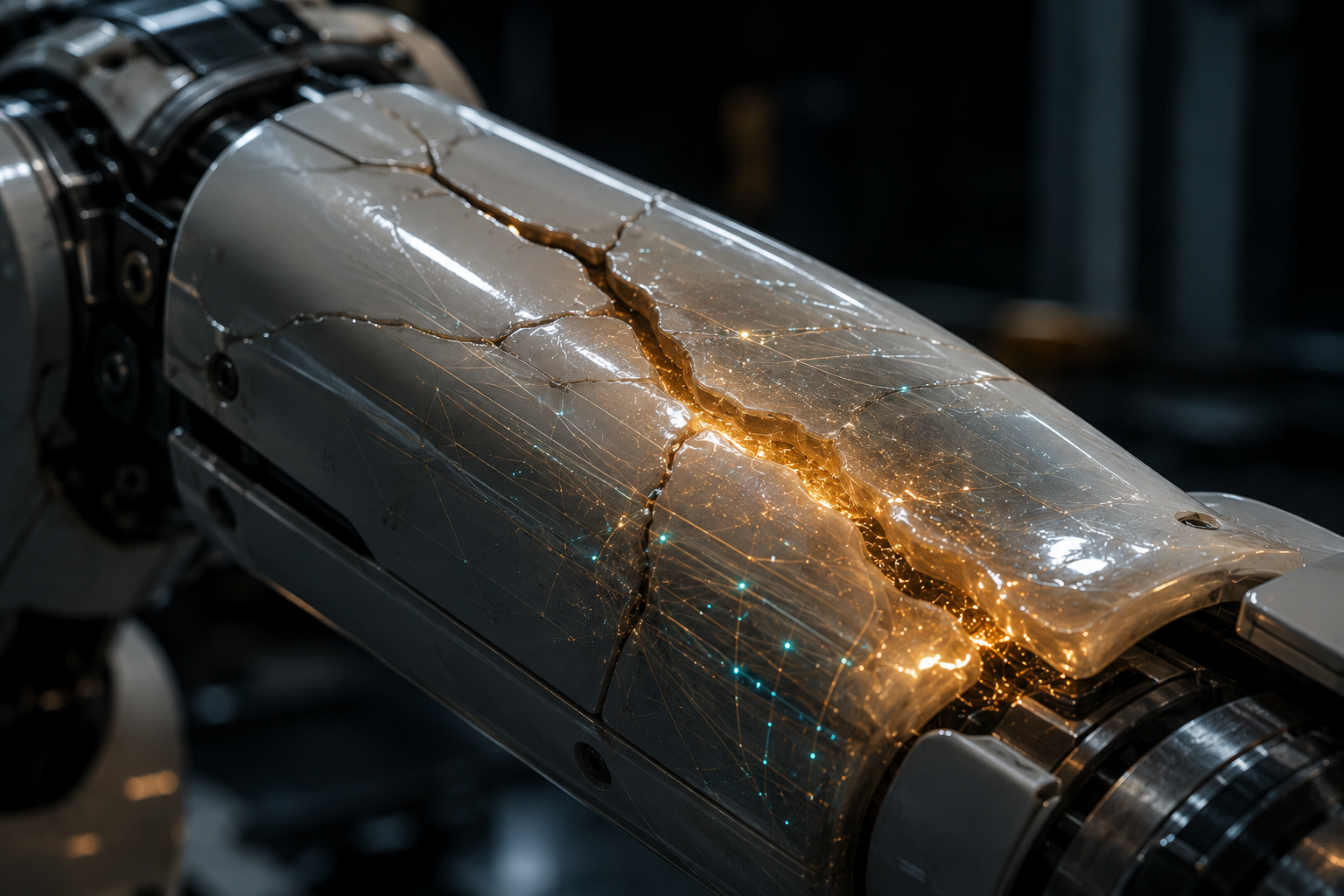
Most self-healing robot skins and structural components rely on polymers built with reversible chemical bonds, such as dynamic covalent bonds or hydrogen-bonded networks, that can break and reform under heat, pressure, or simple proximity after a cut or puncture. When a soft robot sustains damage, sensors detect the location and severity of the damage, actuators or the material itself realign the damaged area so the torn surfaces make contact again, and the self-healing polymer network re-bonds across that interface, gradually restoring both mechanical strength and, in some formulations, electrical conductivity.
Self-healing conductive composites
Restoring shape is only half the problem for a robot, because most damage also severs electrical pathways such as sensor wiring or actuator leads. Newer composite materials, sometimes marketed under names like HealTech in adjacent industries such as aerospace propellant tanks, combine autonomous damage sensing with high resistance to micro-cracking, and researchers are adapting similar conductive self-healing composites so that a robot’s embedded circuitry can reform electrical continuity alongside structural repair, rather than needing a separate wiring harness replacement.
| Material Family | What It Restores | Typical Trigger |
|---|---|---|
| Dynamic covalent polymers | Mechanical strength, surface integrity | Heat, pressure, or proximity after cut |
| Hydrogen-bonded elastomers | Flexibility, tensile strength | Ambient temperature contact |
| Self-healing conductive composites | Electrical continuity in sensors and wiring | Reconnection after micro-crack or puncture |
| Self-healing coatings | Corrosion and wear resistance on outer shell | Environmental exposure after surface abrasion |
The Control Layer: Detecting and Responding to Degradation
Materials alone cannot decide when repair is needed or confirm that it worked. That is the job of the control system, which must continuously monitor the robot’s own physical state, distinguish genuine damage from normal sensor noise, and choose an appropriate response. There are three broad response strategies in use today.
Autonomous compensation
When a joint, sensor, or actuator degrades but is not fully disabled, many control systems are designed to compensate rather than repair immediately. A humanoid robot that detects reduced torque output in one ankle actuator, for instance, can shift its whole-body control strategy to lean more heavily on the opposite leg and adjust its gait in real time, buying time until a scheduled maintenance window rather than stopping the task outright. This kind of graceful degradation depends heavily on the same whole-body control techniques used for balance and locomotion more broadly.
Triggered self-healing cycles
For materials-based repair, the control system’s job is to recognize damage, reposition or apply the correct stimulus such as heat or pressure, and confirm restoration before resuming full operation. This is the closest analog to an immune response: detect, localize, respond, verify.
Escalation to human maintenance
Not every failure is self-correctable. Robust self-repairing systems are explicitly designed to recognize the limits of their own compensation and healing capacity, and to flag a unit for human maintenance rather than silently degrading past a safe operating threshold. Systems that skip this escalation step are the ones most likely to fail unpredictably in the field.
The Detect-Localize-Respond-Verify Loop
A robot’s onboard sensors detect an anomaly such as a torque drop or a break in a conductive trace. The control system localizes the affected component, applies the appropriate response, either mechanical compensation or a self-healing stimulus, and then re-runs a diagnostic check to verify recovery before resuming normal operation. If verification fails twice, the unit is automatically flagged for human maintenance instead of continuing to compensate indefinitely.
Autonomous Maintenance Systems in Practice
At the industrial deployment level, autonomous maintenance is described as the fusion of AI-driven analytics with real-time sensor data, robotics, and self-repairing materials, working together to catch developing issues early and correct them before they cascade into full failures. This fusion typically follows a predictable structure regardless of the specific robot platform.
| Stage | Function |
|---|---|
| Continuous condition monitoring | Embedded sensors track strain, temperature, conductivity, and vibration across critical components |
| Anomaly detection | AI models compare live readings against expected baselines to catch early-stage degradation |
| Response selection | Control system chooses between compensation, self-healing activation, or maintenance escalation |
| Verification and logging | Repair outcome is confirmed and logged for fleet-wide reliability tracking |
This kind of logging matters beyond the individual robot. Data about which components degrade fastest and which self-healing responses succeed or fail feeds back into design improvements for future hardware revisions, and in fleets that also share learning data across units, informs how proactively other robots should be monitored for the same wear pattern.
Current Limitations
Despite genuine progress through 2025 and into 2026, fully autonomous self-healing remains an active research challenge rather than a solved problem. Review literature is candid about this: achieving fully autonomous self-healing systems still presents difficulties in integrating every phase of the healing process, from initial damage sensing through localized response to full mechanical and electrical restoration, especially under the repeated damage cycles a working robot experiences over years of service rather than a single lab demonstration. Healing speed is also a real constraint; many dynamic polymer systems require minutes to hours and sometimes elevated temperature to fully re-bond, which is far slower than a human technician’s rapid patch or part swap, meaning self-healing today is best suited to minor, recurring wear rather than catastrophic structural damage.
- Dynamic covalent bondA chemical bond that can break and reform under specific conditions, giving certain polymers the ability to reseal after damage.
- Graceful degradationA control strategy where a robot adjusts its behavior to keep functioning safely despite a partial hardware fault, rather than stopping outright.
- Healing stimulusThe trigger, such as heat, pressure, or light, required to activate a self-healing material’s repair reaction.
- Verification loopThe diagnostic check performed after a repair or compensation response to confirm the fault was actually resolved before resuming full operation.
- Escalation thresholdThe point at which a robot’s control system determines a fault exceeds its own repair or compensation capacity and flags a human technician.
- Condition monitoringContinuous background sensing of strain, temperature, and conductivity used to catch degradation before it becomes a functional failure.
Common Mistakes in Self-Repair System Design
Common mistake
A frequent design error is treating self-healing materials as a drop-in replacement for diagnostics, assuming that if the material can physically reseal, the robot does not need to actively monitor for damage. In practice, without active sensing, a robot has no way to know a healing cycle is needed, no way to confirm it worked, and no way to detect that a component is nearing the limit of how many times it can heal before losing structural integrity. Material capability without a monitoring and verification loop produces robots that appear fine until they abruptly are not.
What worked
Designs that paired even modest self-healing materials with conservative, frequent condition monitoring outperformed designs using more advanced materials but sparser sensing. Catching degradation early, while it is still within the material’s healing capacity, produced far more reliable long-term uptime than waiting for a dramatic failure and hoping a stronger material could recover from it.
Where Self-Repair Fits Alongside Other Robot Durability Approaches
Self-repairing materials and control are one piece of a larger durability puzzle that also includes hardware choices such as battery chemistry and actuator design; readers interested in the physical limits robots face before self-repair even becomes relevant should see our coverage of battery and actuator limits in bipedal robots. Self-repair also intersects with whole-body control, since compensating for a degraded joint requires the same balance and coordination systems described in our piece on whole-body control. On the cost side, reducing technician callouts and unplanned downtime is one of the clearer paths toward the economics discussed in our humanoid robot cost curve analysis, and safety regulators are beginning to ask how self-healing claims should be verified, a topic touched on in our overview of humanoid safety standards. Deployments that rely on dense robot populations working long shifts, such as those covered in our piece on humanoid robots in warehouses, are also where the uptime gains from self-repair matter most in practice.
Key Takeaways
Key Takeaways
- Self-repairing robots combine two distinct engineering layers: self-healing materials that physically mend damage, and control systems that detect and manage that damage.
- Dynamic covalent and hydrogen-bonded polymers can reseal cuts and cracks, while self-healing conductive composites restore severed electrical pathways in sensors and wiring.
- Control systems respond to detected damage in one of three ways: autonomous compensation, a triggered self-healing cycle, or escalation to human maintenance.
- A detect-localize-respond-verify loop is central to reliable self-repair; skipping verification risks a robot resuming operation on a fault that was never actually fixed.
- Industrial autonomous maintenance systems fuse AI-driven anomaly detection with self-healing materials and continuous condition monitoring to catch problems before they cascade.
- Current self-healing materials are best suited to minor, recurring wear rather than catastrophic damage, since many healing reactions take minutes to hours and sometimes need heat to complete.
- Pairing even modest self-healing materials with frequent condition monitoring has proven more reliable in practice than relying on stronger materials with sparse sensing.
Glossary
- Self-healing material
- A material engineered to autonomously repair physical damage such as cracks or cuts, restoring mechanical or electrical properties without external intervention.
- Dynamic covalent bond
- A reversible chemical bond capable of breaking and reforming under specific conditions, enabling certain polymers to reseal after damage.
- Graceful degradation
- A control strategy that allows a system to continue operating safely at reduced capacity after a partial component failure, rather than shutting down entirely.
- Condition monitoring
- Continuous sensing of physical parameters such as strain, temperature, and conductivity used to detect early-stage component degradation.
- Escalation threshold
- The predefined point at which a robot’s control system determines a fault is beyond its self-repair or compensation capacity and requests human maintenance.
FAQs
What is a self-repairing robot?
A self-repairing robot is a system built with self-healing materials, such as dynamic polymers or conductive composites, combined with control systems capable of detecting damage and either triggering a repair response or compensating for the fault autonomously, without requiring immediate human intervention.
How do self-healing materials work in robotics?
Most self-healing robot materials use reversible chemical bonds, such as dynamic covalent or hydrogen bonds, that break under damage and can reform when the damaged surfaces are brought back into contact, often with heat or pressure as a trigger, restoring mechanical strength and sometimes electrical conductivity.
Can self-repairing robots fix any type of damage?
No. Current self-healing materials are best suited to minor, recurring wear such as small cracks or punctures. Catastrophic structural damage typically still requires human maintenance, since healing reactions can take minutes to hours and may not fully restore severe structural loss.
What is graceful degradation and how does it relate to self-repair?
Graceful degradation is a control strategy where a robot adjusts its behavior, such as shifting weight to a healthy limb, to keep functioning safely despite a partial hardware fault. It complements material self-healing by letting a robot keep working during the time a repair cycle takes to complete.
How does a robot know when it needs to repair itself?
Continuous condition monitoring tracks parameters like strain, temperature, and electrical conductivity against expected baselines. When readings deviate significantly, an anomaly detection system flags the affected component, prompting either a self-healing response or a compensation strategy.
Do self-repairing robots still need human technicians?
Yes. Well-designed self-repair systems include an escalation threshold that recognizes when damage exceeds the robot’s own healing or compensation capacity, at which point the unit is flagged for human maintenance rather than continuing to operate on an unresolved fault.
What industries are adopting self-repairing robot technology first?
Early adoption is concentrated in environments where downtime is expensive and technician access is limited, including warehouse logistics, aerospace-adjacent manufacturing, and remote industrial sites, where autonomous maintenance systems combining AI monitoring with self-healing materials reduce unplanned stoppages.
What is the biggest current limitation of self-healing robot materials?
The biggest limitation is integrating all phases of the healing process reliably over years of repeated damage cycles. Many materials also require specific conditions such as heat to fully re-bond, and healing speed remains far slower than a human technician performing a direct repair or part replacement.
- Robot, repair thyself: laying the foundations for self-healing machines, Nature
- Toward Autonomous Self-Healing in Soft Robotics: A Review and Perspective for Future Research, Advanced Intelligent Systems, Wiley Online Library
- Self-Healing Materials: Mechanisms, Properties, and Applications, MDPI Processes
- Self-Healing Soft Robots: Materials, Sensors and Integrated Systems, International Journal of Precision Engineering and Manufacturing, Springer Nature
- The Future of Autonomous Maintenance and Self-Healing Systems, Llumin