| Cost Driver | 2026 Status | 2030 Trajectory |
|---|---|---|
| Joint actuators (linear + rotary) | Often 30-50%+ of total bill of materials | Still the largest cost category, but per-unit cost falling fastest through volume manufacturing |
| Dexterous hands | A meaningful, growing share as hands add tactile sensors and more degrees of freedom | Projected around 19% of BOM by 2030 per BofA Global Research analysis |
| Battery, sensors, compute, structure, labor | The remaining minority share of BOM | Falling more slowly than actuators as these components already benefit from consumer electronics and EV supply chains |
Why a Single Headline Price Misses the Real Story
Most coverage of humanoid robot economics reduces the topic to two numbers: a current enterprise price tag somewhere in the tens of thousands of dollars, and a future target, often cited from a single manufacturer’s own roadmap, in the $20,000 to $30,000 range. Those numbers are directionally useful but explain nothing about mechanism. This piece builds the cost curve from the bottom up, component by component, using bill-of-materials analysis from BofA Global Research and industry cost trackers, to show which parts of a humanoid robot are actually expensive, why, and where the real headroom for further cost reduction sits. For the broader industry narrative, see our companion overview of the 2035 humanoid workforce; this piece stays narrowly focused on the hardware economics underneath that story.
The Current Bill of Materials, Component by Component
Bill-of-materials, or BOM, cost is the sum of every physical part a robot is built from, before assembly labor, software, and margin. At the pilot-production stage in 2026, total BOM cost for a high-specification humanoid with dexterous hands and a full sensor suite has been estimated in the $90,000 to $100,000 range by industry cost trackers, while BofA Global Research separately estimated a China-built humanoid’s BOM at roughly $35,000 in 2025, illustrating how much cost varies by region, specification level, and supply chain maturity.
| Component Category | Approximate 2026 BOM Share | Why It Costs What It Costs |
|---|---|---|
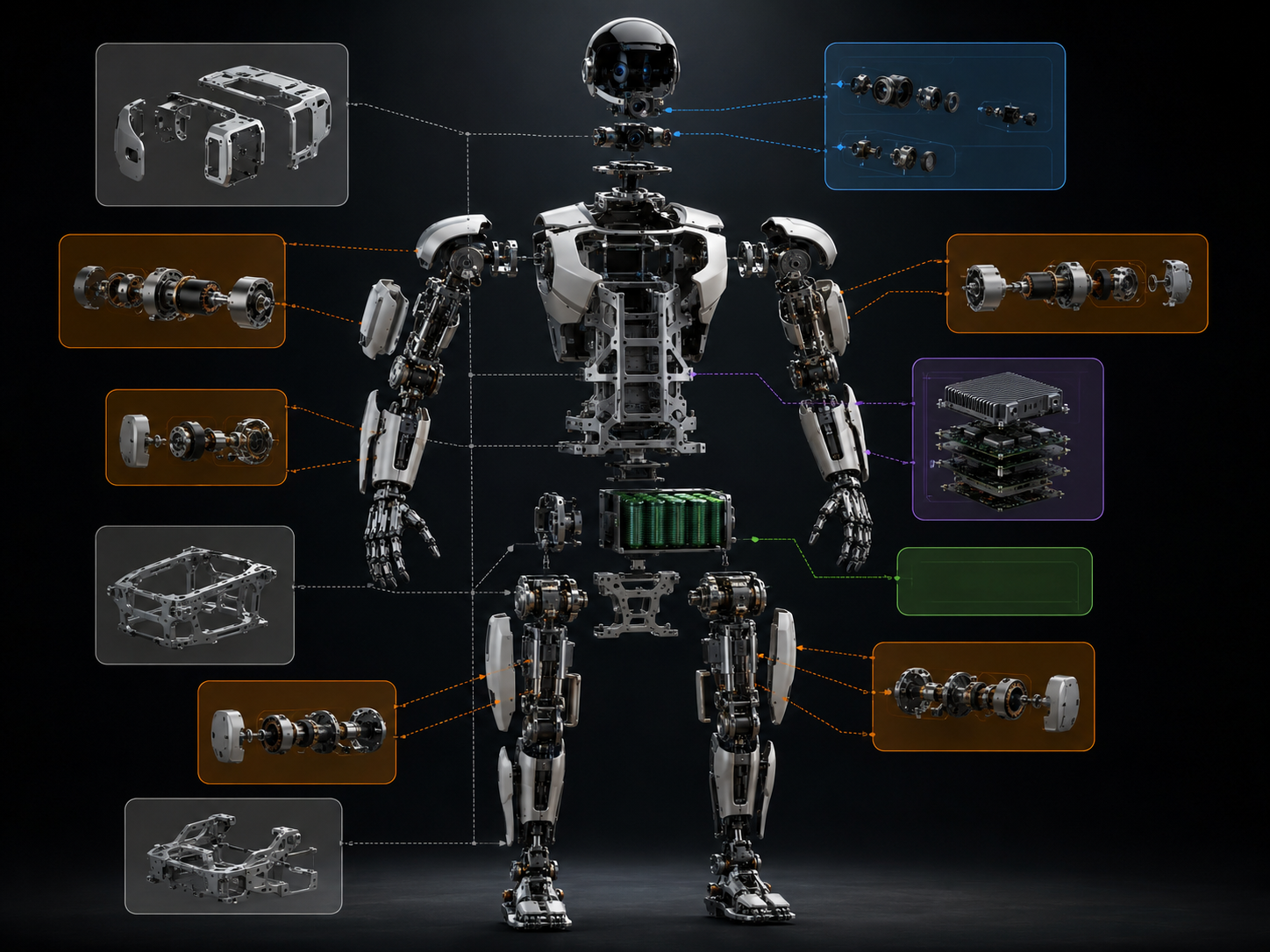
| Joint actuators (linear + rotary) | 30% in high-configuration units, over 50% in simpler models | Custom motors, high-reduction gearing, and precision manufacturing at low volumes; low-volume actuator sets alone can cost $16,000-$40,000 per robot |
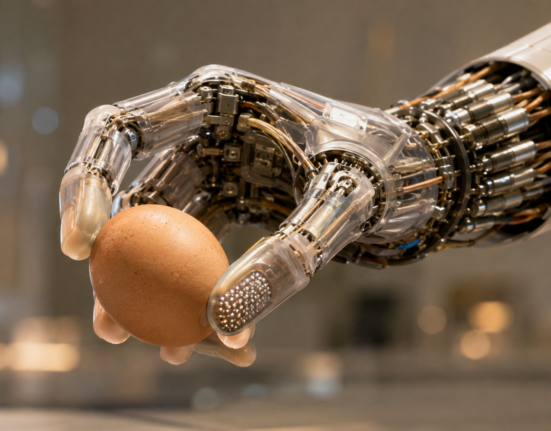
| Dexterous hands | Meaningful and rising share | Dozens of small actuators, tendons, and tactile sensors packed into a human-sized hand, a manufacturing challenge disproportionate to the part’s small size |
| Battery pack | Moderate share | High-nickel lithium-ion cells sized for both energy density and high discharge rates, a topic covered in more depth later in this series |
| Sensors and cameras | Moderate share | Depth cameras, IMUs, and foot-force sensors compound the total sensor count needed for safe bipedal locomotion |
| Onboard compute | Moderate share | GPU-class modules for real-time perception and control inference, running the AI models that interpret vision and language |
| Structure and chassis | Smaller share | Lightweight alloys and composites chosen to minimize the mass every actuator must move |
| Assembly and integration labor | Smaller share, currently manual-intensive | Precision assembly of dense actuator and sensor packages is not yet highly automated at low production volumes |
Actuators: The Single Biggest Lever on Total Cost
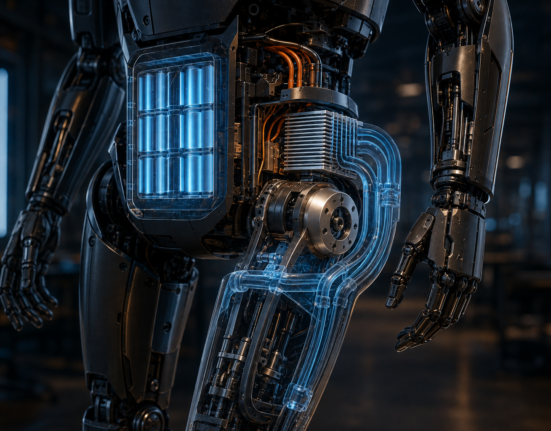
If there is one number that explains most of a humanoid robot’s price tag, it is the actuator bill. Joint actuators, whether linear (used heavily in legs for lifting-style motion) or rotary (used in hips, shoulders, and other rotating joints), typically account for over 30 percent of total BOM in high-configuration humanoids and can exceed 50 percent in simpler designs that skip dexterous hands and advanced sensor suites. At low production volumes, the full actuator set for one robot can cost $16,000 to $40,000, driven by custom motor windings, precision strain-wave or planetary-roller-screw gearing, and the low manufacturing volumes typical of an early-stage industry.
Mass production is expected to cut actuator costs by 50 to 70 percent as volumes scale, according to industry cost analysis, which is the single largest identifiable lever behind the entire humanoid robot cost curve. This is why BofA Global Research’s 2030 projection puts linear actuators at roughly 27 percent and rotary actuators at roughly 24 percent of total BOM, a combined 51 percent, alongside dexterous hands at around 19 percent, together accounting for roughly 70 percent of the entire bill of materials in a mature 2030 design.
Figure: Where 2030’s Dollar Goes, By BofA’s Projected BOM Split
A stacked bar chart would show three dominant slices, linear actuators at 27 percent, rotary actuators at 24 percent, and dexterous hands at 19 percent, together consuming roughly 70 percent of a projected 2030 humanoid robot’s bill of materials, with the remaining 30 percent split across battery, sensors, compute, structure, and assembly labor.
Named Prices on the Market Today
Retail and enterprise list prices give a useful, if imperfect, real-world anchor for the BOM analysis above, since list price includes margin, software, and support on top of raw component cost.
| Robot | Listed Price (2026) | Positioning |
|---|---|---|
| Unitree G1 | Approximately $13,500 | Lower-cost research and development platform |
| 1X Neo | Approximately $20,000 (or a $499/month subscription) | Consumer-oriented humanoid, subscription model spreads BOM cost over time |
| Tesla Optimus | Company target of $20,000-$30,000 | Mass-manufacturing bet leveraging Tesla’s existing EV battery and motor supply chain |
| Enterprise pilot-stage humanoids generally | $50,000-$150,000 | Full sensor suites, dexterous hands, and integration support for commercial pilots |
The spread between a $13,500 research platform and a $150,000 enterprise pilot unit is not primarily a difference in “how humanoid” the robot looks. It mostly reflects sensor suite completeness, hand dexterity, actuator count and quality, and the amount of integration and support bundled into the price, precisely the components broken out in the BOM table above.
Common mistake
Comparing a single retail price across two robots without adjusting for actuator count, hand dexterity, and sensor suite completeness. A $13,500 research platform and a $100,000 enterprise pilot unit are not the same product tier; the price gap tracks almost entirely to differences in the exact BOM categories, especially actuators and hands, detailed above, not to brand markup alone.
What worked
Tesla’s strategy of reusing electric-vehicle battery cells, motor windings, and inference chips for Optimus is a genuine example of amortizing fixed research and development and manufacturing-line cost across a much larger existing production base, rather than building a humanoid-specific supply chain from zero. Whether or not Tesla hits its exact price target, the underlying mechanism, borrowing an adjacent industry’s economies of scale, is a real and replicable cost-reduction strategy other manufacturers are also pursuing with EV and consumer-electronics suppliers.
Why Costs Fall: Three Distinct Mechanisms
Bottom-up cost reduction in this industry comes from three largely independent mechanisms, and it is worth separating them because they move on different timelines.
- Manufacturing scale. Actuators built in the thousands rather than dozens benefit from tooling amortization, supplier negotiating leverage, and yield improvements, the mechanism behind the cited 50-70 percent potential actuator cost reduction at volume.
- Design simplification. Reducing degrees of freedom, part count, or the number of distinct actuator models used across a robot’s body lowers both unit cost and assembly complexity, though usually at some cost to dexterity or capability.
- Supply chain borrowing. Reusing batteries, motor components, or compute chips already produced at scale for electric vehicles or consumer electronics, as Tesla does for Optimus, sidesteps the need to build humanoid-specific manufacturing capacity from scratch.
Where the Remaining Headroom Actually Sits
Given that actuators and dexterous hands are projected to remain roughly 70 percent of BOM even in a mature 2030 design, the largest absolute dollar reduction opportunity through the rest of this decade sits squarely in that category, not in batteries, sensors, or compute, which are already riding largely separate cost curves set by the EV and consumer electronics industries. Battery cost per kWh, for instance, is governed mostly by the lithium-ion supply chain broadly, not by humanoid-specific demand, meaning battery cost reduction will track the wider industry rather than humanoid-specific volume.
| Component | Primary Cost Reduction Driver | Realistic Pace of Decline |
|---|---|---|
| Actuators (linear + rotary) | Manufacturing scale, design standardization | Fast; 50-70% reduction cited as achievable at volume |
| Dexterous hands | Design simplification, tendon/actuator miniaturization | Moderate; still a comparatively immature manufacturing process |
| Battery pack | Broader lithium-ion and solid-state industry scale, not humanoid-specific demand | Slow to moderate; tied to the wider EV and consumer battery market |
| Sensors and compute | Consumer electronics and semiconductor cost curves | Steady, incremental, largely independent of humanoid robot volume |
| Assembly labor | Automation of final assembly and testing | Slow today; currently one of the least automated stages of production |
What This Means for a 2030 Price Estimate
Piecing the bottom-up components together rather than anchoring on a single company’s headline target, a defensible 2030 estimate for a full-featured, dexterous-handed humanoid lands in the $15,000 to $25,000 range for BOM cost alone, assuming actuator costs fall by 50 percent or more at scale as projected, dexterous hand costs decline more modestly, and battery, sensor, and compute costs track their respective broader industries downward at typical annual rates. Retail or enterprise price, which includes margin, software licensing, and support, would sit meaningfully above that BOM figure, consistent with the $20,000 to $30,000 range multiple manufacturers are independently targeting for the end of the decade.
- BOM versus retail priceBill-of-materials cost excludes assembly labor markup, software, research and development amortization, and profit margin; retail and enterprise prices sit meaningfully above the raw component cost.
- Actuator count compounds costA humanoid with 40-plus degrees of freedom needs roughly that many individual actuators, each with its own motor, gearing, and control electronics, multiplying a per-unit actuator cost across the entire body.
- Dexterous hands are disproportionately expensiveA hand’s small size hides a dense concentration of tiny actuators and tactile sensors, making it one of the costliest components per gram anywhere on the robot, a topic covered further in our piece on dexterous manipulation.
- Battery and compute costs ride separate industry curvesBecause batteries and chips are produced at massive scale for unrelated industries, their cost decline is largely independent of humanoid robot production volume specifically.
- Subscription pricing reshapes the cost conversationModels like 1X’s monthly subscription convert a large upfront BOM cost into a recurring fee, changing the economics for buyers without necessarily changing the underlying hardware cost, a distinction relevant to broader robot labour economics.
- Bill of materials (BOM)
- The total cost of every physical component used to build a product, excluding assembly labor, software, and profit margin, used as a baseline for hardware cost analysis.
- Linear actuator
- An actuator that produces motion along a straight line, commonly used in humanoid robot legs for lifting-style joint motion.
- Rotary actuator
- An actuator that produces rotational motion, commonly used in hip, shoulder, and other rotating joints throughout a humanoid robot’s body.
- Degrees of freedom (DoF)
- The number of independent directions a robot’s joints can move, with higher DoF counts generally requiring more individual actuators and higher total cost.
- Robots-as-a-Service (RaaS)
- A pricing model, also relevant to cost curves, where a customer pays a recurring fee for robot access rather than purchasing hardware outright, shifting BOM cost into an operating expense.
Key Takeaways
- Joint actuators alone account for 30 percent or more of total bill-of-materials cost in high-configuration humanoids, and over 50 percent in simpler designs, making them the single largest lever on price.
- BofA Global Research projects that by 2030, linear actuators (27%), rotary actuators (24%), and dexterous hands (19%) will together make up roughly 70 percent of a mature humanoid robot’s bill of materials.
- Mass production is expected to cut actuator costs by 50 to 70 percent at scale, the single biggest identifiable driver of the entire cost curve.
- Named 2026 prices span from roughly $13,500 (Unitree G1) to $150,000 (full enterprise pilot units), a spread that tracks actuator count, hand dexterity, and sensor completeness rather than brand alone.
- Battery, sensor, and compute costs largely ride separate industry cost curves (EV batteries, consumer electronics) rather than humanoid-specific manufacturing volume.
- Tesla’s strategy of reusing EV supply chain components for Optimus illustrates a real, replicable cost-reduction mechanism: borrowing scale from an adjacent industry rather than building humanoid-specific capacity from zero.
- A bottom-up 2030 BOM estimate lands around $15,000-$25,000 for a full-featured dexterous humanoid, consistent with, but independently derived from, the $20,000-$30,000 retail targets multiple manufacturers have separately announced.
FAQs
What percentage of a humanoid robot’s cost is actuators?
Joint actuators typically account for over 30 percent of total bill-of-materials cost in high-configuration humanoids with dexterous hands and full sensor suites, and can exceed 50 percent in simpler designs without those features, making actuators the single largest cost category.
How much does a humanoid robot’s actuator set cost at low production volume?
Industry cost analysis puts the full actuator set for one robot at roughly $16,000 to $40,000 at current low production volumes, with mass production expected to cut this by 50 to 70 percent as manufacturing scales up.
What will the cost breakdown of a humanoid robot look like by 2030?
BofA Global Research projects linear actuators at about 27 percent of bill-of-materials cost, rotary actuators at about 24 percent, and dexterous hands at about 19 percent by 2030, together accounting for roughly 70 percent of total component cost.
Why don’t battery costs fall as fast as actuator costs?
Battery costs are governed largely by the broader lithium-ion and emerging solid-state battery industries, which serve electric vehicles and consumer electronics at far larger scale than humanoid robots alone, so battery cost decline tracks that wider market rather than humanoid-specific production volume.
How much do humanoid robots cost to buy today?
Prices span a wide range in 2026: the Unitree G1 research platform lists around $13,500, 1X’s Neo is priced near $20,000 (or offered as a $499 monthly subscription), and full enterprise pilot units with complete sensor suites and dexterous hands run $50,000 to $150,000.
Is Tesla’s $20,000-$30,000 Optimus target realistic based on the bottom-up cost model?
It is broadly consistent with an independently derived bottom-up estimate of roughly $15,000-$25,000 in bill-of-materials cost by 2030, once retail margin, software, and support are added on top, though it depends heavily on actuator costs actually falling by the 50-70 percent industry analysts project at scale.
What is the difference between bill-of-materials cost and retail price?
Bill-of-materials cost covers only the physical components used to build the robot. Retail or enterprise price adds assembly labor, software licensing, research and development amortization, support services, and profit margin, so retail price is always meaningfully higher than raw BOM cost.
Which humanoid robot component has the least remaining cost-reduction headroom?
Battery, sensor, and compute costs have comparatively less humanoid-specific headroom because they already ride the broader cost curves of the electric vehicle and consumer electronics industries; the largest remaining reduction opportunity sits in actuators and dexterous hands, which are still relatively immature, low-volume manufacturing processes.
References
- Bank of America Institute: “Transformation Physical AI, part 2: Humanoid Robots” (March 2026)
- RoboZaps Blog: “Humanoid Robot Price 2026: $1.4K-$100K+”
- RoboZaps Blog: “Humanoid Production Economics [2026]”
- TheHumanoid.ai Glossary: “BOM Costs”
- ZMProbots: “Humanoid Robot Price 2026: What You’ll Actually Pay”
- Standard Bots: “Humanoid robots in 2026: Types, prices, and what’s next”
- GReverse: “How Much Does a Humanoid Robot Cost in 2026?”
For related coverage in this series, see our reality-check comparison on humanoid robots in warehouses, our explainer on robot foundation models, and our opinion piece on battery and actuator limits in bipedal robots. See also our coverage of general-purpose robots versus purpose-built machines and humanoid safety standards.