| Myth | Reality |
|---|---|
| Robots on sidewalks legally have the same rights as pedestrians everywhere. | Rules vary sharply by city and state; some jurisdictions grant pedestrian-equivalent status while others impose speed caps, weight limits, and permit quotas that pedestrians never face. |
| Sensors alone guarantee polite behavior around people. | Obstacle avoidance prevents collisions but does not by itself produce socially legible behavior; robots also need predictable, human-readable cues like slowing early, announcing intent, and choosing wider paths near accessibility infrastructure. |
| Robots yielding to humans is a solved, symmetric interaction. | Researchers studying real sidewalk deployments describe an asymmetry sometimes called robot privilege, where pedestrians absorb most of the adjustment burden rather than robots consistently stepping aside first. |
| Faster robots are always better for delivery efficiency. | Speed increases approved by cities, such as raising caps from 4 mph to 7 mph, come bundled with stricter yielding and audible-warning requirements specifically because higher speed raises the stakes of a bad interaction. |
Why Robot Etiquette Has Become a Real Policy Problem
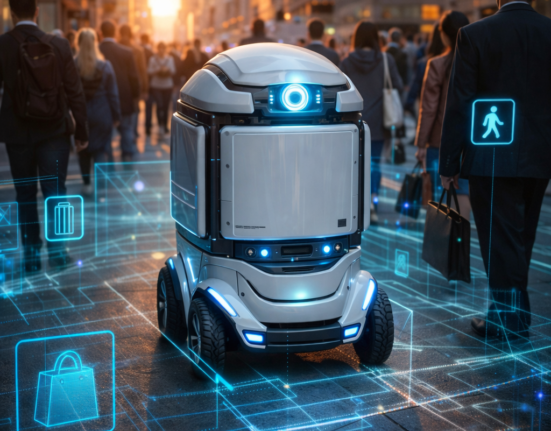
Five years ago, a delivery robot rolling down a sidewalk was a novelty that drew phone cameras. In 2026, it is routine enough in dozens of cities that the interesting question is no longer whether robots belong on sidewalks, but how they should behave once they are there. That shift has moved robot etiquette out of engineering labs and into city council chambers, disability advocacy groups, and state legislatures. The core tension is simple: sidewalks were designed for humans moving at human speed, negotiating right of way through eye contact, body language, and a lifetime of unwritten social calibration. A wheeled machine has none of that instinct built in, and every behavior it exhibits has to be deliberately engineered, tested, and in a growing number of places, legally mandated.
The stakes are highest for people who already have the least margin on a sidewalk: wheelchair users, people with canes or walkers, parents pushing strollers, and anyone with a mobility or sensory impairment. A pedestrian in good health who has to step around a stalled robot loses a few seconds. A wheelchair user who finds a robot idling in the only curb-ramp path may have no alternative route at all. This is why the accessibility community has become one of the loudest and most technically specific voices in shaping robot public space rules, and why any credible etiquette framework starts with accessible clearance, not general obstacle avoidance.
The Three Layers of Robot Etiquette
It helps to separate robot etiquette into three distinct layers, because they are built, tested, and regulated in different ways.
1. Perception and Prediction
Before a robot can behave courteously, it has to correctly interpret what is happening around it. This means distinguishing a person about to cross its path from one standing still, recognizing a wheelchair user’s likely turning radius, and predicting that a child running ahead of a parent is unpredictable and needs extra clearance. Socially aware navigation research, including early work from labs such as MIT’s Aerospace Controls Lab, has focused on teaching robots to model not just where people are, but where they are about to be, and to leave room well before a human would consider the space contested.
2. Communication and Signaling
Once a robot has a plan, it needs to make that plan legible to the humans around it, because a robot that silently swerves at the last second feels alarming even when it is technically safe. This is why most sidewalk delivery robots now combine motion cues, such as slowing down early and choosing a wide arc, with audible signals like a soft chime or a short spoken phrase announcing that it is passing or delivering. The tradeoff regulators are still negotiating is volume and frequency: too little signaling and pedestrians are startled, too much and residents complain about constant beeping outside their homes.
3. Rules, Permits, and Enforcement
The final layer is the legal one, and it is the least standardized. Some states classify sidewalk delivery robots as personal delivery devices with a defined legal status, speed cap, and weight limit. Others leave the question to individual cities, which produces a patchwork where a robot behavior that is fully compliant three blocks away may be a violation once it crosses a municipal line.
| City or State | Sidewalk Speed Cap | Key Yielding Rule |
|---|---|---|
| Georgia (statewide, 2026 update) | 7 mph, raised from 4 mph under House Bill 986 | Must yield to pedestrians and emit a sound within six feet of a person, wheelchair user, or vehicle |
| Boston, Massachusetts | Roughly 5 mph near pedestrians | Weight capped near 150 pounds including cargo; must not obstruct curb ramps |
| Coral Gables, Florida | 7 mph | Cannot loiter longer than 30 minutes unless actively completing a delivery |
| Washington, D.C. | Pedestrian-equivalent pace | Personal delivery devices must always yield right of way to pedestrians |
Reading across these examples, a pattern emerges: nearly every jurisdiction that has updated its rules in the last two years has paired any increase in permitted speed with a tightening of yielding and signaling obligations. Regulators appear to have concluded that speed and courtesy have to move together, not that courtesy can be assumed once speed is capped low enough.
Sidewalk Width, Accessibility, and the Real Bottleneck
Much of the public debate about robot etiquette focuses on robot behavior, but the physical constraint that actually determines whether an interaction goes well is sidewalk width. A standard residential sidewalk in an older American city is often four to five feet wide, barely enough for two adults to pass comfortably, let alone a person and a robot with cargo bins bolted to its sides. Add a stroller, a delivery cart, or a wheelchair with a service dog, and there may be no legal way for a robot to pass without one party stepping into the street or onto a lawn.
This is why accessibility advocates have pushed for etiquette standards that go beyond simple obstacle detection and require robots to actively route around known accessibility infrastructure, including:
- Curb ramps and depressed curbs, which robots should never block even briefly while waiting or charging.
- Detectable warning strips (the truncated dome pavement used by blind and low-vision pedestrians), which a robot should treat as a zone requiring extra caution and reduced speed.
- Bus stops and crosswalk waiting areas, where pedestrian density spikes unpredictably and a robot’s normal spacing assumptions break down.
- Narrow historic sidewalks and areas with street furniture, where there may not be enough width for a robot to yield without leaving the sidewalk entirely.
A growing number of city ordinances now explicitly require sidewalk robot operators to file routing plans that account for these features, rather than assuming a general-purpose navigation stack will handle them adequately in every neighborhood.
A Typical Yielding Sequence
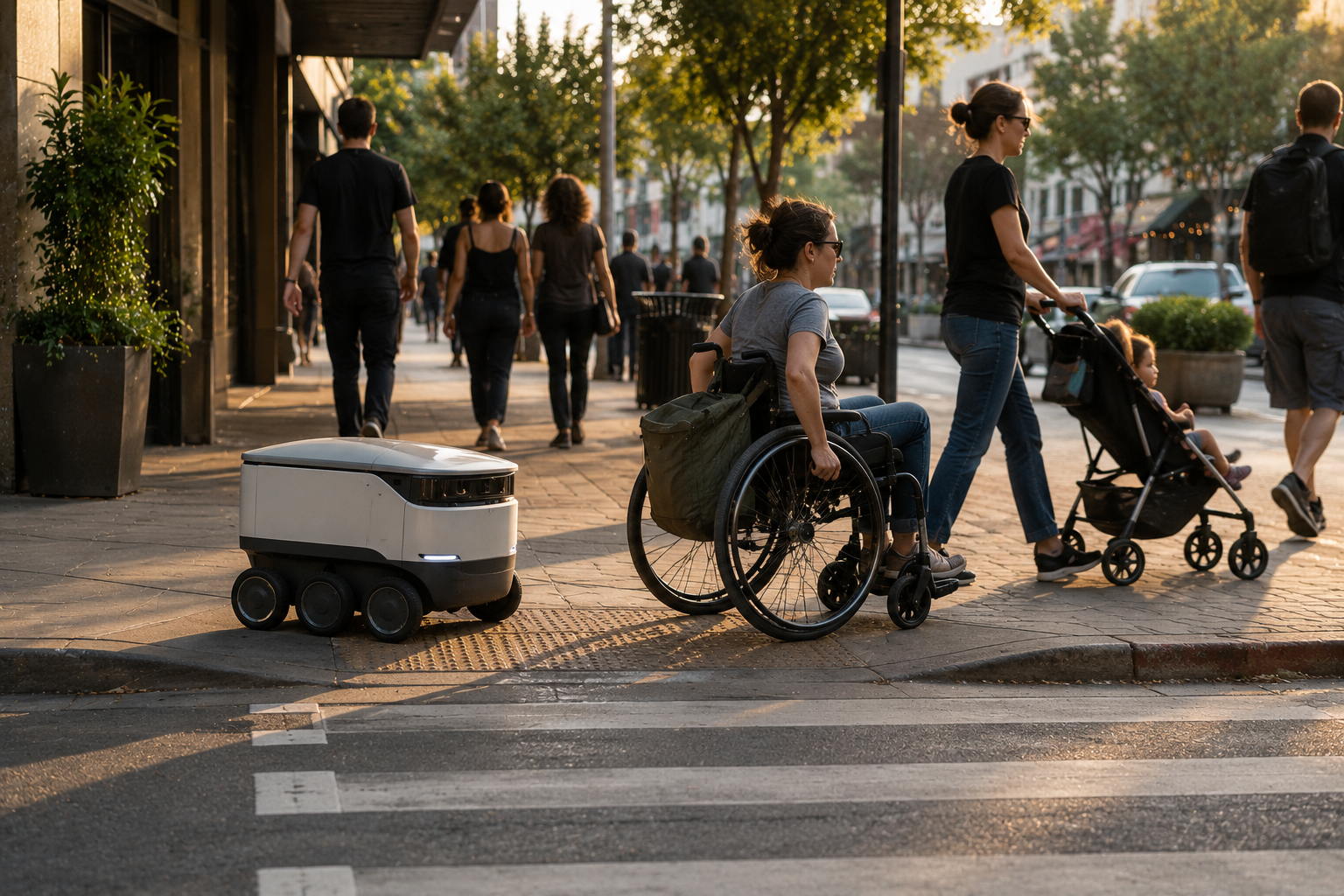
Illustration of a well-designed interaction: a delivery robot approaching a narrow sidewalk section detects a wheelchair user roughly twenty feet ahead, slows gradually starting at fifteen feet, moves to the widest available edge of the path by ten feet, and comes to a full stop with a soft audible cue if the remaining gap is under three feet, resuming only once the person has fully passed.
The “Robot Privilege” Problem
One of the more uncomfortable findings from recent human-robot interaction research is that current sidewalk etiquette is not as symmetric as it looks on paper. Studies following fleets of delivery robots on city sidewalks have documented that pedestrians, not robots, tend to absorb most of the burden of spatial adjustment: stepping aside, slowing down, or crossing to the other side of the street, often before the robot itself has done anything to accommodate them. Researchers have started calling this dynamic robot privilege, borrowing the term to describe how a machine’s presence can quietly reorganize who is expected to yield in a shared space, even when the written rule says the robot should yield first.
This matters because it exposes a gap between de jure etiquette, meaning the rules written into ordinances and company policies, and de facto etiquette, meaning what actually happens on the pavement. A city ordinance that requires a robot to yield is only meaningful if the robot’s default behavior, its speed, its stopping distance, and its signaling actually produce that outcome in practice, rather than pedestrians simply learning to get out of the way because the robot is slow to react.
What Companies Are Doing to Close the Gap
Delivery robot operators generally agree, at least publicly, that goodwill on sidewalks is a scarce resource that has to be protected. A single viral video of a robot blocking a wheelchair user or nearly colliding with a child can undo months of careful community outreach. In response, most fleet operators now combine several mitigation strategies rather than relying on any single fix.
| Mitigation Strategy | What It Addresses | Limitation |
|---|---|---|
| Geofenced speed reduction near schools, hospitals, and senior centers | High-vulnerability pedestrian zones | Requires accurate, regularly updated maps of sensitive locations |
| Remote human oversight for ambiguous situations | Edge cases the autonomy stack cannot confidently resolve | Adds latency and depends on reliable connectivity |
| Community liaison and complaint hotlines | Neighborhood-specific friction and repeated bad interactions | Reactive rather than preventative; depends on residents reporting issues |
| Standardized audible and visual signaling | Legibility of robot intent to pedestrians | Signal fatigue and noise complaints in dense residential blocks |
Toward a Real Standard
Standards bodies have taken notice of the patchwork problem. Industry groups working on public-area mobile robot standards have targeted 2026 for finishing an initial comprehensive standard covering how these machines should behave in shared civic spaces, including sidewalks, plazas, and building lobbies. A workable standard needs to address at least three things simultaneously: a minimum passing clearance that accounts for wheelchairs and mobility aids, a maximum acceptable stopping distance triggered by pedestrian proximity, and a consistent signaling vocabulary so that a robot’s chime or announcement means roughly the same thing regardless of manufacturer.
Until that kind of cross-manufacturer standard is adopted and enforced, cities are left writing their own rules block by block, which is inefficient but not without value: it lets individual neighborhoods calibrate rules to genuinely different conditions, from wide new suburban sidewalks to narrow historic downtown cores where a one-size-fits-all speed cap simply does not fit.
Common mistake
Assuming that a robot passing a basic obstacle-avoidance test in a controlled parking lot demonstration will behave acceptably on a real, cluttered residential sidewalk. Obstacle avoidance prevents collisions; it says nothing about whether the robot leaves a wheelchair user enough clearance, respects a curb ramp, or behaves predictably enough that a pedestrian is not startled into stepping into traffic.
What worked
Cities that paired any increase in robot sidewalk speed limits with a corresponding tightening of mandatory yielding distance and audible signaling requirements saw fewer complaint spikes than cities that raised speed limits alone. Pairing the two changes, rather than treating speed as an isolated variable, kept the net risk to pedestrians roughly flat even as delivery throughput improved.
Frequently Overlooked Details
- Curb ramp blockingEven a robot parked temporarily to wait for a delivery recipient can fully block the only accessible curb cut on a block, stranding a wheelchair user with no alternative route.
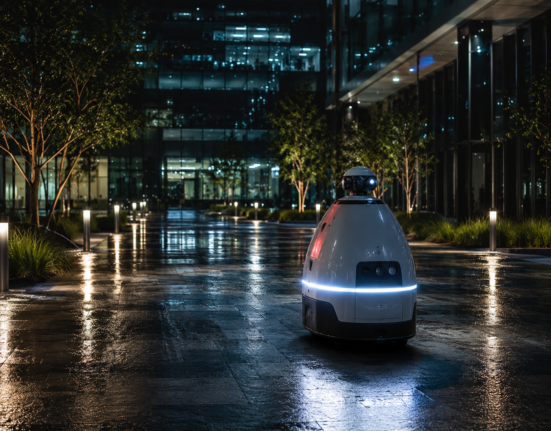
- Nighttime visibilityLow-profile robots are harder to see at dusk and after dark; some ordinances now require reflective marking or active lighting distinct from headlight-style beams that could dazzle pedestrians.
- Weather-driven sidewalk narrowingSnow piles, wet leaves, and construction barriers routinely shrink usable sidewalk width well below a robot’s normal operating assumptions, and few current systems adjust their clearance targets seasonally.
- Service animal interactionsGuide dogs and other service animals can react unpredictably to a robot’s motion or sound, and etiquette guidance increasingly recommends full stops rather than slow passes near visible service animals.
- Multi-robot clusteringDuring peak delivery windows, several robots from different companies can converge on the same block simultaneously, and etiquette standards rarely address robot-to-robot coordination as carefully as robot-to-pedestrian behavior.
- Complaint accountabilityMany cities lack a clear public channel for reporting a specific bad robot interaction, which makes it hard to distinguish a systemic etiquette failure from an isolated incident.
What Cities and Operators Should Do Next
The most effective near-term path is not waiting for a single global standard, but converging on a small set of shared practices that most current ordinances already gesture toward. First, treat accessible clearance as a hard constraint rather than a soft optimization goal, meaning a robot should be programmed to fully stop and wait rather than squeeze past a wheelchair user in a narrow gap, even if squeezing past is technically feasible. Second, require legible signaling that is consistent enough that pedestrians learn what it means across different robot brands operating in the same city, rather than every company inventing its own chime and phrasing. Third, build a genuine feedback loop between residents and operators so that recurring friction points, such as a specific block where robots repeatedly idle in the wrong spot, get fixed at the routing level rather than accumulating as one-off complaints.
For readers tracking the broader shift of robots into daily public life, this etiquette question sits alongside related debates about how autonomous delivery robots operate on sidewalks and how security patrol robots navigate similarly sensitive public and semi-public spaces. The underlying design challenge, building a machine that behaves predictably around people it was never explicitly trained on, recurs across nearly every category of urban robot.
Key Takeaways
- Robot etiquette in public spaces combines perception, legible signaling, and locally enforced rules; no single layer is sufficient on its own.
- Sidewalk speed caps and yielding requirements vary significantly by city and state, creating a compliance patchwork for multi-city robot operators.
- Accessible clearance for wheelchair users, strollers, and curb ramps should be treated as a hard constraint, not an optional optimization.
- Research on real deployments has identified an asymmetry, sometimes called robot privilege, where pedestrians currently absorb more adjustment burden than robots do.
- Cities that pair speed increases with stricter yielding and signaling rules have generally avoided the complaint spikes seen where speed rises alone.
- Industry standards bodies are targeting 2026 for an initial comprehensive public-area mobile robot behavior standard, but adoption will take longer than the standard itself.
- Weather, service animals, and multi-robot clustering remain under-addressed edge cases in most current etiquette frameworks and ordinances.
Glossary
- Personal delivery device (PDD)
- The legal classification many states use for sidewalk delivery robots, defining their speed, weight, and right-of-way status distinctly from both pedestrians and vehicles.
- Socially aware navigation
- A robotics research approach that models predicted human movement and social space, not just physical obstacles, to plan paths that feel natural to the people nearby.
- Robot privilege
- A term used by human-robot interaction researchers to describe situations where pedestrians consistently bear more responsibility for yielding than the robot does, despite formal rules stating otherwise.
- Detectable warning surface
- The truncated-dome textured pavement installed at curb ramps and platform edges to alert blind and low-vision pedestrians, which robots are increasingly required to treat as a caution zone.
- Geofencing
- Software-defined virtual boundaries that trigger automatic behavior changes, such as reduced speed, when a robot enters a mapped sensitive area like a school zone.
FAQs
Do sidewalk delivery robots legally have to yield to pedestrians?
In most jurisdictions with specific ordinances, yes. Cities such as Washington, D.C. require personal delivery devices to always yield right of way to pedestrians, and Georgia’s updated law requires yielding plus an audible signal within six feet of a person. Rules do vary, so local ordinances remain the authoritative source.
What speed do sidewalk robots typically travel at?
Most current ordinances cap sidewalk robots between 5 and 7 mph, roughly a brisk walking pace, though some jurisdictions like Georgia raised limits from 4 mph to 7 mph in 2026 while simultaneously tightening yielding and signaling requirements.
How do delivery robots handle wheelchair users on narrow sidewalks?
Well-designed systems detect a wheelchair user well in advance, slow early, and move to the widest available part of the path, stopping entirely if the remaining clearance is too tight. Not all deployed systems handle this consistently, which is a major focus of current accessibility advocacy.
What is “robot privilege” in the context of sidewalk robots?
It is a term researchers use to describe an observed asymmetry where pedestrians, rather than robots, tend to do most of the yielding and adjusting in practice, even when written policy says the robot should yield first to people on foot.
Are there national standards for robot behavior in public spaces?
Not yet a single unified global standard, but industry standards groups have targeted 2026 for finishing an initial comprehensive standard for public-area mobile robots, covering behavior, signaling, and safety expectations across manufacturers.
Can a delivery robot legally block a curb ramp while waiting?
Generally no under most current ordinances, though enforcement is inconsistent. Best-practice guidance and several city rules explicitly prohibit robots from idling, charging, or waiting in locations that would block accessible curb cuts or ramps.
Why do delivery robots make sounds when passing people?
Audible cues, such as a soft chime or spoken announcement, make the robot’s intent legible to nearby pedestrians, reducing startlement and helping people with visual impairments understand that a robot is nearby and moving.
How should pedestrians respond if a robot appears to be malfunctioning near them?
Most operators provide a visible support number or app-based reporting tool on the robot itself; the general safety guidance is to give the robot generous space, avoid touching or attempting to move it, and report the specific location and behavior to the operator or city.
References
- Fast Company, “MIT’s New Robot Has Better Sidewalk Etiquette Than You”
- ACM/IEEE International Conference on Human-Robot Interaction, “Sharing Public Space with Robots: Following a Fleet of Delivery Robots on City Sidewalks”
- Governing, “Lawmakers Should Allow Sidewalk Delivery Robots to Stay”
- RAILS Blog (ai-laws.org), “What’s Appropriate? Rethinking Robot’s Behavior in Public Spaces”
- Urban Robotics Foundation, “Standardization and Public-Area Mobile Robots”
- North American Community Hub, “Delivery Robots Can Move Faster on Atlanta Sidewalks After New July 1 Law”
- GovTech, “Coral Gables, Fla., Tries to Stop Food Delivery Robot Chaos”
- District Department of Transportation (DDOT), “Personal Delivery Devices”
- Boston.gov, “Sidewalk Delivery Robots”
- arXiv, “Making Sense of Robots in Public Spaces: A Study of Trash Barrel Robots”
Related reading: for the regulatory backbone behind these behaviors, see our coverage of autonomous delivery robots on sidewalks, and for how form factor shapes public perception, see why humanoid is the preferred form factor for 2026. Retailers weighing customer-facing deployments may also want our breakdown of retail robots. For the consumer side of this same robotics wave, see our companion pieces on personal robot assistants and the consumer product roadmap and what home robots actually deliver beyond vacuuming in 2027.