| Myth | Reality |
|---|---|
| Security robots are replacing human guards entirely. | Current deployments extend what one human guard can supervise rather than replacing guards outright; robots handle continuous patrol while humans handle response and judgment calls. |
| A patrol robot is just a camera on wheels. | Modern patrol robots combine movement, real-time anomaly detection, and direct alerting to a security operations center, giving them a deterrent effect a static camera cannot replicate. |
| Privacy concerns are overblown since the robot is just recording public space. | Many deployments record continuously in semi-public and even employee work areas, triggering workplace surveillance laws and data retention obligations that vary significantly by jurisdiction. |
| Deterrence value cannot be measured. | Multiple deployment studies report specific incident-reduction percentages in patrolled zones compared to unpatrolled baseline periods. |
What Security Patrol Robots Actually Do
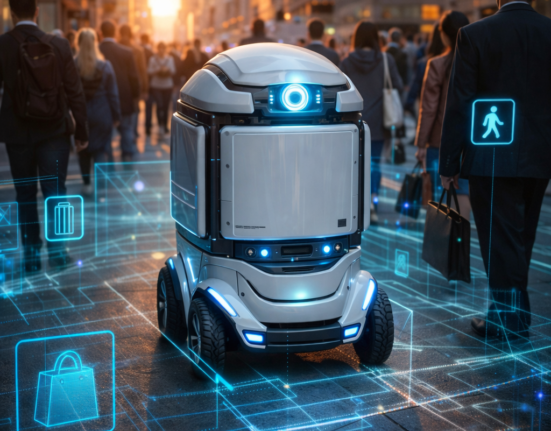
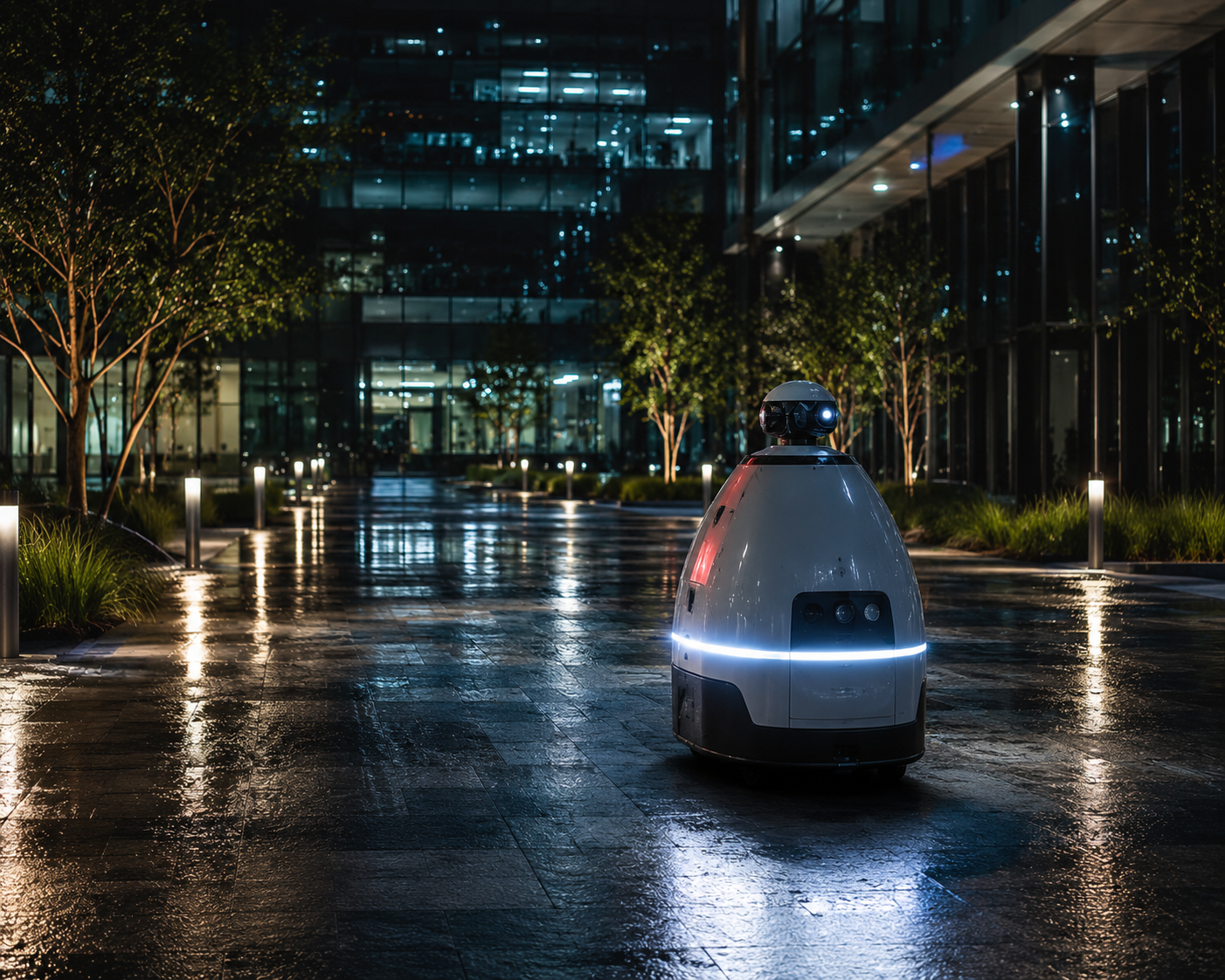
Autonomous security patrol robots are wheeled or tracked units that move through defined routes across parking lots, corporate campuses, retail exteriors, and increasingly public-adjacent spaces, combining onboard cameras, thermal or motion sensors, and sometimes license plate readers or facial recognition with a live connection to a security operations center. Unlike a fixed camera, the robot’s mobility lets it investigate an anomaly rather than simply record it from a static angle, and its physical presence is designed to be noticed.
The pitch to property owners is straightforward: extend the coverage of a limited human security staff without the cost of hiring more guards for 24-hour coverage. In 2026, that is largely how the technology is actually being used — not as a guard replacement, but as a force multiplier that lets fewer people supervise more ground.
Measured Effectiveness: Incident Reduction and Deterrence
Deployment data from Knightscope sites report reductions of 30 to 50 percent in security incidents such as trespassing, theft, and vandalism in areas patrolled regularly by robots, compared to baseline periods before deployment. This is a meaningful, quantified effect, not just anecdotal marketing.
Two separate mechanisms explain why: detection and deterrence. On the detection side, onboard camera systems provide continuous recording and can trigger real-time alerts to a security operations center when anomalies appear — people in restricted areas after hours, vehicles lingering in unusual spots, or sounds like breaking glass. On the deterrence side, a moving robot creates unpredictability a static camera cannot: an intruder can time their approach around a fixed camera’s blind spot, but a mobile unit on an unpredictable route removes that certainty, projecting a visible, dynamic security posture around the clock.
| Factor | Static Camera System | Autonomous Patrol Robot |
|---|---|---|
| Coverage pattern | Fixed field of view | Moving route, can investigate anomalies directly |
| Deterrence via unpredictability | Low — fixed blind spots learnable over time | Higher — route and timing can vary |
| Reported incident reduction | Not typically isolated as a standalone metric | 30-50% at patrolled Knightscope sites |
| Staffing model | Requires monitoring staff for footage review | Extends single guard’s effective coverage area |
The Privacy Trade-offs Nobody Skips Past
The same mobility and sensor suite that makes patrol robots effective is exactly what makes them a privacy concern. Continuous video and, in some systems, audio recording of public and semi-public spaces raises questions that a fixed camera in a known location does not raise in quite the same way, because the robot’s roaming coverage is harder for the people being recorded to anticipate or avoid.
Growing deployment has raised urgent questions about privacy, accountability, cost, and public trust, particularly where police-adjacent or quasi-public patrol robots rely on facial recognition and license plate readers alongside 24/7 video feeds. Two specific risks stand out beyond the general surveillance concern:
- Data security. Any camera system connected to the internet can be hacked, and cloud-stored video can be exposed in a data breach — turning a security tool into a liability if the footage itself becomes compromised.
- Workplace surveillance law. When patrol robots operate in areas where employees work, not just public thoroughfares, workplace surveillance regulations apply, and organizations that deployed robots primarily for external security have sometimes been slow to apply the same scrutiny to the employee-facing footage they are also capturing.
Where Detection Meets Deterrence
A patrol robot’s value comes from two separate effects operating at once: the sensor suite detects an anomaly and alerts a human operator in real time, while the robot’s simple visible presence on an unpredictable route discourages the incident from being attempted in the first place. Removing either half — detection without visible presence, or presence without a monitored alert pipeline — sharply reduces the measured benefit.
Data Retention and Accountability
Data retention policy is where many deployments are least mature. Organizations running patrol robots need retention policies that comply with local regulations and their own organizational privacy commitments, covering how long footage is kept, who can access it, and under what circumstances it is shared with law enforcement or third parties. In practice, retention policy has often lagged behind the pace of hardware deployment — robots go live on a site well before a comprehensive data governance policy is finalized.
| Privacy Risk Area | Why It Matters | Common Mitigation |
|---|---|---|
| Facial recognition / license plate reading | Identifies specific individuals, not just anomalous behavior | Restricting use to specific high-risk zones or disabling by default |
| Cloud video storage | Exposed to hacking or data breach risk | Encryption, access logging, defined retention windows |
| Employee area coverage | Triggers workplace surveillance law obligations | Clear signage, employee notice, scope limits on footage use |
| Third-party data sharing | Footage shared with law enforcement without clear policy | Written data-sharing agreements and audit trails |
Common mistake
Deploying a patrol robot’s full sensor suite — facial recognition, license plate reading, continuous audio — everywhere on a property by default instead of scoping each capability to where it is actually needed. Blanket activation maximizes privacy exposure and legal risk without a proportional increase in the incident-reduction benefit the deployment is meant to deliver.
What worked
Sites that combined visible signage disclosing robot patrol and recording, clearly scoped high-risk zones for advanced sensing capabilities, and a defined, published data retention window reported both strong incident-reduction results and fewer complaints or legal challenges than sites that treated the deployment as a purely technical rollout.
Frequently Overlooked Factors
- Response pipeline staffingA patrol robot’s detection is only as useful as the human response behind it; an alert with no monitored operator on the other end delivers none of the measured benefit.
- Route predictabilityFixed, repeating patrol routes erode the deterrence advantage over time as would-be intruders learn the pattern, the same weakness static cameras already have.
- Jurisdictional varianceFacial recognition and audio recording rules differ significantly by state and country, meaning a deployment plan that is compliant in one location may not be in another.
- Signage and disclosureClear notice that an area is patrolled and recorded is both a legal safeguard in many jurisdictions and, separately, part of the deterrence mechanism itself.
- Cybersecurity of the robot itselfAn internet-connected patrol robot is itself a potential attack surface; a compromised unit could expose live video feeds rather than just stored footage.
- Public versus employee space distinctionThe legal and ethical bar for recording is different in public-facing zones than in areas where the same organization’s employees work daily.
- Battery and charging downtimeRobots off the floor for charging create predictable coverage gaps that a rotating schedule with overlapping units is needed to close.
Glossary
- Security operations center (SOC)
- A centralized team or facility that monitors alerts and footage from security systems, including patrol robots, and coordinates human response.
- Deterrence value
- The degree to which a visible security measure discourages an incident from being attempted in the first place, distinct from its ability to detect an incident already underway.
- Data retention policy
- A formal policy governing how long recorded footage or sensor data is stored, who can access it, and when it is deleted.
- Workplace surveillance law
- Regulations governing the monitoring of employees in their place of work, which can apply to security robots operating in shared or employee-only areas.
- Anomaly detection
- A system’s capability to flag behavior or conditions that deviate from an expected baseline, such as a person in a restricted area after hours.
Key Takeaways
- Deployment data from patrolled sites reports 30-50 percent reductions in trespassing, theft, and vandalism versus unpatrolled baselines.
- Deterrence comes from unpredictable mobile presence combined with real-time anomaly detection, not from either capability alone.
- In 2026, patrol robots are extending human guard coverage rather than replacing security staff.
- Facial recognition, license plate readers, and continuous audio create privacy and legal exposure well beyond simple video monitoring.
- Cloud-connected camera systems carry hacking and data breach risk independent of the robot’s physical security function.
- Workplace surveillance law applies whenever patrol robots cover areas where employees work, not just public-facing zones.
- Sites that pair clear signage, scoped sensor use, and published retention policies see stronger results and fewer complaints.
FAQs
Do security patrol robots actually reduce crime?
Deployment data from patrolled Knightscope sites shows 30 to 50 percent reductions in incidents such as trespassing, theft, and vandalism compared to baseline periods before the robots were introduced. The effect combines direct detection with the deterrence value of an unpredictable, visible patrol presence.
Are security patrol robots replacing human security guards?
Not currently. In 2026, patrol robots are primarily used to extend what a single human guard can supervise, handling continuous patrol and initial detection while humans retain response, judgment, and escalation decisions.
What privacy concerns do security patrol robots raise?
Continuous video and sometimes audio recording of public and semi-public spaces, combined with facial recognition and license plate reading in some systems, raises data retention, accountability, and workplace surveillance concerns that vary by jurisdiction and are not always addressed before deployment.
Can a security patrol robot’s camera feed be hacked?
Yes. Any internet-connected camera system, including a patrol robot’s, carries hacking risk, and cloud-stored footage can also be exposed in a data breach independent of the robot’s own security. This makes cybersecurity a core part of any deployment’s risk profile, not a separate concern.
Do patrol robots need to disclose that they are recording?
Requirements vary by jurisdiction, but many organizations use visible signage to disclose patrol and recording as both a legal safeguard and part of the deterrence mechanism itself. Sites using clear disclosure report fewer complaints than those that treat recording as unannounced.
How is deterrence different from incident detection in patrol robots?
Detection is the robot’s sensor suite identifying an anomaly and alerting a human operator after something has started. Deterrence is the separate effect of the robot’s visible, unpredictable presence discouraging an incident from being attempted at all; both effects contribute to the overall incident-reduction numbers reported at patrolled sites.
Do workplace surveillance laws apply to security patrol robots?
Yes, whenever a patrol robot’s coverage area includes spaces where employees work, not just public-facing zones. Organizations that deploy robots primarily for external security purposes still need to apply workplace surveillance compliance to any employee-facing footage the same units capture.
What is the biggest mistake organizations make when deploying patrol robots?
Activating a robot’s full sensor suite — facial recognition, license plate reading, continuous audio — across an entire property by default rather than scoping advanced capabilities to specific high-risk zones. This maximizes privacy and legal exposure without a matching increase in measured security benefit.
References
- SMP Robotics, “Security Robots for Physical Protection and Perimeter Patrol”
- Standard Bots, “What Are Police Robots? Types, Real Examples, and Challenges in 2026”
- Robotomated, “Security Robots 2026: Autonomous Patrol and Surveillance Systems Guide”
- RAD Security, “Autonomous Security Patrol Robots: Enhancing Perimeter Security”
- The Robots HQ, “Best Security Robot of 2026: Patrol, Surveillance, and Deterrence”
For more on how autonomous systems interact with the public, see our coverage of robot etiquette in shared public spaces and wildfire detection and response robotics. Readers may also be interested in our look at inspection drones for energy infrastructure, our companion piece on retail inventory robots and shelf analytics, and our guide to healthcare robots for seniors.