| Robot category | Typical capex (mid-size farm) | Primary savings driver | Typical payback period |
|---|---|---|---|
| Precision spray / See and Spray retrofit | $18,000 to $50,000 per boom kit | Herbicide volume reduction of 40 to 70 percent | 1.5 to 2 growing seasons |
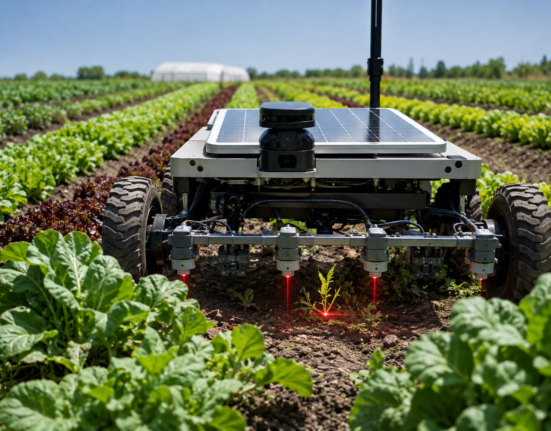
| Autonomous weeding (laser or mechanical) | $150,000 to $500,000 per unit | Reduced hand-weeding and chemical labor | 2 to 3 seasons on high-value crops |
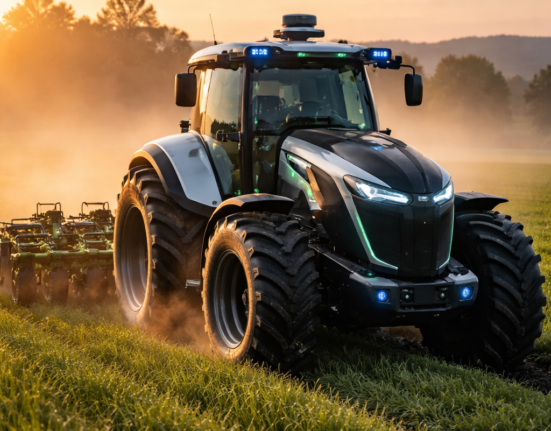
| Autonomous tractor (retrofit kit or OEM) | $50,000 to $200,000 | Reduced operator hours, extended field hours | 2 to 4 seasons |
| Robotic harvester (RaaS or purchase) | $0 upfront (RaaS) to $300,000+ (purchase) | Reduced seasonal harvest labor cost | 1 to 2 seasons (RaaS), 3 to 5 (purchase) |
For a mid-size operation, “should we buy a robot” is rarely answered by a spec sheet. It is answered by a spreadsheet. Farms in the 200 to 2,000 acre range sit in an awkward middle: too small to negotiate the fleet discounts and dedicated service contracts that mega-agribusiness operations get, and too large to treat automation as a hobbyist curiosity the way a five-acre market garden might. The capital is real money relative to the operation’s balance sheet, and the labor problem is also real and immediate. This piece is about the numbers that actually matter at that scale: capital expenditure per acre, labor savings per season, and the payback period by robot category, using data gathered from 2026 industry reporting, vendor disclosures, and farm equipment analysts.
For the broader context of how automated planting and harvesting technology is reshaping agriculture as a category, see our companion piece on automated planting and harvesting robotics, linked in the resources section below. This article goes narrower and deeper: it is only about the economics of adoption for operations that are neither huge nor tiny.
Why Mid-Size Farms Are a Different ROI Case
Robotics vendors size their pitch decks around two extremes. At one end are vertically integrated agribusinesses running tens of thousands of acres, where a single autonomous tractor purchase is a rounding error against fuel and labor budgets, and where in-house agronomists and mechanics can absorb a shaky first-generation machine. At the other end are hobby farms and small market gardens, where a $20,000 weeding robot is often justified more by curiosity or a niche premium crop than by a hard payback calculation.
Mid-size farms, roughly 200 to 2,000 acres of row crops or 20 to 200 acres of high-value specialty crops, do not have either luxury. A $150,000 robotic weeder has to actually pencil out against a real labor budget, usually within a bank’s financing window of three to seven years. That has pushed vendors in 2026 toward leasing models, robotics-as-a-service (RaaS) subscriptions billed per acre or per box harvested, and smaller-footprint machines sized for narrower row spacing and shorter runs between headlands.
Capex Per Acre: What It Actually Costs
Capital cost is the number growers ask about first, but it is also the number vendors are least consistent about disclosing, because financing structures vary so widely. Broadly, 2026 industry data groups mid-size farm robotics into four capex tiers.
| Category | Approx. capex per acre (mid-size deployment) | Financing pattern seen in 2026 |
|---|---|---|
| Precision spray retrofit kits | $15 to $40 per acre | Outright purchase or dealer financing, bolted onto existing sprayer |
| Autonomous weeding (laser or mechanical) | $300 to $900 per acre (high-value crops) | Lease or per-acre subscription increasingly common |
| Autonomous tractor retrofit | $40 to $120 per acre depending on fleet size | Kit purchase plus subscription software fee |
| Robotic harvesting (specialty crop) | $0 capex under RaaS; effectively $0.35 to $0.90 per pound picked | Robotics-as-a-service, billed per box or per pound |
The per-acre numbers above compress a wide range of real deployments, and growers should treat them as planning inputs rather than quotes. What is consistent across 2026 reporting is the direction of travel: capex per acre is falling as vendors move toward subscription and RaaS pricing specifically to make the technology reachable for farms that cannot absorb a six-figure purchase in a single fiscal year.
Labor Savings by Robot Category
Labor is where the ROI case is actually won or lost, because labor is the expense line growing fastest and least predictably for most mid-size operations. Three patterns show up consistently in 2026 data.
Precision spraying and targeted weeding
Computer-vision-guided spray systems that identify individual weeds and apply herbicide only to them, rather than blanket-spraying a field, have delivered the most dramatic and best-documented savings. Field data circulating in 2026 shows non-residual herbicide use reductions of close to 50 percent on row crops using camera-guided spot spraying, and laser-based weeding systems have been reported to cut weed-control costs by roughly 80 percent versus manual and chemical combined, mostly by eliminating hand-weeding crews in high-value vegetable and berry operations.
Autonomous tractors and hauling
Autonomous tractor kits let a single operator supervise multiple machines from a tablet, or let a machine run unattended overnight during planting or tillage windows. The labor saving is less about eliminating a role and more about extending usable field hours without adding a second or third shift of paid operators, plus roughly 10 to 15 percent fuel savings from more consistent driving patterns.
Robotic harvesting
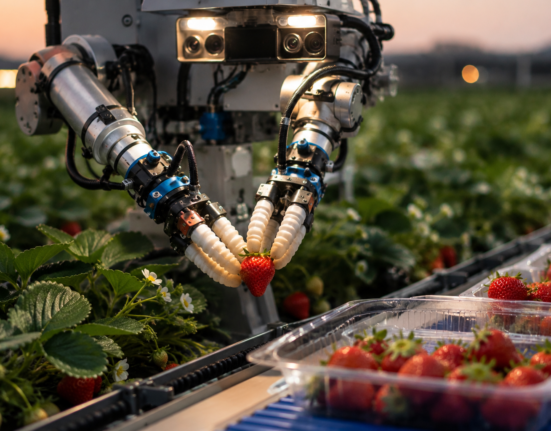
Harvest labor is the single largest seasonal cost for many specialty crop growers, and it is also the hardest to staff reliably given tightening seasonal labor availability. Robotic harvesters for strawberries and similar soft fruit are reported in 2026 field trials to run at two to three times human picking speed under good conditions, though actual field efficiency (the share of ripe fruit a robot can find and pick without damage) still runs lower than a skilled human crew in dense canopy conditions later in the season. For a full technical breakdown of which crops this actually works for today, see our deep dive on which crops robotic harvesting has actually solved, linked in the resources section below.
Figure: Where the payback clock starts on a 500-acre vegetable operation
A composite timeline built from 2026 vendor and industry data: month 1 to 6 covers machine commissioning and operator training, month 6 to 18 covers realized herbicide and labor savings on weeding equipment, and full ROI on a combined weeding-plus-drone-scouting deployment lands around the 30-month mark for a farm saving roughly $150,000 annually on a comparable capital base.
Payback Periods by Robot Category, In Detail
Payback period is the number that ultimately drives the purchase decision at a bank or with a farm’s own capital committee. Based on 2026 reporting across multiple vendors and independent farm technology analysts, here is how payback typically breaks down for a mid-size operation.
- Precision spraying: 1.5 to 2 growing seasons for row crop operations, driven almost entirely by herbicide cost reduction rather than labor.
- Autonomous weeding, high-value crops: As fast as 1 to 2 seasons on crops like strawberries and organic vegetables where hand-weeding labor is both expensive and hard to source; 2 to 3 seasons is more typical for mixed vegetable rotations.
- Autonomous weeding, row crops: 2 to 4 seasons, since per-acre savings are lower on lower-value crops like corn and soybeans.
- Autonomous tractors: 2 to 4 seasons for a mid-size fleet, depending heavily on how many additional field hours the machine unlocks versus simply replacing an existing operator’s hours one for one.
- Robotic harvesting under RaaS: Effectively immediate, since there is no capital outlay; the comparison is a per-box or per-pound robotic fee against a comparable per-box human labor cost, and growers see savings whenever the robotic fee undercuts current labor plus overtime and recruiting costs.
- Robotic harvesting, outright purchase: 3 to 5 seasons, and this is the category where mid-size farms are most exposed to obsolescence risk if a next-generation machine arrives before the current one is paid off.
A Worked Example: 500-Acre Mixed Vegetable Operation
One of the more concrete data points available for 2026 comes from a documented case of a roughly 500-acre vegetable operation that deployed robotic weeding alongside drone-based crop scouting. That combination produced annual savings reported north of $150,000, with a full payback period of about 2.5 years on the combined capital outlay. That number sits squarely inside the range described above for autonomous weeding on mixed vegetable rotations, and it is a useful anchor for a mid-size grower trying to sanity-check a vendor’s payback pitch: if a vendor quotes a payback period dramatically shorter than 18 months for a mixed-crop weeding deployment at this scale, ask what assumptions are driving that number, because it is running well ahead of the documented market baseline.
| Line item | Annual value (approx.) |
|---|---|
| Reduced hand-weeding labor | $70,000 to $90,000 |
| Reduced herbicide spend | $25,000 to $40,000 |
| Yield protection from earlier weed detection (drone scouting) | $20,000 to $35,000 |
| Combined capital cost recovered by month 30 | Full payback |
Financing Structures Changing the Math in 2026
The single biggest shift in mid-size farm robotics economics in 2026 is not the hardware, it is the financing. Leasing and per-acre subscription models are now common across weeding and spraying categories specifically because vendors realized that a mid-size farm cannot write a check for a six-figure machine the way a large agribusiness can. Robotics-as-a-service pricing on harvesting removes capex risk almost entirely by shifting cost into a per-unit-of-output fee, which is easier for a lender or an operation’s own cash flow planning to model. The tradeoff is that RaaS and subscription pricing generally costs more over a five-to-seven-year horizon than an outright purchase would, so farms with strong balance sheets and long planning horizons still often come out ahead buying outright, while farms optimizing for near-term cash flow and lower risk tend to prefer the subscription route.
Common Mistakes When Farms Calculate Robotics ROI
Common mistake
Farms frequently calculate payback using only the sticker price of the robot against last year’s labor bill, without accounting for operator training time, seasonal downtime for repairs, or the fact that a first-generation machine on a new crop typically operates at reduced efficiency for its first one to two seasons. A payback estimate that ignores the ramp-up period will consistently overstate year-one savings and can make an otherwise sound investment look like it underperformed.
What worked
Growers who ran a side-by-side trial on a limited number of acres or rows for one full season before committing to a farm-wide rollout consistently reported more accurate payback estimates and fewer surprises, because the trial surfaced real-world issues (canopy density, row spacing mismatches, connectivity gaps for cloud-based vision models) before they were baked into a full capital commitment.
Frequently Overlooked Factors in the ROI Calculation
- Connectivity requirementsVision-guided weeding and spraying robots often rely on cloud inference or over-the-air model updates, which can be unreliable on farms with poor rural broadband or cellular coverage, silently degrading performance below the payback model’s assumptions.
- Service and parts logisticsMid-size farms are frequently outside the dense service territories built around large agribusiness clusters, so a breakdown during a critical window can mean days of lost field time waiting for a technician.
- Software subscription creepMany robotics platforms bundle a required annual software or data subscription fee separate from the hardware capex, which is easy to omit from a simple payback spreadsheet.
- Operator retraining, not eliminationRobotics rarely eliminates a labor role outright on a mid-size farm; more often it converts a field laborer into a machine supervisor, which changes the wage line rather than deleting it entirely.
- Resale and depreciation riskBecause the category is moving fast, a robot purchased outright in 2026 may face a materially reduced resale value by the time a next-generation model arrives, an important factor for farms financing over five-plus years.
- Crop rotation compatibilityA machine tuned for one crop’s row spacing and canopy structure may need costly reconfiguration or simply sit idle during rotation years into a different crop, an overlooked drag on annual utilization.
How to Build a Realistic Payback Model for Your Farm
A defensible ROI model for a mid-size farm should include, at minimum: current labor cost for the task being automated (including overtime and recruiting costs, not just base wage), current input cost for the task (herbicide, fuel), the vendor’s quoted capex or subscription rate, an explicit ramp-up discount for year one (most operations should model 60 to 75 percent of steady-state efficiency in the first season), ongoing software and service fees, and a sensitivity check against at least one documented industry baseline like the 500-acre example above. Farms that skip the ramp-up discount and the documented baseline comparison are the ones most likely to be disappointed by a real-world payback that runs six to twelve months longer than the vendor’s pitch deck suggested.
Glossary
- Robotics-as-a-Service (RaaS)
- A pricing model where a farm pays per unit of output (per acre, per box, per pound) for a robotic service rather than purchasing the hardware outright.
- Payback period
- The length of time it takes for cumulative savings or cost avoidance from an investment to equal its total cost.
- Capex per acre
- Capital expenditure divided by the number of acres a machine or fleet is expected to service, used to compare investments across farms of different sizes.
- Ramp-up efficiency
- The reduced operating performance typically seen in the first one to two seasons of deploying a new robotic system, before operators and the system reach steady-state performance.
- Retrofit kit
- A hardware and software package added to existing equipment, such as a tractor or sprayer, to add autonomous or computer-vision capability without purchasing an entirely new machine.
Key Takeaways
- Precision spraying delivers the fastest and most consistently documented payback, typically 1.5 to 2 growing seasons.
- Autonomous weeding pays back fastest on high-value crops like strawberries and organic vegetables, often within 1 to 2 seasons.
- Autonomous tractors and outright-purchased robotic harvesters typically need 2 to 5 seasons to pay back on a mid-size farm.
- Robotics-as-a-service and leasing models are reshaping adoption by removing large upfront capex, at the cost of higher long-run total spend.
- A documented 500-acre case saved over $150,000 annually with a 2.5-year payback, a useful sanity-check baseline for vendor pitches.
- Ramp-up inefficiency in year one is the most commonly omitted factor in farmer-built ROI models.
- Connectivity, service logistics, and software subscription fees are recurring hidden costs that erode paper payback estimates.
FAQs
What is a realistic payback period for a mid-size farm buying its first robotic weeder?
Most mid-size operations should plan for 2 to 3 growing seasons on mixed vegetable rotations, and as little as 1 to 2 seasons on high-value crops like strawberries where hand-weeding labor costs are highest. Row crop operations like corn and soybeans typically see slower paybacks of 2 to 4 seasons.
Is leasing or buying better for a mid-size farm’s first robot?
Leasing and robotics-as-a-service models generally reduce risk and near-term cash outlay but cost more over a five-to-seven-year horizon. Farms with strong balance sheets and long planning windows often do better buying outright; farms prioritizing cash flow flexibility tend to prefer subscription pricing.
How much can precision spraying actually reduce herbicide costs?
2026 field data on camera-guided spot spraying shows non-residual herbicide use reductions approaching 50 percent on row crops, with laser-based weeding systems in high-value crops reporting weed-control cost reductions in the range of 80 percent when comparing total chemical plus labor spend.
Do robotic harvesters actually work at commercial scale yet?
For select soft fruit and leafy crops, yes, at growing but still partial scale; efficiency drops later in the season as canopy density increases. See our detailed crop-by-crop assessment for the current state of the technology by crop.
What is the biggest hidden cost mid-size farms miss when budgeting for robotics?
Software and data subscription fees layered on top of hardware capex, plus the reduced efficiency during a machine’s first one to two seasons of operation, are the two most commonly underestimated costs in farmer-built payback models.
Do autonomous tractors save on fuel as well as labor?
Yes. 2026 reporting on autonomous tractor deployments cites fuel savings in the range of 10 to 15 percent, attributed to more consistent driving patterns and route optimization compared to manual operation.
How many acres does a farm need before robotics becomes worthwhile?
There is no fixed threshold, but most of the documented 2026 payback data is anchored around operations in the 200 to 2,000 acre range for row and mixed vegetable crops, or 20 to 200 acres for high-value specialty crops, where labor and input savings are large enough relative to capital cost to produce payback within a financeable window.
Should a mid-size farm run a trial before a full rollout?
Yes. Growers who piloted a robotic system on a limited number of acres or rows for one full season before a farm-wide rollout consistently reported more accurate payback estimates, since a trial surfaces connectivity, canopy, and service issues that a vendor’s spec sheet will not.
References
- DataM Intelligence, “Autonomous Farming Equipment ROI: Fastest Payback Applications in 2026”
- Monday Robotics, “Farm Automation ROI Guide: Calculate Your Robot Investment Return”
- CropLife, “More Farmers Are Adopting John Deere’s See and Spray. Here’s Why”
- AgFunderNews, “Brief: NVIDIA’s venture arm invests in autonomous weeding startup Carbon Robotics”
- Carbon Robotics, LaserWeeder product and cost-savings disclosures
- Farm Progress, “Investing in autonomy? Here are 5 metrics to consider”
- Intel Market Research, “Robotic Weeding Machines Market Outlook 2026-2034”
Related reading on this site: for the broader landscape of automated planting and harvesting, see automated planting and harvesting robotics. For a crop-by-crop technical breakdown of harvesting automation, see which crops robotic harvesting has actually solved. For the hardware behind weeding and spraying economics discussed here, see autonomous weeding and precision spraying systems. For how drones factor into the broader precision agriculture picture, see AI drones for precision agriculture. For a comparison of consumer-adjacent autonomous mowing economics, see robot lawn mowers compared. For how robotic fleets are being costed out in adjacent land-management use cases, see swarm robotics for reforestation and restoration.