| Myth | Reality |
|---|---|
| Robotic harvesting works equally well on any crop with enough R&D investment | Crop morphology matters more than R&D budget; loose, low-canopy soft fruit and structured leafy greens are tractable, while dense-canopy stone fruit with subtle ripeness cues remains an open research problem |
| Once a robot can pick a strawberry, it can pick anything roughly berry-shaped | Even within soft fruit, canopy density changes through the season and cuts robotic pick rates by 20 to 50 percent as the plant matures |
| Robotic harvesting is mostly a labor-cost story | It is equally a bruising, grading, and food-safety story; a solved crop is one where the gripper can consistently avoid damaging the fruit while a vision system judges ripeness at least as reliably as a human picker |
“Solved” is a loaded word in agricultural robotics, and it gets thrown around loosely by vendors, journalists, and investors alike. This piece uses a stricter bar: a crop counts as solved only where robotic systems are operating at commercial customer sites, picking marketable produce, at a cost and speed that is at least competitive with human labor for a meaningful share of the harvest. By that bar, the list of solved crops in 2026 is short, and the list of unsolved crops is long. Our companion piece on automated planting and harvesting robotics, linked in the resources section below, covers the broader category of agricultural robotics including planting, spraying, and general adoption trends; this article goes crop by crop, specifically on harvesting.
The Three Things That Make a Crop Hard or Easy to Harvest Robotically
Across 2026 technical literature and vendor field reports, three factors consistently separate solved crops from unsolved ones.
1. Ripeness signal clarity
Crops where ripeness correlates strongly and visibly with color, size, or a simple firmness threshold are far easier for a vision system to judge correctly than crops where ripeness is a subtle combination of color, give, aroma, and grower experience, cues that are hard to encode into a machine-vision model.
2. Canopy structure and occlusion
Crops grown in structured, low-occlusion canopies (raised bed strawberries, hydroponic lettuce, trellis-trained apples) are far more tractable than crops with dense, irregular canopies where the target fruit is frequently hidden behind leaves or other fruit, a persistent problem for tree fruit like peaches and cherries.
3. Damage tolerance
A gripper that bruises 5 percent of a soft fruit crop can still be commercially viable if the fruit is destined for a market where minor blemishes are simply downgraded. The same 5 percent bruising rate can be commercially fatal on a crop destined exclusively for a premium fresh market with zero blemish tolerance.
| Crop | 2026 status | Primary technical obstacle |
|---|---|---|
| Strawberries (field-grown) | Commercial pilots and early deployments | Canopy density increases through season, cutting robotic pick rates |
| Lettuce and leafy greens | Commercially solved for uniform-maturity blocks | Mixed-maturity fields still need selective human passes |
| Apples (trellis-trained) | Commercial deployment on structured orchards | Traditional dense orchards still resist robotic reach and occlusion |
| Tomatoes (processing) | Solved via mechanical shake-harvest for decades; vision-guided fresh-market picking still emerging | Fresh-market tomatoes need bruise-free selective picking, harder problem |
| Table grapes | Early commercial trials | Cluster-level selective cutting without damaging remaining fruit |
| Stone fruit (peaches, cherries, apricots) | Largely unsolved | Thin skin bruises easily, dense canopy, subtle ripeness judgment |
| Citrus | Partially solved for juice-market fruit; fresh market lagging | Grip and detachment force can damage rind, affecting fresh-market grade |
Solved: Strawberries, With an Asterisk
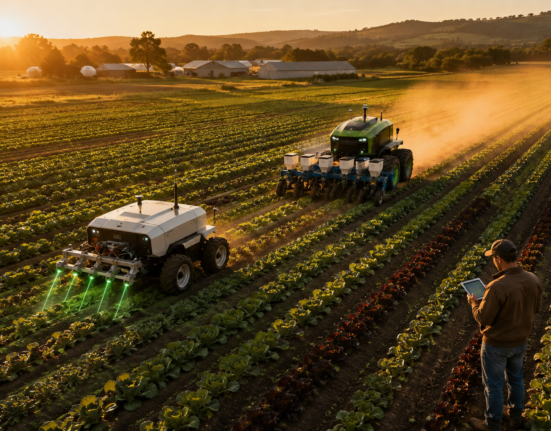
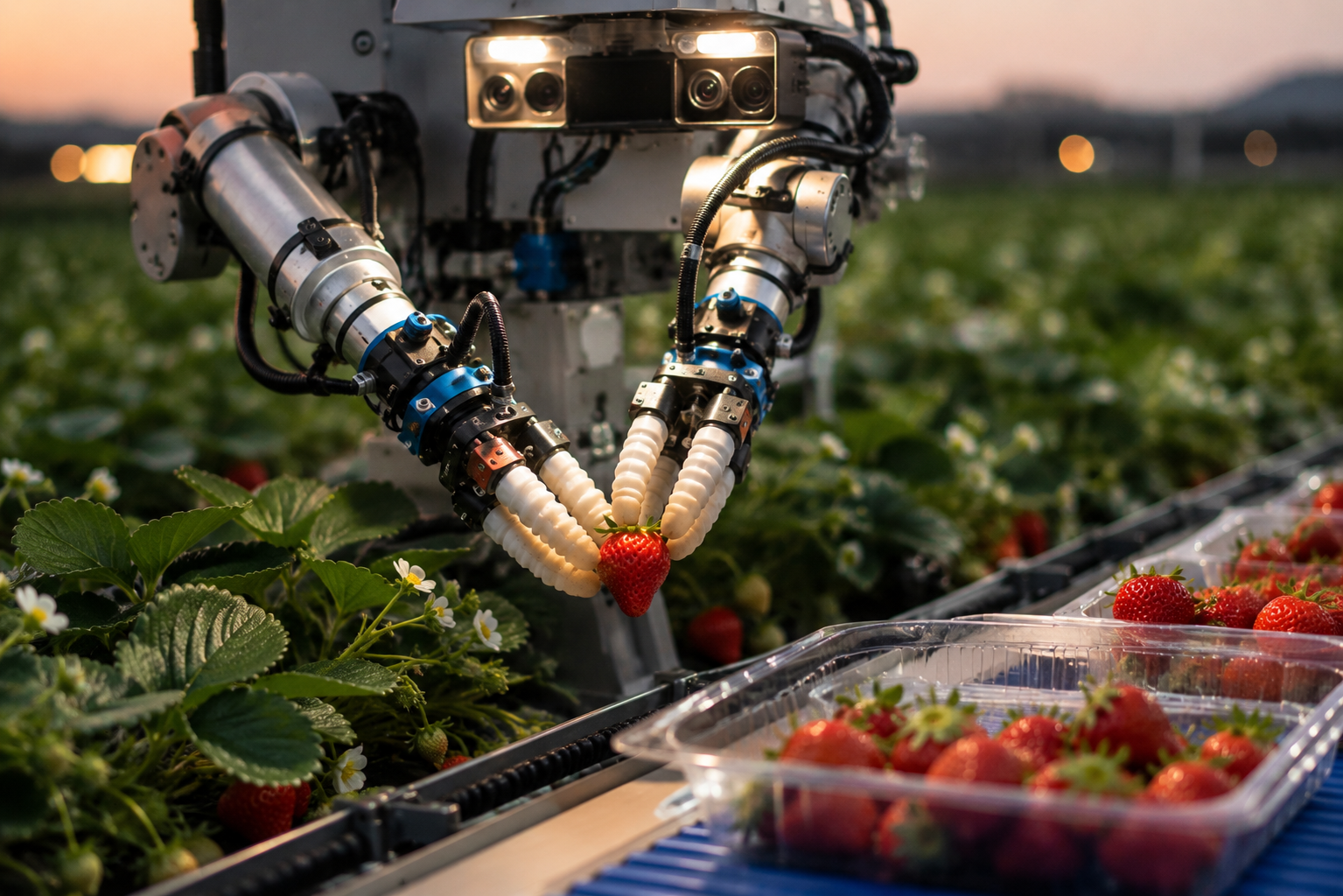
Field-grown strawberries are the closest thing agricultural robotics has to a commercial harvesting success story in 2026, and they are also the clearest illustration of why “solved” needs qualification. Robotic strawberry harvesters using dual robotic arms and soft grippers are picking directly into clamshells at two to three times human picking speed under good field conditions, and at least one vendor has moved from pilot to first paying commercial customer deployment in California in 2026. But the same reporting is consistent about a real limitation: robots can find and pick roughly 50 to 70 percent of ripe strawberries early in the season when canopies are open and low, and that share falls as the plant canopy fills in later in the season and fruit becomes harder for the camera to see and the arm to reach without collateral damage.
In practice, this means commercial strawberry robots today are best understood as a labor-supplementing tool rather than a labor-replacing one: they handle the easiest 50 to 70 percent of the pick, and human crews still handle the remainder, particularly later in the season. That is a genuinely useful commercial outcome, but it is not “solved” in the sense of eliminating the need for human pickers.
Solved: Leafy Greens in Uniform-Maturity Blocks
Lettuce and similar leafy greens present a fundamentally easier problem than fruit: there is no ripening judgment call in the same sense, size and visual maturity are the dominant cues, and a whole-head cutting action is a simpler mechanical operation than selectively detaching one ripe piece of fruit from a cluster. Robotic lettuce harvesters operating on blocks planted for uniform maturity are genuinely solved at commercial scale in 2026, cutting and loading heads with minimal human intervention. The caveat is fields planted or grown with mixed maturity, where a robotic system either has to selectively skip immature heads (a solvable but harder vision problem) or a human crew still makes a follow-up pass.
Figure: Where the harvesting difficulty curve breaks
Plotting canopy occlusion against ripeness-signal ambiguity for seven crop categories shows a clear cluster of solved crops (lettuce, structured-orchard apples, early-season strawberries) in the low-occlusion, clear-signal quadrant, and a cluster of unsolved crops (peaches, cherries, dense-canopy stone fruit) in the high-occlusion, ambiguous-signal quadrant, with almost no crops occupying the middle ground.
Partially Solved: Tree Fruit Under Structured Training
Apples grown on trellis or fruiting-wall training systems, where trees are pruned into a narrow, flat, uniformly spaced structure specifically to make mechanical and robotic access easier, have reached commercial deployment for dual-arm robotic harvesters in 2026, according to recent field evaluation research. This is a case where agronomy adapted to meet the robot halfway: growers who wanted robotic harvesting to work invested years in retraining their orchards into structures that reduce occlusion and simplify the arm’s reach geometry. Traditional freestanding orchards, without that retraining investment, remain substantially harder for robotic systems and are not considered solved.
Unsolved: Stone Fruit and Nuanced-Ripeness Crops
Peaches, cherries, apricots, and similar stone fruit remain the clearest example of a genuinely unsolved robotic harvesting problem in 2026. Three compounding factors are responsible: the fruit bruises under even modest gripping force, ripeness is judged through a subtle combination of color, slight give, and grower experience that is difficult to encode reliably into a vision model, and canopy structures in most commercial stone fruit orchards remain dense and irregular, causing heavy occlusion. No vendor has reached commercial-scale deployment on these crops as of 2026; the work remains at the research and early-prototype stage.
Fresh-market tomatoes, table grapes at cluster-selection granularity, and fresh-market citrus sit in a middle category: real commercial pilots exist, but none have reached the scale and reliability where a grower can plan a harvest season assuming full robotic coverage without a human backstop crew.
Why “Multi-Crop” Harvesters Are Mostly a 2026 Marketing Claim, Not a Technical Reality
Several vendors in 2026 market “multi-crop” or “universal” harvesting platforms. In practice, these systems typically share a chassis and navigation stack across crops while requiring a substantially different end-effector (the gripping or cutting mechanism) and a retrained vision model for each crop. That is a legitimate engineering efficiency, reusing the expensive parts of the system, but it is not evidence that the underlying picking problem has been solved across crops. A chassis that can drive itself down a row of lettuce and a row of apple trees equally well tells you nothing about whether the gripper on the end of its arm can actually harvest either crop without damage. Growers evaluating a “multi-crop” claim should ask specifically which crops the vendor has running at a paying commercial site today, not which crops are on a roadmap.
Common mistake
Growers and investors frequently treat “our robot successfully picked a strawberry in a demo” as equivalent to “our robot has solved strawberry harvesting.” A demo pick rate under ideal early-season canopy conditions is a different number from a season-long commercial pick rate, which typically runs meaningfully lower once canopy density increases and edge cases accumulate. Always ask for full-season commercial performance data, not a best-case demo number.
What worked
Growers who piloted robotic harvesting on a single block or a limited number of rows for a full season, rather than committing an entire farm’s harvest plan to a new robotic system in year one, were able to accurately measure the real percentage of the crop the robot could handle and plan human labor coverage for the remainder, rather than being surprised mid-season.
Frequently Overlooked Factors in Robotic Harvesting Readiness
- Seasonal pick-rate decayRobotic pick rates on soft fruit are consistently highest early in the season and decline as canopy density increases, a pattern that a single-point demo statistic will not reveal.
- End-effector specificityA gripper engineered for one crop’s fruit size, skin thickness, and detachment force rarely transfers to another crop without a substantial redesign, regardless of shared chassis or navigation software.
- Orchard retraining costTree fruit growers pursuing robotic harvesting compatibility often must invest years and significant capital retraining orchards into trellis or fruiting-wall structures before a robot can work effectively.
- Grading and food-safety integrationA harvesting robot that picks well but cannot integrate with existing grading, washing, and packing lines adds workflow friction that can offset labor savings.
- Human backstop crew planningEven solved crops like early-season strawberries and uniform-maturity lettuce still typically need a smaller human crew for the fruit or heads the robot misses.
- Business model exposureSome robotic harvesting vendors have exited the market or been acquired for their underlying technology rather than scaling commercially, a reminder that vendor stability matters as much as the technology’s raw capability.
Glossary
- End-effector
- The gripping, cutting, or picking mechanism at the end of a robotic arm, engineered specifically for a given crop’s fruit shape, skin thickness, and detachment force.
- Occlusion
- The degree to which target fruit is hidden from a camera or sensor by leaves, branches, or other fruit, a key factor in how hard a crop is to harvest robotically.
- Fruiting wall / trellis training
- An orchard management technique that prunes and trains trees into a narrow, flat, uniformly spaced structure to reduce occlusion and simplify mechanical or robotic access.
- Robotics-as-a-Service (RaaS)
- A pricing model where growers pay per box or per pound of robotically harvested produce rather than purchasing the harvesting hardware outright.
- Pick rate
- The percentage of ripe, marketable fruit or produce that a robotic harvester successfully locates and picks without damage during a pass through the field.
Key Takeaways
- Field-grown strawberries are the clearest 2026 commercial success story, but robots still miss 30 to 50 percent of ripe fruit later in the season.
- Uniform-maturity lettuce and leafy greens are genuinely solved at commercial scale; mixed-maturity fields are not.
- Trellis-trained apple orchards have reached commercial robotic harvesting; traditional freestanding orchards have not.
- Stone fruit like peaches and cherries remain largely unsolved due to bruising sensitivity, dense canopy, and subtle ripeness cues.
- “Multi-crop” harvester marketing usually refers to a shared chassis, not a shared solved end-effector or vision model across crops.
- A single demo pick is not evidence of season-long commercial performance; always ask for full-season data.
- Even solved crops typically still need a human backstop crew for the share of produce the robot cannot reliably pick.
FAQs
Is robotic strawberry harvesting actually commercially solved in 2026?
Partially. Commercial deployments exist and pick at two to three times human speed, but robots typically catch only 50 to 70 percent of ripe fruit early in the season, with that share falling as canopy density increases later in the season, so a human backstop crew is still required.
Which crops are most solved for robotic harvesting today?
Uniform-maturity leafy greens like lettuce are the most reliably solved, since there is no fruit-ripeness judgment involved and the cutting action is mechanically simple. Structured, trellis-trained apple orchards are also seeing genuine commercial deployment.
Why can’t robots harvest peaches and cherries yet?
Stone fruit bruises easily under gripping force, ripeness depends on subtle visual and tactile cues that are hard to encode into a vision model, and most commercial orchards have dense, irregular canopies that heavily occlude the fruit from cameras and robotic arms.
What does “multi-crop” robotic harvester actually mean in practice?
Usually it means a shared driving chassis and navigation system across crops, with a different end-effector and a separately trained vision model required for each crop. It is not evidence that the picking problem itself has been solved across crops.
Do tomatoes count as a solved crop for robotic harvesting?
Processing tomatoes have been mechanically shake-harvested for decades, which is a solved but different problem from vision-guided selective picking. Fresh-market tomatoes requiring bruise-free selective picking are still an emerging, not fully solved, application.
How should a grower evaluate a harvesting robot vendor’s claims?
Ask specifically for full-season commercial pick-rate data from an existing paying customer site, not a best-case demo number, and ask which specific crops the end-effector and vision model have actually been validated on commercially, rather than which crops are on the roadmap.
Does orchard design affect whether robotic harvesting will work?
Yes, significantly. Trellis or fruiting-wall trained orchards, pruned into narrow flat structures specifically to reduce occlusion, have reached commercial robotic harvesting, while traditional freestanding orchard designs remain substantially harder for current robotic systems.
Will robotic harvesting eventually replace human pickers entirely?
Not in the near term for most crops. Even in the most solved categories today, robots handle a majority but not all of the harvest, and a smaller human crew remains necessary to cover the produce the robot misses or cannot safely pick.
References
- AgFunderNews, “DailyRobotics gears up for commercial launch in California in 2026 with robotic strawberry harvester”
- TechHQ, “Crop harvesting robots dream of soft fruits”
- arXiv, “Advancement and Field Evaluation of a Dual-arm Apple Harvesting Robot”
- arXiv, “Peduncle Gripping and Cutting Force for Strawberry Harvesting Robotic End-effector Design”
- The Robot Report, “Harvesting innovation: The story behind Tortuga’s autonomous harvesting robots”
- AgTecher, “Tortuga Harvesting Robot: Strawberry and Grape”
- FFRobotics, product and commercial deployment disclosures
- Built In, “19 Agricultural Robots and Farm Robots You Should Know”
Related reading on this site: for the broader landscape of agricultural robotics adoption, see automated planting and harvesting robotics. For the financial case behind adopting harvesting robots on a mid-size operation, see agricultural robotics ROI for mid-size farms. For the hardware used in weeding and spraying, a related but distinct field robotics category, see autonomous weeding and precision spraying systems. For how drone-based scouting complements harvesting decisions, see AI drones for precision agriculture. For a look at swarm-based approaches to land management robotics, see swarm robotics for reforestation and restoration.