| Myth | Reality |
|---|---|
| Bio-hybrid robots are just soft robots made from flexible plastic or silicone. | Bio-hybrid actuators contain actual living biological cells, typically cultured muscle tissue, that must be kept alive with nutrients and oxygen to function. |
| This is the same field as bio-inspired soft robotics. | Bio-inspired soft robotics copies biological mechanical design in synthetic materials; bio-hybrid robotics integrates real living tissue directly as a functional component. |
| Living muscle actuators are ready for commercial deployment. | Current systems remain lab-stage, constrained by tissue longevity, nutrient supply logistics, and precise control challenges outside a living body. |
| Muscle-tissue actuators are less efficient than electric motors. | Living muscle tissue offers a notably high power-to-weight ratio and energy efficiency compared to many conventional actuators, though only at small scale so far. |
What Makes an Actuator “Bio-Hybrid”
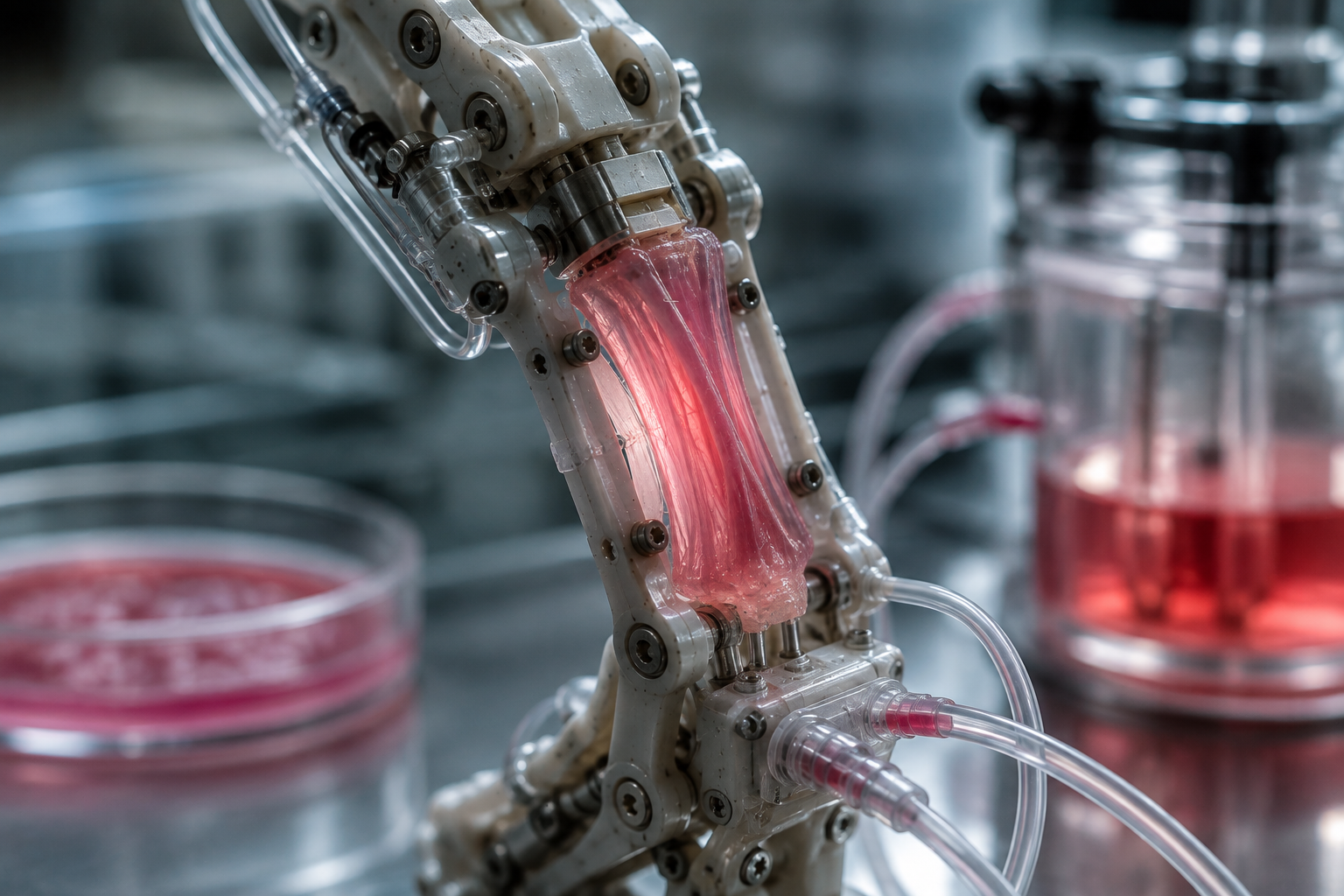
Bio-hybrid actuators sit at the intersection of tissue engineering and robotics: a robotic structure, typically a skeleton, joint, or fin built from synthetic or hydrogel scaffolding, is powered not by a motor or pneumatic cylinder but by living muscle cells cultured directly onto or around that structure. When stimulated, the muscle tissue contracts exactly as it would inside a living organism, pulling on the scaffold and producing movement. This is a genuinely different category from biomimetic or bio-inspired soft robotics, which studies how animals move and then builds synthetic materials and mechanisms that copy those principles without using any living cells at all. Our existing coverage of that adjacent field, in the piece on soft robotics inspired by biological organisms, is explicit that true biological enhancement and living-tissue approaches sit outside its scope. Bio-hybrid actuation is that excluded, more experimental category: it is not inspired by biology, it is built from biology.
Two cell types dominate current research. Cardiomyocytes, heart muscle cells, contract rhythmically and spontaneously without external stimulation, which makes them useful for simple, repetitive, clock-like actuation. Skeletal muscle cells require an external trigger, typically an electrical pulse, optical stimulation in genetically modified optogenetic tissue, or activation through an engineered neuromuscular junction, but in exchange offer more controllable, on-demand contraction that is closer to what a robot designer actually wants for deliberate movement.
| Cell Type | Contraction Behavior | Best Suited For |
|---|---|---|
| Cardiomyocytes | Spontaneous, rhythmic, self-triggered | Simple pumps, repetitive motion, clock-like actuation |
| Skeletal muscle tissue | Requires external electrical, optical, or neuromuscular trigger | Controllable, deliberate, on-demand movement |
How Living Tissue Actually Moves a Robot
The engineering challenge is not simply growing muscle cells in a dish, it is coupling that tissue’s contraction force efficiently into a mechanical structure that can do useful work. Early biohybrid designs placed muscle actuators directly onto a skeleton, but this architecture wastes force at the interface. Recent research has shifted toward biohybrid tendons, structures that bridge the muscle-to-skeleton interface the same way tendons do in real animals, improving both the power-to-weight ratio and the modularity of muscle-powered robots by giving engineers a standardized connection point rather than requiring custom tissue-to-frame integration for every design.
Stimulation methods have also diversified. Beyond simple electrical pacing, researchers have demonstrated optogenetically controlled muscle contractions, where muscle cells are genetically modified to contract in response to specific wavelengths of light, offering more precise, non-contact control than electrodes. Advances in 3D bioprinting have opened additional avenues for shaping tissue into more complex, functional actuator geometries rather than simple flat strips, while newer work with 2D skeletal muscle thin-film actuators grown as precisely aligned monolayers on micropatterned hydrogel skeletons has produced small locomotive biohybrid robots and multi-limbed designs built from independent muscle-powered fins.
From Muscle Contraction to Robot Motion
A thin strip of cultured skeletal muscle tissue is anchored across a flexible hydrogel joint via a biohybrid tendon interface. An electrical or optogenetic stimulus triggers synchronized contraction across the aligned muscle fibers, pulling the joint closed. Because the tendon interface distributes force efficiently, a relatively small tissue sample can generate proportionally large movement in the connected limb, compared with placing muscle directly against a rigid frame.
Why Researchers Want Living Muscle in Robots at All
Given the complexity of keeping cells alive, it is worth being clear about what living muscle offers that a servo motor does not. Living muscle tissue is intrinsically soft and compliant, meaning it deforms safely on contact rather than colliding rigidly, a property that is difficult and expensive to fully replicate synthetically. It is also self-repairing at the cellular level, since muscle tissue naturally regenerates minor damage the way it would in a living organism, a property broadly relevant to the wider self-healing robotics research covered in our piece on the materials and control needed for self-repairing robots, though bio-hybrid tissue repairs itself biologically rather than through engineered polymer chemistry. On energy efficiency, muscle tissue converts chemical energy to mechanical work with efficiency that is competitive with, and in some regimes better than, comparable small-scale synthetic actuators, particularly when the alternative is a heavy battery and motor assembly for a device that needs to stay extremely lightweight.
| Property | Living Muscle Actuator | Conventional Electric Actuator |
|---|---|---|
| Compliance | Naturally soft, safe on contact | Rigid unless specifically engineered to be compliant |
| Self-repair | Cellular regeneration of minor damage | None, without added self-healing materials |
| Energy efficiency at small scale | Competitive to favorable | Declines sharply at very small scale |
| Operating environment | Requires nutrient medium, oxygen, temperature control | Operates in open air across wide conditions |
| Lifespan outside supportive conditions | Limited, currently a major constraint | Effectively unlimited with routine maintenance |
The Limitations That Keep This Lab-Stage
None of this is close to commercial deployment, and the research community is candid about why. Living tissue at any meaningful scale requires strict control of temperature, humidity, pH, oxygen levels, and a specialized nutrient medium tailored to the specific cell type in use, and maintaining these conditions reliably becomes a formidable obstacle the moment a design moves beyond a small benchtop demonstration toward anything resembling large-scale manufacturing or long-term field use. A bio-hybrid actuator is not simply a mechanical part, it is a small life-support system with a mechanical output attached.
Durability is the second major constraint. Engineered muscle tissue has a limited functional lifespan outside a body, and researchers are still working through how to extend viable operating time from hours or days toward anything resembling the years of service expected from conventional robot hardware. Control precision is a third open problem: while optogenetic and electrical stimulation offer improving levels of control, achieving the fine-grained, individually addressable actuation needed for complex multi-degree-of-freedom movement, the kind described in our coverage of dexterous manipulation, remains substantially harder with living tissue than with individually addressable electric motors.
- CardiomyocyteA heart muscle cell that contracts spontaneously and rhythmically without requiring an external trigger, useful for simple repetitive actuation.
- Optogenetic stimulationA technique where muscle cells are genetically modified to contract in response to specific wavelengths of light, enabling precise, non-contact control.
- Biohybrid tendonAn engineered interface structure that bridges living muscle tissue to a robot’s skeleton, improving force transmission the way biological tendons do in animals.
- Neuromuscular junction stimulationActivation of muscle contraction through an engineered connection point mimicking how nerves trigger muscle in a living organism.
- Tissue viability windowThe limited span of time engineered living tissue remains functional outside a body under current support technology.
- Homeostatic biohybrid systemA biohybrid robot design that includes built-in nutrient and environmental regulation, aiming to sustain living tissue over longer, meter-scale deployments.
A Common Mistake in Evaluating This Field
Common mistake
A recurring error, including in some popular coverage, is conflating bio-hybrid robotics with bio-inspired soft robotics simply because both produce soft, organic-looking movement. This matters because the engineering challenges are almost entirely different. A bio-inspired soft robot’s challenges are materials science and mechanical design problems, solvable with better polymers and geometry. A bio-hybrid robot’s challenges are additionally biological: nutrient supply, cell viability, immune-like tissue behavior, and sterility, none of which have anything to do with polymer chemistry. Treating the two fields as interchangeable leads to unrealistic expectations about how quickly living-tissue actuators could reach the durability and reliability of purely synthetic soft robots.
What worked
Research groups that adopted a tendon-style interface between muscle tissue and the skeletal frame, rather than attaching muscle directly to a rigid structure, consistently reported better power-to-weight ratios and easier modular redesign across different robot prototypes. Borrowing this specific piece of musculoskeletal architecture from biology, rather than only borrowing the muscle cells themselves, meaningfully improved practical performance.
Where This Fits in the Broader Robotics Landscape
Bio-hybrid actuation is currently a specialized research pursuit rather than a path toward general-purpose humanoid deployment, and it is worth contrasting it with the purpose-built versus general-purpose debate covered in our piece on general-purpose robots versus purpose-built machines, since bio-hybrid systems today are almost always narrow, single-function demonstrations rather than general platforms. It also intersects with ongoing questions in humanoid safety standards, since regulatory frameworks built around motors, batteries, and rigid mechanical failure modes were not designed with living biological components in mind. For readers interested in how actuator choice more broadly shapes what a robot can physically do, our analysis of battery and actuator limits in bipedal robots covers the conventional side of this same underlying engineering question: how much force, efficiency, and durability can be packed into a given mass and volume.
Key Takeaways
Key Takeaways
- Bio-hybrid actuators use actual living muscle cells, typically cardiomyocytes or skeletal muscle tissue, as the force-generating component of a robot, not just biologically inspired materials.
- Cardiomyocytes contract spontaneously and rhythmically, while skeletal muscle tissue requires an external electrical, optical, or neuromuscular trigger for more controllable, on-demand movement.
- Biohybrid tendon interfaces, which bridge muscle tissue to a skeletal frame the way real tendons do, have measurably improved power-to-weight ratio and modularity over direct muscle-to-frame designs.
- Living muscle offers genuine advantages over conventional actuators at small scale: natural compliance, cellular self-repair, and competitive energy efficiency.
- Major limitations remain lab-stage blockers: nutrient and oxygen supply logistics, limited tissue viability outside a body, and control precision below what individually addressable electric motors achieve.
- Bio-hybrid robotics is a genuinely distinct field from bio-inspired soft robotics; the former integrates living cells directly, while the latter copies biological mechanical principles in synthetic materials only.
- Current bio-hybrid systems are narrow, single-function lab demonstrations rather than general-purpose platforms, and existing safety and regulatory frameworks are not yet built around living biological components.
Glossary
- Bio-hybrid actuator
- A robotic actuator that uses living biological cells, typically cultured muscle tissue, as its force-generating component rather than a motor or pneumatic mechanism.
- Cardiomyocyte
- A heart muscle cell capable of spontaneous, rhythmic contraction without requiring an external stimulus.
- Optogenetic stimulation
- A control method in which cells are genetically engineered to respond to specific wavelengths of light, enabling precise, non-contact activation of muscle contraction.
- Biohybrid tendon
- An engineered structural interface that transmits force from living muscle tissue to a robot’s skeleton, modeled on the function of biological tendons.
- Homeostatic biohybrid system
- A biohybrid robot design incorporating built-in environmental and nutrient regulation intended to extend the operational lifespan of living tissue components.
FAQs
What is a bio-hybrid actuator?
A bio-hybrid actuator is a robotic component that uses actual living biological cells, most commonly cultured cardiac or skeletal muscle tissue, to generate physical force through contraction, rather than relying on an electric motor, pneumatic cylinder, or other synthetic mechanism.
How is bio-hybrid robotics different from bio-inspired soft robotics?
Bio-inspired soft robotics copies biological movement principles using synthetic materials such as flexible polymers, with no living cells involved. Bio-hybrid robotics integrates genuinely living muscle tissue directly into the robot as a functional component, a more experimental and biologically complex category that existing bio-inspired soft robotics coverage explicitly excludes from its scope.
What kinds of cells are used in bio-hybrid actuators?
The two most common cell types are cardiomyocytes, heart muscle cells that contract spontaneously and rhythmically, and skeletal muscle cells, which require an external electrical, optical, or neuromuscular trigger but offer more controllable, on-demand movement.
What are the main advantages of living muscle actuators over conventional motors?
Living muscle tissue is naturally soft and compliant, capable of some cellular self-repair, and can achieve energy efficiency that is competitive with or better than conventional small-scale actuators, all properties that are difficult and costly to fully replicate synthetically.
What is the biggest limitation preventing commercial bio-hybrid robots?
The biggest limitations are keeping living tissue alive outside a body, which requires strict control of nutrients, oxygen, temperature, and pH, combined with a currently limited tissue lifespan and control precision that lags behind individually addressable electric motors.
What is a biohybrid tendon and why does it matter?
A biohybrid tendon is an engineered interface structure that bridges living muscle tissue to a robot’s skeletal frame, similar to how tendons connect muscle to bone in animals. It matters because it improves force transmission efficiency and modularity compared with attaching muscle tissue directly to a rigid frame.
Can bio-hybrid robots repair themselves?
To a limited degree, yes. Living muscle tissue can naturally regenerate minor cellular damage the way it would inside a living organism, which is a genuinely different mechanism from the engineered self-healing polymers used in other self-repairing robot designs.
Are bio-hybrid robots available outside research labs today?
No. As of 2026, bio-hybrid actuators remain confined to laboratory research due to the challenges of sustaining living tissue, achieving precise control, and scaling designs beyond small benchtop demonstrations, with no commercial deployment yet achieved.
- Biohybrid actuators in robotics: recent trends and future perspectives of skeletal and cardiac muscle integration, npj Robotics, Nature
- Biohybrid living robotics: A comprehensive review of recent advances, technological innovation, and future prospects, npj Robotics, Nature
- Biohybrid Tendons Enhance the Power-to-Weight Ratio and Modularity of Muscle-Powered Robots, Advanced Science, Wiley Online Library
- Soft Biological Actuators for Meter-Scale Homeostatic Biohybrid Robots, Chemical Reviews, ACS Publications
- Advances in muscle-driven biohybrid robots: electrical, optical and neuromuscular junction-based stimulations, Interface Focus, The Royal Society
- Emerging Trends in Biomimetic Muscle Actuators: Paving the Way for Next-Generation Biohybrid Robots, Journal of The Institution of Engineers India Series C, Springer Nature