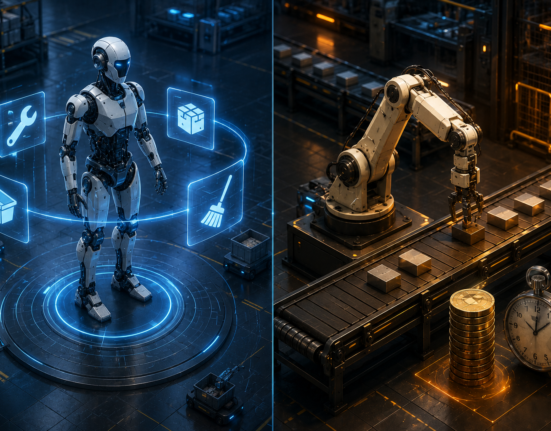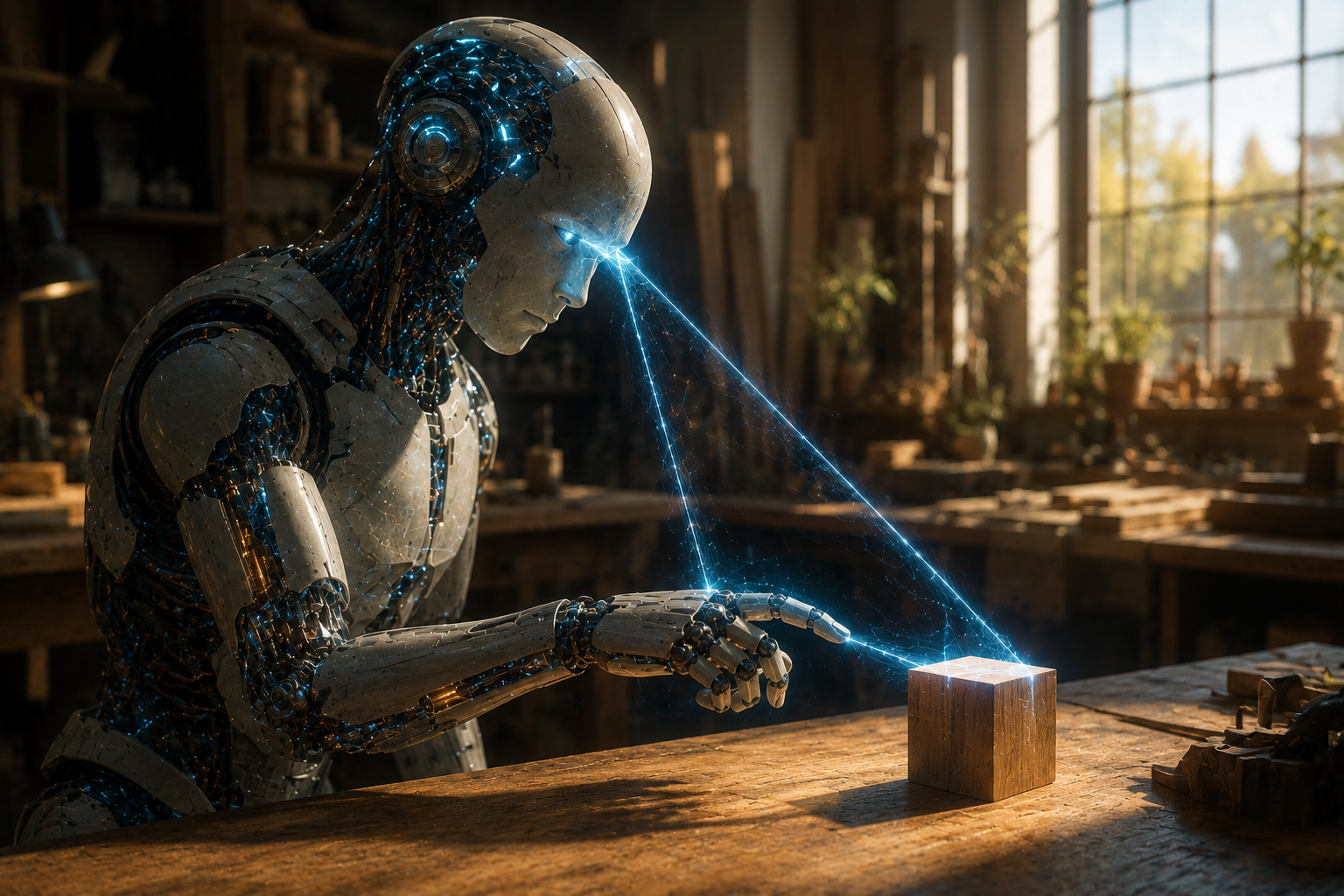
| Disembodied Reasoning (Text-Only Models) | Embodied Reasoning (Physically Grounded Systems) |
|---|---|
| Learns physical concepts secondhand, from descriptions of gravity, weight, and friction written by humans | Learns physical concepts directly, by dropping, lifting, and pushing real objects and observing the consequences |
| Can describe what should happen in a physics scenario fluently, but frequently fails on novel physical reasoning tasks | Builds an internal model of cause and effect calibrated against real sensorimotor feedback |
| Has no stake in outcomes; a wrong answer costs nothing and changes nothing about its “experience” | Has to live with the consequences of an action, creating a feedback loop that shapes future behavior |
| Excels at pattern completion across enormous text corpora | Excels at generalizing to genuinely novel physical situations it was never explicitly trained on |
My Position, Stated Plainly
I think the field has spent the better part of a decade assuming that general intelligence is fundamentally a scaling problem: more parameters, more tokens, more compute, and eventually something general falls out the other end. I no longer believe that is sufficient, and I do not think I am alone. The argument I want to make here is not that today’s large language models are useless or that scaling has stopped producing gains. It clearly has not. The argument is narrower and, I think, more defensible: genuine general reasoning, the kind that lets a system handle truly novel physical and causal situations rather than fluently recombining patterns it has seen described in text, likely requires a body that interacts with the real world. Not a simulation of a body. Not a description of embodiment fed in as more training data. An actual sensorimotor loop, with real consequences.
This is not a new idea invented by robotics companies with hardware to sell, although it is worth being honest that the people making this argument loudest often do have exactly that incentive. The underlying claim descends from decades of embodied cognition research in cognitive science, which has long argued that human reasoning is not an abstract symbol-manipulation process running on top of a body, but is shaped through and through by the body’s specific sensorimotor capacities. If that argument is even partially right for biological minds, it is a serious problem for the assumption that a disembodied system trained purely on text can reach the same kind of generality.
What “Physical Grounding” Actually Means
It is worth being precise here because “embodiment” gets thrown around loosely. Physical grounding does not simply mean a system has a camera or a robot arm attached to it. It means the system’s internal representations of concepts like weight, distance, friction, and causality are built from, and continuously checked against, its own sensorimotor experience of acting in the world. Recent survey work on embodied intelligence frames this as the central scientific question of the field: whether physical agents can be given autonomy that is safe, robust, and genuinely generalizable, as opposed to autonomy that looks robust in a benchmark and falls apart the moment conditions shift even slightly.
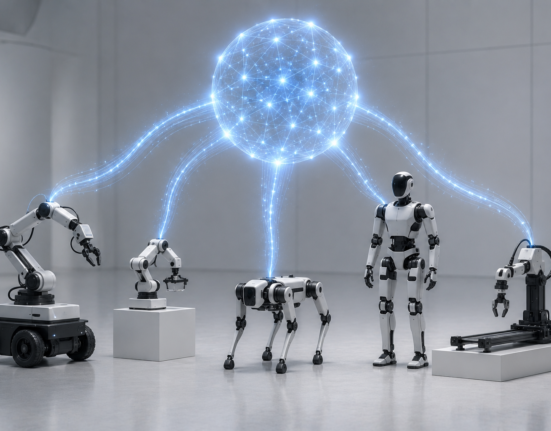
Embodied intelligence researchers increasingly describe embodiment, grounding, causality, and memory as interrelated and mutually reinforcing, where embodiment supplies the physical structure for interfacing with the world, and grounding is what lets an AI system genuinely experience that world through sensing and acting in response to sensory input and goals, rather than merely processing descriptions of it. This is a stronger and more specific claim than simply saying robots need sensors. It says the sensors and the actuators have to be tied into the reasoning loop itself, not bolted onto a reasoning system that was trained separately on text.
Two Paths to “Understanding” a Falling Object
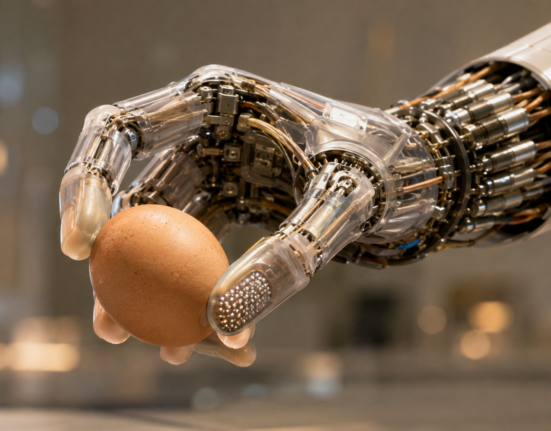
A text-trained model can generate a fluent, accurate-sounding paragraph about gravity, acceleration, and impact based on millions of descriptions it has ingested. A physically grounded system that has actually dropped, caught, and mishandled hundreds of objects has instead built an internal predictive model calibrated by real consequences, one that generalizes to an object it has never encountered, in a configuration it has never seen described, because the underlying representation was built from interaction rather than assembled from other people’s descriptions of interaction.
The Evidence That Text Alone Has a Ceiling
The strongest evidence for the embodiment argument is not philosophical, it is empirical, and it comes from watching where today’s most capable disembodied models actually fail. Recent analysis of large language model reasoning failures documents a consistent pattern: these systems remain fundamentally limited by their lack of true physical grounding, producing systematic errors and unrealistic predictions specifically when asked to reason about basic physical situations involving spatial relationships, object dynamics, and physical laws, the exact domain where an embodied system would have direct sensorimotor calibration to draw on instead of secondhand description.
This matters because these are not edge-case trivia failures. Reasoning, in any meaningful general sense, requires the ability to perceive, interpret, predict, and act within the physical world, with an accurate working model of how space, objects, and forces behave. A system that only knows about physical causality through text description is reasoning about a map of the territory it has never actually walked. It can be an extremely good map. It is still not the territory, and there will always be a category of situation where the map’s abstractions quietly diverge from what would actually happen if you tried it.
| Claim | Supporting Observation |
|---|---|
| Text-only models struggle with novel physical reasoning | Documented systematic errors and unrealistic predictions on basic physical reasoning tasks in recent LLM failure analysis |
| Embodiment provides a distinct grounding mechanism | Embodied intelligence research treats embodiment, grounding, causality, and memory as interlocking, not substitutable components |
| Robotics-specific manipulation still faces open challenges | Surveys of embodied intelligence for robot manipulation describe persistent gaps in generalization and development, not a solved problem |
| World models are being pursued as a middle path | Research explicitly frames “world models” and physical simulators as a route to embodied intelligence without requiring every training step to occur on physical hardware |
The Counterargument, and Where I Think It Falls Short
The strongest counterargument is that embodiment can be simulated. If a model trains inside a sufficiently rich physics simulator, or absorbs enough video of the physical world, perhaps that substitutes for a physical body without the expense, slowness, and safety risk of real hardware. There is real research energy behind this position, with a growing body of work on learning embodied intelligence from physical simulators and world models specifically because full physical deployment is expensive and slow.
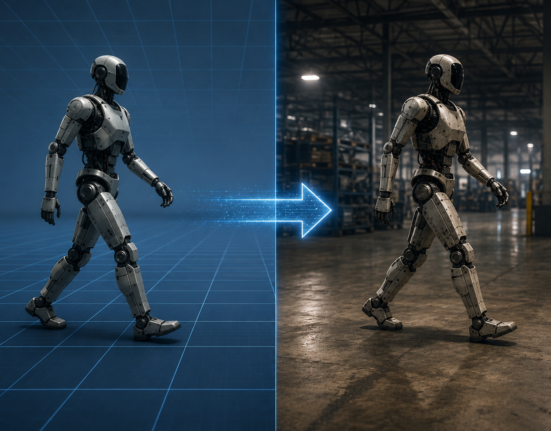
I take this seriously, because I do not think embodiment necessarily requires a literal humanoid robot destroying its knees on real pavement for a decade. But I think there is a load-bearing assumption in the pure-simulation view that does not hold up: a simulator is still, ultimately, a description of physics written by humans and encoded into code, and it inherits the same fundamental limitation as text, just at a different level of abstraction. A simulation can only be as physically accurate as the assumptions its designers built into it, and the situations where reality surprises us are disproportionately the situations a simulator’s designers did not anticipate. Real embodiment, with real sensors reporting real consequences, is the only mechanism that is, by construction, guaranteed to be checked against actual physics rather than someone’s model of it. That does not mean simulation is worthless. It means simulation is a scaffold, and at some point the scaffold has to touch the ground.
What This Means for the AGI Timeline Debate
If the physical grounding argument holds, it reframes a lot of the current AGI discourse. Progress on ever-larger disembodied language models should be understood as progress on a specific, extremely valuable but bounded kind of intelligence, roughly: fluent manipulation of and reasoning over the corpus of things humans have already written down and described. That is enormously useful. It is not obviously the same trajectory as general reasoning about a physical world that does not care what humans have written about it. Embodied AI is increasingly described in the literature as essential to advancing AGI precisely because it establishes the foundational link between cognitive representation and interaction with the physical world, letting a system engage with environments and manipulate objects rather than only discuss them.
Practically, this suggests that the organizations most likely to reach something resembling general intelligence are not necessarily the ones with the largest text corpora, but the ones combining large-scale learning with real embodied interaction loops, of the kind described in our coverage of vision-language-action models and robot foundation models, both of which are explicit attempts to fuse language-scale pretraining with physical action data rather than treating the two as separate problems.
- Embodied cognitionThe cognitive science position that reasoning and concept formation are shaped by an agent’s specific bodily and sensorimotor capacities, not purely abstract symbol manipulation.
- Physical groundingThe idea that a system’s internal representations of concepts must be built from and checked against real sensorimotor interaction, not just description.
- Sensorimotor loopThe closed cycle of sensing the environment, acting on it, and observing the consequences, which embodied cognition treats as central to genuine understanding.
- World modelAn internal predictive model of how the environment behaves, which some researchers pursue as a bridge between simulation and full physical embodiment.
- Generalization gapThe difference between a system’s performance on familiar benchmark scenarios and its performance on genuinely novel physical situations.
- Reality gapThe persistent mismatch between what a simulator predicts and what actually happens on real hardware in the real world, the core limitation of pure-simulation approaches.
A Common Mistake in This Debate
Common mistake
A frequent error on both sides of this debate is treating “embodiment” as binary, either a system has a robot body or it does not. In practice, embodiment exists on a spectrum from a passive camera feed with no ability to act, through simulated bodies acting in physics engines, to full physical robots with real consequences for their actions. Conflating these categories leads to overclaiming that any system with a camera is “embodied” in the sense that matters for grounding, when the research actually points to the closed sensorimotor loop, sensing plus acting plus consequence, as the operative mechanism, not the mere presence of a camera or a chassis.
What worked
Research programs that combined large-scale language and video pretraining with even modest amounts of real physical interaction data consistently showed better generalization to novel physical scenarios than either pure text training or pure simulation alone. The physical interaction data did not need to be enormous in volume to matter; it needed to be real, providing a calibration signal that simulation and description could not fully replace.
Where I Could Be Wrong
Intellectual honesty requires admitting the failure modes of my own position. It is possible that sufficiently rich multimodal training, video, audio, simulated physics, and text combined at a scale we have not yet reached, closes the gap without ever requiring a physical body with real consequences. It is also possible that “general reasoning” is itself a less unified concept than this debate assumes, and that different flavors of generality, linguistic, mathematical, physical, social, require different grounding mechanisms rather than one embodiment requirement covering all of them. I do not think either of these possibilities currently has strong empirical support, but they are the versions of the counterargument I take most seriously, and they are falsifiable in a way that should keep this debate empirical rather than purely philosophical over the next few years. For readers tracking the practical side of how physical data actually gets collected to test these claims, our pieces on teleoperation data collection, sim-to-real transfer, and dexterous manipulation cover the concrete mechanisms researchers are using to close the reality gap in the near term, regardless of which side of the theoretical debate turns out to be correct.
Key Takeaways
Key Takeaways
- Embodied cognition research argues that reasoning is shaped by an agent’s sensorimotor capacities, not purely abstract computation, a claim with decades of support in cognitive science.
- Disembodied language models show documented, systematic failures specifically on physical reasoning tasks involving space, objects, and causality, the exact domain embodiment would calibrate.
- Physical grounding means internal representations are built from and checked against real sensorimotor interaction, not merely having a camera or robot chassis attached.
- Simulation-based approaches to embodiment are valuable but inherit the same fundamental limitation as text: they are bounded by their designers’ assumptions about physics, unlike real interaction.
- Embodied AI is increasingly framed in research literature as a foundational requirement for AGI, not an optional enhancement layered on top of language capability.
- The most promising near-term path combines large-scale pretraining with real, even if modest, physical interaction data, rather than choosing purely text or purely embodied approaches.
- This remains a genuinely open empirical question; multimodal scaling without physical consequence, or a non-unified theory of generality, are the strongest counterarguments and should be tracked as the field progresses.
Glossary
- Embodied cognition
- A theory in cognitive science holding that cognitive processes are deeply shaped by an organism’s body and its interactions with the environment, rather than existing as abstract, body-independent computation.
- Physical grounding
- The requirement that a system’s internal representations of concepts be built from and validated against real sensorimotor experience rather than secondhand description.
- World model
- An internal, learned representation of how an environment behaves and responds to actions, used to predict outcomes without always requiring direct physical trial.
- Reality gap
- The persistent discrepancy between predictions made in simulation and actual outcomes observed on physical hardware in the real world.
- Generalist policy
- A single trained model capable of performing a wide range of tasks across varied conditions, as opposed to a narrow policy trained for one specific task.
FAQs
What does “embodied AGI” mean?
Embodied AGI refers to the idea that artificial general intelligence may require a physical body that senses and acts in the real world, rather than being achievable purely through training on text, images, or other disembodied data, because reasoning about physical causality may depend on real sensorimotor grounding.
Why do some researchers think physical grounding is necessary for general reasoning?
Embodied cognition research in cognitive science argues that human reasoning is shaped by bodily interaction with the world, and recent analysis shows large language models make systematic errors on basic physical reasoning tasks, suggesting text-based training alone may not produce the kind of grounded understanding general reasoning requires.
Can simulation substitute for real physical embodiment?
Simulation is a valuable and increasingly used tool, but it is bounded by the assumptions its designers encode into the physics engine. Real embodiment provides a calibration signal checked against actual physical consequences, which many researchers argue simulation alone cannot fully replicate, particularly for genuinely novel situations.
Do large language models already reason well about physical situations?
Not reliably. Recent research documents that large language models remain limited by a lack of true physical grounding, producing systematic errors and unrealistic predictions when reasoning about spatial relationships, object dynamics, and physical laws, especially in novel scenarios outside their training description.
Is this theory widely accepted in the AI research community?
It is an active and growing area of research rather than a settled consensus. Many embodied intelligence researchers argue physical grounding is foundational to AGI, while others believe sufficiently large-scale multimodal training without physical consequence could eventually close the gap; the debate remains genuinely open and empirically testable.
How does embodied AGI relate to current humanoid robot projects?
Humanoid robot projects that combine vision-language-action models with real-world physical interaction data are, in effect, live experiments in the embodied grounding hypothesis, since they test whether combining large-scale pretraining with genuine sensorimotor feedback produces more general reasoning than either approach alone.
What is the strongest counterargument to the physical grounding requirement?
The strongest counterargument is that sufficiently rich multimodal training, combining video, simulated physics, audio, and text at a scale not yet reached, might close the physical reasoning gap without requiring a real body with real consequences, though this remains unproven and is actively being tested.
What would prove the physical grounding argument wrong?
The argument would be seriously weakened if a purely disembodied, text-and-simulation-trained model achieved robust, human-level generalization on genuinely novel physical reasoning tasks it was never exposed to in any form during training, something that has not yet been demonstrated as of mid-2026.
- Embodied Intelligence: where control meets cognition in the physical world, OAE Publishing
- Large Language Model Reasoning Failures, arXiv
- Embodied intelligence for robot manipulation: development and challenges, Springer Nature
- Embodied AI: From LLMs to World Models, arXiv
- AGI and the Human Body: Embodiment, Cognition, and the Operational Reality Today, TechnoLynx
- A Survey: Learning Embodied Intelligence from Physical Simulators and World Models, arXiv