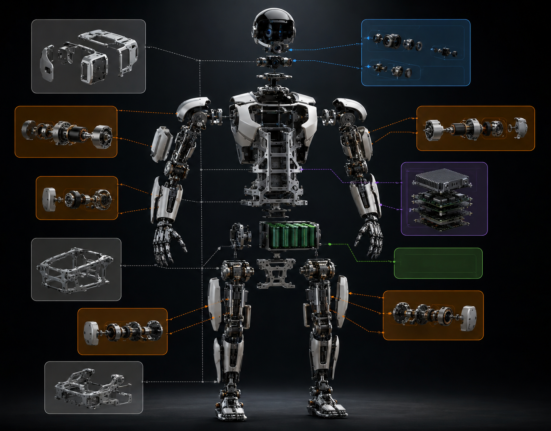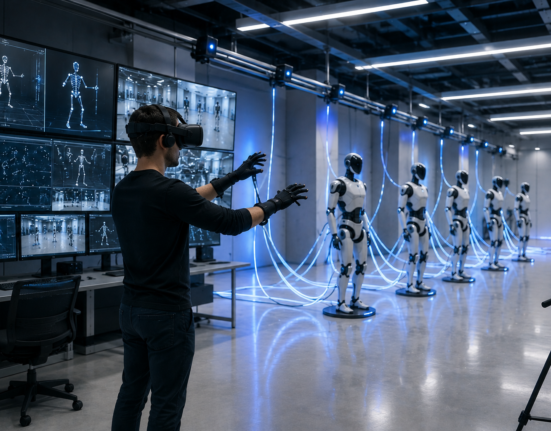
| Traditional Robot Programming | Foundation Model Approach |
|---|---|
| One model trained per robot, per task | One shared model trained across many robots and many tasks at once |
| New robot body requires starting from scratch | New robot body can reuse a pretrained backbone and fine-tune a small action head |
| Skills do not transfer between hardware platforms | Skills learned on one embodiment can partially transfer to another (cross-embodiment learning) |
| Performance plateaus with limited task-specific data | Performance improves as more embodiments and tasks are added to the shared training pool |
What “Foundation Model” Means When the Output Is a Motion, Not a Sentence
A language foundation model like GPT or Gemini is trained on huge amounts of text so that a single network can write, summarize, translate, and reason across countless tasks it was never explicitly programmed for. A robot foundation model applies the same idea to physical action: a single network is trained across huge amounts of visual, language, and motion data so that it can control many different tasks, and increasingly many different robot bodies, without being rebuilt from scratch for each one.
The term of art for this in robotics research is a Vision-Language-Action model, or VLA. A VLA takes in camera images and a natural-language instruction, such as “pick up the red block and place it in the bin,” and outputs a sequence of low-level motor commands. What makes it a foundation model rather than a narrow controller is that the same weights are trained across dozens of robots, hundreds of tasks, and millions of demonstration frames, so the model develops transferable visual and physical reasoning rather than memorizing one robot’s motion patterns.
This is a different, narrower framing than the industry-wide “humanoid robot workforce” story covered in our broader overview of the humanoid robot revolution. This piece is about the specific technical approach making cross-robot skill transfer possible, not the business or labor story around it.
The Core Problem: Every Robot Body Is Different
A robot arm bolted to a lab bench has a different number of joints, different camera placement, and a different gripper than a bipedal humanoid hand with 20-plus degrees of freedom. Historically, this meant a policy trained on one robot was close to useless on another, even for the exact same task, because the action space, meaning the set of numbers the model outputs to move motors, was structurally different from robot to robot.
Cross-embodiment learning solves this with a data trick as much as an architectural one. The Open X-Embodiment dataset, a widely used research collection, aggregates more than 1 million demonstration episodes across 22 distinct robot types into one training pool. Rather than training 22 separate models, researchers pad every robot’s action vector to match the dimensionality of the largest robot in the set, so a single model can be trained on all of them simultaneously, with the model learning which parts of its output apply to which embodiment.
The Shared Architecture: Backbone Plus Action Head
Nearly every recent generalist robot policy follows the same two-part architectural pattern, regardless of which lab built it:
- A shared perception-and-language backbone. This is typically a pretrained vision-language model, the same category of network behind image-captioning and visual question-answering systems, which already understands what objects look like and what language means before it ever sees a robot.
- An embodiment-specific action head. A smaller module bolted onto the backbone translates the shared understanding into the specific joint commands, gripper positions, or torque values a particular robot body needs.
This split is what allows the expensive part, teaching a model to understand the visual world and language, to be shared across every robot, while only the cheaper, smaller action head needs to be retrained or fine-tuned for a new body. It is directly analogous to how a single language model can be fine-tuned with a small adapter for a new domain rather than retrained from zero.
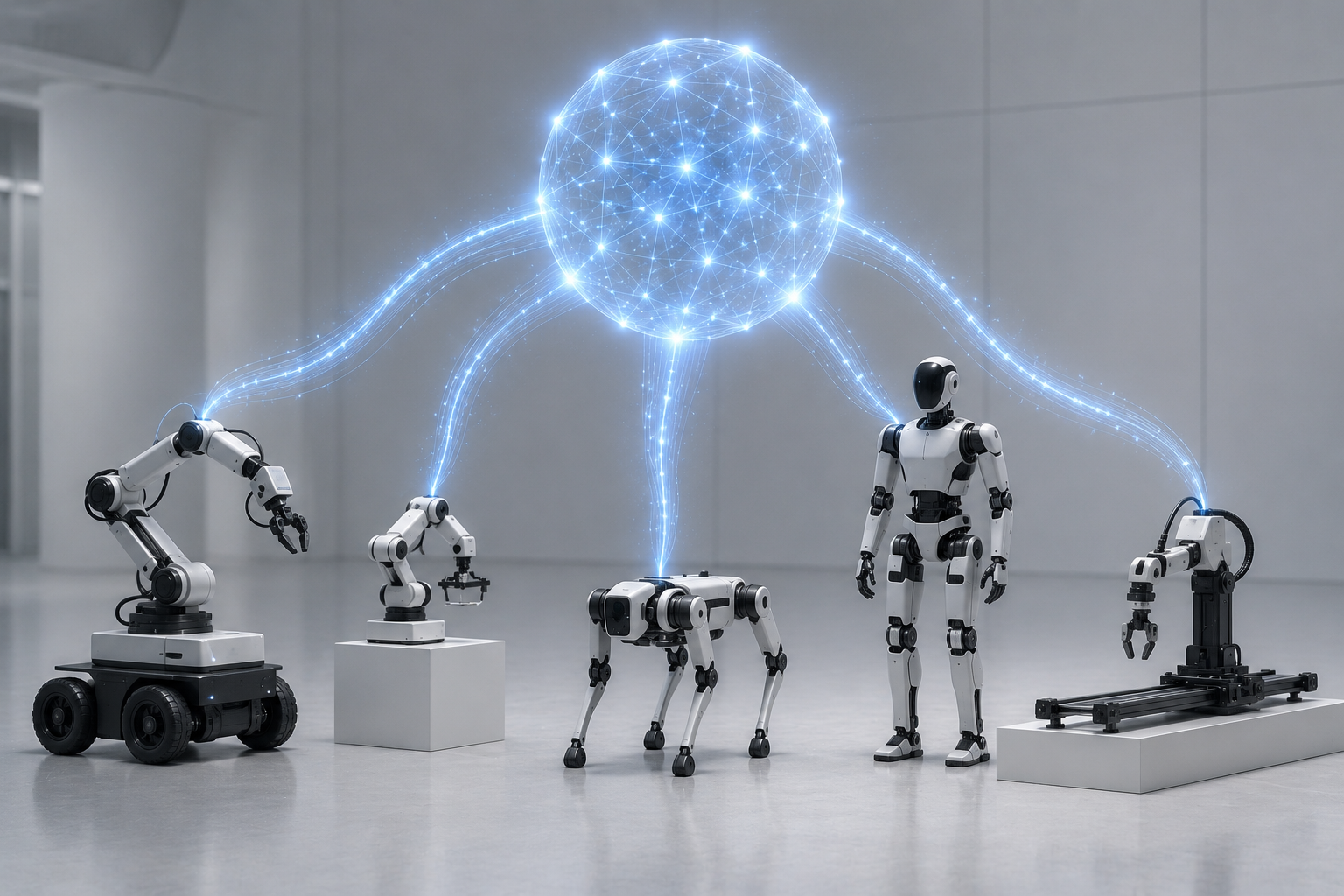
Figure: One Backbone, Many Action Heads
A conceptual diagram would show a single central network block labeled “shared vision-language backbone” with arrows branching outward to four smaller blocks, each representing a different robot’s action head: a stationary arm, a mobile manipulator, a quadruped, and a bipedal humanoid. The backbone is trained once across all of them; each action head is comparatively small and fast to adapt.
Major Research Efforts, Side by Side
No single company owns this approach. It is an active research category with contributions from multiple labs, each making different architectural choices.
| Model / Effort | Origin | Notable Detail |
|---|---|---|
| RT-2 | Google DeepMind research line | Combines internet-scale vision-language data with robot trajectories; raised manipulation success rate from 44 percent (RT-1) to 62 percent |
| RT-X / Open X-Embodiment | Multi-institution collaboration | Trained on over 1 million demonstrations spanning 22 robot types in one shared dataset |
| Octo | Open-source academic project | Transformer-based policy with a diffusion action head, pretrained on 800,000 robot episodes, designed to be quickly fine-tuned to new robots |
| OpenVLA | Open-source research release | Open-weights vision-language-action model trained on large-scale robot demonstration data |
| Pi-0 (Physical Intelligence) | Physical Intelligence | Flow-matching action generation on a PaliGemma-2B backbone, trained across 7 distinct robot configurations and 68 tasks with over 10,000 hours of demonstration data |
Some of these are pure research releases with no commercial product attached; others sit underneath commercial humanoid and manipulation platforms. NVIDIA’s GR00T and Large Behavior Model efforts, covered briefly elsewhere on this site, are one industry implementation of this same general approach, not a separate category of technology, which is why this explainer treats the concept broadly rather than as a single-vendor story.
How Skill Transfer Actually Happens
Transfer is rarely perfect zero-shot magic. In practice, cross-embodiment training produces two measurable benefits. First, a new robot body needs meaningfully less task-specific demonstration data to reach a usable success rate, because the shared backbone already understands what “picking up a cup” or “opening a drawer” generally looks like. Second, tasks that are rare on any single robot, but common somewhere across the combined dataset, become learnable at all, because the model pools experience across every embodiment in training rather than relying on one robot’s limited history.
This is conceptually similar to how a large language model that has never seen a specific company’s internal documents can still write a competent memo, because it learned the general structure of memos from millions of other documents. A robot foundation model that has never controlled a specific hand can still make a reasonable first attempt at grasping, because it learned general grasping physics from every other hand in its training pool.
Common mistake
Assuming cross-embodiment transfer means a model works immediately, at full reliability, on a brand-new robot with zero additional data. In practice, most deployments still require some fine-tuning on the target robot, and success rates on entirely unseen embodiments are typically lower than on embodiments included during training.
What worked
Padding action vectors to a common maximum dimensionality, the technique used in Open X-Embodiment and adopted by pi-0, turned out to be a simple, effective way to let one model ingest wildly different robot action spaces without needing a bespoke architecture per robot. It is one of the more practically important, if unglamorous, engineering decisions in this field.
Benchmarks: What “Better” Looks Like in This Field
Robot foundation models are typically evaluated on task success rate across held-out tasks and held-out robot embodiments, not on the kind of single leaderboard score common in language model benchmarking. RT-2’s jump from a 44 percent to 62 percent manipulation success rate over its predecessor RT-1 is one of the more concretely cited improvements attributable to adding internet-scale vision-language pretraining to a robot control model.
| Evaluation Dimension | What It Measures |
|---|---|
| In-distribution task success | Performance on tasks and robots seen during training |
| Cross-embodiment transfer | Performance on a robot body not included, or only lightly included, in training |
| Data efficiency | How few new demonstrations are needed to reach a usable success rate on a new robot |
| Language-following accuracy | Whether the robot correctly interprets varied natural-language phrasings of the same instruction |
Why This Matters More Than a Single Company’s Product Roadmap
The reason this category matters beyond any one company’s marketing is economic as much as technical. Collecting robot demonstration data is expensive: it typically requires a physical robot, a human operator, and substantial time, a process covered in more depth in our piece on teleoperation and data collection. If every robot body needed its own from-scratch dataset, the cost of training useful policies would scale linearly with the number of robot designs on the market. Cross-embodiment foundation models break that link, letting data collected on a cheap research arm partially benefit a completely different commercial humanoid platform.
This also connects directly to sim-to-real transfer, since simulated training data for one embodiment can, in principle, contribute to a shared foundation model that ultimately controls a different physical robot, and to whole-body control, which governs how a shared model’s outputs get coordinated across a humanoid’s full set of joints rather than a single arm.
- Action space paddingA simple engineering trick, zero-padding smaller robots’ action vectors to match the largest robot in the training set, is what makes joint training across dissimilar hardware feasible at all.
- Pretrained vision-language backbonesReusing an existing image-and-language model as the starting point means the robot policy inherits general visual understanding before it ever sees a single robot demonstration.
- Diffusion and flow-matching action headsRather than predicting one rigid motion, modern action heads generate a distribution of plausible motions and sample from it, which better captures the many valid ways to complete a physical task.
- Open X-Embodiment as shared infrastructureA public, pooled dataset spanning 22 robot types functions like a shared library that any research group can train against, accelerating progress across the whole field rather than one company alone.
- Data efficiency over raw scaleThe most cited benefit of cross-embodiment training is not that any single robot gets smarter, but that a new robot needs far less of its own data to become useful, directly lowering the cost of dexterous manipulation research on new hardware.
Where This Approach Still Falls Short
Cross-embodiment foundation models are not a solved problem. Transfer quality drops off for robot bodies that are structurally very different from anything in the training pool, such as a humanoid hand transferring from a simple two-finger gripper’s data. Long-horizon tasks requiring many sequential steps remain harder than single-step pick-and-place actions. And most public benchmarks still measure success in controlled lab settings rather than the variable conditions of a live warehouse or factory floor, the same gap explored in our warehouse deployment reality check.
- Vision-Language-Action model (VLA)
- A neural network that takes camera images and a natural-language instruction as input and outputs low-level robot motor commands as its prediction target.
- Cross-embodiment learning
- Training a single model across data from multiple different robot bodies so that skills learned on one platform partially transfer to another.
- Action head
- The smaller, embodiment-specific output module of a robot policy that converts a shared internal representation into the specific motor commands a given robot body requires.
- Open X-Embodiment
- A large, publicly pooled dataset of robot demonstration episodes spanning 22 distinct robot types, widely used to train generalist robot policies.
- Flow matching
- A generative modeling technique used by some action heads, including Physical Intelligence’s pi-0, to produce smooth, continuous robot motion trajectories rather than discrete predicted steps.
Key Takeaways
- A robot foundation model is a single network trained across many robot bodies and tasks, built from a shared vision-language backbone paired with embodiment-specific action heads.
- The category includes multiple independent research efforts, including Google’s RT-2, the open Octo project, OpenVLA, and Physical Intelligence’s pi-0, not one company’s product alone.
- The Open X-Embodiment dataset, spanning over 1 million demonstrations across 22 robot types, is a key shared resource enabling cross-embodiment training industry-wide.
- RT-2 demonstrated a concrete jump from 44 percent to 62 percent manipulation success by adding internet-scale vision-language pretraining over its predecessor RT-1.
- Cross-embodiment transfer mainly delivers data efficiency on new robot bodies, not instant, perfect zero-shot performance on unseen hardware.
- Padding action vectors to a shared maximum dimensionality is the simple engineering technique that makes joint training across dissimilar robots possible.
- The approach still struggles with structurally novel robot bodies, long-horizon multi-step tasks, and the gap between lab benchmarks and messy real-world deployment conditions.
FAQs
What is a robot foundation model in simple terms?
It is a single AI model trained across many different robots and tasks at once, rather than one model built for a single robot doing a single job. It uses a shared understanding of vision and language plus a smaller, robot-specific output layer to control different hardware.
What is cross-embodiment learning?
Cross-embodiment learning is training one model on data from multiple different robot bodies simultaneously, so skills learned on one platform partially transfer to a structurally different platform, reducing how much new data each robot needs.
What is a Vision-Language-Action model?
A Vision-Language-Action model, or VLA, takes camera images and a natural-language instruction as input and outputs the low-level motor commands needed to complete the described task, combining perception, language understanding, and control in one network.
Is NVIDIA’s GR00T the same thing as a robot foundation model?
GR00T is one commercial implementation of the broader robot foundation model concept, not the concept itself. The same architectural approach, a shared backbone with embodiment-specific action heads, appears across many independent research efforts including RT-2, Octo, OpenVLA, and pi-0.
How much data does it take to train a generalist robot policy?
Published examples vary widely; Physical Intelligence’s pi-0 was trained on more than 10,000 hours of demonstration data across 7 robot configurations and 68 tasks, while Octo was pretrained on roughly 800,000 robot episodes, illustrating that scale requirements differ by architecture and goal.
Do foundation models work perfectly on a brand-new robot with no extra data?
Not reliably. Most deployments still benefit from some fine-tuning on the target robot’s own data, and success rates on entirely unseen embodiments are typically lower than on robots represented during training, even though far less new data is required than training from scratch.
What is an action head in a robot foundation model?
The action head is the smaller output component of the model that translates a shared internal representation of the task into the specific joint angles, gripper commands, or torque values a particular robot body needs, allowing the larger backbone to remain shared across robots.
Why does this approach matter for the cost of robotics research?
Collecting robot demonstration data is expensive and typically requires physical hardware and human operators. Cross-embodiment foundation models let data collected on one robot partially benefit training for a different robot, reducing the total data collection burden across the industry.
References
- Octo Model Team: “Octo: An Open-Source Generalist Robot Policy”
- Physical Intelligence: “Pi-0: A Vision-Language-Action Flow Model for General Robot Control”
- Physical Intelligence: “Pi-0: Our First Generalist Policy”
- Google DeepMind research documentation on RT-2 and Open X-Embodiment / RT-X
- RoboCloud Hub: “Google Robotics Foundation Models 2026: RT-2, RT-X and Gemini Robotics Benchmarked”
- Penn PAL Lab: “Evaluating Pi-0 in the Wild: Strengths, Problems, and the Future of Generalist Robot Policies”
For related coverage in this series, see our reality-check comparison on humanoid robots in warehouses, our opinion piece on battery and actuator limits in bipedal robots, and our data-driven breakdown of the humanoid robot cost curve.