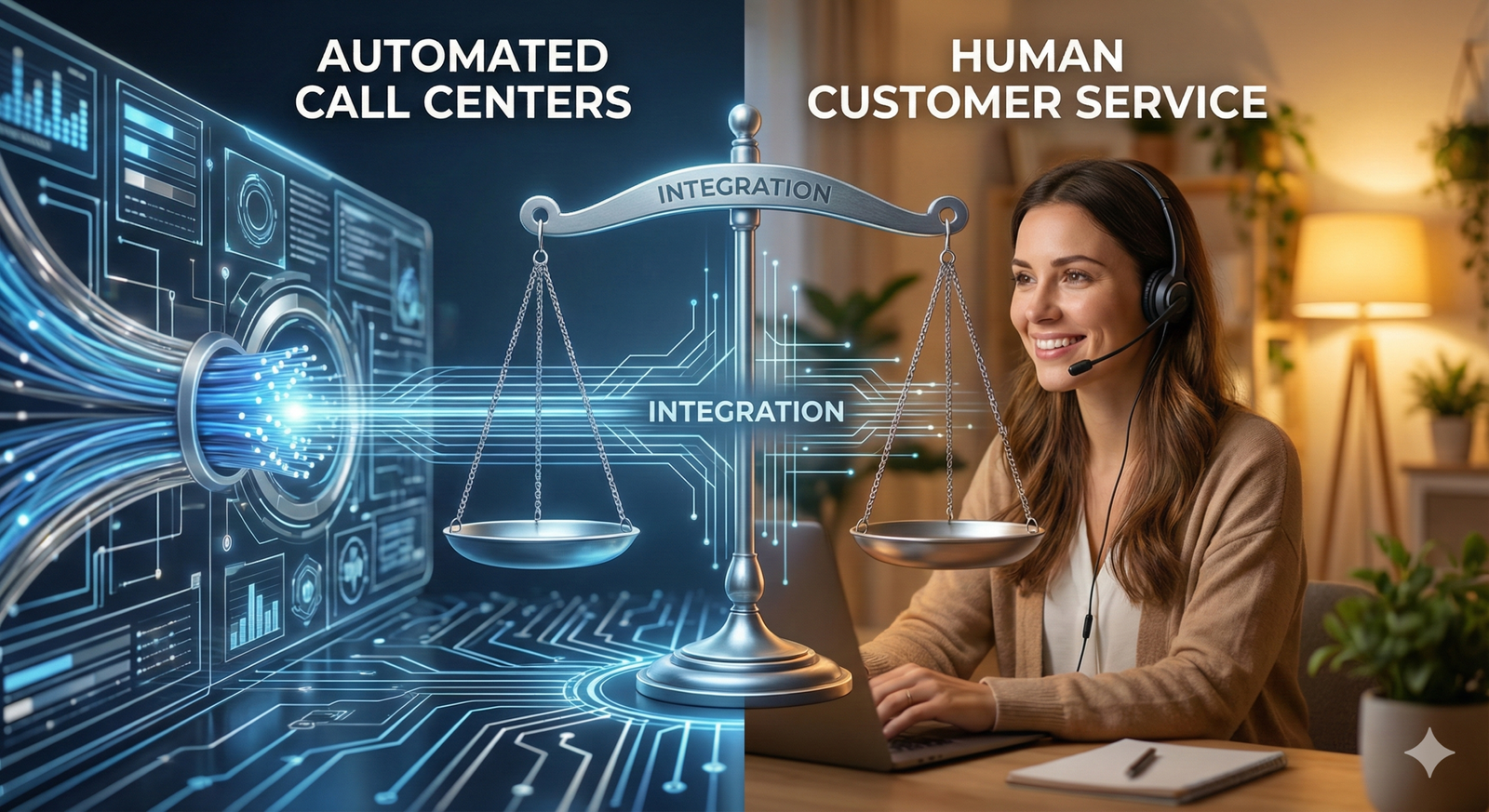
The debate between automated call centers vs human customer service has shifted dramatically in recent years. It is no longer a binary choice between robotic efficiency and human warmth. As of January 2026, the conversation has evolved into a strategic analysis of how to deploy both assets to maximize customer lifetime value (CLV) and operational efficiency.
For business leaders, operations managers, and customer support directors, the decision regarding where to draw the line between automation and human interaction is one of the most critical financial and reputational choices they will make. Get it wrong by over-automating, and you risk alienating loyal customers with “IVR loops” and unfeeling bots. Get it wrong by relying solely on humans, and you risk ballooning costs and inability to scale during peak seasons.
Who this guide is for (and who it isn’t)
This guide is designed for decision-makers and operations leaders in mid-market to enterprise-level organizations who are evaluating their customer support infrastructure. It is also highly relevant for startup founders scaling their support teams who need to decide whether to hire more staff or invest in AI stacks.
This guide is not for consumers looking for a phone number to call a specific company, nor is it a technical coding tutorial for setting up a specific telephony API. It is a strategic and operational comparison guide.
Key Takeaways
- The Cost Dynamic has Flipped: While automation requires upfront capital for software and configuration, human support carries compounding costs in salaries, benefits, and attrition management.
- Empathy remains the Human Moat: Despite advances in Large Language Models (LLMs), human agents remain vastly superior at handling emotional distress, complex complaints, and high-stakes negotiation.
- Speed vs. Accuracy: Automation wins on speed and availability (24/7), but human agents often win on “first contact resolution” for complex, non-standard issues that baffle algorithms.
- The Hybrid Model is the Standard: The most successful companies in 2026 use automation as a filter and assistant, not a replacement, reserving human talent for high-value interactions.
- Customer Tolerance is Finite: Data suggests that while younger demographics prefer self-service for simple tasks, tolerance for bad automation has plummeted across all age groups.
How we evaluated (criteria and trade-offs)
To provide a fair and useful comparison of automated call centers vs human customer service, we must look beyond simple sticker prices. We evaluated these two modalities based on five core pillars that determine the health of a support organization:
- Cost Efficiency: Not just salary vs. software, but “Total Cost of Ownership” (TCO) including training, turnover, implementation, and maintenance.
- Scalability & Availability: The ability to handle volume spikes (e.g., Black Friday or a service outage) and provide service outside of standard business hours.
- Customer Experience (CX) & Empathy: The qualitative impact on the customer’s mood, loyalty, and perception of the brand.
- Resolution Capability: The ability to actually solve the problem, whether it is a simple password reset or a complex billing dispute involving multiple departments.
- Data & Insights: The capacity to gather, analyze, and act on customer data generated during the interaction.
1. The Landscape of Automated Call Centers
When we discuss “automation” in 2026, we must distinguish between the legacy systems of the past and the intelligent systems of today.
Defining the Technology
- Traditional IVR (Interactive Voice Response): The “Press 1 for Sales” menu trees. These are rigid, rule-based systems that route calls but rarely solve problems.
- Conversational AI & Voicebots: These systems utilize Natural Language Understanding (NLU) to interpret spoken sentences. They can handle dynamic queries like “I want to change my flight to next Tuesday” without forcing the user through a menu tree.
- RPA (Robotic Process Automation) Integration: Automation that works in the background to execute tasks, such as processing a refund or updating an address in the CRM without human intervention.
The Primary Benefits of Automation
Speed and Availability
The single greatest advantage of an automated call center is immediacy. An automated system does not sleep, take breaks, or go on vacation. It creates a “zero wait time” environment. For a customer calling at 2:00 AM with a critical but simple issue—like locking their credit card—automation is superior simply because it is there.
Infinite Scalability
If your call volume triples due to a marketing campaign or a service outage, a human team will collapse under the pressure, leading to hour-long hold times. Automated systems can scale elastically. Cloud-based contact center solutions (CCaaS) can spin up thousands of concurrent instances instantly.
Data Consistency
Robots do not have bad days. They do not forget to ask for the account number, and they do not deviate from the script. This ensures 100% compliance with regulatory disclosures (essential in finance and healthcare) and ensures that data entry is standardized.
The Hidden Costs of Automation
While the “cost per contact” is low (often cents vs. dollars for humans), the Cost of Frustration is high. Bad automation creates “doom loops” where customers scream “Representative!” at the receiver. This damages Net Promoter Scores (NPS) and can lead to churn. Furthermore, the setup and maintenance of sophisticated AI require specialized talent—data scientists and conversation designers—who are expensive to hire.
2. The Case for Human Customer Service
Despite the hype surrounding AI, human customer service remains the premium standard for high-touch industries.
The Power of Empathy and Judgment
Humans possess “Theory of Mind”—the ability to understand that the person on the other end of the line has different knowledge, feelings, and intentions.
If a customer calls because their shipment is late and they need it for a wedding tomorrow, an AI can process a refund or check the status. It cannot, however, genuinely commiserate, understand the emotional weight of the “wedding” context, or creatively brainstorm an out-of-the-box solution (like calling a local branch to courier a replacement personally). That emotional connection builds brand loyalty that efficiency alone cannot achieved.
Handling Complexity and Ambiguity
Automation thrives on structure. Humans thrive on ambiguity.
- Automation: “If X, then Y.”
- Human: “It seems like X, but based on the tone of voice and the account history, it might actually be Z, so let me check with the warehouse manager.”
Complex issues often involve multiple variables: a billing error caused by a technical glitch during a promotional period for a grandfathered account. An AI might reject the request because it violates current rules. A human can navigate the “grey area,” make an exception, or escalate to a manager who can override the system.
Upselling and Relationship Building
While AI can suggest products based on algorithms (“Customers who bought this also bought…”), humans are better at consultative selling. A human agent can pick up on subtle cues—a mention of a growing family or a new home—and naturally suggest relevant upgrades in a way that feels helpful rather than intrusive.
3. Comparative Deep Dive: Automated vs. Human
Here we will break down the comparison across specific operational metrics.
Cost Analysis: Capex vs. Opex
| Cost Category | Human Customer Service | Automated Call Centers |
| Setup/Recruitment | High. Recruiting, background checks, onboarding. | High. Software licensing, API integration, conversation design. |
| Training | High & Recurring. 4-8 weeks initial training, plus ongoing coaching. | Medium. “Training” the model requires data, but once learned, it is deployed instantly. |
| Cost Per Interaction | High. $5.00 – $12.00+ per call (depending on region). | Low. $0.05 – $0.50 per interaction. |
| Scalability Costs | Linear. To handle double the calls, you need roughly double the staff. | Logarithmic. Marginal cost decreases as volume increases. |
| Attrition/Maintenance | High. Turnover rates in call centers often exceed 30-40%. | Low. Software requires updates, but “staff” never quits. |
In practice: For a low-volume, high-ticket business (e.g., luxury concierge), humans are more cost-effective because the setup cost of a great AI isn’t amortized over enough calls. For high-volume, low-complexity businesses (e.g., utility meter readings), automation is exponentially cheaper.
The “Empathy Gap” and CSAT Scores
Customer Satisfaction (CSAT) scores often dip when companies switch aggressively to automation. However, this is usually due to poor implementation rather than the automation itself.
- Scenario A: A customer waits 45 minutes to speak to a human to reset a password.
- Result: Low CSAT (Frustration with wait time).
- Scenario B: A customer resets a password in 2 minutes via a Voicebot.
- Result: High CSAT (Appreciation of speed).
- Scenario C: A customer tries to report a complex fraud case to a Voicebot that keeps offering to reset their password.
- Result: Extremely Low CSAT (Rage).
The Verdict: Automation drives CSAT up for simple tasks (speed) but drives it down for complex tasks (rigidity). Humans drive CSAT up for complex tasks (empathy) but down for simple tasks (waste of time/wait times).
Error Rates and Accuracy
- Human Error: Humans get tired. They mistype email addresses. They forget to read the mandatory disclosure script. However, they rarely make “contextual” errors (e.g., they know not to wish someone a “great day” after they report a death in the family).
- Machine Error: Machines do not make typos. They are 100% consistent. However, they suffer from “hallucinations” (in Generative AI) or classification errors (misunderstanding the intent). A machine might confidently give the wrong answer if the NLU confidence score is falsely high.
4. The Hybrid Model: The “Centaur” Approach
As of 2026, the industry standard is no longer “Automated vs. Human,” but rather “AI-Augmented Human Support.” This is often referred to in the industry as the “Centaur” model—combining the strength of the beast (AI horsepower) with the wisdom of the human.
Tiered Support Structure
The most effective structure utilizes automation as the Tier 0 and Tier 1 support layer.
- Tier 0 (Self-Service/Automation): The customer engages with a Voicebot or Chatbot.
- Goal: Deflect 40-70% of routine queries (FAQs, status checks, payments).
- Tech: NLU (Natural Language Understanding) identifies intent.
- Tier 1 (AI-Assisted Human): If the bot cannot solve it, the call is routed to a human. Crucially, the AI passes the context. The human sees a transcript of what the bot already asked.
- Augmentation: While the human talks, an “Agent Assist” AI listens to the conversation and pops up relevant knowledge base articles or compliance checklists on the agent’s screen in real-time.
- Tier 2 (Specialized Human): Highly complex issues are escalated to senior agents who are freed from routine calls and can dedicate time to deep problem solving.
“Human in the Loop” (HITL)
In this model, the AI handles the data entry and retrieval while the human handles the conversation. For example, during a call, the AI might automatically generate the “After Call Work” (ACW) summary notes, allowing the human to focus entirely on the customer rather than typing. This reduces burnout and improves accuracy.
5. Strategic Implementation: Making the Choice
If you are deciding how to balance your investment, use this decision framework.
When to Prioritize Automation
You should lean heavily into automated call centers if:
- Transactional Volume is High: You have thousands of daily calls regarding order status, balance checks, or appointment confirmations.
- Predictability is High: The types of questions you receive are repetitive and follow a clear logic tree.
- Budget is Tight / Labor is Scarce: You cannot afford to scale headcount linearly, or you operate in a region with a labor shortage.
- 24/7 Requirement: Your customers are global or operate outside standard hours.
When to Prioritize Human Customer Service
You should lean heavily into human agents if:
- High Stakes / High Emotion: You deal with emergencies, healthcare triage, insurance claims, or bereavement services.
- Luxury / High Touch: Your brand promise is exclusivity and personal attention (e.g., private banking).
- Complex Troubleshooting: Your product requires diagnostic creativity (e.g., bespoke IT hardware support).
- Sales Focus: Every support call is viewed as a retention or upsell opportunity that requires persuasion.
Transitioning Strategy
Do not flip a switch overnight.
- Analyze Contact Drivers: Use speech analytics on your current human calls to identify the top 5 reasons people call.
- Automate the Top 20%: Take the single most repetitive, simple task (usually “Where is my order?” or “Reset Password”) and automate only that.
- Validate: Measure CSAT specifically for that automated flow.
- Expand: Slowly add more intents to the automation layer.
- Retrain: As automation eats the simple tasks, retrain your human agents to handle the harder stuff. Their jobs will become more difficult (because they lose the “easy” mental breaks), so you may need to adjust compensation or break schedules.
6. Common Mistakes and Pitfalls
The “Set It and Forget It” Fallacy
Many companies deploy a chatbot or IVR and assume the job is done. Automation requires constant “gardening.” You must review logs of failed interactions weekly to tune the NLU model. If 500 people ask for “refunds” but your bot only understands “returns,” you are failing 500 customers.
The “Prisoner” Experience
Nothing destroys brand loyalty faster than an automated system that refuses to let the customer speak to a human. Always provide an escape hatch. If the customer asks for a “representative” twice, or if the system detects high sentiment urgency (shouting or negative keywords), route the call immediately. Trapping a customer in automation is a hostile act.
Ignoring Context
A common failure in 2026 is the “Amnesiac Bot.” If a customer is logged into your app and clicks “Call Support,” the system should know who they are. If the automation asks “Please enter your account number,” you have already failed. Modern automation must be context-aware.
Underestimating Voice Latency
In text chat, a 3-second delay is acceptable. In voice, a 3-second delay feels like an eternity and leads to people talking over each other. When implementing voice automation, latency must be sub-1000ms to feel natural.
7. Future Outlook: The Landscape in 2026 and Beyond
As of January 2026, several emerging trends are reshaping this debate.
Generative Voice AI
We have moved past robotic text-to-speech. Modern AI voices are indistinguishable from humans, complete with “umms,” “ahhs,” and breath pauses. They can modulate tone to sound sympathetic. This blurs the line for the customer, raising ethical questions about whether bots should self-identify as non-human (regulatory bodies in the EU and parts of the US now mandate this disclosure).
Sentiment-Based Routing
Advanced systems now analyze the customer’s biometrics and tone within the first few seconds of a call. If the system detects extreme stress or anger, it bypasses the standard automation queue and routes the caller to a specialized “de-escalation” human team.
Proactive Service
The debate is moving from “how do we answer calls” to “how do we prevent calls.” IoT (Internet of Things) devices and predictive AI are allowing companies to reach out to customers before they notice a problem (e.g., “We noticed your internet router is fluctuating; we are resetting it remotely now”). This reduces the volume for both humans and bots.
Conclusion
The battle of automated call centers vs human customer service is not a zero-sum game; it is an optimization puzzle. In 2026, the question is not “which one is better,” but “which one is better for this specific interaction?”
The winning strategy maximizes the strengths of both. Automation offers the reliability, speed, and data processing power that serves as the backbone of modern operations. Humans provide the empathy, creativity, and judgment that serve as the heart of the brand.
Businesses that lean too far into automation risk becoming sterile and frustrating. Businesses that rely too heavily on humans risk becoming slow and expensive. The sweet spot lies in the middle: a seamless, AI-enabled ecosystem where technology handles the friction, and humans handle the connection.
Next Steps:
- Audit your current call volume to identify the “low-hanging fruit” for automation (high volume, low complexity).
- Calculate your “Cost per Contact” for human agents to establish a baseline for ROI.
- Investigate CCaaS (Contact Center as a Service) platforms that offer “Agent Assist” features to start your hybrid journey.
FAQs
What is the biggest disadvantage of automated call centers?
The biggest disadvantage is the lack of genuine empathy and flexibility. Automated systems, even advanced ones, operate within defined logic parameters. They struggle to handle unique, multi-layered problems or emotional distress, which can lead to “doom loops” where a customer cannot get their problem resolved, leading to severe frustration and churn.
Are human customer service agents better for sales?
Generally, yes. While AI can handle transactional order-taking efficiently, human agents excel at consultative sales. They can build rapport, read emotional cues, and identify unstated needs, allowing them to upsell or cross-sell more effectively. High-value sales almost always require a human touch to build trust.
How much money can automation save a call center?
Automation can typically reduce operational costs by 30% to 50%. This savings comes from deflecting routine calls away from expensive human agents, reducing the need for large headcounts, and lowering training costs. However, these savings must be balanced against the cost of software implementation and potential risks to customer satisfaction if implemented poorly.
Can AI completely replace human customer service agents?
No, not in the foreseeable future. While AI can replace humans for routine, repetitive tasks (Tier 1 support), humans are still essential for complex problem solving, emotional support, high-stakes decision making, and managing the AI systems themselves. The role of the human agent is shifting from “answering phones” to “problem solving and relationship management.”
What is “first contact resolution” (FCR) and why does it matter?
First Contact Resolution (FCR) is a metric measuring the percentage of customer issues resolved during the very first interaction, without the need for follow-up calls. It is a primary driver of customer satisfaction. Human agents often have higher FCR for complex issues, while automation can achieve high FCR for simple transactional issues.
How do customers feel about speaking to AI?
Customer sentiment is mixed. Most customers appreciate AI when it is fast and solves their problem immediately (e.g., checking a balance). However, tolerance drops to near zero if the AI is confused, repetitive, or prevents them from speaking to a human when the issue is difficult. Transparency is key; customers prefer knowing they are speaking to a bot.
What is a “hybrid” customer service model?
A hybrid model combines AI and human support. Typically, AI handles the initial contact, verifying identity and solving simple requests. If the request is complex, the AI seamlessly transfers the call to a human agent, passing along all the data and context so the customer doesn’t have to repeat themselves.
Does automation improve employee retention in call centers?
Ideally, yes. By removing the boring, repetitive tasks (like resetting passwords all day), automation allows human agents to focus on more engaging and challenging work. This can lead to higher job satisfaction and reduced burnout. However, it also means the average difficulty of a human-handled call increases, requiring better support and pay for agents.
References
- McKinsey & Company. (2024). The State of Customer Care in 2024: AI, Analytics, and the Human Touch. McKinsey & Company.
- Gartner. (2025). Magic Quadrant for Contact Center as a Service (CCaaS). Gartner Research.
- Harvard Business Review. (2023). When to Automate and When to Humanize Customer Service. Harvard Business Publishing. https://hbr.org/
- Salesforce. (2025). State of Service Report, 7th Edition. Salesforce Research. https://www.salesforce.com/resources/research-reports/
- Forrester. (2024). The Future of the Contact Center: Predictions for 2030. Forrester Research.
- Zendesk. (2025). CX Trends 2025: The Rise of Immersive CX. Zendesk. https://www.zendesk.com/customer-experience-trends/
- Deloitte Digital. (2024). Global Contact Center Survey: Elevating the Human Experience. Deloitte.
- J.D. Power. (2024). U.S. Customer Service Satisfaction Study. J.D. Power.
- Qualtrics. (2025). Global Consumer Trends Report: The Human Connection. Qualtrics XM Institute.
- MIT Sloan Management Review. (2023). Designing AI for Empathy in Customer Service. MIT Sloan. https://sloanreview.mit.edu/