Imagine a flock of birds turning in the sky. Hundreds of individuals shift direction simultaneously, without a single leader shouting orders or a central air traffic controller directing their path. This fluid, adaptive, and robust behavior is the holy grail of modern robotics. It is known as swarm intelligence, and today, Artificial Intelligence (AI) is bridging the gap between biological wonder and engineered reality.
AI for robotics swarm coordination is the discipline of applying machine learning algorithms and decentralized control strategies to groups of robots—whether they are drones in the air, rovers on the ground, or AUVs (Autonomous Underwater Vehicles) in the deep sea. Instead of building one expensive, sophisticated robot to do a complex job, engineers are increasingly turning to hundreds of smaller, cheaper, and simpler robots that cooperate to achieve a common goal.
This guide explores the mechanisms, applications, and challenges of this transformative technology. Whether you are an engineering student, a tech industry professional, or a logistics manager, this comprehensive analysis will break down how AI turns individual machines into a cohesive, intelligent super-organism.
Key Takeaways
- Decentralization is Key: Unlike traditional robotics, swarms rarely rely on a central “brain.” Decisions are made locally by individual agents based on immediate sensor data and peer-to-peer communication.
- Resilience through Redundancy: If one robot in a swarm fails, the mission continues. The collective adapts to the loss, making swarms ideal for hazardous environments.
- Biomimicry: Most algorithms used in AI swarm robotics are directly inspired by nature—ant colonies, bee dances, and bird flocks.
- Scalability: AI models allow these systems to scale from ten to ten thousand units without needing exponential increases in computing power or bandwidth.
- Diverse Applications: From precision agriculture and warehouse logistics to search and rescue operations, swarm robotics is reshaping industries that require coverage of large areas.
Scope of This Guide
In this guide, “swarm robotics” refers to multi-robot systems that coordinate autonomously via local interactions. We will focus on the AI and software layer that enables this coordination—specifically machine learning, evolutionary robotics, and control algorithms.
- IN SCOPE: Decentralized algorithms, Reinforcement Learning (RL) in multi-agent systems, communication topologies, and industrial use cases.
- OUT OF SCOPE: Detailed hardware manufacturing guides (e.g., how to solder a drone motor) or singular remote-controlled robots (e.g., a hobbyist flying a single drone).
What is Swarm Robotics?
To understand how AI coordinates a swarm, we must first define what makes a “swarm” different from just a “group” of robots. In traditional multi-robot systems, a central computer often tracks every unit and tells exactly where to go. This is efficient for small numbers but fails at scale. If the central computer crashes, or communication is jammed, the entire fleet stops.
Swarm robotics flips this paradigm. It relies on Emergent Behavior.
The Principle of Emergence
Emergence occurs when complex global patterns arise from simple local rules. In a robot swarm, an individual robot might have only three rules:
- Separation: Don’t crash into your neighbors.
- Alignment: Head in the same general direction as your neighbors.
- Cohesion: Don’t drift too far away from the group.
When hundreds of robots follow these simple AI-driven rules, the group emerges as a cohesive unit that can navigate narrow corridors or encircle a target, even though no single robot has a map of the whole area.
Bio-Inspiration: The Roots of the Tech
AI researchers look to biology for “source code.”
- Ant Colonies (Stigmergy): Ants communicate indirectly by leaving pheromone trails. Robots mimic this by leaving “digital pheromones”—tagging a GPS location as “explored” or “hazardous” in a shared virtual map that other robots can read.
- Bee Dances (Consensus): Bees vote on new hive locations by dancing. Robots use consensus algorithms to “vote” on a path or strategy, ensuring the group acts as one without a leader.
- Fish Schools (Fluidity): Fish use pressure sensors to detect neighbor movements instantly. Robots use LiDAR and V2V (Vehicle-to-Vehicle) communication to react to neighbors in milliseconds.
The Role of AI in Swarm Coordination
While the basic rules of flocking can be hard-coded, modern industrial applications require something smarter. This is where advanced AI, specifically Machine Learning (ML) and Deep Reinforcement Learning (DRL), comes into play.
Moving Beyond Hard-Coded Rules
Hard-coded rules (If X, then Y) are brittle. They fail when the environment changes unexpectedly—for example, if a drone swarm encounters a type of wind turbulence it wasn’t programmed for. AI allows the swarm to learn and adapt.
Multi-Agent Reinforcement Learning (MARL)
Reinforcement Learning is a method where an AI agent learns by trial and error, receiving “rewards” for good actions and “penalties” for bad ones. In Multi-Agent Reinforcement Learning (MARL), multiple robots learn simultaneously.
- Collaborative Rewards: The robots are not rewarded for their individual speed, but for the group’s success. If one robot reaches the goal but leaves the rest behind, it gets zero points. It learns that “helping the group” maximizes its own score.
- Adversarial Training: AI swarms are often trained in simulated environments against “adversary” swarms. This evolutionary pressure forces them to invent complex tactics, such as sacrificial diversions or pincer movements, that human programmers might never have thought to code.
Evolutionary Robotics
This approach mimics natural selection. An algorithm generates hundreds of different “brains” (neural networks) for the robots. They run a simulation (e.g., “collect all the trash in the arena”). The best-performing brains are “bred” (mixed code) and mutated to create the next generation. Over thousands of generations, the AI evolves highly efficient coordination strategies that are often incomprehensible to humans but mathematically perfect for the task.
Key Algorithms and Mechanisms
How do these robots actually talk and think? The “AI” is usually a stack of several algorithms working in concert.
1. Stigmergy and Indirect Communication
As mentioned, this is communication through the environment. In a warehouse, a robot might not radio another robot to say “I am moving Box A.” Instead, it updates a digital tag on Box A in the cloud database. The next robot scans Box A, sees the status “Moved,” and knows not to touch it. This reduces bandwidth congestion because robots don’t need to constantly chatter with every peer.
2. Consensus Algorithms
When a swarm needs to make a decision—such as “Is this bridge safe to cross?”—it cannot wait for a human operator.
- The Process: Robot A scans the bridge and rates safety at 80%. Robot B scans it at 40%. They share data with neighbors.
- The Average: Through iterative local exchanges, the values propagate through the swarm. The swarm quickly converges on an average value. If the consensus falls below a safety threshold, the entire swarm retreats.
- Blockchain Integration: Some secure swarms use lightweight blockchain ledgers to ensure that the data fed into the consensus hasn’t been spoofed by a hacked robot.
3. Potential Fields Method
This is a navigation AI technique. The target (e.g., a survivor in a rescue mission) is assigned an attractive force (gravity). Obstacles (walls, fire) are assigned a repulsive force. Other robots also have a slight repulsive force (to prevent collisions).
- The Result: The robot simply “rolls downhill” through the mathematical landscape. It naturally flows around obstacles and toward the target while maintaining spacing from peers, requiring very little computation power.
4. Task Allocation (Auction-Based)
How do you decide which robot does what?
- The Auction: A task appears (e.g., “Inspect Sector 7”).
- The Bids: Robots calculate their “bid” based on their battery level, distance to Sector 7, and current sensor capabilities.
- The Winner: The robot with the best bid (lowest cost/highest efficiency) automatically wins the task. This happens in milliseconds without human intervention.
Technological Components of a Smart Swarm
AI is the mind, but the body must be capable of supporting it.
Sensors and Perception
For AI coordination to work, robots must have “spatial awareness.”
- LiDAR & Radar: For precise distance measuring.
- Optical Flow Cameras: Used by drones to detect movement and stabilize flight without GPS.
- Proprioception: Sensors that tell the robot about its own internal state (battery, motor heat). A robot sensing low battery effectively “removes itself” from the available pool of agents, triggering the swarm to reorganize.
Communication Topologies
- Mesh Networks: This is the gold standard for swarms. Robot A talks to Robot B, and Robot B talks to Robot C. If Robot A wants to send data to Robot C, it hops through B. This extends the range of the swarm far beyond the range of a base station.
- Local Broadcasting: Robots often shout “I am here!” ten times a second via Wi-Fi or Zigbee. Neighbors listen to maintain formation.
Edge Computing
Latency is the enemy of coordination. If a drone sees a bird and has to send that image to a cloud server to ask “What is this?”, it will crash before the answer returns. Edge AI involves running the neural networks directly on the robot’s onboard chips (like NVIDIA Jetson or Raspberry Pi modules). The robot processes the image, identifies the obstacle, and swerves—all in microseconds. Only the summary data (“Obstacle avoided at coordinates X,Y”) is sent to the cloud.
Real-World Applications
We are moving from “cool lab demos” to critical industrial infrastructure.
1. Search and Rescue (SAR)
In the aftermath of an earthquake, time is the enemy. A single dog or human can only check one spot at a time.
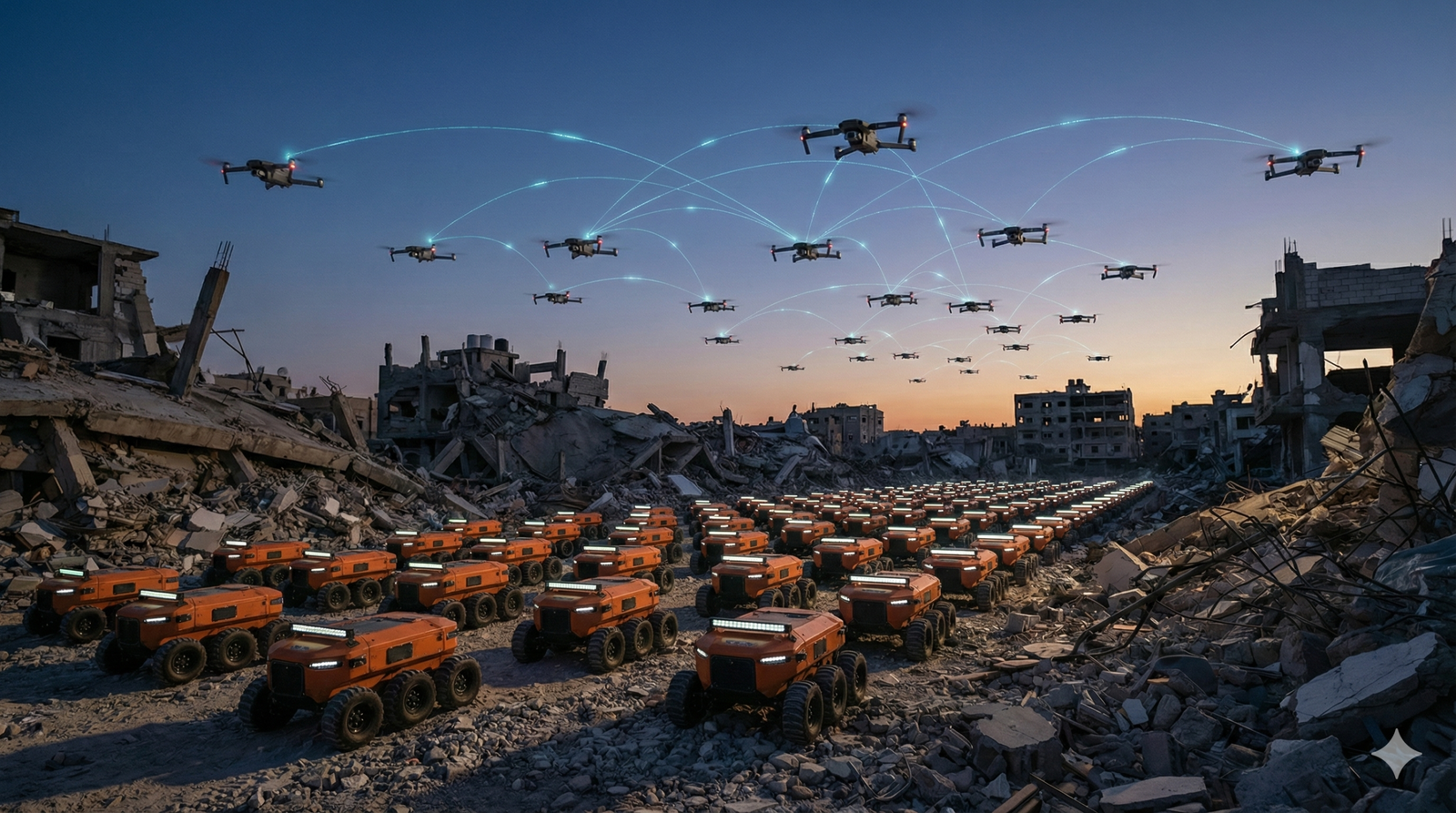
- The Swarm Solution: A truck releases 50 small drones and 20 ground crawlers. They disperse instantly.
- Coordination: The drones map the rubble from above, identifying voids. They beam this data to the crawlers, which navigate into the holes to listen for heartbeats.
- Self-Healing: If a drone runs out of battery or is damaged by falling debris, the mesh network reroutes data around it, and other drones expand their flight paths to cover the gap.
2. Precision Agriculture
Feeding 10 billion people requires efficiency that tractors cannot provide.
- The Swarm Solution: Instead of one massive tractor compressing the soil, a farmer deploys a swarm of small, solar-powered “agribots.”
- Action: These robots patrol rows of crops 24/7. Using computer vision AI, they identify individual weeds and zap them with a micro-dose of herbicide or a laser. They communicate pest outbreaks instantly (“Aphids detected in Row 40”), triggering neighboring robots to converge and contain the infestation.
3. Warehousing and Logistics
Companies like Amazon and Ocado have pioneered this.
- The Grid: In Ocado’s hives, thousands of robots zip around a grid faster than the eye can follow. They pass within millimeters of each other.
- AI Traffic Control: While often centrally managed, newer systems use decentralized AI to allow robots to negotiate right-of-way at intersections dynamically, reducing the computing load on the central server and preventing “traffic jams.”
4. Environmental Monitoring
- Oil Spills: Swarms of aquatic surface robots can coordinate to surround an oil slick, moving in formation to tow a containment boom.
- Forest Fires: Drone swarms can fly below the tree canopy (where satellites can’t see) to map the exact heat front of a fire, calculating wind speed and fuel density to predict where the fire will jump next.
Challenges and Ethical Considerations
Despite the promise, significant hurdles remain before we see swarms everywhere.
The Scalability vs. Bandwidth Dilemma
As you add more robots, the “chatter” increases exponentially. If 1,000 robots all try to talk at once, the network jams (spectral congestion).
- The Fix: AI researchers are developing “meaning-based communication.” Instead of sending raw data, robots use Semantic Communication—sending only the meaning or intent of a message, compressing the data needed by 90% or more.
The “Sim-to-Real” Gap
An AI trained in a simulator (like a video game) often fails in the real world because the real world is messy. Mud is slippery in ways code isn’t; wind gusts are unpredictable.
- The Fix: Domain Randomization. During training, the simulation gravity, friction, and lighting are wildly varied, forcing the AI to learn robust strategies that work even when physics feels “off.”
Battery Life and Energy
Coordination costs energy. Constantly transmitting data and running GPU processors drains batteries.
- The Fix: Energy-aware algorithms. The swarm might decide to “sleep” part of its members while others patrol, rotating shifts autonomously to ensure 24/7 coverage without human intervention.
Security and Hacking
A swarm is only as strong as its weakest node. If a hacker captures one drone and injects false data (e.g., “There is a fire here” when there isn’t), the consensus algorithm might be tricked, causing the whole swarm to react to a phantom event.
- The Fix: Immunological systems. AI that monitors the “health” of the data. If one robot’s data deviates statistically from its neighbors, the swarm identifies it as “infected” and ignores it.
Weaponization and Dual-Use
This is the most pressing ethical concern. The same technology used to find survivors in rubble can be used to hunt soldiers on a battlefield.
- Lethal Autonomous Weapons Systems (LAWS): There is intense international debate regarding bans or regulations on swarms that can deploy lethal force without specific human authorization for each target.
- The “Black Box” Problem: If a swarm destroys a civilian building because its neural network “thought” it was a target, who is responsible? The programmer? The commander? The robot manufacturer? The decentralized nature of the decision-making makes liability murky.
Future Trends: What’s Next?
Heterogeneous Swarms
Currently, most swarms are homogeneous (all drones or all rovers). The future is heterogeneous collaboration.
- Scenario: A large “Mother” blimp (high altitude) deploys fast fixed-wing drones (mid-altitude) for scanning, which deploy quadcopters (low altitude) for inspection, which deploy crawling robots (ground) for interaction. The AI must translate data between these vastly different platforms seamlessly.
Human-Swarm Interaction (HSI)
How does one human control 100 robots? You cannot use a joystick.
- Intent-Based Control: The human commander issues a high-level goal: “Secure this perimeter.” The AI swarm figures out the formation, the patrol schedules, and the resource allocation.
- Brain-Computer Interfaces (BCI): Research is underway to allow humans to “guide” swarms using EEG headsets, influencing the swarm’s movement through thought patterns interpreted by AI.
Nano-Swarms
Looking further ahead, researchers are looking at medical swarms—microscopic robots injected into the bloodstream. These would use simple swarm intelligence to congregate around a tumor and deliver drugs, governed by the same algorithmic principles as drones, but operating in fluid dynamics.
Conclusion
AI for robotics swarm coordination represents a fundamental shift in how we build and deploy machines. We are moving away from the era of the “smart robot” to the era of the “smart system.” By leveraging decentralized AI, biomimicry, and reinforcement learning, we are creating mechanical workforces that are robust, scalable, and adaptable.
While challenges in power, security, and ethics remain substantial, the trajectory is clear. From the food on our plates (harvested by agribots) to the packages at our door (sorted by logistics swarms) and our safety in disasters (ensured by rescue drones), swarm robotics will be the invisible, intelligent fabric of the automated future.
Next Steps: If you are a developer or student interested in this field, start by exploring simulation environments like Gazebo or Webots, and look into Python libraries for Multi-Agent Reinforcement Learning such as PettingZoo or Ray RLlib. The barrier to entry is dropping, and the swarm is waiting for new minds to guide it.
FAQs
What is the difference between a robot swarm and a multi-robot system?
While the terms are often used interchangeably, a multi-robot system can be centralized (one computer controlling everyone) and may consist of only 2-3 robots. A robot swarm specifically refers to a decentralized system with a large number of units (often dozens or hundreds) where collective behavior emerges from local interactions, and no single robot is critical to the mission.
How do swarm robots communicate without jamming the network?
They use a combination of mesh networking (hopping messages from robot to robot) and stigmergy (communicating via environmental modifications). Furthermore, advanced swarms use AI to compress data, sending only high-level semantic information (“Target found”) rather than raw video feeds, which saves massive amounts of bandwidth.
Can a swarm work if the internet goes down?
Yes. This is one of the primary benefits of swarm robotics. Because they rely on local Peer-to-Peer (P2P) communication and onboard Edge AI processing, they do not need a connection to the cloud or a central server to function. They are fully autonomous in the field.
What programming languages are used for swarm robotics?
Python and C++ are the dominant languages. Python is preferred for developing the AI and Machine Learning models (using PyTorch or TensorFlow), while C++ is used for the low-level flight control and sensor processing on the robot hardware due to its speed and efficiency. ROS (Robot Operating System) is the standard middleware used to tie it all together.
Are swarm robots expensive?
Individually, no. The philosophy of swarm robotics is “quantity over quality.” The goal is to use cheap, disposable, off-the-shelf components. If a $500 drone crashes, it doesn’t matter. This is in contrast to a single $50,000 robot where a crash is catastrophic. The cost lies in the software development, not the individual hardware units.
Is AI necessary for swarm robotics?
For simple flocking behaviors, simple mathematical rules suffice. However, for complex real-world tasks like searching a collapsed building or differentiating between crops and weeds, AI is essential. It enables the robots to perceive their environment, learn from mistakes, and adapt to unforeseen obstacles dynamically.
What happens if a “rogue” robot joins the swarm?
This is a security risk known as the “Byzantine Generals Problem.” If a robot is hacked and sends bad data, it can disrupt the swarm. To counter this, swarms use consensus algorithms and trust modeling. If a robot’s data consistently contradicts the majority of its neighbors, the swarm’s AI will identify it as an outlier and ignore its inputs or electronically isolate it from the network.
Who is leading the research in swarm robotics?
Major academic institutions like MIT (Senseable City Lab), Harvard (Wyss Institute), and ETH Zurich are leaders. In the defense sector, DARPA (with programs like OFFSET) pushes the boundaries. Commercial leaders include companies in logistics (like Kiva Systems/Amazon Robotics) and dedicated drone swarm startups like Verity or Skydio.
References
- Science Robotics. (2021). Swarm robotics: A review from the swarm engineering perspective. American Association for the Advancement of Science. https://robotics.sciencemag.org
- Nature. (2019). Scalable and robust self-organized behaviors in a swarm of 1000 autonomous robots. Nature Publishing Group. https://www.nature.com
- DARPA. (2022). OFFensive Swarm-Enabled Tactics (OFFSET) Program Information. Defense Advanced Research Projects Agency. https://www.darpa.mil/work-with-us/offensive-swarm-enabled-tactics
- IEEE Transactions on Robotics. (2023). Decentralized Multi-Agent Reinforcement Learning for Swarm Coordination. IEEE Robotics and Automation Society. https://ieeexplore.ieee.org
- Harvard Wyss Institute. (2020). Kilobots: A Thousand-Robot Swarm. Harvard University. https://wyss.harvard.edu/technology/kilobots-a-thousand-robot-swarm/
- MIT News. (2023). Decentralized control for drone swarms in cluttered environments. Massachusetts Institute of Technology. https://news.mit.edu
- Frontiers in Robotics and AI. (2024). Ethical Considerations in the Design of Autonomous Swarms. Frontiers Media. https://www.frontiersin.org
- Amazon Robotics. (2023). The technology behind the Amazon fulfillment centers. Amazon Science. https://www.amazon.science