In the rapidly evolving landscape of digital marketing, a new face has emerged—one that has never taken a breath, never signed a contract, and never walked a runway. AI-generated faces in advertising are transforming how brands connect with consumers, offering unprecedented control, cost efficiency, and scalability. From hyper-realistic “influencers” on Instagram to diverse cast members in global campaigns, synthetic humans are becoming ubiquitous.
However, this technological leap brings profound ethical questions. When a skincare brand uses a face that has never had skin problems to sell acne cream, is that deception? When a company generates a diverse array of digital models instead of hiring marginalized human talent, does it support inclusion or merely simulate it?
This guide explores the complex ethical dilemmas surrounding the use of AI-generated faces in advertising. We will examine the tension between innovation and authenticity, the legal frameworks forming around synthetic media, and practical strategies for brands to navigate this new reality responsibly.
In this guide, “AI-generated faces” refers to photorealistic human visages created entirely by artificial intelligence algorithms (such as GANs or diffusion models), distinct from “deepfakes” which swap existing likenesses, though the ethical lines often blur.
Key Takeaways
- Authenticity Crisis: Using synthetic faces for performance-based products (like cosmetics) risks misleading consumers and violating truth-in-advertising laws.
- Displacement Concerns: The rise of digital models poses a significant threat to the livelihoods of entry-level and mid-tier human models and photographers.
- Diversity vs. “Diversity Washing”: Generating diverse faces can lower costs, but it risks commodifying representation without providing economic opportunity to actual diverse communities.
- Legal Ambiguity: As of January 2026, copyright and “right of publicity” laws are struggling to keep pace, creating liability risks for brands using look-alike generators.
- Disclosure is Mandatory: Emerging regulations and ethical standards increasingly require clear labeling of AI-generated content to maintain consumer trust.
What Are AI-Generated Faces in Advertising?
To understand the ethics, we must first understand the capability. AI-generated faces are not merely photoshopped images; they are entirely new creations synthesized by machine learning models.
The Technology Behind the Faces
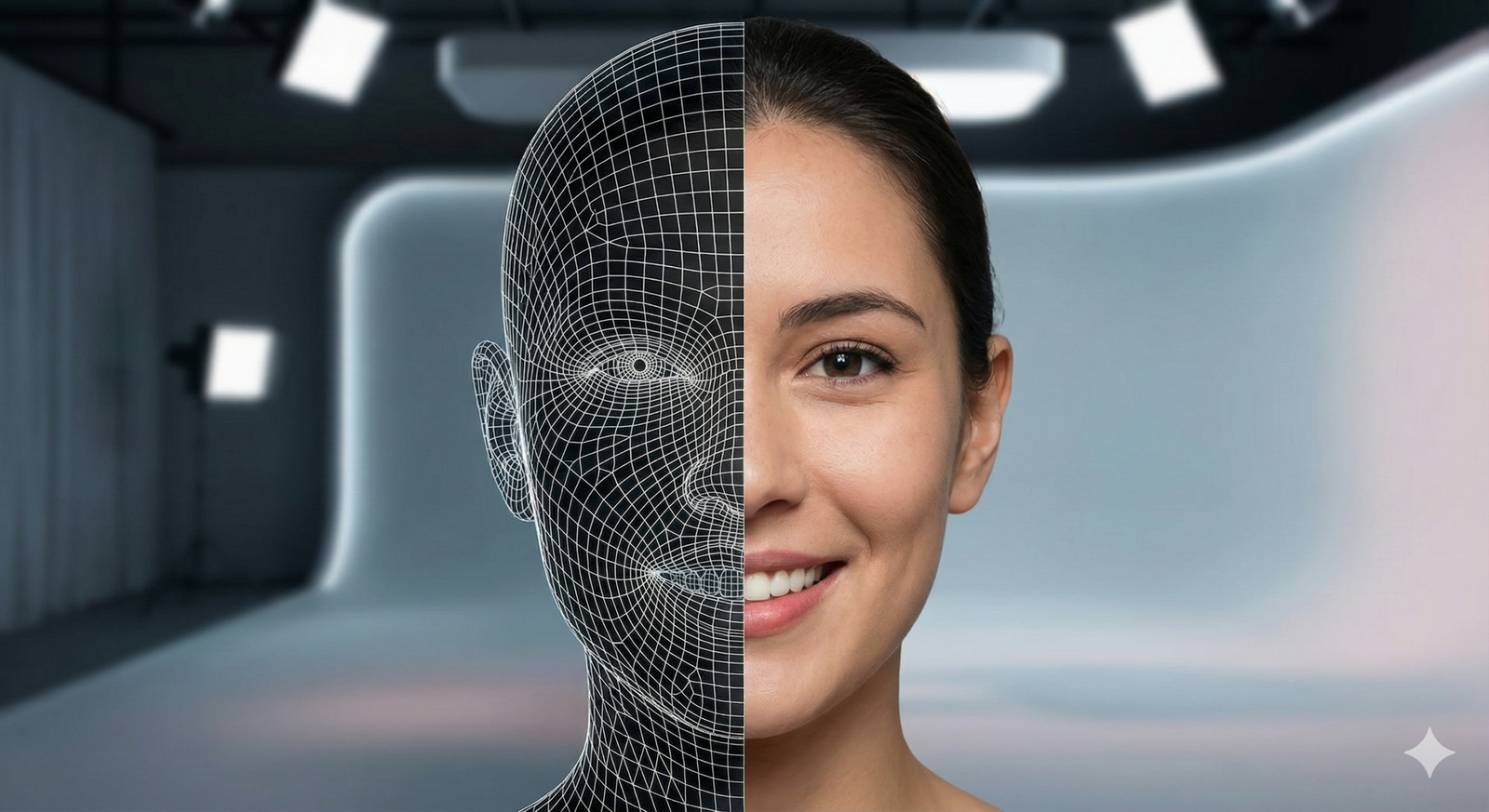
The technology relies heavily on Generative Adversarial Networks (GANs) and, more recently, advanced diffusion models. These systems are trained on datasets containing millions of real human images. The AI learns the statistical correlations of facial features—how light hits a cheekbone, the texture of skin pores, the symmetry of eyes—to construct a new face that looks indistinguishable from a photograph.
Tools have evolved from generating static headshots to creating full-body, moving digital avatars that can speak, express emotion, and wear digital clothing. This allows for “virtual influencers” like Lil Miquela (though often manually animated, increasingly AI-driven) and on-demand model generation for e-commerce.
The Business Case for Synthetic Models
Brands are not adopting this technology solely for its novelty. The economic and operational incentives are massive:
- Cost Reduction: A traditional photoshoot requires booking models, photographers, makeup artists, lighting crews, and studio space. AI generation requires a subscription and a prompt.
- Scalability: A single base image can be altered to look European, Asian, or African to suit different regional markets without reshooting.
- Total Control: Digital models never show up late, never age, never get involved in scandals, and can work 24/7.
- Perpetual Rights: Brands own the image assets completely, avoiding the need to renegotiate usage rights or pay residuals to human talent.
While these benefits are clear, they are the exact drivers of the ethical friction we see today.
The Trust Deficit: Authenticity and Deception
The most immediate ethical challenge regarding AI-generated faces in advertising is the potential for deception. Advertising relies on a social contract: the consumer understands the image is polished, but assumes a baseline of reality. AI threatens to sever this link entirely.
The “Results” Problem in Beauty and Wellness
The stakes are highest in industries where the physical appearance of the model serves as “proof” of the product’s efficacy.
- Skincare and Cosmetics: If an advertisement for an anti-aging cream features an AI-generated woman with flawless skin, the advertisement is fundamentally deceptive. The model has no skin; she has pixels. She has never used the product, nor could she. Her lack of wrinkles is a result of code, not collagen.
- Fitness and Wellness: Similarly, using AI-generated bodies to sell fitness apps or supplements implies a physiological result that the digital entity never achieved.
As of January 2026, regulatory bodies like the FTC (Federal Trade Commission) in the US and the ASA (Advertising Standards Authority) in the UK have signaled that using synthetic media to substantiate objective product claims without disclosure constitutes false advertising.
The Uncanny Valley of Brand Trust
Beyond legalities, there is the issue of consumer sentiment. When consumers discover that a “person” they felt a connection with is a fabrication, the backlash can be severe. Trust is hard to build and easy to break.
- Parasocial Betrayal: Virtual influencers often build followings based on perceived personality and lifestyle. When these accounts promote products, the line between character-play and deceptive endorsement blurs.
- Brand Authenticity: Brands that champion “real beauty” or “authentic connection” risk appearing hypocritical if they pivot to synthetic models to save money.
Case Study: The “Perfect” Smile
Consider a hypothetical dental aligner company. They use AI to generate smiling faces with perfectly straight teeth for their landing page.
- The Argument For: It saves money on a photoshoot; the teeth are just illustrative of the ideal outcome.
- The Ethical Breach: It implies that the aligners can achieve that specific geometry. If the AI generates a jaw structure that is biologically improbable for most humans, the ad sets a false standard of success.
“Diversity Washing”: The Representation Paradox
One of the most contentious aspects of AI-generated faces in advertising is their use to artificially inject diversity into marketing campaigns.
The Economic Bypass
Brands are under immense pressure to represent a wide range of ethnicities, ages, and body types. Historically, this meant casting calls that actively sought out diverse talent, paying them, and giving them visibility. AI allows a brand to take a photo of a white model (or a purely digital base) and “toggle” the ethnicity to Black, Asian, or Hispanic.
- The Ethical Issue: This is often termed “digital blackface” or “diversity washing.” It allows a company to reap the social capital of appearing inclusive without actually employing marginalized people. The money that would have gone to a Black model remains in the company’s pocket, while the company creates a facade of diversity.
Commodification of Identity
When identity becomes a slider on a software interface, it risks commodifying race and ethnicity. It reduces complex human identities to skin textures and facial feature sets that can be swapped in and out to optimize click-through rates (CTR).
- In Practice: A fashion retailer might dynamically serve a user in Tokyo an ad with an Asian AI model and a user in Lagos an ad with a Black AI model, using the same digital clothing assets. While this is “personalization” from a data science perspective, ethically it creates a “mirror world” where consumers only see reflections of themselves, potentially increasing social fragmentation.
Is There a Positive Angle?
Proponents argue that for small businesses with zero budget for models, AI allows them to show diversity rather than defaulting to generic stock photos or no models at all. If a small indie brand can show their clothes on different body types using AI, does that benefit the consumer?
- The Verdict: While it improves the visual experience for the shopper, it does not solve the structural inequity of the modeling industry. It is a visual solution to a systemic problem.
Displacement: The Human Cost of Automation
The conversation about AI automation often focuses on blue-collar jobs or coding, but the modeling and photography industries are facing an existential crisis due to AI-generated faces in advertising.
The Hollow Middle Class of Modeling
Supermodels with established personal brands (like Bella Hadid or Naomi Campbell) are likely safe; their value lies in their celebrity, not just their face. Brands pay for their endorsement, not just their image. However, the vast majority of the industry consists of:
- Catalog models: The people you see on e-commerce sites wearing t-shirts.
- Hand/part models: Specialized modeling.
- Stock photography models: Generic imagery for corporate websites.
These jobs are highly susceptible to automation. Why pay a human $500 for a day rate plus usage rights when an AI can generate 50 variations for $20?
Impact on the Creative Ecosystem
It isn’t just the face in front of the lens. The entire ecosystem is affected:
- Photographers: Less need for studio shoots.
- Makeup Artists (MUAs): Digital skin needs no foundation.
- Stylists: Digital clothes can be draped over digital bodies.
The “Right to Work” Argument
Ethicists argue that human connection is intrinsic to the value of art and commerce. By removing the human, we remove the “soul” of the creative process. However, businesses operate on margins. The ethical dilemma here is societal: do we owe human creatives protection from automation, or is this simply the latest version of the loom replacing the weaver?
Psychological Impact: Hyper-Reality and Body Image
Advertising has always presented an idealized version of reality. Airbrushing and Photoshop have been criticized for decades for promoting unrealistic beauty standards. AI-generated faces in advertising take this to a new, more dangerous level.
The Perfection of Mathematics
AI models generate faces based on aggregated data of what is considered “attractive” or “high quality.” This often results in faces that are mathematically perfect—perfect symmetry, perfect skin texture, ideal ratios.
- The Impact: When consumers are exposed to faces that are not just retouched humans, but composites of the best features of millions of humans, the standard of beauty becomes literally unattainable. A human can diet or get surgery, but they cannot become a diffusion model output.
Erosion of Reality
As the volume of AI content increases, our collective perception of what a human looks like may shift.
- Face Dysmorphia: Just as social media filters have led to “Snapchat dysmorphia” (patients asking surgeons to look like their filtered selfies), continuous exposure to AI faces in ads could distort self-perception, particularly among younger audiences whose brains are still developing.
Legal Landscapes and Rights of Publicity
The legal environment surrounding AI-generated faces in advertising is a minefield of emerging statutes and gray areas.
The “Frankenstein” Face Dilemma
AI models are trained on scraped images. If an AI generates a face that looks eerily similar to a real person, or a composite of three real people, who owns that face?
- Right of Publicity: In many jurisdictions (like California and New York), individuals have the right to control the commercial use of their likeness. If an AI generates a “look-alike” of a celebrity (e.g., a “young Tom Cruise” or a “generic Scarlett Johansson”), the brand risks a massive lawsuit.
- The Scarlett Johansson Case (Reference): In recent years, high-profile cases have arisen where AI voices or faces mimicked celebrities without consent. These serve as precedents that likeness—even synthesized likeness—is protected.
Copyrightability of AI Assets
Can a brand copyright their AI model?
- USCO Guidance: As of early 2026, the US Copyright Office generally maintains that works created purely by AI without significant human creative input are not copyrightable. This means if a brand generates a “mascot” face using Midjourney or similar tools, a competitor might technically be able to use that image without copyright infringement (though trademark laws might still apply).
Mandatory Disclosure Laws
Governments are moving toward mandatory transparency.
- EU AI Act: Stringent rules on transparency for AI systems interacting with people.
- Watermarking: Requirements for invisible and visible watermarks on synthetic media are becoming standard to combat misinformation, which extends to advertising standards.
Practical Framework: How to Use AI Faces Ethically
If your organization decides to utilize AI-generated faces in advertising, it is possible to do so ethically. It requires a commitment to transparency and guardrails.
1. The “No-Performance” Rule
Do not use AI faces to demonstrate the efficacy of a product that affects physical appearance.
- Bad: Using an AI face to sell foundation, mascara, acne cream, or weight loss tea.
- Acceptable: Using an AI face to model sunglasses, headphones, or digital clothing, or for abstract branding concepts.
2. The Disclosure Mandate
Always label AI content. Do not hide it in the fine print.
- Visual Indicators: Use icons or watermarks (like the AI credentials standard).
- Text Labels: “Synthetically Generated Image” or “Digital Model Presentation.”
- Why: This respects the consumer’s intelligence and protects the brand from “gotcha” journalism or viral backlash.
3. Fair Compensation Models (Hybrid Approach)
Some forward-thinking brands are licensing the data of real models to create digital twins.
- The Workflow: A brand hires a model, scans them, and pays them for the usage of their digital twin.
- The Benefit: The model gets paid for their likeness without having to be physically present for every shot, and the brand gets scalability. This preserves the economic value of the human worker.
4. Diversity with Intent
If using AI for diversity:
- Ensure the prompt engineering and selection process is overseen by a diverse team to avoid stereotyping (e.g., AI models often revert to caricatures if not carefully guided).
- Don’t use it as a complete replacement. Maintain a ratio of human talent to digital talent to support the creative community.
Common Mistakes and Pitfalls
Brands often stumble when adopting new tech. Here are the most common failures regarding AI-generated faces in advertising:
1. The “Uncanny Valley” Oversight
Brands often release images that look almost real but have subtle defects—too many teeth, dead eyes, or strange fingers.
- Result: The ad goes viral for the wrong reasons. It becomes a meme, and the brand looks cheap and out of touch.
2. The “Real People” Lie
Creating a testimonial section on a website with AI-generated faces and fake names (“John D., verified buyer”).
- Result: This is fraud. It is illegal in most jurisdictions and destroys credibility instantly.
3. Ignoring Contextual Nuance
Using an AI face that looks happy and perfect in a context that requires grit and reality (e.g., an ad about financial hardship or medical recovery).
- Result: The emotional disconnect creates a sense of dystopian insensitivity.
The Future: From Static Images to AI Agents
As we look beyond 2026, AI-generated faces in advertising will evolve from static images into interactive agents. We will see the rise of personalized video ads where an AI avatar speaks directly to the consumer, using their name and referencing their browsing history.
This creates a new tier of privacy and manipulation concerns. If an AI face mimics the eye contact and micro-expressions of a trusting friend to sell a loan, is that undue influence?
Evaluation Criteria for Future Campaigns
Brands must establish an internal “AI Ethics Board” or checklist that asks:
- Is this deceptive?
- Whose job does this replace, and is that trade-off justified?
- Does this image perpetuate harmful stereotypes or impossible standards?
- Would we be embarrassed if the public knew this was AI?
Conclusion
The integration of AI-generated faces in advertising is inevitable. The genie is out of the bottle, and the cost efficiencies are too great for the market to ignore. However, efficiency does not equal ethics.
For brands, the path forward is not to reject the technology, but to humanize its application. This means using AI to handle the mundane, repetitive tasks of asset generation while reserving high-value, emotional, and performance-based storytelling for human talent.
Ultimately, advertising is about connection. A synthetic face can mimic a smile, but it cannot mimic the human experience behind it. Brands that recognize this distinction—and treat their consumers with truth and transparency—will thrive. Those that use AI to deceive or cut corners will find that in the age of synthetic media, authenticity is the only currency that cannot be generated.
Next Steps for Brands
- Audit your assets: Check where you are currently using stock photos and determine if AI is a viable, ethical swap.
- Draft an AI policy: Explicitly state what you will and won’t generate.
- Consult legal: Review current FTC/ASA guidelines on synthetic media disclosure.
FAQs
1. Is it legal to use AI-generated faces in advertising? Yes, it is generally legal, provided the content does not violate other laws such as false advertising, copyright infringement of specific protected works, or the right of publicity of real individuals. However, specific regulations regarding disclosure (labeling the content as AI) are emerging globally and must be followed.
2. Do consumers care if a model is AI-generated? Studies suggest that consumers are generally accepting of AI models for displaying clothing or accessories but react negatively when AI models are used for beauty products or when the use is concealed. Transparency significantly mitigates negative consumer reaction.
3. What is “diversity washing” in the context of AI? Diversity washing refers to the practice of using AI to generate racially diverse models to create an appearance of inclusivity without actually hiring, paying, or supporting diverse human talent. It allows brands to look progressive without doing the systemic work of inclusion.
4. Can AI-generated faces be copyrighted? As of 2026, in the United States, images generated purely by AI prompts without significant human manipulation generally cannot be copyrighted. This means competitors could theoretically use your generated assets. However, trademark protections may still apply if the image becomes associated with your brand identity.
5. How much cheaper is an AI model compared to a human model? The cost difference is substantial. A professional photoshoot with a human model, including rights, travel, and crew, can cost thousands to tens of thousands of dollars. Generating high-quality AI images can cost a fraction of that, often just the subscription fee for the software and the hourly rate of the designer.
6. Are there specific industries where AI faces are banned? While few outright bans exist, regulations are strictest in sectors like pharmaceuticals, finance, and political advertising. Social media platforms also have their own policies requiring the labeling of AI-generated content to prevent misinformation.
7. How can I tell if a face in an ad is AI-generated? Look for inconsistencies in textures (hair merging with skin), background logic (weird geometry), ear shapes, and hands (though AI is improving at hands). Also, look for a hyper-smooth, “dreamlike” quality to the skin texture that lacks natural imperfections.
8. Does using AI models kill the modeling industry? It significantly disrupts the lower and middle tiers of the industry (stock, catalog, e-commerce). However, it creates new roles for “human-in-the-loop” creatives, prompt engineers, and digital asset managers. High-end modeling that relies on personality and celebrity is less affected.
9. What tools are used to create these faces? Common tools include Midjourney, Stable Diffusion, DALL-E 3, and specialized enterprise platforms like Lalaland.ai or Botika, which are designed specifically for fashion and retail model generation.
10. What is the “Right of Publicity”? This is a legal right that protects an individual from the unauthorized commercial use of their identity, including their name, image, and likeness. Brands cannot train an AI on a specific celebrity to generate a “sound-alike” or “look-alike” to endorse a product without permission.
References
- Federal Trade Commission (FTC). (2025). Guides Concerning the Use of Endorsements and Testimonials in Advertising. Washington, D.C.: FTC. Available at: https://www.ftc.gov
- European Parliament. (2024). The EU Artificial Intelligence Act: Regulation on European Approach to AI. Brussels: European Commission. Available at: https://artificialintelligenceact.eu
- Advertising Standards Authority (ASA). (2025). Guidance on AI and Synthetic Media in Marketing. London: ASA. Available at: https://www.asa.org.uk
- U.S. Copyright Office. (2023). Copyright Registration Guidance: Works Containing Material Generated by Artificial Intelligence. Washington, D.C.: Library of Congress. Available at: https://www.copyright.gov
- Nightingale, S. J., & Farid, H. (2022). “AI-synthesized faces are indistinguishable from real faces and more trustworthy.” Proceedings of the National Academy of Sciences (PNAS). Available at: https://www.pnas.org
- Lalaland.ai. (2025). The State of Digital Models in Fashion E-commerce. [Industry Report]. Available at: https://lalaland.ai
- Campbell, C., et al. (2024). “The Uncanny Valley of Trust: Consumer Responses to Virtual Influencers.” Journal of Marketing Research. Available at: https://journals.sagepub.com
- Vogue Business. (2025). Technology Edit: How AI is Reshaping the Modeling Agency Business Model. Available at: https://www.voguebusiness.com