| Metric | Manual Shelf Audit | Autonomous Scanning Robot |
|---|---|---|
| Full-store scan time (45,000 sq ft) | Several hours across multiple staff shifts | Under 60 minutes |
| SKU recognition accuracy | Variable, dependent on staff diligence | 95-98%+ on trained SKUs |
| Scan frequency | Typically once per day or less on busy aisles | Multiple times per day, consistently |
| Data output | Manual notes or spot counts | Structured dashboards, alerts, task prioritization |
Why Grocery and Retail Chains Are Deploying Scanning Robots
Out-of-stock items are one of retail’s most persistent and expensive problems: a shopper who cannot find an item either substitutes a cheaper product, delays the purchase, or walks out to a competitor. Manual shelf audits catch a fraction of these gaps because staff time is scarce and aisles are long. Retail inventory robots exist to close that gap by turning shelf-checking into a scheduled, automated, data-generating process rather than an occasional manual task squeezed between other duties.
The technology has moved well past pilot programs. Retailers including Walmart, Sam’s Club, and a growing list of regional grocery chains in the US and Europe now run autonomous scanning robots on scheduled routes through store aisles, capturing shelf-level data that feeds directly into replenishment algorithms rather than sitting in a manager’s notebook.
How Shelf-Scanning Robots Actually Work
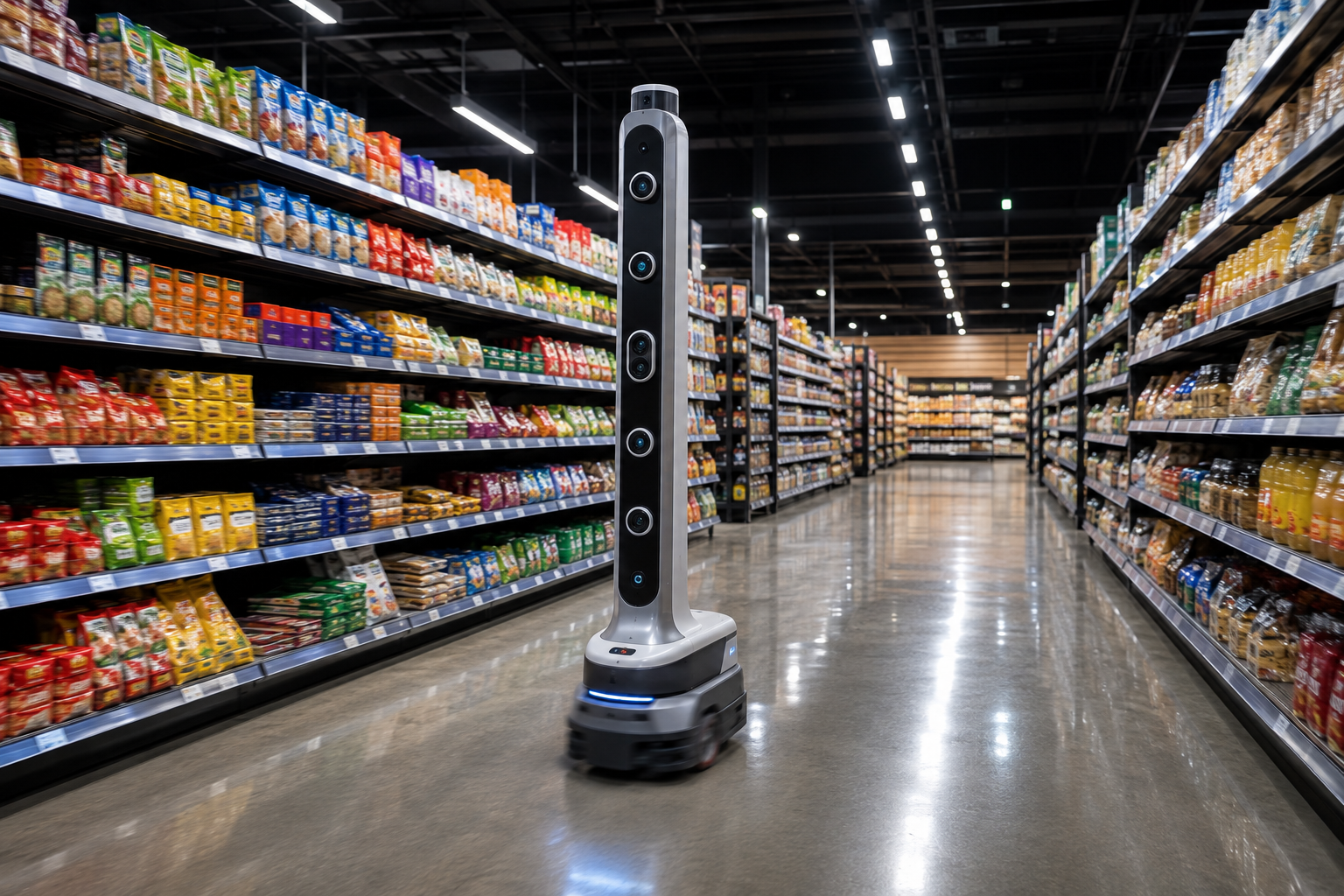
Most autonomous retail floor robots share a common architecture: a wheeled base for navigation, a vertical mast of cameras that captures the full height of a shelf as the robot passes, and onboard or cloud-based computer vision that identifies products, reads price tags, and flags gaps. The robot follows a mapped route through the store, typically during low-traffic hours or continuously throughout the day, and uploads its findings to a central dashboard.
Three capabilities matter most in what these robots are actually built to catch:
- Out-of-stock detection. The core function — identifying empty or nearly empty shelf space where a product should be.
- Price accuracy. Cross-checking the price tag on the shelf against what the register or e-commerce listing charges, catching mismatches that cause customer disputes or lost margin.
- Planogram compliance. Verifying that products are placed where the store’s planned layout says they should be, which affects both promotional revenue (brands pay for specific placement) and shopper navigation.
Real Deployment Data From Grocery and Retail Chains
Simbe’s Tally robot has been deployed across thousands of stores and has scanned billions of shelf positions industry-wide. The newer Tally 3 generation completes a full scan of a typical 45,000-square-foot grocery store in under 60 minutes, with product recognition accuracy above 98 percent for SKUs in its training set. B and R Stores introduced the Simbe platform, pairing the Tally robot with a broader store-intelligence system to capture real-time data on product availability, pricing, and placement at locations in Lincoln, Nebraska.
Badger Technologies’ Marty robot takes a broader approach, operating in more than 500 Giant Eagle and Stop and Shop locations and combining inventory scanning with hazard detection — identifying spills and debris on the floor in addition to shelf gaps. Zebra Technologies’ SmartSight system, an AI-powered shelf-scanning platform used by major grocery chains, monitors on-shelf availability with accuracy above 95 percent.
| Platform | Deployment Scale | Primary Function | Reported Accuracy |
|---|---|---|---|
| Simbe Tally (3rd gen) | Thousands of stores | Shelf scanning, price and placement audit | 98%+ on trained SKUs |
| Badger Technologies Marty | 500+ Giant Eagle and Stop and Shop stores | Inventory gaps plus floor hazard detection | Not separately disclosed |
| Zebra SmartSight | Multiple major grocery chains | On-shelf availability monitoring | 95%+ |
A Full-Store Scan Cycle
A scanning robot enters at one end of the store and works aisle by aisle, its vertical camera mast capturing every shelf level as it glides past. Each frame is matched against a product catalog; gaps, misreads, and price mismatches are flagged instantly and queued into a store associate’s task list before the robot reaches the last aisle.
From Raw Scans to Shelf Analytics
The scanning itself is only half the value. What retailers actually pay for is the analytics layer built on top of the scan data: dashboards that show out-of-stock trends by category, alerts that push directly to a store associate’s handheld device, and prioritization logic that ranks which gaps to fix first based on sales velocity. A robot that flags a hundred issues an hour is only useful if the software sorts those issues by revenue impact rather than dumping an unsorted list on an already-busy floor team.
Store-level analytics increasingly roll up into chain-wide dashboards for regional managers and executives, turning what used to be anecdotal “that store always seems to run out of X” complaints into a comparable, quantified metric across hundreds of locations.
Planogram Compliance in Practice
Planogram compliance is worth more to a retail chain than it might first appear. Manufacturers frequently pay for premium shelf placement as part of promotional agreements, and a misplaced end-cap display or an incorrectly stocked promotional item is effectively unbilled or unrealized revenue. Automated compliance checks give chains the ability to audit far more locations, far more often, than a regional merchandising team could ever visit in person.
Price Accuracy as a Trust Issue
Price mismatches between the shelf tag and the register are a direct source of customer complaints and, in some jurisdictions, regulatory scrutiny. Automated price-accuracy scanning turns an occasional customer complaint into a proactive, chain-wide audit trail.
Common mistake
Treating a shelf-scanning robot purchase as a hardware decision rather than a workflow decision. Chains that saw the least benefit were the ones that deployed scanning robots without redesigning the associate task-assignment workflow around the new alert stream — the robot generated more data, but staff still worked from the same manual walk-the-aisle habits instead of the prioritized alert queue.
What worked
Chains that saw the clearest returns integrated scan alerts directly into existing handheld devices staff already carried, rather than requiring a separate app or dashboard login. Pairing scan frequency with known peak shopping windows — scanning right before predictable high-traffic periods — caught the out-of-stocks that mattered most to revenue rather than spreading scans evenly across a low-value overnight schedule.
Frequently Overlooked Factors
- SKU training dataRecognition accuracy above 95 percent typically applies only to SKUs the system has already been trained on; new or reformulated packaging temporarily degrades accuracy until the model is updated.
- Aisle traffic timingRobots sharing aisles with shoppers during peak hours can slow both the robot’s route and customer flow, pushing many chains toward off-peak or overnight scanning schedules.
- Floor surface and lighting varianceReflective flooring and inconsistent aisle lighting between store sections can affect camera-based recognition accuracy store to store, not just model to model.
- Alert fatigueUnfiltered alert streams overwhelm floor staff quickly; prioritization by sales velocity or promotional importance is what makes the data usable rather than ignorable.
- Integration with replenishment systemsThe biggest gains come when scan data feeds directly into automated reordering, not when it simply generates a report someone has to act on manually.
- Multi-vendor data formatsChains running more than one scanning platform across different store formats often face friction reconciling data schemas between vendors.
- Associate buy-inStore staff who see the robot as a surveillance tool rather than a workload-reduction tool are slower to act on its alerts, undermining the return on the deployment.
Glossary
- Planogram
- A diagram or model specifying where and how a retailer places specific products on shelves or displays.
- On-shelf availability (OSA)
- The percentage of time a product is present and accessible for purchase on the shelf where it belongs.
- SKU (Stock Keeping Unit)
- A unique identifier assigned to a specific product variant for inventory tracking purposes.
- Store intelligence platform
- A software layer that aggregates data from in-store sensors or robots into dashboards and actionable alerts for staff and management.
- Replenishment algorithm
- An automated system that determines when and how much stock to reorder based on sales velocity and current inventory data.
Key Takeaways
- Autonomous shelf-scanning robots can complete a full 45,000-square-foot store scan in under an hour, versus hours of manual auditing.
- Leading platforms report SKU recognition and on-shelf availability accuracy above 95 percent for trained products.
- Simbe Tally, Badger Technologies Marty, and Zebra SmartSight are all deployed at meaningful scale across major grocery and retail chains today.
- The analytics and alert-prioritization layer built on top of scans matters as much as the scanning hardware itself.
- Planogram compliance and price-accuracy checks translate directly into recovered promotional revenue and reduced customer disputes.
- Deployments that succeed integrate alerts into existing staff workflows rather than adding a separate dashboard to check.
- Recognition accuracy is highest on trained SKUs and can degrade temporarily with new packaging or store-specific lighting conditions.
FAQs
What do retail inventory robots actually scan for?
They primarily scan for out-of-stock items, price mismatches between the shelf tag and register, and planogram compliance — whether products sit where the store’s planned layout says they should. The combined data feeds dashboards used by store associates and regional managers.
How accurate are shelf-scanning robots?
Leading platforms report SKU recognition and on-shelf availability accuracy above 95 percent, with some reaching 98 percent or higher on products already in their training data. Accuracy can dip temporarily with new or reformulated packaging until the recognition model updates.
Which retailers currently use shelf-scanning robots?
Walmart, Sam’s Club, Giant Eagle, Stop and Shop, and B and R Stores are among the retailers using autonomous scanning robots at scale, running platforms from vendors including Simbe, Badger Technologies, and Zebra Technologies.
How long does it take a robot to scan an entire grocery store?
Newer-generation platforms complete a full scan of a typical 45,000-square-foot grocery store in under 60 minutes, a task that would take a human team several hours of manual walking and note-taking to approximate.
Do shelf-scanning robots replace store staff?
No — they are designed to eliminate the manual walk-the-aisle audit task, not front-line roles. Store associates still handle restocking, customer service, and any physical task the alerts generate; the robot’s job is only detection and reporting.
What is planogram compliance and why does it matter to retailers?
Planogram compliance measures whether products are placed exactly where a store’s planned layout specifies. It matters financially because manufacturers often pay for premium placement as part of promotional deals, making misplaced products a direct revenue loss for the retailer.
Do scanning robots work well during busy shopping hours?
Many chains schedule scans during off-peak or overnight hours specifically to avoid slowing both the robot and shopper foot traffic in aisles, though some platforms are designed to operate continuously throughout the day at a pace that shares aisle space safely with customers.
What is the biggest factor in getting value from a retail scanning robot deployment?
Integrating the robot’s alert stream directly into the workflow and devices staff already use, and prioritizing alerts by sales velocity, matters more than the hardware itself. Deployments that simply add a new dashboard without changing staff workflow see far weaker returns.
References
- Trend Hunter, “Autonomous Inventory Robots: B and R Stores Introduced Its Shelf-Scanning Robot”
- Robotomated, “Retail Shelf-Scanning Robots 2026: Inventory Intelligence at Scale”
- Yenra, “AI Automated Shelf-Scanning Robots: 19 Updated Directions (2026)”
- RobotsUSA, “Supermarket Robots Guide 2026”
- TROC Global / ARKI Insights, “Real Automated Retail Trends Shaping 2026”
For related coverage of autonomous systems operating around the public, see our pieces on robot etiquette in shared public spaces and security patrol robots and their effectiveness. Readers interested in other sensor-heavy autonomous platforms may also want our look at inspection drones for energy infrastructure, our guide to healthcare robots for seniors, and our broader roundup of home robots heading into 2027.