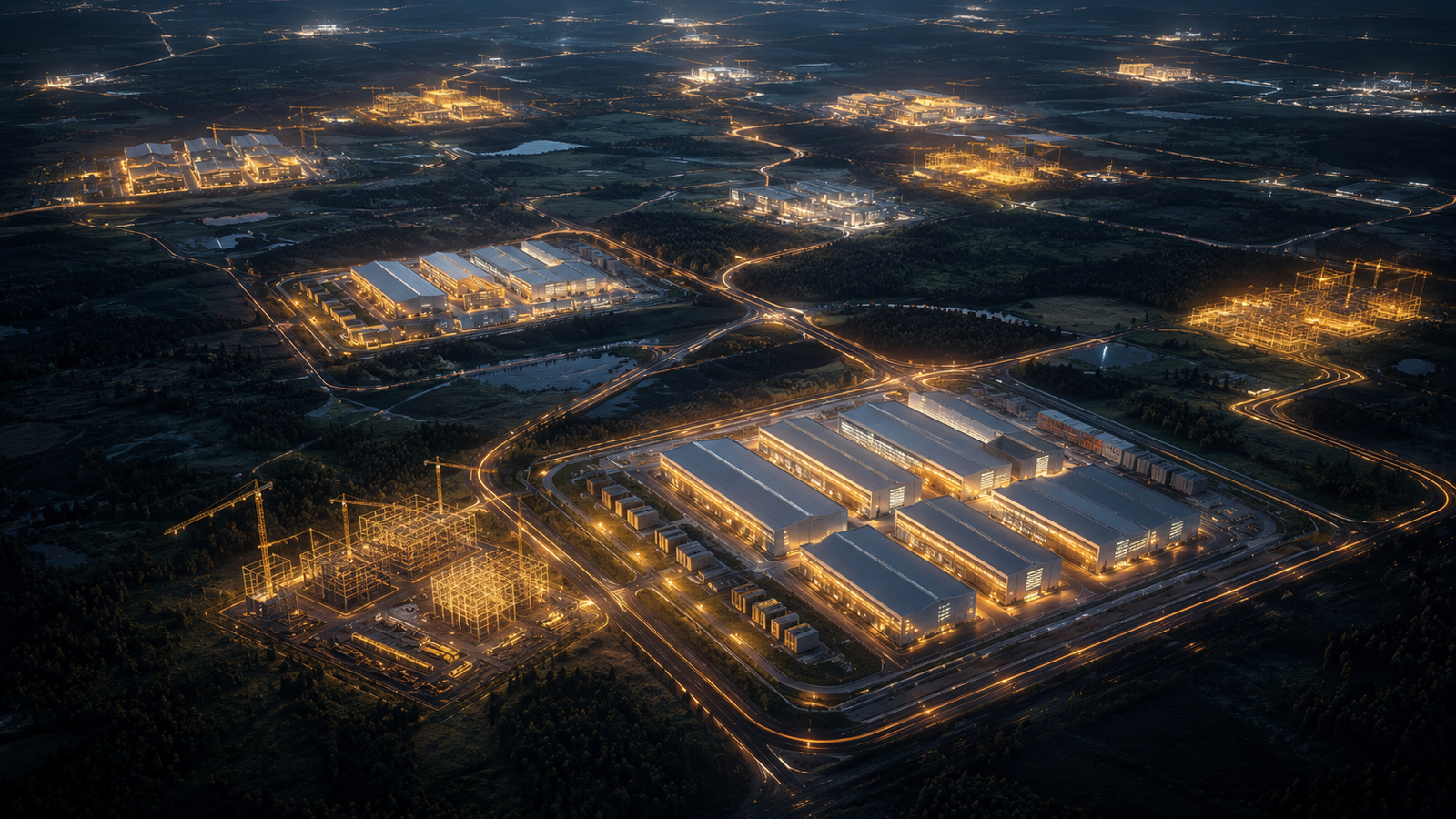
- ~$700Bcombined big-tech AI infrastructure spending expected in 2026 alone
- $5.3TGoldman Sachs Research’s projected combined capex from large tech companies, 2025 through 2030
- $1.7TDell’Oro Group’s projected worldwide data center capex by 2030
Every credible forecast for AI data center capex through 2030 agrees on direction and disagrees wildly on magnitude, which is itself the most useful fact in the story. Dell’Oro Group projects worldwide data center capex reaching $1.7 trillion by 2030. Omdia puts global data center capital expenditure surpassing $1 trillion by the same date. McKinsey’s estimate is far larger — nearly $7 trillion in global data center infrastructure capex by 2030. Goldman Sachs Research, looking specifically at large technology companies rather than the whole data center market, projects $5.3 trillion in combined capital spending from 2025 through 2030. These aren’t small rounding differences; they reflect genuinely different assumptions about how much of this buildout is AI-specific versus general data center capacity, and how much demand actually materializes versus how much capacity gets announced and never built.
Where the money is actually going right now
The top four US hyperscalers — Amazon, Google, Meta, and Microsoft — entered 2026 with combined data center capex approaching $600 billion, and are expected to represent roughly half of global data center capex by 2030. That concentration matters: this isn’t hundreds of companies each spending modestly, it’s a handful of companies making capital commitments at a scale that reshapes entire regional power grids and construction markets simultaneously. Moody’s projects total capex climbing further still, to around $820 billion in 2027 — meaning 2026’s already enormous spending level is itself expected to be a stepping stone, not a peak.
| Forecaster | Projection | Scope |
|---|---|---|
| Dell’Oro Group | $1.7 trillion by 2030 | Worldwide data center capex |
| Omdia | >$1 trillion by 2030 | Global data center capital expenditure |
| Goldman Sachs Research | $5.3 trillion, 2025-2030 combined | Large technology companies specifically |
| McKinsey | ~$7 trillion by 2030 | Global data center infrastructure capex, broadest scope |
| Moody’s | ~$820 billion in 2027 alone | Total capex, near-term single-year estimate |
Why the estimates diverge so much
The spread between a $1 trillion projection and a $7 trillion projection for the same rough time horizon isn’t sloppy forecasting — it reflects three genuinely different questions that get conflated under “data center capex.” One is how much of global data center spending is AI-attributable versus general enterprise IT capacity that would have grown anyway. Another is whether “announced” capacity commitments should be counted as committed spend, when a meaningful share of announced projects — by some estimates up to 11 gigawatts’ worth for 2026 alone — remain stuck at the announcement stage without construction underway, often due to the power constraints covered in a companion piece. The third is whether financing structure matters: a growing share of this buildout is being financed through private markets and off-balance-sheet vehicles rather than direct corporate capex, which changes what counts in a given estimate depending on how the analyst defines the boundary.
- 1. Committed capexHyperscalers reach roughly $600B combined in 2026, funding land, shells, and power agreements already underway.
- 2. Announced but unbuiltUp to 11 GW of announced 2026 capacity remains stuck at the announcement stage, largely due to power and grid constraints.
- 3. Private market financingA growing share of buildout capital comes through private financing vehicles rather than direct corporate balance sheets.
- 4. Divergent 2030 forecastsDepending on which of the above an analyst counts, 2030 projections range from roughly $1T to nearly $7T.
Why credible analysts disagree by a factor of seven on the same buildout
Read every headline capex number with its scope attached — “global data center capex,” “large tech company capex,” and “AI-specific capex” are three different, non-interchangeable measurements.
The real constraint isn’t capital anymore
What’s notable across nearly every 2026 forecast is that the binding constraint on this buildout has shifted away from capital availability — hyperscalers clearly have the money and the willingness to spend it — toward physical constraints that money alone doesn’t solve on a useful timeline: power grid interconnection, GPU and HBM supply, and construction and skilled labor capacity. A capex projection assumes the money gets spent as planned; the more interesting operational question, covered in more detail in the companion piece on data center power constraints, is how much of that planned spending actually converts into operating capacity on schedule.
Track committed, funded capex Most reliable
Hyperscaler quarterly capex disclosures are audited, public numbers — the most trustworthy real-time signal of what’s actually being spent, as opposed to announced or projected totals.
Read 2030 projections as scenario ranges Necessary caution
A $1T-to-$7T spread for the same rough time horizon means any single number quoted without its source and scope should be treated as one scenario among several, not a consensus figure.
Treat “announced capacity” as equivalent to built capacity Common error
A meaningful share of announced 2026 capacity — plausibly up to 11 GW — remains stuck without construction underway, mostly due to power and grid constraints unrelated to capital.
Common mistakes
Common mistake
Quoting a single “AI data center capex by 2030” figure without checking its scope. A $1.7 trillion Dell’Oro projection, a $5.3 trillion Goldman Sachs projection, and a $7 trillion McKinsey projection are not competing forecasts of the same thing — they measure different scopes over different assumptions.
Common mistake
Assuming spending growth translates linearly into available compute capacity. Power grid interconnection delays, now running 24-36 months for approval and 4-7 years for new high-capacity connections in major hubs, mean a large share of funded capex converts into usable capacity on a much longer timeline than the spending itself suggests.
What worked
Analysts and operators tracking this most accurately separated three numbers explicitly: committed and disclosed capex, announced-but-unbuilt capacity, and actual megawatts brought online — rather than treating capex growth alone as a proxy for capacity growth.
Glossary
- Hyperscaler capex
- Capital expenditure by the largest cloud providers (Amazon, Google, Meta, Microsoft, and similar) specifically on data center and AI infrastructure buildout.
- Announced vs built capacity
- The distinction between a data center capacity commitment publicly announced and the actual construction and power interconnection that brings it into operation — a gap that has widened significantly in 2026.
- Energy island
- A data center campus with dedicated, on-site power generation designed to operate independently of the public grid, a strategy hyperscalers are increasingly pursuing to bypass interconnection delays.
- Off-balance-sheet data center financing
- Capital structures where data center buildout is financed through private market vehicles rather than direct corporate capital expenditure, changing how a given spending figure is counted.
Key takeaways
- The top four US hyperscalers alone are approaching $600 billion in combined 2026 data center capex, with total big-tech AI infrastructure spending expected near $700 billion this year.
- 2030 projections for global data center capex range enormously by source — from roughly $1 trillion (Omdia) to $1.7 trillion (Dell’Oro) to nearly $7 trillion (McKinsey) — because each measures a different scope.
- Goldman Sachs Research projects $5.3 trillion in combined capital spending specifically from large technology companies between 2025 and 2030.
- The top four hyperscalers are expected to represent roughly half of all global data center capex by 2030, reflecting an unusually concentrated buildout among a small number of companies.
- Moody’s projects total capex climbing to around $820 billion in 2027, indicating 2026’s already record spending is expected to keep accelerating rather than plateau.
- Up to 11 gigawatts of announced 2026 data center capacity reportedly remains stuck without construction underway, largely due to power and grid interconnection constraints rather than capital availability.
- The binding constraint on this buildout has shifted from capital availability to physical constraints — power interconnection, chip supply, and construction capacity — that spending alone doesn’t resolve quickly.
FAQs
How much are hyperscalers actually spending on AI data centers in 2026?
The top four US hyperscalers — Amazon, Google, Meta, and Microsoft — are approaching a combined $600 billion in 2026 data center capex, with total big-tech AI infrastructure spending for the year expected near $700 billion.
Why do 2030 data center capex projections vary so much between analysts?
Because they measure different scopes: some cover only large technology companies, others cover the entire global data center market, and some count announced capacity as committed spend while others don’t — producing a range from roughly $1 trillion to nearly $7 trillion for the same rough time horizon.
Which analyst has the largest 2030 data center capex projection?
McKinsey’s estimate is the largest at nearly $7 trillion in global data center infrastructure capex by 2030, considerably larger than Dell’Oro’s $1.7 trillion or Omdia’s over $1 trillion projections for similar timeframes.
What share of global data center spending will hyperscalers represent by 2030?
The top four US hyperscalers are expected to represent roughly half of all global data center capex by 2030, reflecting how concentrated this buildout is among a small number of companies.
Is all the announced AI data center capacity actually getting built?
Not on schedule. Up to 11 gigawatts of announced 2026 data center capacity reportedly remains stuck at the announcement stage without construction underway, largely due to power grid interconnection delays rather than a lack of capital.
What is actually limiting AI data center buildout if money isn’t the constraint?
Physical constraints — power grid interconnection delays, GPU and HBM chip supply, and construction and skilled labor capacity — have become the binding limits, since hyperscalers clearly have sufficient capital and willingness to spend it.
Is data center capex spending expected to slow down after 2026?
No, forecasts suggest continued acceleration — Moody’s projects total capex rising to around $820 billion in 2027, meaning 2026’s record spending level is expected to be a stepping stone rather than a peak.
How is AI data center buildout being financed?
Increasingly through private market financing vehicles and off-balance-sheet structures rather than solely direct corporate capital expenditure, which is part of why total spending figures vary depending on what an analyst counts as capex.
References
- Dell’Oro Group — “AI Boom Drives Data Center Capex to $1.7 Trillion by 2030”
- Fortune — “Big Tech is about to spend $700 billion on AI this year”
- CIO — “Data center capex to hit $1.7 trillion by 2030 due to AI boom”
- Data Center Knowledge — “Hyperscaler Capex Snowballs Toward $700B”
Related reading on The Tech Trends: Data Center Power Constraints, GPU Shortage Economics, Liquid Cooling for AI Racks, and Inference vs Training Economics.