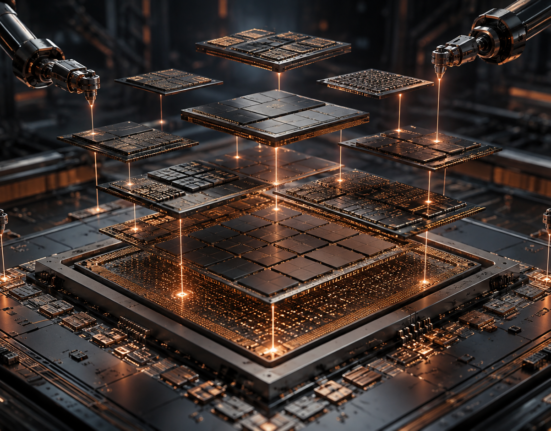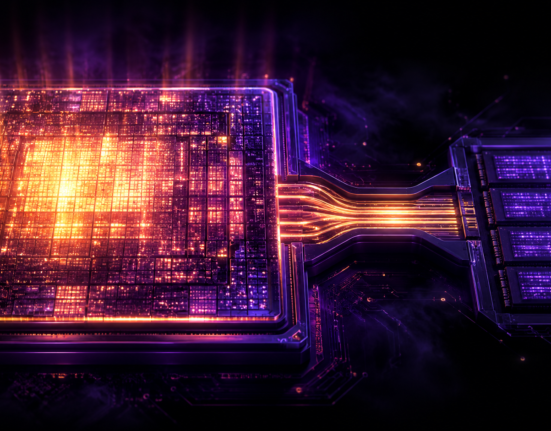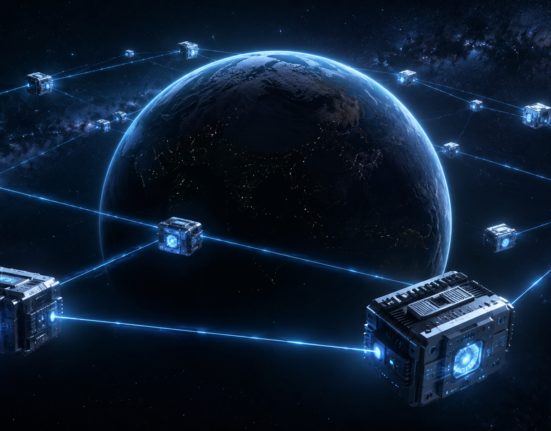
- 2 orders of magnitudepotential improvement in throughput, power efficiency, and compute density some photonic systems could demonstrate over state-of-the-art electronic hardware
- 51.2 Tbpsthroughput of Broadcom’s co-packaged optics switch platform, delivered 2024 — the leading edge of photonic-adjacent commercial deployment
- 2030srealistic timeline for photonic computing to meaningfully displace conventional digital architectures at scale, per current industry outlooks
“Photonic computing” gets used loosely to describe several genuinely different things, and separating them matters for understanding where the technology actually stands. At one end is optical I/O and interconnect — using light purely to move data between chips, which is already commercially shipping (Broadcom’s co-packaged optics platforms, NVIDIA’s silicon photonics roadmap for GPU communication). At the other end is true optical computation — performing the actual arithmetic using light rather than electrons, which remains largely a research and early-commercialization proposition. The industry’s 2026 progress is concentrated overwhelmingly in the first category, not the second.
What’s actually shipping versus what’s still research
Ultra-compact photonic AI chips have achieved nanosecond-scale processing in demonstrations, with some systems showing potential to surpass state-of-the-art electronic hardware by roughly two orders of magnitude in throughput, power efficiency, and compute density. Those are genuinely impressive research results. But the first mainstream photonic computing products reaching real deployment are not all-optical processors — they’re optical I/O engines that move data into and out of otherwise conventional electronic processors more efficiently. Broadcom delivered a 51.2 Tbps co-packaged optics switch platform in 2024, NVIDIA announced silicon-photonics networking switches in 2025, and Intel has demonstrated an optical I/O chiplet — all interconnect technology, not computation.
| Category | 2026 status | Example |
|---|---|---|
| Optical interconnect / I/O | Commercially shipping, scaling fast | Broadcom’s 51.2 Tbps CPO switch, NVIDIA silicon photonics for GPU communication |
| Optical circuit switching | Early commercial deployment | iPronics/Fabrinet silicon-photonic packaging line, operational Q2 2026 |
| All-optical neuromorphic computing | Advanced research, early demonstrations | Nanosecond-scale ultra-compact photonic AI chips |
| General-purpose optical processor | Long-horizon research proposition | No commercial timeline established; widely expected well into the 2030s |
Why photonics excels at movement but struggles at computation
The physics explains the gap. Moving data as light is a comparatively well-understood problem: photons don’t generate resistive heat the way electrons moving through copper do, and light can carry enormous bandwidth over a fiber with very low loss, which is exactly what makes optical interconnects and co-packaged optics such a clean efficiency win for data movement. Performing actual computation with light is a fundamentally harder problem, because the mathematical operations neural networks need — nonlinear activation functions in particular — don’t have a natural, efficient optical analog the way linear operations like matrix multiplication sometimes do. Photonic computing research has made real progress on the linear-algebra portion of neural network computation, but the nonlinear pieces remain the harder unsolved part of building a genuinely general-purpose optical processor.
- 1. Data movement problem solved firstOptical I/O and co-packaged optics reach commercial deployment because moving light is comparatively well understood physics.
- 2. Linear computation shows research promisePhotonic systems demonstrate strong results on matrix multiplication and other linear operations central to neural networks.
- 3. Nonlinear computation remains unsolvedActivation functions and other nonlinear operations lack an efficient, mature optical implementation.
- 4. Hybrid systems bridge the gap for nowNear-term products use optics for interconnect and linear operations, keeping electronics for nonlinear and control logic.
Why photonic interconnects arrived years before photonic computation will
This mirrors a broader pattern in emerging hardware: the easier sub-problem (moving data) reaches market first, while the harder sub-problem (general computation) takes a fundamentally longer research runway.
Reading the timeline honestly
Realistic industry expectations for 2026 center on significant progress in data-center optical interconnects and early circuit-switching deployment — both real and valuable — while widespread replacement of conventional computing architectures with photonic alternatives is expected to require a considerably longer timeline, likely extending well into the 2030s. That’s a useful corrective against marketing language that blurs “photonic computing is happening now” (true for interconnects) with “optical processors will replace GPUs soon” (not supported by the current state of the nonlinear-computation research problem).
Adopt optical I/O and interconnect technology now Commercially ready
Co-packaged optics and silicon photonics for chip-to-chip communication are shipping products today, with real vendor roadmaps (NVIDIA, Broadcom) backing continued deployment.
Track photonic linear-algebra accelerators as an emerging category Early but real
Photonic acceleration of matrix multiplication specifically shows genuine research progress and early commercialization, worth monitoring for workloads dominated by linear operations.
Plan a product roadmap around general-purpose optical processors replacing GPUs soon Premature
The unsolved nonlinear-computation problem means genuine general-purpose photonic computing realistically remains a 2030s-and-beyond proposition, not a near-term planning assumption.
Common mistakes
Common mistake
Conflating optical interconnect progress with optical computation progress. Broadcom’s CPO switch and NVIDIA’s silicon photonics roadmap are genuine, shipping technology — but they move data, they don’t compute with light, and treating the two as equivalent overstates how far photonic computation itself has come.
Common mistake
Extrapolating from an impressive research demonstration (nanosecond-scale photonic AI chips showing two-orders-of-magnitude gains) to a near-term commercial timeline. Research results on narrow benchmarks don’t automatically translate into general-purpose products, especially given the unresolved nonlinear-computation problem.
What worked
Organizations that got real value from photonics in 2026 focused specifically on the commercially mature layer — optical interconnects and co-packaged optics for AI cluster networking — rather than waiting for or betting product plans on general-purpose optical computation arriving on a near-term timeline.
Glossary
- Optical I/O
- Using light to move data into and out of a processor or between chips, as distinct from performing computation with light.
- Photonic integrated circuit (PIC)
- A chip that processes optical signals using integrated photonic components, the building block for both optical interconnects and photonic computation research.
- Nonlinear activation function
- A mathematical operation in a neural network that introduces non-proportional behavior between input and output — a core requirement for deep learning that lacks a mature, efficient optical implementation.
- All-optical computing
- Performing computation using light throughout, without converting to electronic signals — the long-horizon research goal distinct from optical interconnects that are already commercially deployed.
Key takeaways
- Photonic computing spans a spectrum from commercially shipping optical interconnects to long-horizon research on all-optical computation — and 2026’s real progress is concentrated in the interconnect category.
- Broadcom delivered a 51.2 Tbps co-packaged optics switch platform in 2024, and NVIDIA is implementing silicon photonics for GPU communication this generation — both are optical data movement, not optical computation.
- Ultra-compact photonic AI chips have demonstrated nanosecond-scale processing with potential gains of roughly two orders of magnitude over electronic hardware in research settings.
- Photonics excels at data movement because light doesn’t generate resistive heat and carries enormous bandwidth efficiently, while nonlinear neural network operations still lack a mature, efficient optical implementation.
- Realistic industry timelines expect significant 2026 progress in optical interconnects but place general-purpose photonic computing displacing conventional architectures well into the 2030s.
- Conflating shipping optical interconnect products with hypothetical near-term optical computers is the most common source of overstated expectations for this technology.
- The most effective 2026 strategy is adopting mature optical interconnect technology now while monitoring, rather than betting on, longer-horizon photonic computation research.
FAQs
Is photonic computing already being used in AI data centers?
Yes, but specifically for optical interconnects and data movement — Broadcom’s 51.2 Tbps co-packaged optics switch and NVIDIA’s silicon photonics roadmap for GPU communication are both shipping technology, though they move data with light rather than computing with it.
What’s the difference between optical interconnects and photonic computing?
Optical interconnects use light to move data between chips, a commercially mature technology today; photonic computing aims to perform the actual arithmetic using light, which remains largely a research proposition due to unresolved challenges with nonlinear operations.
When will all-optical AI processors replace GPUs?
Not soon. Realistic industry timelines place general-purpose photonic computing displacing conventional digital architectures well into the 2030s, considerably later than the near-term progress happening in optical interconnects.
Why is optical data movement easier than optical computation?
Because photons don’t generate resistive heat the way electrons do and can carry enormous bandwidth efficiently over fiber, while neural network computation requires nonlinear operations that don’t have a mature, efficient optical analog yet.
How much faster could photonic computing be than electronic chips?
Some research demonstrations show potential for roughly two orders of magnitude improvement in throughput, power efficiency, and compute density over state-of-the-art electronic hardware, though these are research results on narrow benchmarks rather than proven general-purpose performance.
Are any companies actually building photonic computers today?
Companies like Lightmatter and Q.ANT are developing photonic AI accelerators, primarily focused on the linear-algebra portion of neural network computation, while the broader industry’s commercial focus remains on optical interconnects rather than full optical computation.
What is the hardest unsolved problem in photonic computing?
Implementing nonlinear activation functions optically — these are essential to neural network computation but lack a mature, efficient optical implementation, unlike linear operations such as matrix multiplication where photonic approaches show more promise.
Should a company plan its AI hardware roadmap around photonic computing?
For optical interconnects, yes — that technology is commercially mature and actively being adopted by major vendors. For general-purpose optical computation, no — the realistic timeline extends well into the 2030s, making it premature to build near-term plans around it.
References
- PhotonDelta — “Will photonic chips revolutionize computing by 2026?”
- Tech Xplore — “Ultra-compact photonic AI chip operates at the speed of light”
- Compute Compass — “52 Photonic Computing Companies in 2026”
- arXiv — “Integrated photonic neuromorphic computing: device, architecture, chip, algorithm”
Related reading on The Tech Trends: Co-Packaged Optics for AI Clusters, Analog In-Memory Computing, Thermodynamic and Probabilistic Computing Chips, and HBM Memory Bandwidth.