| Approach | Guidance Method | Typical Targeting Accuracy | Operator Dependency |
|---|---|---|---|
| Freehand percutaneous biopsy | CT or ultrasound, manual needle adjustment | Variable, highly skill-dependent | High |
| CT-guided robotic navigation | Pre-procedure CT plus robotic arm trajectory planning | Sub-millimeter to a few millimeters | Moderate |
| Robotic-assisted bronchoscopy (lung) | Electromagnetic or shape-sensing navigation, sometimes with cone-beam CT | Diagnostic yield 69-96% depending on platform | Moderate |
| MRI-guided robotic biopsy (prostate) | Real-time MRI with fully actuated robotic assistant | Sub-millimeter targeting | Low to moderate |
Why Image-Guided Robots Are Replacing Freehand Biopsy
A biopsy is only as good as the tissue it samples. If the needle misses the lesion, even by a few millimeters, the result is a false negative, a repeat procedure, or a delayed diagnosis. For decades, the standard approach to sampling a small lung nodule, a suspicious prostate lesion, or a deep liver mass has been freehand percutaneous biopsy: a radiologist watches real-time CT or ultrasound imaging and manually adjusts needle angle and depth by hand and eye, often through several iterative images.
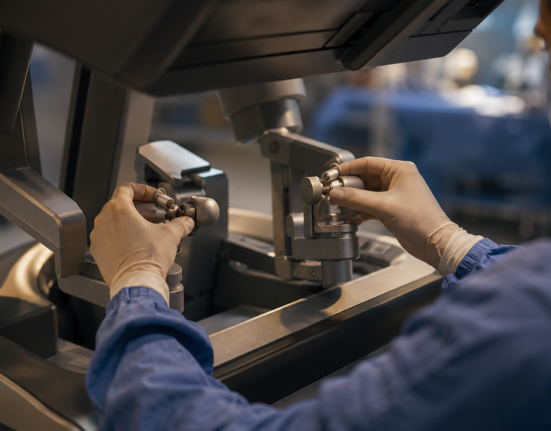
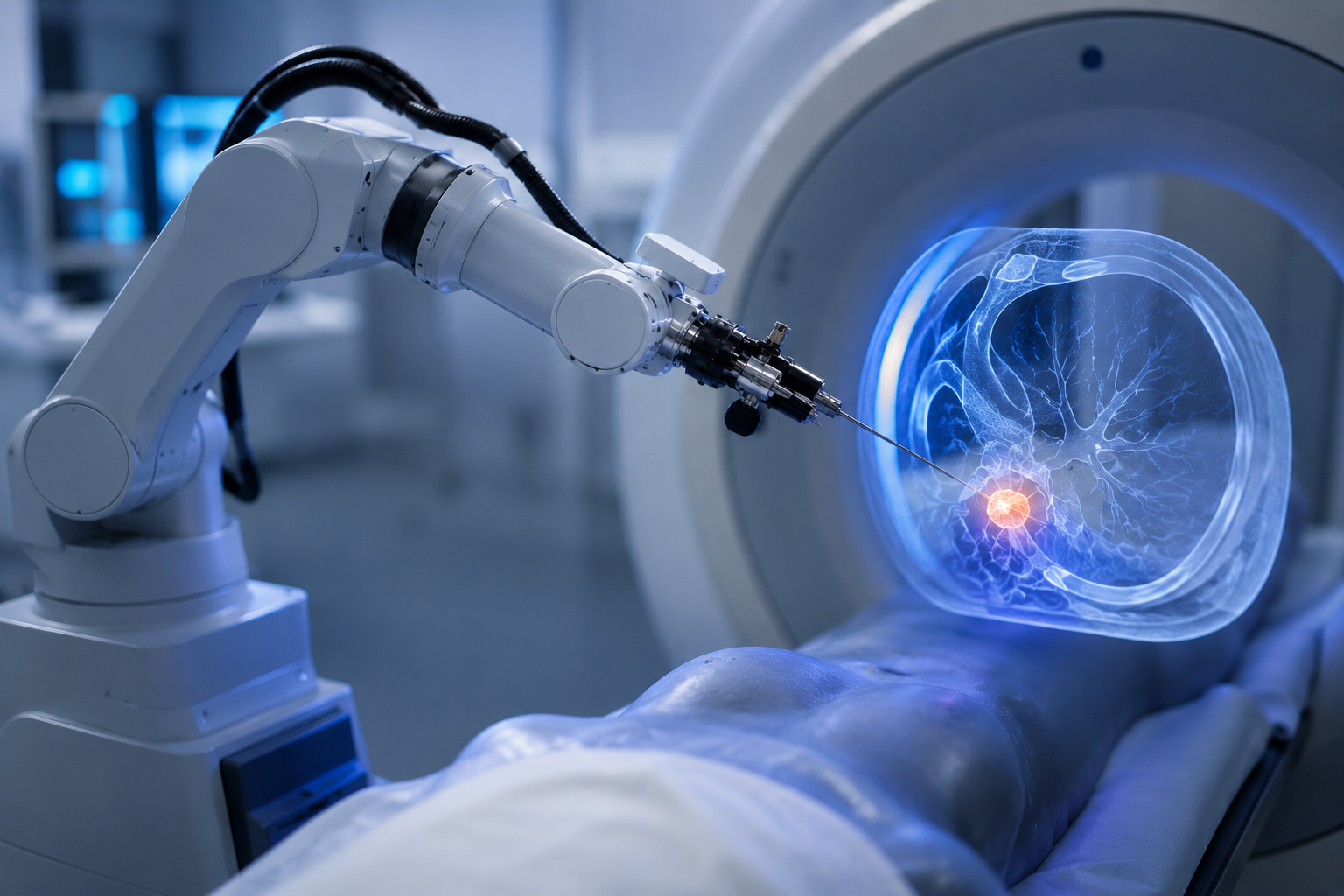
This works, but it is inherently variable. Needle deflection, respiratory motion, and the physical limits of a human hand holding a needle steady over several centimeters of soft tissue all introduce error. Robotic biopsy and image-guided intervention systems address this by combining a mechanically precise needle-guidance platform, typically with four to six degrees of freedom, with real-time or pre-procedure imaging data to calculate and hold a trajectory far more consistently than a freehand approach allows.
This piece is a Technical Deep Dive specifically into macro-scale, needle-based image-guided biopsy robots, a category distinct from the ingestible capsule diagnostics and vascular micro-swimmers covered elsewhere on this site; our related coverage of ophthalmic and vascular micro-procedures in The Evolution of Micro-Robotics in Precision Medicine touches on a much smaller physical scale of intervention than the needle-based systems discussed here.
How Robotic Biopsy Systems Work
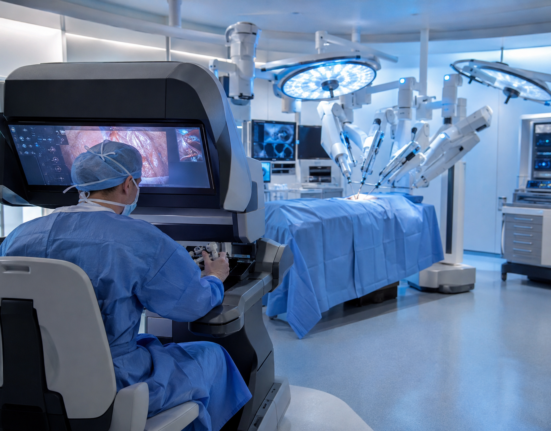
Most robotic biopsy platforms follow a similar architectural pattern regardless of the target organ: an imaging system establishes the location of the lesion in three-dimensional space, planning software calculates an optimal needle trajectory that avoids critical structures like blood vessels, nerves, and airways, and a robotic manipulator then holds and advances the needle along that calculated path, often with continuous imaging feedback to correct for any drift.
| Imaging Modality | Best Suited For | Key Advantage | Key Limitation |
|---|---|---|---|
| CT / Cone-beam CT | Lung nodules, deep abdominal lesions | Excellent spatial resolution and bone/soft tissue contrast | Radiation exposure with repeated imaging passes |
| MRI | Prostate, some breast and brain lesions | Superior soft-tissue contrast, no ionizing radiation | Slower imaging cycle, MRI-compatible robotics required |
| Ultrasound | Breast, superficial liver, thyroid | Real-time, low-cost, no radiation | Operator-dependent image quality, limited depth penetration |
| Fluoroscopy / augmented fluoroscopy | Vascular-adjacent and hybrid procedures | Real-time visualization during instrument advancement | Cumulative radiation dose over a longer procedure |
Lung Nodule Biopsy: The Leading Use Case
Pulmonary nodules are one of the most common and most technically demanding biopsy targets, since the lung is a moving, air-filled organ where a nodule’s position shifts with every breath. Traditional CT-guided transthoracic biopsy is highly dependent on operator skill, can involve extended procedure duration, and carries meaningful radiation exposure from repeated confirmatory CT passes.
Robotic-assisted bronchoscopy platforms approach this differently: rather than puncturing the chest wall from outside, they navigate a thin robotic catheter through the natural airway to reach peripheral pulmonary nodules from the inside, guided by electromagnetic navigation, shape-sensing fiber optics, or a combination with mobile cone-beam CT for real-time confirmation. Robot-assisted navigation for CT-guided transthoracic lung interventions has also been shown to reduce radiation dose compared with conventional freehand CT-guided procedures.
Reaching a Peripheral Lung Nodule
In a robotic-assisted bronchoscopy procedure, a thin, flexible robotic catheter is threaded through the natural airway using a pre-procedure CT-based virtual map. Electromagnetic or shape-sensing navigation tracks the catheter’s exact position in real time, and once it reaches the target nodule, a biopsy tool is advanced through the catheter’s working channel to collect tissue, all without a single external incision.
Diagnostic Yield: How Robotic Platforms Compare
Diagnostic yield, the proportion of biopsies that produce a definitive diagnosis, is the key performance metric for these systems, and published data shows meaningful variation both across platforms and across the methodology used to calculate yield.
| Platform | Reported Diagnostic Yield | Notable Data Point |
|---|---|---|
| Monarch | 63.8% (strict) to 87% (liberal methodology) | Multicenter TARGET trial, 679 subjects; sensitivity for malignancy above 81% |
| Ion | 79.3% to 92.0% | Range reported across multiple published cohorts |
| Galaxy | 89.5% to 94.7% | Preliminary data from 19 peripheral pulmonary nodules |
| Conventional CT-guided freehand biopsy | Generally lower than robotic-assisted approaches per comparative reviews | Higher operator-skill dependency and radiation exposure |
A 2026 systematic review and meta-analysis comparing robotic-assisted versus conventional CT-guided lung biopsy for pulmonary nodules found that the safety profile and diagnostic yield of robotic-assisted bronchoscopy were superior to conventional bronchoscopic and electromagnetic navigation approaches when compared crudely across published data, with an adverse event rate around 3.8 percent in the largest multicenter trial.
Prostate Biopsy: MRI-Guided Robotic Targeting
Prostate biopsy has followed a parallel evolution. Traditional transrectal ultrasound-guided biopsy samples tissue somewhat systematically across the gland, which can miss small, clinically significant lesions that are visible on MRI but not clearly seen on ultrasound alone. MRI-guided robotic biopsy systems solve this by using a fully actuated robotic assistant that can position and advance a needle directly within the MRI bore, targeting a lesion identified on real-time or fused MRI imaging with far greater precision than a manually operated ultrasound-guided approach.
These systems are also used for brachytherapy seed placement, using the same robotic platform to position radioactive seeds with the same targeting precision used for diagnostic sampling, illustrating how the underlying robotic and imaging infrastructure serves both diagnostic and therapeutic purposes.
Robotic Biopsy vs. Freehand Biopsy: A Direct Comparison
| Myth | Reality |
|---|---|
| Robotic biopsy removes the physician from the procedure entirely. | A radiologist or interventionalist still plans the trajectory, supervises the procedure, and makes the final call on needle placement; the robot holds and advances the needle with more mechanical consistency than a hand can. |
| Robotic-assisted bronchoscopy always has a higher diagnostic yield than any freehand approach. | Reported yield varies by platform, methodology, and patient selection; some robotic platforms report yields in the 60s percentile range under strict methodology, comparable to or only modestly better than well-performed freehand biopsy in some series. |
| Radiation exposure is always lower with a robotic system. | Robotic navigation can reduce radiation dose compared with conventional CT-guided approaches by minimizing repeated confirmatory scans, but exposure still depends heavily on the imaging protocol used. |
| Robotic biopsy is only relevant for lung and prostate. | Image-guided robotic biopsy is also used for liver, kidney, breast, and brain lesions, though lung and prostate remain the most studied and widely adopted applications. |
What Sets Robotic Navigation Apart from Traditional Freehand Technique
- Trajectory planning software calculates an optimal path before the needle ever moves, accounting for critical structures to avoid, something a freehand operator estimates in real time by eye.
- Mechanical steadiness eliminates the natural hand tremor and fatigue-related drift that can accumulate over a long freehand procedure.
- Continuous positional feedback, whether via electromagnetic tracking, shape-sensing fiber, or repeated imaging, lets the system detect and correct for drift mid-procedure rather than only confirming position at the end.
- Reproducibility across operators means outcomes are less dependent on the specific individual physician performing the procedure, an important factor for hospitals without a highly experienced interventional radiology team on every shift.
Common mistake
Assuming that “robotic” automatically means “higher diagnostic yield” without checking which yield methodology is being reported. Strict methodology (counting only biopsies with a specific malignant or specific benign diagnosis as successful) produces notably lower percentages than liberal methodology (counting any biopsy that avoided a repeat procedure). Comparing a strict-methodology yield for one platform against a liberal-methodology yield for another produces a misleading picture of relative performance.
What worked
Programs that combined robotic-assisted bronchoscopy with intraprocedural cone-beam CT confirmation, rather than relying on navigation software alone, reported measurably better correlation between the planned and actual needle or biopsy tool position at the moment of tissue sampling, which is understood to be a major contributor to higher real-world diagnostic yield.
Frequently Overlooked Details in Robotic Biopsy
- CT-to-body divergenceThe lung’s position at the time of pre-procedure planning CT can differ from its position during the actual procedure due to breathing pattern changes, a source of targeting error robotic systems try to correct with real-time confirmation.
- Yield methodology mattersDiagnostic yield figures can vary by 20 percentage points or more for the same platform depending on whether strict, intermediate, or liberal calculation methodology is used.
- MRI compatibility constraintsRobotic components used inside an MRI bore must be built from non-ferromagnetic materials and often use pneumatic or piezoelectric actuation rather than standard electric motors.
- Learning curve still existsRobotic assistance reduces but does not eliminate operator-dependent variability; teams still show measurable improvement in yield and procedure time as they gain experience with a given platform.
- Adverse event trackingComplication rates around 3 to 4 percent reported in large robotic bronchoscopy trials still require careful monitoring, particularly for pneumothorax risk in lung procedures.
- Therapeutic overlapThe same robotic platforms used for diagnostic biopsy are increasingly also used for localized treatment delivery, such as brachytherapy seed placement or tumor ablation probe positioning.
Regulatory Context for Image-Guided Biopsy Robots
Robotic biopsy and navigation systems generally sit within the FDA’s Class II or Class III device categories depending on their specific function and level of autonomy in trajectory execution, following a broader classification logic that also governs other autonomous and AI-assisted medical devices. For the full landscape of how the FDA and EMA regulate autonomous medical technology across categories, including diagnostic AI and surgical robots, see our companion Policy Analysis, Regulatory Pathways for Autonomous Medical Devices.
Key Takeaways
- Robotic biopsy systems combine a precision needle-guidance platform with CT, MRI, or ultrasound imaging to hold a calculated trajectory more consistently than freehand technique.
- Robotic-assisted bronchoscopy platforms for lung nodule biopsy report diagnostic yields ranging from roughly 64 percent under strict methodology up to the mid-90s percent under liberal methodology, varying significantly by platform.
- MRI-guided robotic prostate biopsy allows direct targeting of lesions visible on MRI with sub-millimeter precision, addressing a key limitation of systematic ultrasound-guided sampling.
- Robot-assisted navigation for CT-guided lung interventions has been shown to reduce radiation dose compared with conventional freehand CT-guided procedures.
- Diagnostic yield comparisons across platforms must account for methodology differences (strict vs. liberal), since the same platform can show a 20-plus percentage point swing depending on how yield is calculated.
- A human interventionalist still plans and supervises every robotic biopsy procedure; the robot improves mechanical consistency, it does not replace clinical judgment.
- The same robotic platforms used for diagnostic biopsy increasingly support therapeutic applications like brachytherapy seed placement, reflecting shared underlying navigation infrastructure.
Glossary
- Robotic biopsy
- A tissue-sampling procedure in which a robotic manipulator holds and advances a needle or catheter along a trajectory calculated from imaging data, rather than relying on freehand manual control.
- Diagnostic yield
- The proportion of biopsy procedures that produce a definitive diagnosis, used as the primary performance metric for comparing biopsy techniques and platforms.
- Cone-beam CT (CBCT)
- A mobile or fixed imaging system that produces cross-sectional images during a procedure, used to confirm instrument position in real time.
- Electromagnetic navigation bronchoscopy (ENB)
- A bronchoscopy technique that uses an electromagnetic field to track the real-time position of a catheter inside the airway relative to a pre-procedure CT map.
- Shape-sensing technology
- A fiber-optic based tracking method that determines the three-dimensional shape and position of a flexible robotic catheter without relying on an external electromagnetic field.
- Brachytherapy
- A form of radiation therapy in which radioactive seeds or sources are placed directly inside or adjacent to a tumor, sometimes using the same robotic platform employed for diagnostic biopsy.
FAQs
What is robotic biopsy and how is it different from a regular biopsy?
Robotic biopsy uses a mechanical guidance arm or catheter system, directed by real-time or pre-procedure imaging data, to hold and advance a needle or biopsy tool along a precisely calculated trajectory, whereas a regular freehand biopsy relies on a physician manually adjusting needle position and angle by hand while watching live imaging.
How accurate is robotic biopsy compared to freehand technique?
Robotic and image-guided navigation systems can achieve targeting accuracy in the sub-millimeter to few-millimeter range, generally more consistent than freehand technique, which is inherently variable and depends heavily on the individual operator’s skill and steadiness.
What is the diagnostic yield of robotic-assisted lung biopsy?
Reported diagnostic yield varies by platform and calculation methodology; published data shows a range from roughly 64 percent under strict methodology up to the high 80s or mid-90s percent under more liberal methodology, with sensitivity for malignancy above 81 percent in a major multicenter trial.
How does MRI-guided robotic prostate biopsy work?
A fully actuated robotic assistant positions and advances a needle directly within the MRI bore, allowing a physician to target a specific lesion visible on real-time or fused MRI imaging with greater precision than systematic ultrasound-guided sampling alone.
Does robotic biopsy reduce radiation exposure?
Robot-assisted navigation for CT-guided lung interventions has been shown to reduce radiation dose compared with conventional freehand CT-guided procedures by minimizing the number of repeated confirmatory scans needed, though total exposure still depends on the specific imaging protocol used.
Is a physician still involved during a robotic biopsy procedure?
Yes. A radiologist or interventionalist plans the trajectory, supervises the entire procedure, and makes the final clinical decisions; the robotic system improves mechanical precision and consistency but does not operate independently of clinical oversight.
What are the main risks of robotic biopsy procedures?
Risks are similar in category to traditional biopsy, including bleeding, infection, and for lung procedures specifically pneumothorax, with adverse event rates around 3 to 4 percent reported in large robotic bronchoscopy trials, requiring careful patient monitoring after the procedure.
Are robotic biopsy systems used for organs other than the lung and prostate?
Yes. Image-guided robotic biopsy systems are also used for liver, kidney, breast, and some brain lesions, although lung nodule biopsy and prostate biopsy remain the most extensively studied and widely adopted clinical applications to date.
References
- Journal of Robotic Surgery (Springer Nature Link), Robotic-assisted versus conventional CT-guided lung biopsy for pulmonary nodules: a systematic review and meta-analysis
- PatSnap Eureka, Image-Guided Robotic Biopsy Patents 2026
- PMC (National Center for Biotechnology Information), Robotic Assisted-Bronchoscopy With Cone-Beam CT ICG Dye Marking for Lung Nodule Localization: Experience Beyond USA
- ClinicalTrials.gov, Bronchoscopic Navigation Robot-guided Dye Marking-assisted Thoracoscopic Pulmonary Nodule Resection (NCT06821451)
- PubMed, A Fully Actuated Robotic Assistant for MRI-Guided Prostate Biopsy and Brachytherapy
- PMC, Robot-assisted navigation system for CT-guided percutaneous lung tumour procedures: our initial experience in Hong Kong
- ClinicalTrials.gov, The Percutaneous Interventional Surgery Control System for Pulmonary Nodule Biopsy (NCT07277088)
- Springer Nature Link, Image fusion and navigation platforms for percutaneous image-guided interventions
- Frontiers in Surgery, Robotic-assisted bronchoscopy: advancing lung cancer management
- PMC, Diagnostic performance of Monarch robotic bronchoscopy with and without mobile cone-beam CT support
- PMC, Shape-Sensing Robotic-Assisted Bronchoscopy vs. Electromagnetic Robotic-Assisted Bronchoscopy: A Comparative Cohort Study
Our companion pieces on Capsule and Micro-Robotics for Diagnostics cover smaller-scale ingestible diagnostic devices, while Haptic Feedback in Surgical Systems and Surgical Robot Comparison explore how precision navigation technology extends into the operating room.
Medical Disclaimer: The information in this article is provided for educational and informational purposes only and does not constitute medical advice. Decisions about biopsy technique, imaging modality, and interventional procedures should always be made in consultation with a qualified healthcare professional based on individual patient circumstances.