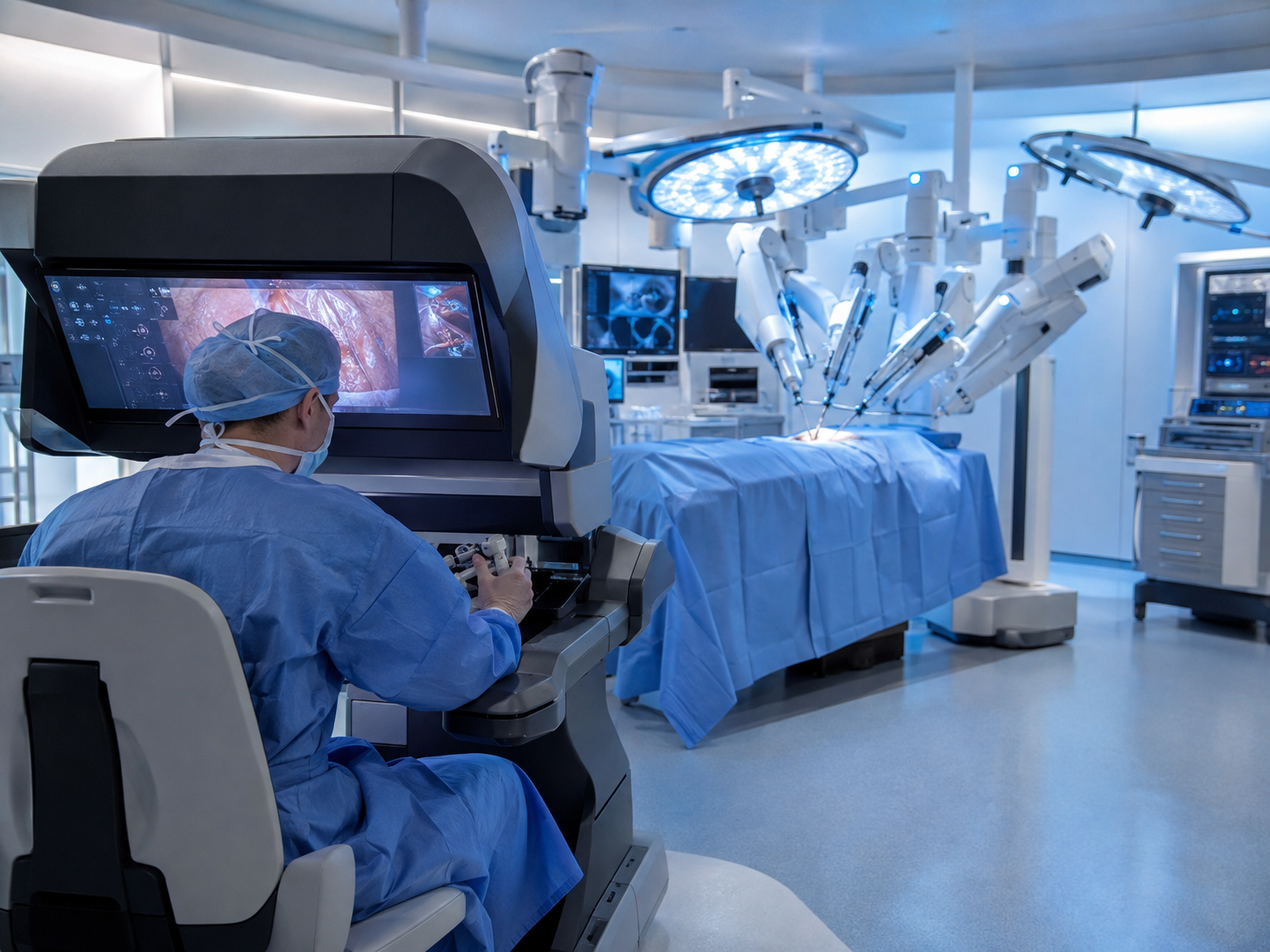
| Platform | Maker | Console style | Approx. list price | Per-case instrument cost |
|---|---|---|---|---|
| da Vinci 5 / Xi | Intuitive Surgical | Closed, immersive, seated | 1.5 to 2.5 million USD | 2,000 to 3,500 USD |
| Hugo RAS | Medtronic | Open, 3D glasses, modular carts | 0.9 to 1.2 million USD | Lower, reusable-leaning |
| Versius / Versius Plus | CMR Surgical | Open, portable bedside units | Sub-1 million USD (regional) | Lower, per-use flexible |
| Senhance | Asensus Surgical | Open, eye-tracking, reusable instruments | Under 1 million USD | Reusable instruments reduce recurring spend |
Ten years ago, choosing a surgical robot meant choosing da Vinci or waiting. That is no longer true. A wave of newly cleared platforms is reaching operating rooms in the United States, Europe, and Asia, and hospital purchasing committees are for the first time running genuine side-by-side evaluations of acquisition cost, throughput, and clinical outcomes. This guide walks through what is actually different among the major commercial platforms, what the emerging outcomes literature says, and how the numbers add up over a five-year ownership horizon.
This article is for general educational and informational purposes only. It does not constitute medical advice, and it is not a substitute for consultation with a qualified healthcare professional, hospital procurement specialist, or licensed surgeon. Decisions about surgical care or capital equipment purchasing should always involve appropriately credentialed professionals.
The Platform Landscape in 2026
Four companies now dominate discussion among hospital robotics committees: Intuitive Surgical (da Vinci), Medtronic (Hugo RAS), CMR Surgical (Versius and the newer Versius Plus), and Asensus Surgical (Senhance). A fifth entrant, Ottava from Johnson and Johnson MedTech, remains in earlier stages of regulatory clearance and limited clinical evaluation, so it is mentioned here for context rather than compared directly on cost and outcomes.
Da Vinci: The Incumbent
Intuitive’s da Vinci 5 is the flagship of a platform family that has been refined across multiple generations since the early 2000s. It uses a closed, immersive console where the surgeon sits with their head inside a binocular viewer, manipulating master controllers that translate hand movements into scaled, tremor-filtered instrument motion at the patient side cart. The newest generation added integrated force feedback, letting surgeons sense push, pull, and tissue tension for the first time on a commercially available da Vinci system. Da Vinci retains an estimated seventy percent or more share of the global soft-tissue surgical robotics market, a position built on two decades of surgeon training infrastructure, a deep instrument catalog, and strong long-term outcomes data across urology, gynecology, and general surgery.
Hugo RAS: The Modular Challenger
Medtronic’s Hugo system takes a deliberately different architectural approach. Instead of a single integrated cart, Hugo uses independent modular arm carts that can be arranged around the patient based on the procedure, paired with an open console where the surgeon wears 3D glasses rather than sitting inside a closed viewer. This modularity lowers the footprint requirement in smaller operating rooms and allows hospitals to scale up the number of arms gradually. Hugo has broad international clearance and is expanding its United States footprint as clinical evidence accumulates.
Versius and Versius Plus: Built for Portability
CMR Surgical’s Versius line emphasizes portability and bedside flexibility, with individual robotic arms mounted on separate carts that can be wheeled in and out of a standard operating room without major renovation. The newer Versius Plus received expanded regulatory clearance and is being positioned for a broader United States rollout. Versius has a substantial installed base across United Kingdom National Health Service hospitals, as well as sites in India, continental Europe, and parts of Latin America.
Senhance: Eye Tracking and Reusable Instruments
Asensus Surgical’s Senhance system differentiates itself with eye-tracking camera control, haptic-style feedback through its control interface, and a reusable instrument model that can reduce the ongoing consumable spend that dominates cost conversations around proprietary limited-use instruments. Senhance has a smaller installed base than the other three platforms but continues to be evaluated for specific procedure types, particularly in colorectal and gynecologic surgery.
Comparing console philosophies
Da Vinci uses a closed, immersive single-console design that isolates the surgeon visually from the room, while Hugo, Versius, and Senhance favor open consoles with 3D glasses or eye tracking, keeping the surgeon aware of the surrounding operating room and care team at all times.
Acquisition Cost and Total Cost of Ownership
Capital cost is only the first line item on a hospital’s spreadsheet. The bigger long-run driver is per-procedure consumable cost, which for platforms using proprietary limited-use instruments can add two to three thousand dollars per case before anesthesia, staffing, or facility costs are counted. Reusable-leaning instrument ecosystems, by contrast, spread that cost differently, trading a higher per-instrument purchase price for lower marginal cost per case over the life of the instrument.
| Cost driver | Da Vinci | Hugo / Versius / Senhance |
|---|---|---|
| Upfront capital | Highest in the category | Meaningfully lower, especially Versius and Senhance |
| Instrument model | Proprietary, roughly 10-use limit | Mixed; several platforms lean toward reusable options |
| Service contracts | Mature, widely available | Expanding as installed base grows |
| Training infrastructure | Extensive, decades old | Newer, growing rapidly |
A 2026 economic assessment published in the Journal of Robotic Surgery compared next-generation robotic surgical systems against the multiport da Vinci platform and found that reduced capital expenditure, alternative instrument-cost structures, and modular architectures were the primary levers next-generation entrants were using to expand access to robotic surgery in markets where da Vinci’s total cost of ownership had limited adoption. In practical terms, this means smaller hospitals and health systems outside wealthy urban centers are more likely to be able to afford a Hugo, Versius, or Senhance installation than an equivalent da Vinci footprint of the same arm count.
Outcomes Data: What the Comparative Studies Show
The most rigorous head-to-head clinical comparison to date is the COMPAR-CRC multiplatform study, which compared outcomes in robot-assisted colon cancer surgery across da Vinci Xi, Hugo RAS, and Versius. The study is notable because it is one of the first prospective efforts to directly compare complication and conversion rates across three commercial platforms performing the same procedure category, rather than comparing a single new platform against historical da Vinci data.
- No conversions to open or laparoscopic surgery occurred in the da Vinci group in the reported cohort.
- Two conversions to laparoscopy were recorded in the Hugo RAS group.
- Three conversions to laparoscopy were recorded in the Versius group.
- One intraoperative instrument malfunction was reported with Hugo RAS.
- One surgical complication was reported in each of the platform groups, suggesting broadly comparable complication rates once accounting for the small sample differences.
The overall takeaway from early multiplatform comparative data is that newer entrants are approaching, though not always matching, da Vinci’s conversion and complication profile, particularly during a surgical team’s early learning period on an unfamiliar system. This matches a pattern well documented in surgical robotics generally: outcomes on any platform improve measurably as a surgical team accumulates case volume, and early-adoption cohorts on any new system tend to show a temporary rise in operative time and a small rise in conversion rate that flattens out after a defined case volume threshold.
Recovery Times and Length of Stay
Across minimally invasive robotic platforms broadly, the clinical literature consistently favors robotic and laparoscopic approaches over open surgery for reduced length of hospital stay, lower blood loss, and faster return to normal activity in eligible procedures. The differences reported between competing robotic platforms performing the same procedure category are considerably smaller than the differences between robotic and open surgery, which is an important framing point: for a patient, the choice of open versus minimally invasive robotic surgery matters far more to recovery time than the specific brand of robot used, assuming the surgical team is well trained on whichever platform is in the room.
Common mistake
Assuming that a hospital advertising “the newest robotic platform” automatically means better outcomes for a specific patient. Surgeon and team experience on a given platform, procedure-specific case volume, and institutional protocols consistently matter more to individual outcomes than which brand of robot is installed in the operating room.
Market Share and Adoption Trends
Intuitive Surgical’s da Vinci platform continues to hold a dominant share of the installed base worldwide, an outcome sustained by first-mover advantage, an entrenched surgeon training pipeline, and strong long-term registry data. However, market share dynamics are shifting for the first time in over two decades because Hugo and Versius Plus have now cleared regulatory hurdles that open the door to competition in the largest single market, the United States.
| Myth | Reality |
|---|---|
| Newer, cheaper platforms mean worse outcomes. | Comparative data so far shows broadly similar complication rates across platforms, with most gaps explained by early team learning curves rather than fundamental design flaws. |
| Market share reflects clinical superiority alone. | Market share also reflects decades of installed training infrastructure, instrument catalog depth, and hospital purchasing inertia, not clinical performance alone. |
Choosing a Platform: What Hospital Committees Actually Weigh
- Procedure mix: urology and general surgery case volume tends to favor platforms with the deepest existing instrument catalogs.
- Operating room footprint: modular, portable systems like Versius and Hugo can fit into rooms that were not built around a large fixed cart.
- Surgeon familiarity: a hospital hiring surgeons trained during residency on one platform will often prioritize that platform to shorten the credentialing timeline.
- Service and uptime guarantees: newer entrants are still building out regional service networks compared to Intuitive’s mature infrastructure.
- Five-year total cost of ownership: capital price, instrument recurring cost, and service contracts must be modeled together, not evaluated on sticker price alone.
What worked
Hospital systems that ran a formal multi-platform trial period, tracking operative time, conversion rate, and instrument cost per case across at least fifty procedures per platform before committing capital, reported far more confidence in their final purchasing decision than systems that selected a platform based on capital price or vendor relationship alone.
Frequently Overlooked Factors in Platform Comparisons
- Learning curve costThe temporary rise in operative time and conversion rate every surgical team experiences when adopting a new platform, regardless of brand.
- Instrument amortizationHow the recurring cost of proprietary or reusable instruments is spread across the expected case volume of a five-year ownership period.
- Console ergonomicsWhether the surgeon sits in a closed immersive console or an open station wearing 3D glasses, which affects fatigue over long procedure days.
- Regional service coverageHow quickly a technician can reach the hospital if a robotic arm or console needs repair, which varies significantly by platform maturity in a given region.
- Credentialing timelineThe formal process by which a hospital privileges a surgeon to operate a specific robotic platform independently, which differs by manufacturer and specialty board requirements.
- Data and registry participationWhether a platform contributes case data to national or international outcomes registries, which shapes the strength of future comparative evidence.
Instrument and Console Technology Differences
| Feature | Da Vinci 5 | Hugo RAS | Versius / Versius Plus | Senhance |
|---|---|---|---|---|
| Force feedback | Yes, integrated in da Vinci 5 | Limited/developing | Limited/developing | Haptic-style interface feedback |
| Camera control | Manual console control | Manual console control | Manual console control | Eye-tracking assisted |
| Arm architecture | Integrated patient cart | Independent modular carts | Independent bedside carts | Independent arm units |
| Instrument reuse | Roughly 10-use limit | Mixed reusable options | Mixed reusable options | Reusable instrument emphasis |
The addition of integrated force feedback to da Vinci 5 is arguably the single largest technology shift in this category in years. Preclinical and early clinical trial data indicate that surgeons using force feedback exert meaningfully less force on tissue during common tasks such as dissection, retraction, and suturing, which may translate into reduced tissue trauma. Competing platforms are actively developing their own force-sensing approaches, and this is likely to be the primary axis of technical competition over the next several product cycles rather than pure imaging resolution or arm dexterity, both of which have already reached a high baseline across all major platforms.
Regulatory and Safety Considerations
All four platforms compared here have cleared regulatory review in at least one major jurisdiction, though the scope of approved procedures and the depth of long-term registry data differ. Hospitals evaluating a new platform should specifically ask what procedure types are covered under the manufacturer’s current regulatory clearance in their jurisdiction, since clearance is often procedure-specific rather than a blanket approval for all minimally invasive surgery.
Glossary
- Conversion rate
- The percentage of robotic or laparoscopic procedures that must be switched to an open surgical approach during the operation, typically due to complications or technical difficulty.
- Force feedback
- A haptic technology that lets a surgeon feel resistance, tension, or pressure from instrument-tissue interaction transmitted back through the console controls.
- Modular arm cart
- An independent robotic arm unit that can be positioned individually around the operating table, as opposed to a single integrated multi-arm cart.
- Total cost of ownership
- The full multi-year cost of operating a surgical robot, including capital purchase, instrument consumables, service contracts, and staff training.
- Credentialing
- The formal hospital process of verifying and approving a surgeon’s competence to operate a specific robotic platform independently.
Key Takeaways
- Da Vinci retains roughly seventy percent of the soft-tissue surgical robotics market but now faces genuine competition from Hugo, Versius, and Senhance.
- Newer platforms generally offer lower acquisition costs and more modular designs, appealing to hospitals with tighter capital budgets or smaller operating rooms.
- Early multiplatform comparative data, such as the COMPAR-CRC colon cancer study, shows broadly similar complication rates across platforms with modest differences in conversion rates.
- Instrument cost structure, not console price alone, drives most of the long-term cost difference between platforms.
- Da Vinci 5’s integrated force feedback is currently the most significant differentiating technology feature in the category.
- Surgeon and team experience on a given platform generally matters more to individual patient outcomes than brand choice.
- Hospital committees should evaluate five-year total cost of ownership, not just sticker price, when comparing platforms.
FAQs
Which surgical robot platform has the largest market share in 2026?
Intuitive Surgical’s da Vinci platform continues to hold roughly seventy percent or more of the global soft-tissue surgical robotics market, a position built on decades of installed training infrastructure and a deep instrument catalog across multiple surgical specialties.
Is da Vinci more expensive than Hugo or Versius?
Yes, da Vinci generally carries the highest acquisition cost in the category, often between 1.5 and 2.5 million dollars, while Hugo and Versius are typically priced lower, with Versius and Senhance frequently coming in under 1 million dollars depending on region and configuration.
Do newer surgical robot platforms have worse outcomes than da Vinci?
Early comparative studies, including the COMPAR-CRC colon cancer trial, show broadly similar complication rates across da Vinci, Hugo, and Versius, with most observed differences in conversion rates linked to teams still early in their learning curve on a new platform rather than fundamental design issues.
What is force feedback and which platform has it?
Force feedback is haptic technology letting a surgeon feel tissue tension and pressure through the console controls. Da Vinci 5 is currently the most established platform with integrated force feedback, though competitors are actively developing comparable force-sensing capabilities.
Why are hospitals choosing modular platforms like Hugo or Versius?
Modular platforms use independent arm carts that fit smaller operating rooms without major renovation, often carry lower acquisition costs, and can be scaled up gradually, making them attractive to hospitals with tighter capital budgets or space constraints.
Does a lower-cost surgical robot mean lower quality care?
Not necessarily. Available comparative outcomes data indicates broadly similar complication rates across major platforms, and cost differences reflect design philosophy, instrument strategy, and installed base maturity rather than a direct measure of clinical quality.
How long does it take a surgeon to become proficient on a new robotic platform?
Learning curves vary by procedure and surgeon background, but comparative data consistently shows a temporary increase in operative time and conversion rate during an initial case volume period that then levels off, a pattern observed across every major platform during early adoption.
What should a hospital evaluate before purchasing a surgical robot?
Key factors include procedure mix and instrument catalog depth, operating room footprint, surgeon familiarity and credentialing timelines, regional service network maturity, and full five-year total cost of ownership rather than capital price alone.
For more on how these systems are increasingly capable of semi-autonomous steps within a procedure, see our deep dive on autonomous surgical robotics and machine-assisted procedures. Hospitals evaluating any connected surgical platform should also review considerations around the cybersecurity of medical robotics, and administrators building a broader digital health strategy may find our piece on home diagnostic robots and longevity stations useful context. Readers curious about how surgeons experience force and touch through these consoles day to day should see our companion deep dive on surgical haptic feedback. New platforms entering the United States market also depend heavily on the regulatory pathways for autonomous medical devices that govern their clearance timelines.
- Standard Bots, “Top 8 surgical robotics companies in 2026”
- Journal of Robotic Surgery, “Economic assessment of next-generation robotic surgical systems compared with the multiport da Vinci platform: a comprehensive review”
- ScienceDirect, “Comparison of outcomes in robot-assisted colon cancer surgery using Da Vinci Xi, Hugo RAS, and Versius: The COMPAR-CRC multiplatform study”
- MedTech Dive, “CMR Surgical gains FDA clearance for new robot”
- MedTech Dive, “CMR Surgical robot builds momentum ahead of US rollout”
- Intuitive Surgical, “Force Feedback technology in Intuitive’s da Vinci 5”