| Platform | Direct force feedback | What the surgeon senses |
|---|---|---|
| da Vinci 5 | Yes, integrated | Push, pull, tissue tension, pressure during dissection, retraction, suturing |
| da Vinci Xi and earlier | No direct force feedback | Visual cues only; surgeons infer force from tissue deformation on screen |
| Senhance | Haptic-style interface feedback | Approximate resistance cues through the control interface |
| Mako (orthopedic) | Haptic boundary feedback | Physical resistance at the edge of a pre-planned cutting boundary |
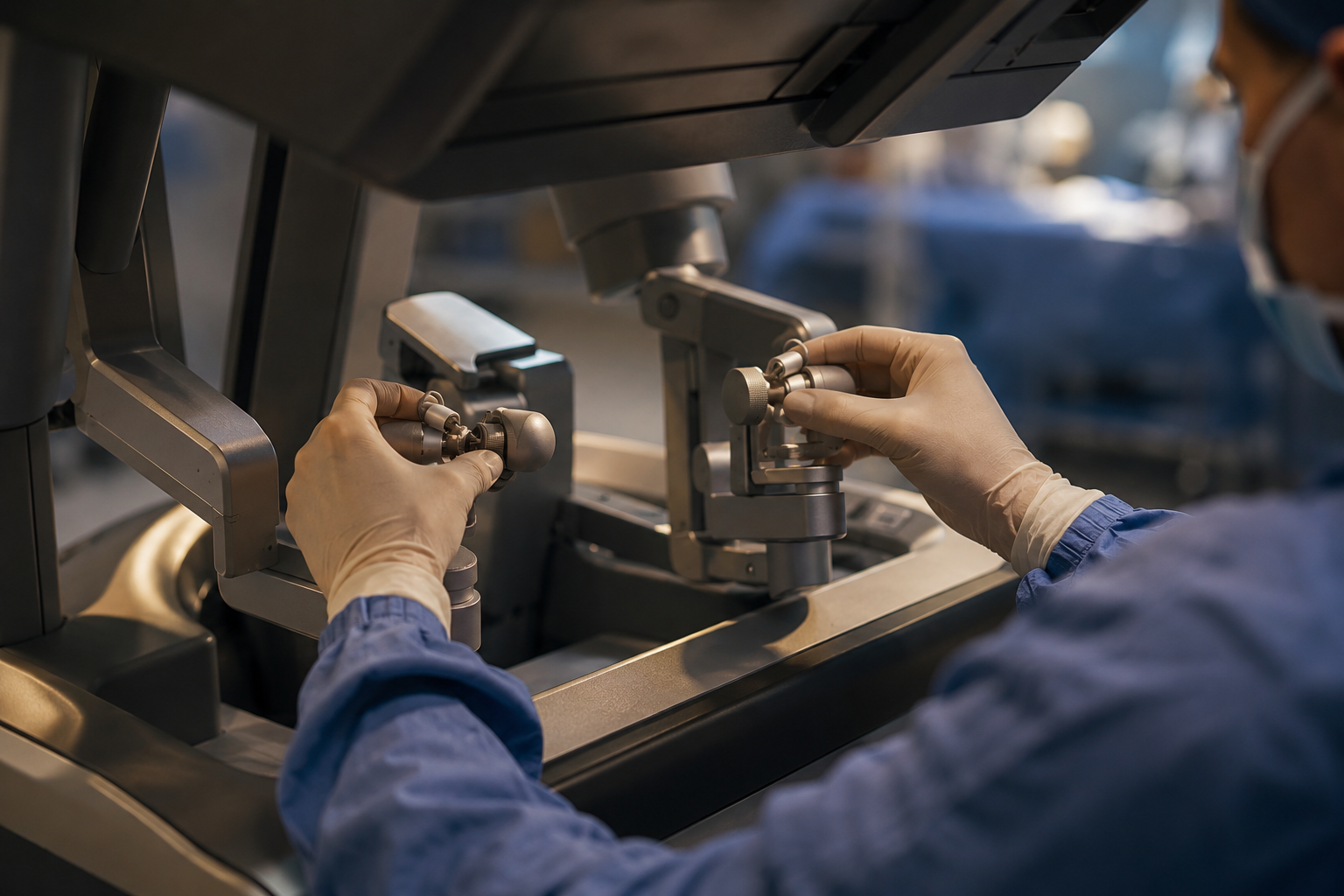
For nearly two decades, the defining criticism of robotic surgery from experienced open surgeons was simple: you cannot feel anything. A surgeon’s hands, trained over years to sense the difference between a healthy vessel and a diseased one by touch alone, were replaced by controllers offering nothing but visual feedback. That is now changing, and the change is narrower and more specific than the more sweeping conversation about haptic feedback across telesurgery, deep-sea robotics, or space exploration. This piece stays inside the operating room and asks a specific question: what does a surgeon operating a modern surgical robot actually feel, platform by platform, and how does that change how they are trained.
This article is for general educational and informational purposes only. It does not constitute medical advice and is not a substitute for consultation with a qualified healthcare professional or surgeon regarding any specific procedure or treatment decision.
Why Surgeons Care About Touch, Not Just Sight
In open surgery, palpation, the act of feeling tissue with fingers, is a core diagnostic and technical skill. Surgeons identify tumor margins, differentiate blood vessels from surrounding fascia, and judge suture tension by touch as much as by sight. Early laparoscopic and robotic surgery removed this sense almost entirely, forcing surgeons to learn to infer force purely from watching how tissue deforms on a video monitor, a skill that takes considerable case volume to develop and that experienced open surgeons often describe as a genuine loss during their transition to robotic platforms.
Da Vinci 5: The First FDA-Cleared Force Feedback Platform
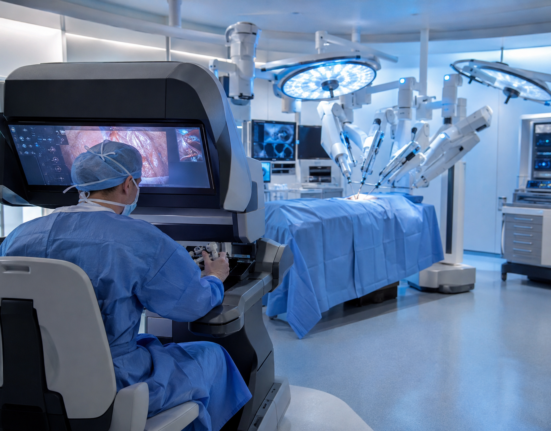
Intuitive Surgical announced that its da Vinci 5 platform would include integrated force feedback haptic technology, becoming the first FDA-cleared surgical robotic system to offer this capability directly to the operating surgeon. Using da Vinci 5, surgeons can sense push and pull forces, feel tissue tension, and detect pressure during common tasks including dissection, retraction, and suturing. This is delivered through force sensing built into the instrument and arm architecture, translated back to resistance the surgeon feels through the master controllers at the console.
What the Force Feedback Actually Feels Like
Surgeons describe the sensation less as a fine-grained tactile texture, the way a fingertip feels fabric, and more as proportional resistance: pulling harder on tissue produces a stronger pushback through the controller, while a gentle retraction produces a correspondingly gentle resistance. It is closer to feeling the tension in a suture thread as it is pulled taut than to feeling the surface texture of an organ. This distinction matters clinically, because the goal is not to replicate the full sensory richness of a bare hand but to give the surgeon a reliable proportional cue that prevents excessive force during common maneuvers.
Measured Clinical Benefits
In preclinical trials, surgeons across all experience levels were found to exert up to forty-three percent less force on tissue during procedures performed with force feedback active, compared to procedures performed without it. A separate simulation-based study found force feedback reduced exerted forces by approximately forty-eight percent during suturing tasks specifically. Surgeons who were early in their learning curve made fewer errors, sutured faster, and caused less tissue trauma when force feedback was available, suggesting the technology may meaningfully shorten the training period needed to reach safe proficiency on a new platform.
Force feedback loop at the console
Sensors near the instrument tip or arm joints detect resistance from tissue contact, that signal is processed and scaled, then relayed back through the master controller grips the surgeon holds, producing a proportional pushback the surgeon feels in real time as they move the instrument.
How Older Platforms Compensate Without Direct Force Sensing
Da Vinci Xi and earlier generations, along with most competing platforms still rolling out their own force-sensing capability, rely on indirect cues rather than true haptic feedback. Surgeons trained on these systems learn to read tissue deformation, color change, and instrument bend visually on the console display, effectively substituting visual interpretation for touch. Experienced robotic surgeons develop this skill to a high degree, but it takes measurable time and case volume, and it is widely regarded within the surgical community as an imperfect substitute for genuine tactile sensing, particularly for less experienced trainees.
A newer engineering approach, appearing in recent patent filings, derives collision and joint-limit feedback from the discrepancy between the commanded arm pose and the pose the arm actually achieves, rather than relying on dedicated tip force sensors. This method aims to provide a safety-relevant haptic cue, such as an alert when an instrument encounters unexpected resistance, without the cost and complexity of instrumenting every tool tip with a force sensor.
Orthopedic Systems: A Different Kind of Haptics
Orthopedic surgical robots such as Stryker’s Mako system use haptics in a fundamentally different way than soft-tissue platforms like da Vinci. Rather than relaying continuous tissue tension, Mako uses haptic boundary feedback: the surgeon pre-plans a precise cutting or resection zone using imaging, and the robotic arm provides physical resistance if the surgeon’s hand-guided cutting tool approaches the edge of that pre-planned boundary. This is a constraint-based haptic experience rather than a tissue-sensing one, and it is specifically designed to prevent bone resection outside the planned area during joint replacement procedures.
| Haptic type | Example platform | What it protects against |
|---|---|---|
| Tissue tension feedback | da Vinci 5 | Excessive force during dissection, retraction, and suturing |
| Boundary resistance feedback | Mako | Cutting or resection outside a pre-planned anatomical zone |
| Interface-level haptic cues | Senhance | General awareness of instrument-tissue contact through the control interface |
| Pose-discrepancy safety feedback | Emerging systems (patent-stage) | Unexpected collisions or joint-limit conditions without dedicated tip sensors |
Force Thresholds and Suturing
Research examining tissue forces during robotic suturing has found that a surgeon’s experience level correlates directly with the forces they apply: novice and intermediate-level surgeons consistently exert higher maximum and average forces during a standardized suturing exercise than expert-level surgeons operating the same platform. This finding underpins much of the enthusiasm around force feedback as a training tool, since a system that lets a trainee feel when they are pulling too hard on a suture, rather than learning only from a mentor’s verbal correction or a torn stitch, could meaningfully compress the experience gap between novice and expert technique.
Common mistake
Assuming that force feedback on a modern platform recreates the full sensory experience of open surgery. Current systems relay proportional resistance cues for specific tasks like retraction and suturing; they do not yet replicate fine tactile discrimination such as feeling a small nodule embedded in tissue, and surgeons should not treat the feedback as a complete substitute for visual assessment and clinical judgment.
Surgeon Training and Adaptation
Introducing force feedback changes how surgical training programs approach robotic simulation. Visual haptic feedback tools, which display a graphical indicator of applied force alongside the physical haptic sensation, have been studied specifically as training aids for robotic suturing, helping trainees build an internal calibration of how much force corresponds to safe tissue handling before they operate on a live patient. Simulation training incorporating haptic feedback of instrument vibrations has also been shown to reduce resident cognitive workload during live robot-assisted procedures, suggesting the benefit of haptic-equipped training extends beyond the specific platform used in simulation.
Surgeons transitioning from a non-haptic platform to a force-feedback-equipped one generally describe an adjustment period during which they must recalibrate their expectations, since the sensation is new even to highly experienced robotic surgeons. Clinical trials are underway examining how force feedback affects the learning curve and safety profile specifically in procedures such as robot-assisted radical prostatectomy, comparing outcomes and training milestones between surgeons using force-feedback-equipped consoles and those using standard consoles.
What worked
Training programs that incorporated dedicated simulation time on force-feedback-equipped consoles before residents operated on live tissue reported that trainees reached safe, independent suturing competence with fewer supervised cases than cohorts trained exclusively on non-haptic systems.
What Surgeons Say They Still Cannot Feel
- Fine surface texture, such as distinguishing a smooth healthy surface from a slightly roughened diseased one, remains difficult to detect through current force feedback systems.
- Temperature differences in tissue, sometimes used by open surgeons as a subtle diagnostic cue, are not currently relayed by any commercial surgical robot.
- Small embedded structures, like a tiny calcification or nodule within otherwise soft tissue, are generally still identified visually or through pre-operative imaging rather than by touch.
- Pulsation and vascular flutter, which an open surgeon’s fingertip can sometimes detect directly, are not yet a standard haptic output on commercial platforms.
Frequently Overlooked Aspects of Surgical Haptics
- Proportional versus absolute feedbackCurrent systems relay force proportionally rather than replicating the exact physical sensation a bare hand would feel, an important distinction for managing surgeon expectations.
- Boundary haptics versus tissue hapticsOrthopedic systems like Mako use haptics to enforce a cutting boundary, a different purpose than the tissue-tension sensing used in soft-tissue platforms like da Vinci.
- Learning curve compressionEarly data suggests force feedback may shorten the case volume needed for a trainee to reach safe suturing proficiency, though long-term studies are still accumulating.
- Pose-discrepancy sensingAn emerging engineering method that infers collision and safety-relevant feedback from arm position error rather than dedicated tip force sensors.
- Visual-haptic training aidsSimulation tools that pair a graphical force display with physical haptic sensation to help trainees calibrate safe force levels before live surgery.
Glossary
- Force feedback
- A haptic technology that relays resistance, tension, or pressure sensed at a surgical instrument back to the surgeon through the console controls.
- Palpation
- The clinical technique of examining tissue by touch, traditionally used to identify texture, firmness, and abnormalities.
- Haptic boundary
- A pre-planned virtual zone in orthopedic robotic surgery that provides physical resistance to keep a cutting instrument within an approved area.
- Tissue tension feedback
- Proportional resistance relayed to a surgeon reflecting how much pulling or pushing force is being applied to tissue during a maneuver.
- Pose discrepancy
- The measured difference between a robotic arm’s commanded position and its actual achieved position, used by some systems to infer unexpected resistance or collision.
Key Takeaways
- Da Vinci 5 is the first FDA-cleared surgical robot with integrated force feedback, letting surgeons feel push, pull, and tension during common tasks.
- Preclinical data shows surgeons can exert up to forty-three to forty-eight percent less force on tissue when using force feedback, depending on the task studied.
- Older platforms without direct force sensing rely on surgeons learning to interpret visual cues of tissue deformation instead of true tactile feedback.
- Orthopedic systems like Mako use a fundamentally different haptic model based on pre-planned cutting boundaries rather than tissue tension.
- Novice and intermediate surgeons consistently apply higher suturing forces than experts, which is part of why force feedback is seen as a promising training tool.
- Surgeons still cannot feel fine surface texture, temperature, or small embedded structures through current commercial haptic systems.
- Training programs incorporating haptic-equipped simulation report faster progression to safe, independent suturing competence.
FAQs
Which surgical robot was the first to offer true force feedback?
Intuitive Surgical’s da Vinci 5 became the first FDA-cleared surgical robotic platform with integrated force feedback, allowing surgeons to sense push, pull, tissue tension, and pressure during tasks such as dissection, retraction, and suturing directly through the console controls.
How much less force do surgeons use with haptic feedback?
Preclinical trial data found surgeons exerted up to forty-three percent less force on tissue overall with force feedback active, while a separate study focused specifically on suturing found roughly a forty-eight percent reduction in exerted force compared to procedures performed without feedback.
Do all surgical robots have haptic feedback?
No. Da Vinci 5 is currently the most established platform with integrated tissue-tension force feedback. Earlier da Vinci generations and several competing platforms rely on visual cues alone, though multiple manufacturers are actively developing their own force-sensing capabilities.
How is haptic feedback different in orthopedic robots like Mako?
Mako uses boundary-based haptics rather than tissue-tension feedback: the surgeon pre-plans a resection zone using imaging, and the robotic arm provides physical resistance if the cutting tool approaches the edge of that boundary, protecting surrounding anatomy rather than sensing tissue tension.
Can force feedback fully replace a surgeon’s sense of touch from open surgery?
Not yet. Current systems relay proportional resistance for specific tasks like retraction and suturing but do not replicate fine tactile discrimination such as surface texture, temperature, or the feel of a small embedded nodule, so visual assessment and clinical judgment remain essential.
Does force feedback shorten surgical training time?
Early evidence suggests it may. Studies show trainees using force feedback make fewer errors and suture with less tissue trauma early in their learning curve, and simulation training incorporating haptic feedback has been shown to reduce cognitive workload during live procedures.
Does surgeon experience level affect how much force is applied during robotic suturing?
Yes. Research measuring tissue forces during standardized robotic suturing exercises found that novice and intermediate-level surgeons consistently applied higher maximum and average forces than expert-level surgeons operating the same platform.
How do newer systems detect collisions without dedicated force sensors?
An emerging engineering approach derives collision and joint-limit feedback from the discrepancy between a robotic arm’s commanded pose and its actual achieved pose, providing a safety-relevant haptic cue without requiring a dedicated force sensor at every instrument tip.
For the broader technology landscape behind haptic feedback across telesurgery and other remote robotic domains, see our companion guide on haptic feedback in remote robotic control. Readers comparing surgical platforms more broadly may also want our surgical robot platform comparison, and those interested in where autonomous decision-making fits into the operating room should see our piece on autonomous surgical robotics and machine-assisted procedures. Hospitals evaluating connected surgical platforms should also review the cybersecurity of medical robotics, and administrators tracking new device clearances may find our coverage of regulatory pathways for autonomous medical devices useful.
- IEEE Pulse, “Feel the Precision: Next-Gen Robotic Surgery With Haptic Feedback”
- Intuitive Surgical, “Force Feedback technology in Intuitive’s da Vinci 5”
- PMC, “Haptic Feedback in Robot-Assisted Minimally Invasive Surgery”
- R2 Surgical, “da Vinci 5’s Force Feedback Explained”
- PMC, “Visual Haptic Feedback for Training of Robotic Suturing”
- PatSnap Eureka, “Surgical Robot Haptic Feedback 2026”
- ClinicalTrials.gov, “The Impact of Force Feedback in the dV5 Robotic Surgical System on Learning Curve and Safety in Robot-Assisted Radical Prostatectomy”