| Myth | Reality |
|---|---|
| Capsule endoscopy is just a camera pill with no real diagnostic power. | AI-assisted review of capsule video has pushed per-lesion sensitivity from roughly 86 percent with standard interpretation to nearly 99 percent in recent studies. |
| All capsules simply drift passively through the gut with no control. | Robotic capsule endoscopy systems now use external magnetic fields to actively steer the capsule through the stomach for a more complete, targeted exam before it moves on to passive small-bowel transit. |
| Capsule robots are the same technology as the micro-swimmers used in vascular surgery. | Ingestible capsules are a distinct, GI-tract-specific category from magnetically-guided vascular and ophthalmic micro-swimmers, which travel through blood vessels rather than the digestive tract. |
| A capsule endoscopy can biopsy tissue just like a traditional scope. | Most capsules today are imaging-only; robotic biopsy-capable capsule designs exist in research settings but are not yet standard clinical tools. |
What Capsule and Micro-Robotics for Diagnostics Actually Covers
When people hear “micro-robotics in medicine,” they often picture a swarm of nanoscale machines swimming through the bloodstream to deliver drugs directly to a tumor. That is a real and rapidly advancing field, and we cover it in depth in our companion article, The Evolution of Micro-Robotics in Precision Medicine, which surveys magnetically-guided micro-swimmers used for targeted drug delivery and minimally invasive vascular and ophthalmic procedures.
This Technical Deep Dive is about a narrower, older, and in some ways more clinically mature category: ingestible, capsule-form diagnostic devices that travel through the gastrointestinal (GI) tract rather than the bloodstream. These are swallowable cameras and sensor platforms, sometimes with active locomotion, that image the esophagus, stomach, small bowel, and in some configurations the colon, without sedation, without an endoscope, and without the discomfort of a traditional procedure. This is a genuinely distinct sub-category from vascular micro-swimmers: different environment, different propulsion physics, different regulatory history, and a different clinical workflow entirely.
| Capsule Platform | Primary Target | Locomotion | Notable Capability |
|---|---|---|---|
| PillCam SB3 | Small bowel | Passive (peristalsis) | High-resolution imaging for obscure bleeding, Crohn’s disease |
| PillCam COLON | Colon | Passive | Adjunct colon visualization for patients unable to complete colonoscopy |
| Robotic capsule endoscopy (magnetically steered) | Stomach plus small bowel | Active, externally steered magnetic field | Simultaneous gastric and enteric evaluation in one exam |
| Kirigami-inspired biopsy capsule (research stage) | Small bowel and stomach | Passive with mechanical actuation | Minimally invasive tissue sampling from within a capsule form factor |
How Capsule Endoscopy Works: From Swallow to Diagnosis
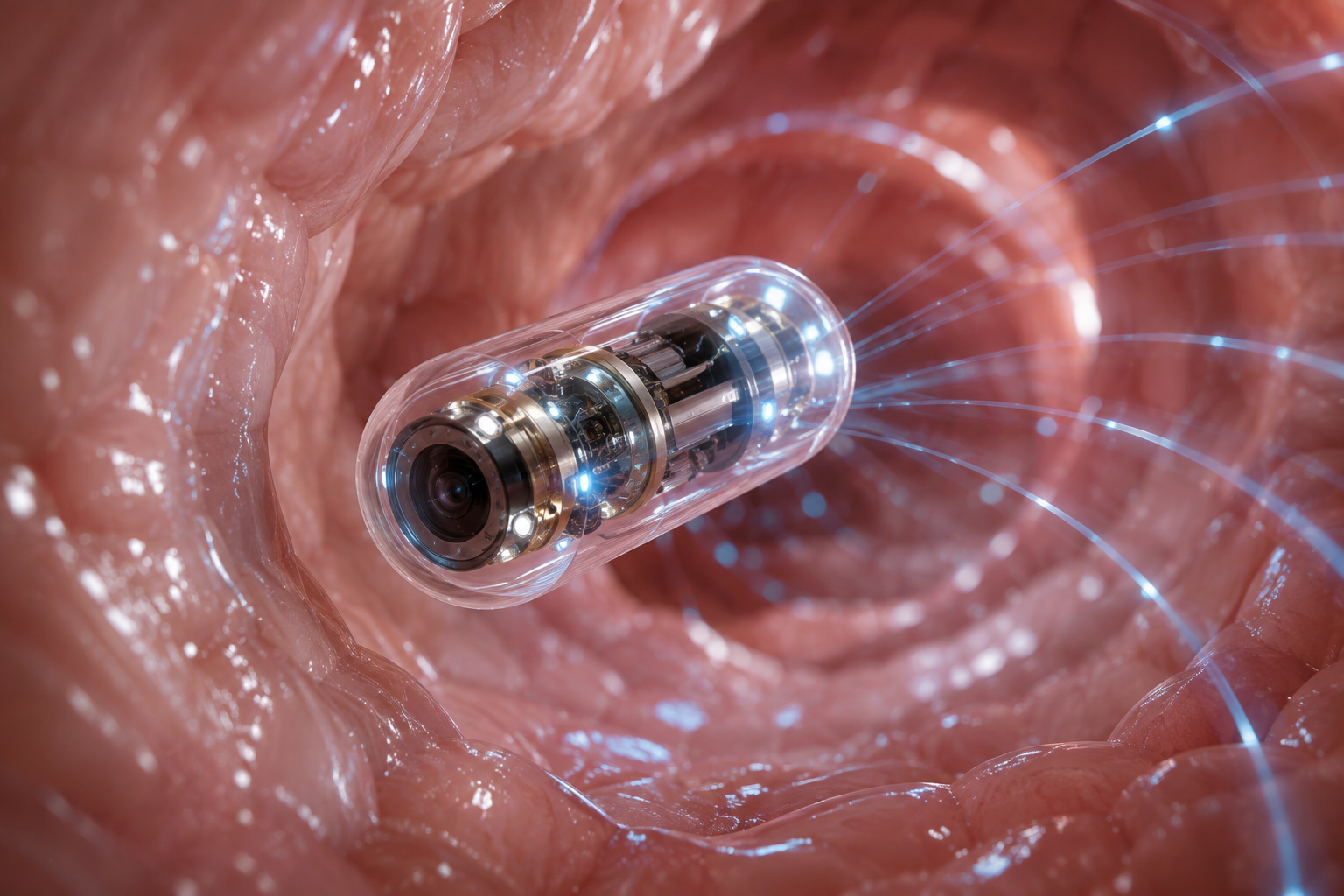
A modern diagnostic capsule is roughly the size of a large vitamin pill. Inside that small shell sits a miniature camera (often two, one at each end for panoramic-style coverage), an LED illumination ring, a battery, a wireless image transmitter, and in newer designs a locomotion or steering mechanism. The patient swallows the capsule with water, and over the following 8 to 12 hours it travels through the digestive tract, capturing thousands of images along the way. Those images are transmitted wirelessly to a sensor belt or array worn by the patient and later downloaded to a workstation for review.
The core clinical use cases are obscure GI bleeding where a standard endoscope or colonoscope found no source, small bowel evaluation in suspected Crohn’s disease, surveillance in polyposis syndromes, and, for colon-specific capsules, an alternative visualization option for patients who cannot or will not complete a traditional colonoscopy.
Passive Transit vs. Robotic Locomotion
The original generation of capsule endoscopes relied entirely on natural peristalsis, the digestive tract’s own muscular contractions, to move the capsule along. That works well for the small bowel, where there is a lot of transit distance and time, but it is a poor fit for the stomach, a large, irregularly shaped organ where a passively drifting capsule may never image every fold and surface.
Robotic capsule endoscopy solves this by pairing a capsule containing an internal magnet with an external magnetic field generator that a clinician or a robotic arm controls in real time. This lets an operator actively steer the capsule around the stomach, systematically imaging the walls, before releasing it to continue passively into the small bowel. Recent real-world practice data describes this as enabling simultaneous gastric and enteric evaluation in a single exam, something passive capsules alone cannot achieve.
A Single-Pass Capsule Exam
In a magnetically steered exam, the clinician first uses the external field to guide the capsule through a deliberate survey pattern across the stomach lining, capturing targeted images of areas that are otherwise easy to miss with passive drift. Once the gastric survey is complete, the magnetic field is released and the capsule continues its passive transit into the small bowel, where it continues recording until it is naturally expelled.
AI-Assisted Lesion Detection: The Real Diagnostic Leap
The biggest recent advance in capsule diagnostics is not the capsule hardware itself but the software that reads its output. A single small-bowel capsule exam generates tens of thousands of frames, and manually reviewing all of that footage is slow and prone to missed lesions, especially subtle ones like small angiodysplasias or flat polyps.
AI-assisted review tools now pre-screen this footage and flag likely lesions for the reading physician. In one study analyzing 249 PillCam SB3 examinations using an AI-assisted review tool, per-lesion sensitivity increased from 86.4 percent with standard interpretation to 98.8 percent with AI-assisted review, and per-patient sensitivity rose from 80.3 percent to 99.1 percent. The same study found a meaningful reduction in reading time, from a mean of 17.9 minutes down to 13.7 minutes per case.
| Metric | Standard Manual Review | AI-Assisted Review |
|---|---|---|
| Per-lesion sensitivity | 86.4% | 98.8% |
| Per-patient sensitivity | 80.3% | 99.1% |
| Mean reading time | 17.9 minutes | 13.7 minutes |
| Lesion categories covered | Reviewer-dependent | Eight standardized lesion categories |
These are not marginal improvements. A near-13-point jump in per-lesion sensitivity means a meaningful number of clinically significant findings, small bleeding sources, early polyps, or inflammatory changes, that would otherwise have been missed on a first manual pass are now being caught. That said, AI-assisted flagging is a screening aid for the physician, not a replacement for expert interpretation, and a qualified gastroenterologist still confirms every finding before it informs a diagnosis or treatment plan.
Steerable and Robotic Locomotion Systems in Detail
Beyond magnetic steering for gastric survey, researchers are developing more sophisticated locomotion and even tissue-interaction mechanisms for capsule robots. One notable research direction uses kirigami-inspired mechanical structures, cut patterns in a thin material that allow it to fold, grip, or actuate in complex ways, to give a capsule the ability to anchor briefly against the intestinal wall and perform a minimally invasive biopsy from within the GI tract, all without an external scope or incision.
Other approaches to robotic capsule locomotion include:
- External magnetic actuation, where a robotic arm or fixed coil array outside the body moves a magnet-equipped capsule with sub-millimeter precision, currently the most clinically mature locomotion approach beyond passive transit.
- Vibration and micro-legged crawling, still largely in the research stage, aimed at giving a capsule active forward motion through the small bowel rather than relying entirely on peristalsis.
- Fluid-jet or expandable-anchor mechanisms, explored for holding a capsule in place long enough to capture a targeted image set or take a sample, rather than continuously drifting past a lesion of interest.
Capsule Diagnostics vs. Traditional Endoscopy
| Factor | Traditional Endoscopy/Colonoscopy | Capsule Endoscopy |
|---|---|---|
| Sedation required | Typically yes | No |
| Coverage | Limited to scope reach (upper GI or colon) | Can cover full small bowel, a region scopes cannot easily reach |
| Biopsy capability | Standard, well established | Largely imaging-only; biopsy-capable capsules remain experimental |
| Patient experience | Invasive, recovery time needed | Swallow a pill, resume normal activity same day |
| Real-time intervention | Yes, operator can act immediately on findings | No, review happens after the capsule is retrieved or footage downloaded |
Clinical Workflow: What a Capsule Diagnostic Exam Looks Like
- Preparation: The patient typically fasts for several hours and may take a bowel-clearing prep depending on the target region.
- Sensor placement: A sensor belt or set of skin electrodes is applied to receive the wireless signal from the capsule.
- Ingestion: The patient swallows the capsule with water, sometimes under direct observation if a robotic gastric survey is planned.
- Active or passive transit: If magnetic steering is used, a clinician guides the capsule through a systematic gastric survey before releasing it to passive small bowel transit.
- Data capture: The capsule continues recording for roughly 8 to 12 hours, transmitting images to the worn recorder.
- Natural passage: The capsule is passed naturally, typically within 24 to 48 hours, and is not retrieved.
- AI-assisted review: Software pre-screens the full video and flags candidate lesions across standardized categories for physician review.
- Physician interpretation and report: A gastroenterologist confirms, rejects, or further investigates flagged findings and issues a diagnostic report.
Common mistake
Assuming a normal or unremarkable capsule study means the small bowel is entirely clear of pathology. Capsule transit time varies, and if the capsule moves through a segment of bowel too quickly, or the battery expires before the capsule reaches the colon, portions of the tract can go unimaged. A truly complete study requires confirming full transit was captured, not just that no lesions were flagged in the footage that was recorded.
What worked
Centers that paired robotic magnetic gastric survey with standard passive small-bowel capsule transit, rather than relying on either technique alone, reported more complete single-session evaluation of both the stomach and small bowel, reducing the need for a separate traditional upper endoscopy to cover the gastric portion of the exam.
Frequently Overlooked Details in Capsule Diagnostics
- Capsule retention riskIn patients with strictures or prior bowel surgery, a capsule can become lodged rather than passing naturally, which is why a patency capsule test is sometimes performed first.
- Battery and transit time mismatchIf the small bowel transit is unusually slow, the capsule’s battery can run out before it reaches the colon, leaving the terminal small bowel unimaged.
- AI flag fatigueOver-sensitive AI flagging can generate a high volume of false positives, which reviewing physicians must still individually triage rather than accept automatically.
- Standardized lesion taxonomyAI systems trained on a fixed set of lesion categories may under-flag findings that fall outside that taxonomy, a limitation worth knowing before relying solely on automated review.
- Magnetic steering is operator-dependentRobotic gastric survey quality still depends heavily on the skill of the clinician driving the external magnetic controller, similar to ultrasound operator dependency.
- Not a treatment toolNearly all clinically deployed capsules are diagnostic only; any bleeding source or lesion identified typically still requires a separate procedure to treat.
Regulatory and Safety Considerations
Ingestible capsule diagnostics generally fall under a distinct regulatory sub-category from other autonomous medical devices, since they combine a passive or semi-autonomous locomotion function with AI-based image interpretation software. For a broader look at how the FDA and EMA classify autonomous medical technology across categories, including where capsule and micro-robotic devices fit relative to surgical robots and diagnostic AI more generally, see our companion Policy Analysis, Regulatory Pathways for Autonomous Medical Devices.
Capsule endoscopy is broadly considered low-risk relative to sedated endoscopic procedures, but it is not risk-free. The main safety concern is capsule retention in patients with known or suspected bowel strictures, which is why a dissolvable “patency capsule” is sometimes used as a pre-screening test in higher-risk patients before the diagnostic capsule is swallowed.
Key Takeaways
- Ingestible capsule endoscopy is a distinct diagnostic category from vascular and ophthalmic micro-swimmers, operating specifically within the GI tract rather than the bloodstream.
- AI-assisted review of capsule video has pushed per-lesion sensitivity from roughly 86 percent to nearly 99 percent in recent multi-case studies.
- Robotic, magnetically steered capsules can actively survey the stomach before transitioning to passive small-bowel transit, enabling combined gastric and enteric evaluation in one exam.
- AI-assisted review also meaningfully reduces physician reading time per case, freeing up clinical capacity without sacrificing sensitivity.
- Most clinically deployed capsules remain imaging-only; robotic biopsy-capable capsule designs exist but are still largely in the research stage.
- Capsule retention in patients with bowel strictures remains the primary safety concern, addressed in higher-risk patients with a patency capsule pre-screen.
- Capsule diagnostics are a screening and imaging tool, not a treatment; any significant finding typically still requires a follow-up procedure to address.
Glossary
- Capsule endoscopy
- A diagnostic procedure using a swallowable, camera-equipped capsule to image the gastrointestinal tract without an inserted scope.
- Robotic capsule endoscopy (RCE)
- Capsule endoscopy enhanced with externally controlled magnetic steering, allowing active navigation of the capsule, particularly through the stomach.
- Patency capsule
- A dissolvable test capsule used to confirm that a patient’s GI tract is free of strictures before a diagnostic capsule is administered.
- AI-assisted lesion detection
- Software that automatically analyzes capsule endoscopy video and flags frames likely to contain clinically significant findings for physician review.
- Small bowel transit time
- The time it takes a capsule to travel from the stomach through the small intestine, a variable that affects how completely the region is imaged.
- Micro-swimmer
- A magnetically or chemically propelled micro-robot designed to travel through the bloodstream or other fluid environments, distinct from GI-tract capsule robots.
FAQs
What is the difference between capsule endoscopy and traditional endoscopy?
Capsule endoscopy uses a small swallowable camera device that requires no sedation and can image the entire small bowel, a region traditional endoscopes cannot easily reach, while traditional endoscopy uses an inserted scope that allows real-time viewing and immediate intervention such as biopsy.
How does AI improve capsule endoscopy diagnosis?
AI-assisted review software pre-screens thousands of capsule video frames and flags likely lesions across standardized categories, which has been shown in studies to raise per-lesion sensitivity from about 86 percent to nearly 99 percent while also reducing physician reading time per case.
Can a robotic capsule be steered inside the body?
Yes. Robotic capsule endoscopy systems use an external magnetic field to actively steer a magnet-equipped capsule through the stomach for a systematic survey before releasing it to passively continue through the small bowel via natural peristalsis.
Is capsule endoscopy the same technology as micro-robots used in blood vessels?
No. Ingestible capsule diagnostics are a distinct category that operates within the gastrointestinal tract, while magnetically-guided micro-swimmers used for vascular or ophthalmic procedures travel through blood vessels or the eye and rely on different propulsion physics and clinical applications entirely.
Can a diagnostic capsule take a tissue biopsy?
Most capsules in current clinical use are imaging-only. Robotic biopsy-capable capsule designs, including kirigami-inspired mechanical sampling structures, exist in research settings but have not yet become standard clinical tools.
What happens if a capsule does not pass naturally?
Capsule retention can occur in patients with bowel strictures or prior surgery. This is why higher-risk patients are sometimes given a dissolvable patency capsule beforehand to confirm the GI tract is clear enough for the diagnostic capsule to pass without becoming lodged.
How long does a capsule endoscopy exam take?
The capsule typically records for about 8 to 12 hours after being swallowed, after which the patient returns the recording device so the footage can be downloaded and reviewed by AI-assisted software and then a physician.
Are capsule endoscopy devices regulated the same way as surgical robots?
No. Capsule diagnostics generally follow a different regulatory track shaped by their imaging and software functions rather than invasive mechanical action, though they still fall under the broader FDA and EMA frameworks that govern autonomous and AI-enabled medical devices generally.
References
- EMJ Reviews, AI Model Boosted Accuracy in Capsule Endoscopy Detection
- ScienceDirect, Automated detection of small bowel lesions based on capsule endoscopy using deep learning algorithm
- PMC (National Center for Biotechnology Information), Robotic Capsule Endoscopy: Simultaneous Gastric and Enteric Evaluation in Real-World Practice
- arXiv, Video Capsule Endoscopy and Ingestible Electronics: Emerging Trends in Sensors, Circuits, Materials, Telemetry, Optics, and Rapid Reading Software
- arXiv, Bioinspired Kirigami Capsule Robot for Minimally Invasive Gastrointestinal Biopsy
- PMC, Deep Learning and Minimally Invasive Endoscopy: Automatic Classification of Pleomorphic Gastric Lesions in Capsule Endoscopy
- PMC, Capsule robots for the monitoring, diagnosis, and treatment of intestinal diseases
- Nature Communications, Robotic wireless capsule endoscopy: recent advances and upcoming technologies
- PMC, Integration of Artificial Intelligence-Enhanced Capsule Endoscopy in Clinical Practice: A Review of Market-Available Tools for Clinical Practice
- Medtronic, PillCam SB3 System clinical and product documentation
Our sibling deep dive on Robotic Biopsy and Image-Guided Intervention covers macro-scale, needle-based tissue sampling as a contrasting approach. You may also find our coverage of The Cybersecurity of Medical Robotics and Haptic Feedback in Surgical Systems relevant to the wider medical robotics landscape.
Medical Disclaimer: The information in this article is provided for educational and informational purposes only and does not constitute medical advice. Capsule and micro-robotic diagnostic technologies described here should only be used under the guidance of a qualified healthcare professional; always consult your physician regarding any GI symptoms or diagnostic testing decisions.