| Consideration | Industry Position | Environmental-Science Position |
|---|---|---|
| Ecosystem knowledge | Years of environmental baseline surveys have been conducted in target zones before collector testing began. | Deep-sea ecosystems remain poorly studied, and recovery timelines for disturbed sediment communities are largely unknown. |
| Sediment plumes | Modern collector vehicles are engineered to minimize plume generation compared to 1970s-era designs. | Even reduced plumes can travel widely and settle on filter-feeding organisms far from the collection site. |
| Mineral necessity | Battery metals in nodules are framed as essential to accelerating the clean energy transition. | Recycling, land-based mining reform, and battery chemistry changes may reduce the need for seabed extraction. |
| Regulatory readiness | Companies argue commercial-scale operations are technically ready to begin. | Over three dozen countries have called for a moratorium until international rules are finalized. |
What Deep-Sea Mining Robotics Actually Looks Like
Deep-sea mining does not resemble a submarine drilling into rock. The primary commercial target, polymetallic nodules, are potato-sized mineral concretions that sit loose on the seafloor across vast abyssal plains, most notably the Clarion-Clipperton Zone in the central Pacific Ocean. Because the nodules are unattached to bedrock, the engineering challenge is less about cutting and more about gentle, efficient collection at depths exceeding four kilometers, in complete darkness, under enormous pressure, thousands of meters below any diver or ROV pilot could safely work in real time.
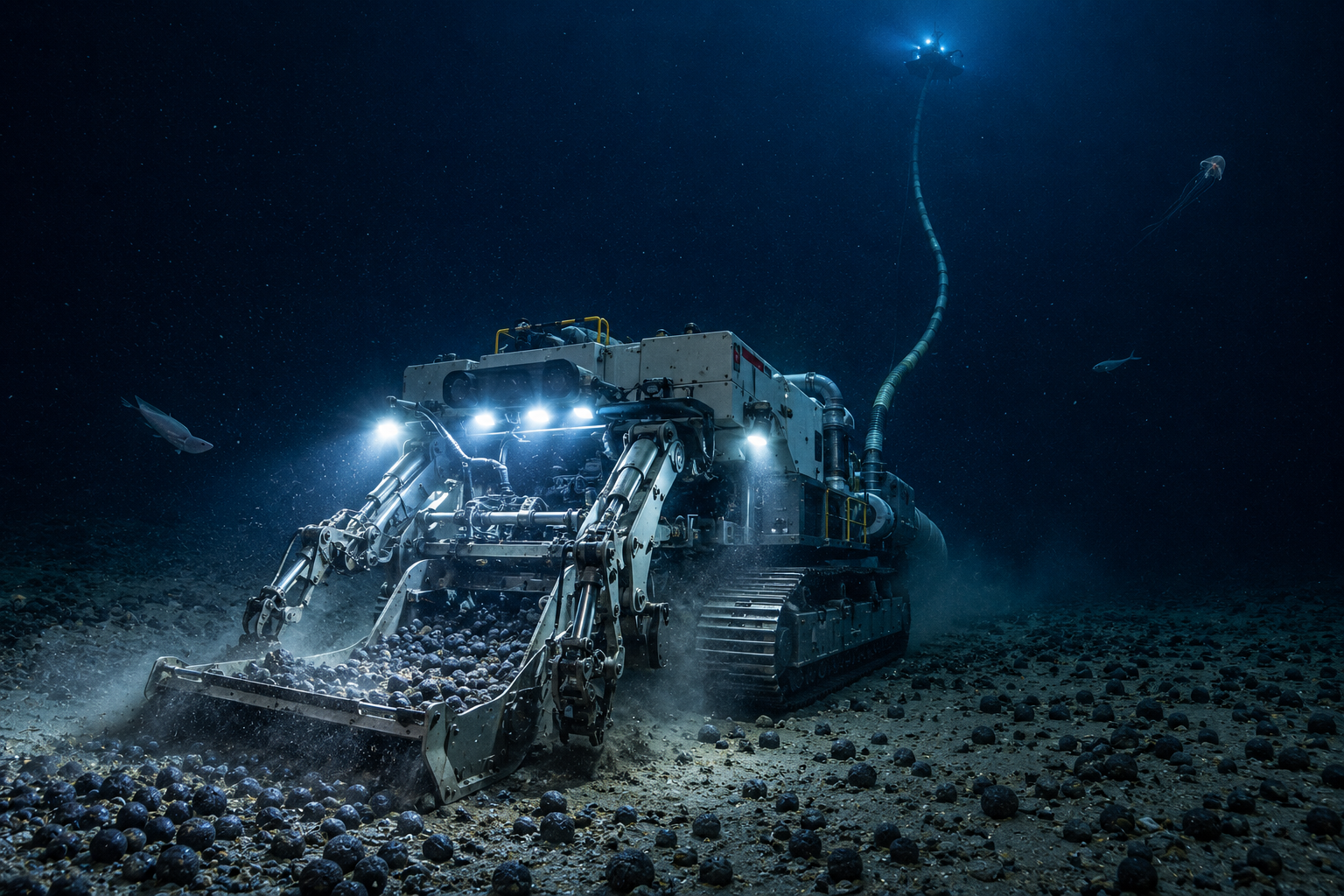
The resulting equipment stack has three main components: a self-propelled collector vehicle that travels along the seafloor gathering nodules, a riser and lift system that transports collected material thousands of meters up to a surface vessel, and a production support ship that separates nodules from water and sediment before returning that water below the photic zone. Recent deep-water trials have tested this full chain together for the first time since pilot-scale tests were run in the 1970s, this time with real-time environmental monitoring built into the operation from the start.
| System Component | Function | Typical Operating Depth | Key Engineering Challenge |
|---|---|---|---|
| Nodule collector vehicle | Tracked vehicle that uses seawater jets to dislodge and gather nodules from the sediment surface | Roughly 4,000 to 5,500 meters | Minimizing sediment disturbance while maintaining collection rate |
| Riser and lift system | A flexible, kilometers-long pipe plus umbilical that lifts nodules and carries power and control signals | Spans full water column to the surface | Structural reliability under current loads across extreme length |
| Jumper hose | Connects the mobile collector vehicle to the fixed riser base | Near seafloor, roughly 500 meters of flexible hose | Maintaining connection as the collector moves across terrain |
| Production support vessel | Dewaters nodules, separates sediment, returns water below the photic zone | Surface | Managing discharge to limit surface and mid-water ecological impact |
The Nodule Collector Vehicle in Detail
The collector vehicle itself is the most visible piece of hardware in this industry. Modern designs are self-propelled, tracked machines that move slowly across the seafloor using directed seawater jets, rather than mechanical scoops or cutters, to lift nodules just off the sediment surface without excavating the seabed itself. This is a deliberate design choice: earlier concepts that behaved more like dredges caused far more sediment disturbance, and current engineering teams have explicitly optimized for gentler collection.
One emerging competitor to the tracked-vehicle approach uses a hovering, hovercraft-like collector that never touches the seafloor at all, using suction from a short distance above the sediment to lift nodules while leaving tracks and heavy sediment disruption behind entirely. Whether hovering or tracked, every collector design faces the same fundamental tradeoff: the gentler the collection method, the slower and more expensive it tends to be per tonne of nodules recovered, which is precisely the tension regulators and companies are still negotiating.
Two-vehicle configurations are also being tested, in which one machine handles collection while a second manages riser connection and material transfer, an arrangement designed to keep the most disruptive seafloor contact concentrated in a smaller footprint.
The Nodule-to-Surface Material Path
Seawater jets lift nodules from the sediment into the tracked collector vehicle; nodules pass through a flexible jumper hose to the base of a multi-kilometer riser; an airlift or pump system carries the nodule slurry up the riser to the production vessel, where nodules are dewatered and separated before residual sediment water is returned to the deep ocean below the photic zone.
The Regulatory Standoff at the International Seabed Authority
Unlike land-based mining, most target nodule fields sit in international waters, meaning no single country’s mining law applies. Instead, the International Seabed Authority, a body established under the United Nations Convention on the Law of the Sea, is responsible for finalizing the exploitation regulations that would govern commercial-scale seabed mining. Exploration contracts have been issued for years, but the ISA has not yet finalized the full commercial exploitation rulebook, creating a legal gray zone that companies, environmental groups, and national governments are all actively contesting.
Some mining companies have signaled intent to pursue permits through national frameworks outside the ISA process entirely, a move that has intensified diplomatic friction and raised questions about whether unilateral national licensing could undermine the international treaty system altogether. Meanwhile, a growing bloc of more than three dozen countries has formally called for a precautionary moratorium on seabed mining until the ISA finalizes robust environmental rules and until scientific understanding of deep-sea ecosystems improves substantially.
Environmental advocacy groups have escalated their opposition through direct action as well, including large-scale ocean protests timed to coincide with ISA council meetings, explicitly designed to pressure delegates ahead of exploitation rule votes.
Common mistake
Assuming deep-sea mining robotics is purely an engineering story and that once the hardware works reliably, commercial operations will simply follow. In reality, the regulatory and diplomatic process at the International Seabed Authority is the binding constraint right now, not the collector vehicle technology. Even a company with a fully functional, tested collection system cannot legally begin large-scale commercial extraction in international waters until exploitation regulations are finalized and a contract is approved.
The Genuine Environmental Science Concerns
The controversy around deep-sea mining is not simply industry versus activists; it is grounded in real, unresolved scientific uncertainty. Seafloor ecosystems in target nodule zones host slow-growing, poorly cataloged species, many still undescribed, that live in habitats that took millions of years to form. Nodules themselves are not inert rock; they serve as the primary hard substrate for many attached organisms in an otherwise soft-sediment environment, meaning their removal eliminates habitat structure that cannot regenerate on any human-relevant timescale.
Sediment plumes generated during collection, even with gentler modern collector designs, can travel well beyond the immediate collection track and settle on filter-feeding organisms, potentially smothering them or clogging respiratory structures. Noise and light pollution from continuous vehicle operation is a newer area of concern, since many deep-sea species have evolved in an environment of near-total silence and darkness. Because comprehensive baseline surveys of deep-sea biodiversity are still incomplete across most of the world’s abyssal plains, scientists caution that the full scope of what could be lost is not yet known, which is precisely why the precautionary principle features so heavily in the policy debate.
On the industry side, proponents point out that land-based mining for the same battery metals, nickel, cobalt, copper, and manganese, carries its own severe environmental and human rights costs, including deforestation, water contamination, and labor conditions in some existing supply chains. The honest framing is a tradeoff between two imperfect extraction paths rather than a clean choice between harm and no harm.
| Stakeholder | Core Argument | Primary Ask |
|---|---|---|
| Mining companies | Nodules offer a lower-impact source of critical battery metals than expanding land-based mines | Finalized ISA exploitation rules and contract approval |
| Moratorium coalition (38+ nations) | Scientific understanding of seabed ecosystems is too incomplete to permit extraction responsibly | A pause on commercial mining until rules and research mature |
| Environmental NGOs | Ecosystem damage from sediment plumes and habitat loss could be irreversible | A permanent moratorium or outright ban on seabed mining |
| Marine scientists | Baseline biodiversity data in target zones remains incomplete | Long-term monitoring and independent research access before any commercial scale-up |
What worked
Building real-time environmental monitoring directly into deep-water collector vehicle trials, rather than treating environmental assessment as a separate, after-the-fact study. Recent large-scale nodule collection tests were conducted alongside independent marine scientists gathering live environmental data during the operation itself, giving regulators and critics alike a shared, contemporaneous dataset to evaluate rather than dueling reports produced months apart.
Where the Technology Goes From Here
Regardless of how the ISA regulatory fight resolves, the underlying robotics will keep improving. Expect continued refinement of low-disturbance collection methods, including hovering and suction-based designs that avoid direct seafloor contact, better real-time sediment plume monitoring using onboard sensors, and longer-endurance riser systems capable of more reliable continuous operation across a full water column exceeding four kilometers. Some of the same underwater robotics advances driving progress in ocean research and autonomous underwater vehicles are feeding directly into this industry, since both fields depend on reliable long-duration operation at extreme depth and pressure.
The near-term outcome most industry analysts expect is a staggered start: a small number of pilot commercial operations under close scientific observation, rather than an immediate large-scale rollout, precisely because the regulatory and public-trust environment remains unsettled even where the hardware itself is closer to ready.
- Polymetallic nodulesPotato-sized mineral concretions rich in nickel, cobalt, copper, and manganese that form over millions of years on the seafloor and are the primary target of current seabed mining efforts.
- Clarion-Clipperton ZoneA vast abyssal plain in the central Pacific Ocean holding the world’s largest known deposit of polymetallic nodules and the focus of most current exploration contracts.
- Photic zoneThe upper ocean layer that sunlight penetrates; processed wastewater from surface vessels is deliberately returned below this zone to limit impact on light-dependent marine life.
- Exploitation regulationsThe still-unfinished commercial mining rulebook the International Seabed Authority must adopt before any company can legally begin large-scale extraction in international waters.
- Precautionary principleThe policy stance that activities with uncertain but potentially severe and irreversible environmental consequences should be paused until sufficient scientific understanding is established.
Glossary
- Nodule collector vehicle
- A self-propelled, typically tracked underwater machine that gathers polymetallic nodules from the seafloor using directed seawater jets or suction.
- Riser and lift system
- The kilometers-long flexible pipe and umbilical assembly that transports collected nodules and provides power and control between the seafloor collector and the surface vessel.
- International Seabed Authority
- The United Nations-affiliated body responsible for regulating mineral-related activities in international waters outside any single nation’s jurisdiction.
- Sediment plume
- A cloud of disturbed fine sediment particles suspended in the water column during and after seafloor collection activity.
- Moratorium
- A temporary, formally requested halt on an activity, in this case commercial deep-sea mining, pending further regulation or research.
Key Takeaways
- Deep-sea mining robotics centers on three components: a tracked or hovering nodule collector, a kilometers-long riser and lift system, and a surface production vessel.
- Modern collector vehicles use directed seawater jets or suction rather than dredging, a deliberate design choice to reduce sediment disturbance compared to 1970s-era systems.
- The Clarion-Clipperton Zone in the central Pacific holds the world’s largest known polymetallic nodule deposit and is the focus of most current activity.
- The International Seabed Authority has not yet finalized commercial exploitation regulations, creating the binding legal constraint on the industry right now.
- Over three dozen countries have called for a precautionary moratorium until environmental rules and scientific understanding mature further.
- Real environmental risks include habitat loss from nodule removal, sediment plume smothering of filter feeders, and noise and light pollution in a naturally dark, quiet environment.
- Industry and environmental-science perspectives both raise legitimate points; the honest framing is a tradeoff between imperfect extraction paths, not a clean right-versus-wrong choice.
FAQs
What exactly do deep-sea mining robots collect?
They primarily collect polymetallic nodules, potato-sized mineral concretions rich in nickel, cobalt, copper, and manganese that sit loose on the seafloor, most notably across the Clarion-Clipperton Zone in the central Pacific Ocean.
How deep do these mining operations actually work?
Current commercial-target operations work at depths generally between 4,000 and 5,500 meters, requiring riser and lift systems roughly four kilometers long to connect the seafloor collector vehicle to a surface production vessel.
Is deep-sea mining currently legal?
Exploration contracts exist, but the International Seabed Authority has not finalized the commercial exploitation regulations needed for legal large-scale mining in international waters, leaving the industry in a regulatory gray zone as of 2026.
Why do some countries want a moratorium on seabed mining?
More than three dozen countries argue that scientific understanding of deep-sea ecosystems remains too incomplete to permit extraction responsibly, and that sediment plumes and habitat loss from nodule removal could cause irreversible damage.
How do modern nodule collector vehicles reduce environmental impact compared to older designs?
Modern collectors use directed seawater jets or hovering suction methods to lift nodules gently from the sediment surface, rather than dredging or excavating, a deliberate engineering choice aimed at reducing sediment plume generation.
Do mining companies dispute the environmental concerns?
Not entirely. Companies generally argue their collection methods are lower-impact than expanding land-based mining, but they do not dispute that seafloor ecosystems are poorly studied; the disagreement is mainly over how much precaution is warranted before commercial-scale operations begin.
What happens to the water and sediment brought up with the nodules?
Production support vessels dewater and separate the nodules from seawater and fine sediment, then return the residual water and sediment fines below the photic zone in an effort to limit ecological impact on light-dependent surface and mid-water marine life.
Are there alternatives to seabed mining for the same battery metals?
Yes. Recycling of existing battery materials, reform of land-based mining practices, and evolving battery chemistries that use fewer or different critical metals are all cited by environmental groups as potential ways to reduce reliance on seabed extraction.
For related robotics context, see how inspection drones support energy infrastructure monitoring and how security patrol robots operate in other high-value industrial settings. Readers may also want to compare this with robotics in agriculture for automated planting and harvesting. Two other deep dives from this same robotics cluster cover wildfire detection and response robotics and lunar surface robotics and ISRU prototypes.
- Grist, “What changed for deep-sea mining in 2025? Everything.”
- New Atlas, “Impossible Metals demonstrates its super-careful seabed mining robot”
- MDPI Sustainability, “Deep-Sea Mining and the Sustainability Paradox: Pathways to Balance Critical Material Demands and Ocean Conservation”
- Deep Sea Mining Summit, “Can hovering robots make deep-sea mining cleaner”
- The Earth and I, “The Race to Mine the Deep Sea Is On”
- Euronews, “Greenpeace stages record deep-sea protest against seabed mining”
- Envisioning, “Deep-Sea Mining Robotics” (Stratum research)
- Discovery Alert, “TMC and Allseas Nodule Collection System: A 2026 Overview”
- The Metals Company Investor News, “NORI and Allseas Lift Over 3,000 Tonnes of Polymetallic Nodules to Surface”
- The Metals Company Investor News, “NORI Receives ISA Recommendation to Commence Pilot Nodule Collection Trials”
- The Metals Company Investor News, “Successful Deep-Water Test of Polymetallic Nodule Collector Vehicle in the Atlantic Ocean at Nearly 2,500 Meters”