| Myth | Reality |
|---|---|
| A VLA model is just a chatbot bolted onto a robot arm | The language model shares weights and attention layers with the vision and action components; it is trained end to end on robot trajectories, not just conversational text |
| One giant model replaces all robotics software | VLA policies still sit on top of low-level joint controllers, safety layers, and state estimators; they replace the task-planning and perception glue code, not the whole stack |
| Bigger language backbones always mean better robots | Action-decoding architecture, control frequency, and training data diversity matter more than parameter count once a baseline language capability is reached |
| VLA models generalize to any new object or environment out of the box | Generalization is real but bounded by the training distribution; novel object geometries and lighting still cause measurable failure-rate increases |
What a Vision-Language-Action Model Actually Is
A vision-language-action model is a single neural network, usually built on a transformer backbone, that accepts two kinds of input at once: pixels from one or more cameras and a natural-language instruction such as “pick up the blue mug and place it on the shelf.” The network outputs a third kind of data entirely: a sequence of continuous or discretized robot actions, typically end-effector positions, joint velocities, or gripper commands, sampled at the control frequency the hardware needs, often 10 to 50 hertz.
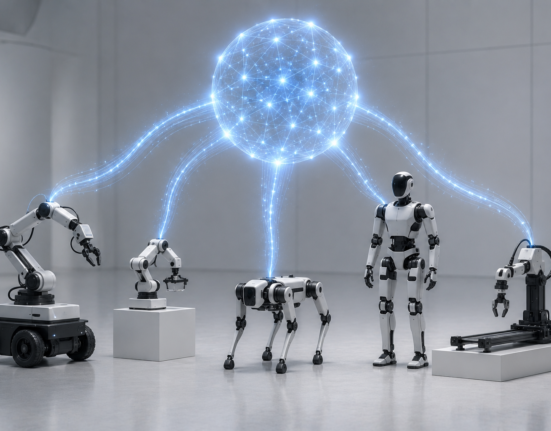
What makes this architecture notable is not that vision and language models exist together in the same codebase. Plenty of robotics stacks have done that for years, with a vision module identifying objects, a language module parsing commands, and a separate planner stitching the two together with hand-written rules. A true VLA model instead trains all three capabilities inside one set of weights, so the representation the model uses to recognize a mug is the same representation it uses to decide how to reach for it. That shared representation is what allows instructions like “hand me the thing next to the laptop, not the mug” to work without anyone writing a rule for the word “not.”
The Three-Part Anatomy of a VLA Policy
Vision Encoder
The vision component is almost always a pretrained vision transformer or a CLIP-style image encoder, chosen because it already carries strong general-purpose visual representations learned from web-scale image-text pairs before the model ever sees a robot demonstration. This encoder converts raw camera frames into a compact sequence of visual tokens that downstream layers can attend to alongside language tokens.
Language Backbone
The language component is typically a pretrained large language model or vision-language model, such as a PaLI or PaLM-derived backbone, or in more recent open efforts a Llama-family or Gemma-family model. This backbone contributes two things: the ability to parse open-ended, free-form instructions, and a broad semantic prior about the world, e.g. that “fragile” objects need gentler grasps, learned from internet-scale text long before any robot data existed.
Action Decoder
The action decoder is the part unique to robotics, and it is where the current research disagreement is sharpest. Early systems like RT-2 represented actions as discretized text tokens, reusing the language model’s own output vocabulary to emit numbers that get decoded back into joint commands. Newer approaches, notably the pi-0 family, instead attach a separate diffusion or flow-matching “action expert” module, a few hundred million parameters trained to iteratively denoise a chunk of continuous action trajectory conditioned on the shared vision-language features. This produces smoother, higher-frequency motion than token-by-token text decoding, at the cost of extra architectural complexity.
| Model or family | Approximate scale | Action representation | Notable characteristic |
|---|---|---|---|
| RT-2 | Up to 55B (built on PaLI-X / PaLM-E) | Discretized text tokens | Co-fine-tuned on web data and robot trajectories together, preserving web-scale reasoning |
| OpenVLA | 7B | Discretized text tokens | Fully open-source, trained on roughly 970,000 real-world demonstration episodes, tunable with low-rank adaptation |
| pi-0 / pi-0.5 | ~3B backbone plus ~300M action expert | Continuous, flow-matching diffusion | Separate action-expert module for smoother continuous control, trained across a cross-embodiment robot dataset |
| Octo | ~93M | Diffusion action head | Lightweight, designed for rapid fine-tuning to new robot embodiments with limited data |
| RT-1 | ~35M | Discretized tokens | Predecessor architecture, transformer trained purely on robot demonstration data without a general-purpose language backbone |
How Training Actually Works
Training a VLA model happens in stages rather than in one pass. The vision and language components typically start from checkpoints already pretrained on internet-scale image and text corpora, which is what gives the finished robot policy its surprising ability to recognize objects or follow phrasings it never saw during robot-specific training. That pretrained backbone is then co-fine-tuned, meaning it continues training on a mixture of the original web data and robot teleoperation trajectories at the same time, rather than being fine-tuned on robot data alone.
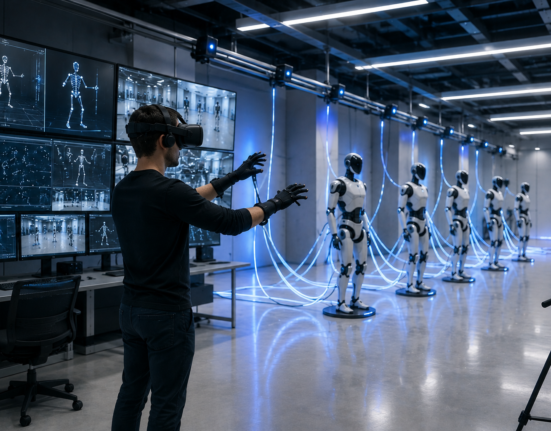
Co-fine-tuning matters because fine-tuning purely on a narrow robot dataset tends to cause catastrophic forgetting of the broad semantic knowledge the language model started with. By continually mixing in general web data during the robot-specific phase, RT-2 and its successors kept much of the original model’s reasoning and recognition ability while adding grounded motor skills on top. The robot demonstration data itself typically comes from teleoperation, where a human operator drives the robot through a task while the system logs synchronized camera frames, the spoken or typed instruction, and the resulting action sequence as one training example.
Action tokenization or the diffusion action-expert head is trained with a straightforward supervised objective: given the visual tokens and the language tokens, predict the action sequence a human demonstrator actually took. There is no reward function and no trial-and-error exploration in this base training phase; it is closer to imitation learning at scale than to classical reinforcement learning, though several 2026 research lines, including online-RL variants built on top of VLA backbones, are starting to add a reinforcement-learning fine-tuning stage after imitation pretraining to correct systematic errors the base policy makes.
The VLA inference loop
At each control step, camera frames and the standing instruction are tokenized together, passed through shared transformer layers, and the action decoder emits the next chunk of motor commands, typically several hundred milliseconds of motion at a time, before the loop repeats with fresh camera input.
Action Chunking and Control Frequency
A detail that separates a lab demo from a deployable policy is action chunking: rather than predicting a single next action and re-running the entire network every control tick, most production VLA systems predict a short chunk of several dozen future actions in one forward pass, then execute that chunk open-loop for a few hundred milliseconds before re-querying the model with fresh camera input. This matters because a full VLA forward pass on a multi-billion-parameter backbone can take tens to low hundreds of milliseconds even on capable onboard or edge compute, which is far slower than the 10-50 Hz control loops that dexterous manipulation and dynamic balance actually need. Chunking amortizes that latency across many executed actions instead of paying it on every single one.
Where Latency and Compute Become the Real Constraint
The gap between a VLA model that works in a research demo and one that works reliably in a factory or warehouse is mostly a systems-engineering gap, not a modeling gap. Running a several-billion-parameter transformer at the frequency needed for smooth manipulation requires either aggressive model distillation down to a smaller student network, quantization to lower-precision weights, or dedicated inference accelerators onboard the robot. Several labs and vendors have responded by publishing smaller “student” VLA models distilled from a larger teacher, trading some generalization for a controller that fits inside a real-time budget on embedded hardware.
| Deployment factor | Typical constraint | Common mitigation |
|---|---|---|
| Inference latency | Full forward pass can exceed the control loop’s time budget | Action chunking, model distillation, quantization |
| Onboard compute and power | Data-center-class GPUs are not battery- or thermally-viable on a mobile humanoid | Edge accelerators, splitting perception and action-expert modules across chips |
| Instruction ambiguity | Natural language under-specifies which object or which grasp point is meant | Clarifying sub-dialogue, pointing gestures, or fallback to a default grasp heuristic |
| Distribution shift | Novel lighting, clutter, or object shapes reduce success rate versus training conditions | Broader demonstration coverage, domain randomization during training |
Common mistake
Teams evaluating a VLA model often benchmark it only on the exact objects and camera angles present in its training demonstrations, then get blindsided when success rates collapse on a slightly different mug shape, a shifted camera mount, or cluttered backgrounds. A VLA policy’s language generalization tends to outpace its visual generalization; testing only with familiar objects and unfamiliar phrasing wildly overstates real-world readiness. Always test the reverse case too: familiar phrasing against unfamiliar scenes.
What worked
Co-fine-tuning on a mixture of general web data and robot trajectories, rather than fine-tuning on robot data alone, consistently preserved semantic generalization in the RT-2 line of research while still grounding the model in physical actions. Teams that skipped this mixed-data step and fine-tuned purely on narrow task demonstrations saw the model’s language understanding narrow sharply, even though task-specific accuracy on the training objects looked fine.
Frequently Overlooked Details That Change the Outcome
- Action representation choiceWhether actions are discretized text tokens or continuous diffusion outputs affects motion smoothness far more than backbone size does.
- Cross-embodiment training dataModels trained across multiple robot bodies, not just one, transfer new skills to a fresh robot with far less fine-tuning data.
- Camera viewpoint consistencyA policy trained on wrist-mounted camera views often fails when deployed with a head-mounted camera, and vice versa, unless both are represented in training.
- Instruction phrasing diversityParaphrase augmentation during training meaningfully reduces brittle failures when end users phrase commands differently than the demonstration operators did.
- Action-chunk lengthLonger open-loop chunks reduce compute cost but increase the risk of executing a stale plan after the scene has changed mid-chunk.
- Safety and torque limitingA VLA policy has no built-in notion of force limits; a separate lower-level safety controller must clip commanded torques regardless of what the network outputs.
Research Lines Worth Watching
Beyond the headline systems, a wave of 2026 research is attacking the weak points of first-generation VLA models directly. Spatial-memory extensions address the problem of objects moving out of camera view mid-task by giving the model a persistent internal representation of where things were last seen. Kinematics-aware decomposition approaches split the action-prediction problem into a coarse waypoint plan and a fine kinematics-respecting refinement, aiming to reduce jerky or physically implausible predicted motions. Token-pruning research targets the inference-latency problem directly, discarding redundant visual tokens before they reach the expensive attention layers so the same backbone runs measurably faster without retraining. None of these are settled standards yet; they represent the directions the field is actively converging on rather than a finished architecture.
Reinforcement Learning on Top of Imitation
A second active direction adds online reinforcement learning on top of an imitation-pretrained VLA backbone, letting the robot correct systematic biases the human demonstrations happened to contain, such as an overly cautious approach speed, through trial and error in either simulation or constrained real-world practice. This hybrid imitation-then-reinforcement recipe is still early, but it addresses a real limit of pure imitation: a policy trained only to mimic demonstrations can never exceed the skill ceiling of whoever generated the demonstrations.
Glossary
- Vision-language-action model (VLA)
- A single neural network that takes camera images and natural-language instructions as input and outputs robot motor commands, trained end to end rather than assembled from separate perception, planning, and control modules.
- Co-fine-tuning
- A training method that continues updating a pretrained model on a mixture of its original general-purpose data and new task-specific data simultaneously, reducing the risk of forgetting general capabilities.
- Action chunking
- Predicting and executing a short sequence of future actions from a single forward pass, rather than re-running inference for every individual control step, to amortize model latency.
- Flow matching
- A generative modeling technique that learns a velocity field transforming random noise into a structured output, in this context a continuous robot action trajectory, through iterative refinement.
- Cross-embodiment dataset
- A training dataset combining demonstrations collected across multiple different robot bodies and configurations, used to help a single policy transfer skills across hardware.
- Action decoder
- The component of a VLA model responsible for converting the shared vision-language representation into robot-executable motor commands, implemented as either token decoding or a diffusion-style action-expert module.
Key Takeaways
- VLA models merge vision, language, and action prediction into one trained network instead of separate perception, planning, and control modules.
- RT-2 pioneered representing robot actions as text tokens inside a large vision-language model, co-fine-tuned on web and robot data together.
- OpenVLA demonstrated that a fully open, 7-billion-parameter model trained on roughly 970,000 demonstrations could match proprietary systems on many tasks.
- The pi-0 family introduced a separate flow-matching action-expert module for smoother continuous control instead of discretized text tokens.
- Action chunking, predicting and executing several dozen actions per forward pass, is what makes multi-billion-parameter models usable at real robot control frequencies.
- Visual generalization lags behind language generalization in current VLA policies, making unfamiliar scenes a more common failure mode than unfamiliar phrasing.
- Ongoing research on spatial memory, kinematics-aware decomposition, and reinforcement-learning fine-tuning is targeting the specific weak points of first-generation VLA systems rather than simply scaling parameter counts further.
FAQs
What is a vision-language-action model in simple terms?
It is a single AI model that looks at a camera feed, reads or hears a natural-language instruction, and directly outputs the motor commands a robot needs to carry out that instruction, replacing separate perception, planning, and control software with one trained network.
How is a VLA model different from a regular robot control program?
Traditional robot control programs use hand-coded rules or narrow task-specific models for perception and planning. A VLA model instead learns all of that jointly from data, letting it follow instructions and recognize objects it was never explicitly programmed to handle, within the bounds of its training distribution.
What is the difference between RT-2 and OpenVLA?
RT-2 is a proprietary Google DeepMind system built on very large PaLI-X or PaLM-E backbones, while OpenVLA is a fully open-source 7-billion-parameter model trained on public demonstration data, designed so researchers can inspect, fine-tune, and deploy it themselves.
Why do some VLA models use diffusion instead of text tokens for actions?
Discretized text tokens can produce jerky, discontinuous motion because they treat continuous physical movement as a sequence of discrete symbols. Diffusion or flow-matching action experts, as used in the pi-0 family, generate smooth continuous trajectories instead, which better matches how physical actuators actually move.
Why do VLA models need action chunking?
Running a full forward pass through a multi-billion-parameter model is too slow to repeat at every control tick a robot needs, often 10 to 50 times per second. Action chunking predicts many future actions in one pass and executes them open-loop for a short window, spreading the model’s latency cost across many executed motions.
Can a VLA model trained on one robot work on a different robot body?
Partially. Models trained on cross-embodiment datasets that already include multiple robot bodies transfer new skills to another robot much faster than single-embodiment models, but some fine-tuning on the new hardware’s own demonstrations is still typically required for reliable performance.
What causes a VLA model to fail in the real world?
The most common failure mode is distribution shift: objects, lighting, or clutter that look different from the training demonstrations reduce success rates substantially, even when the spoken instruction itself is one the model handles well in familiar scenes.
Do VLA models replace safety controllers on humanoid robots?
No. A VLA policy has no inherent understanding of force or torque limits. Production systems still run a separate lower-level safety and torque-limiting controller underneath the VLA policy to prevent the network’s output from causing harm regardless of what it predicts.
For readers who want the underlying simulation and testing infrastructure that VLA models are validated on before deployment, see our deep dive on digital twins for robotics. For the software-agent side of building and iterating on these models, see why vibe coding is coming to the robotics lab. The broader workforce context for these systems is covered in our humanoid workforce 2035 analysis. For the underlying foundation-model landscape these policies draw on, see robot foundation models explained. On the data side that feeds these models, see how teleoperation data is collected and scaled, and for the hardware constraint that still bounds what any VLA policy can physically do, see why dexterous hands remain the hardest problem.
- DigitalOcean, “A Comprehensive Overview of Vision-Language-Action Models”
- arXiv, “Vision Language Action Models in Robotic Manipulation: A Systematic Review”
- LearnOpenCV, “Vision Language Action Models (VLA) and Policies for Robots”
- arXiv, “KineVLA: Towards Kinematics-Aware Vision-Language-Action Models with Bi-Level Action Decomposition”
- arXiv, “OmniVLA-RL: A Vision-Language-Action Model with Spatial Understanding and Online RL”
- arXiv, “VLA-IAP: Training-Free Visual Token Pruning via Interaction Alignment for Vision-Language-Action Models”