As of January 2026, the built environment is undergoing a radical transformation. No longer just static shells providing shelter, buildings are evolving into dynamic, intelligent ecosystems that actively manage their own performance. At the heart of this shift is smart building automation—a convergence of operational technology (OT) and information technology (IT) designed to slash energy waste and revolutionize how facilities are maintained.
For facility managers, sustainability officers, and real estate investors, the stakes have never been higher. With global energy regulations tightening and operational costs rising, the “set it and forget it” approach to building management is obsolete. Smart building automation offers a proactive solution, turning mountains of raw data into actionable insights that drive efficiency and reliability.
This guide explores the mechanics, strategies, and practical implementation of automation systems specifically targeted at energy optimization and maintenance.
Who This Is For (And Who It Isn’t)
This guide is for:
- Facility Managers & Building Operators: Looking to modernize aging infrastructure or optimize new builds.
- Sustainability Directors: Seeking data-driven methods to reduce carbon footprints and meet ESG goals.
- Real Estate Owners/Investors: Interested in increasing asset value and reducing operating expenses (OpEx).
- IT & IoT Integrators: Wanting to understand the operational context of the technologies they deploy.
This guide is NOT for:
- DIY Homeowners: While some concepts overlap with smart homes, the focus here is on commercial, industrial, and multi-tenant residential scales involving complex Building Management Systems (BMS).
- Passive Design Purists: This article focuses on active technological interventions rather than passive architectural design, though the two complement each other.
Key Takeaways
- Shift from Reactive to Predictive: Automation moves maintenance from “fix it when it breaks” to “fix it before it breaks” using predictive analytics.
- Holistic Energy Management: True optimization goes beyond scheduling; it involves real-time adjustments based on occupancy, weather, and grid signals.
- Data is the New Utility: The value of a smart building lies in the quality and integration of its data, not just the hardware.
- Interoperability is Critical: Successful automation requires disparate systems (HVAC, lighting, security) to speak the same language.
- Human-Centric Design: The ultimate goal is not just saving money but improving the health, comfort, and productivity of occupants.
What Is Smart Building Automation?
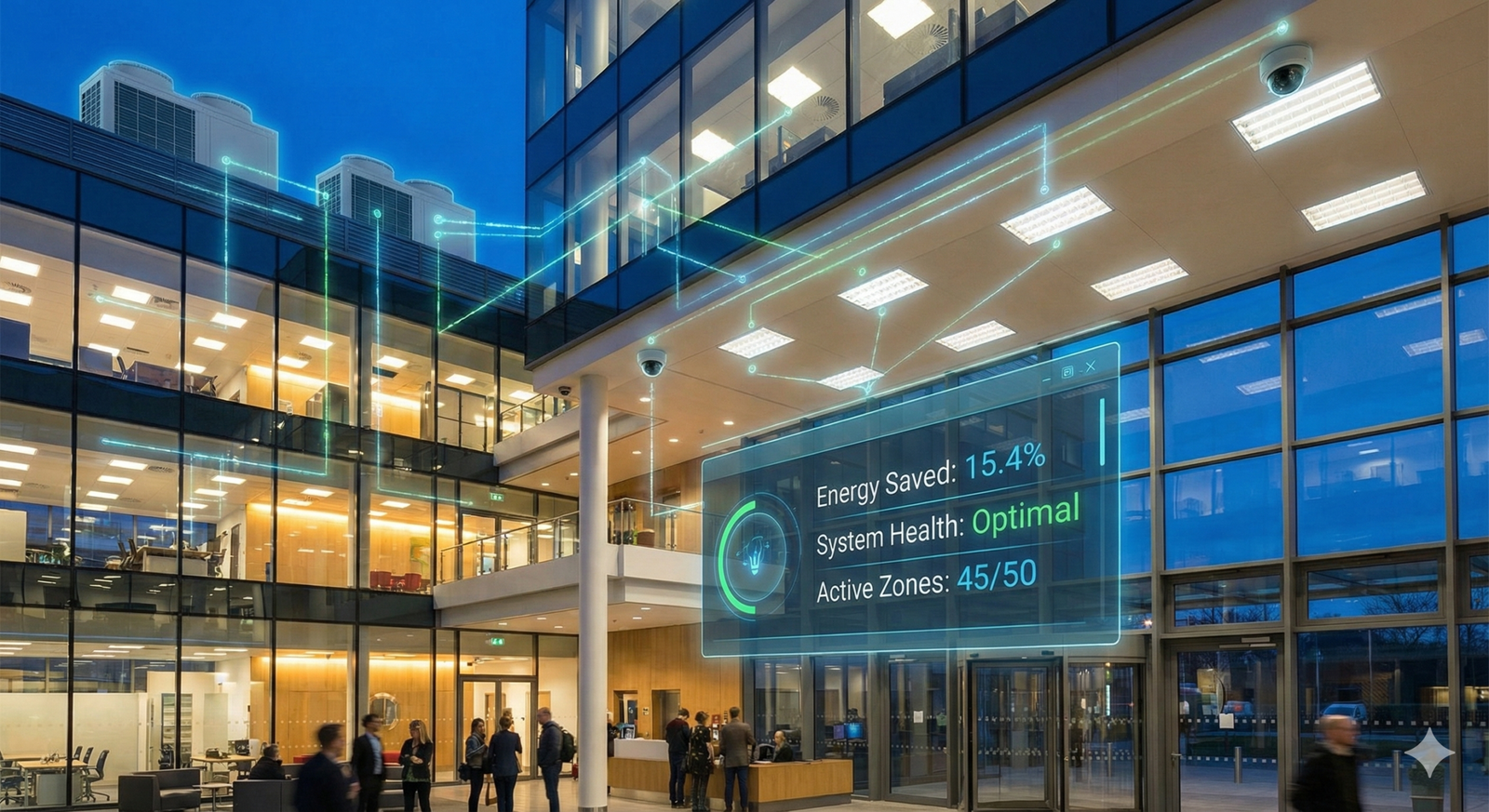
At its core, smart building automation refers to the centralized control and automatic regulation of a building’s systems—heating, ventilation, air conditioning (HVAC), lighting, security, and other systems—through a Building Management System (BMS) or Building Automation System (BAS). However, “smart” automation elevates this traditional concept by integrating the Internet of Things (IoT), Artificial Intelligence (AI), and cloud computing.
Traditionally, a BMS might operate on a simple schedule: turn the lights on at 8:00 AM and off at 6:00 PM. A smart automation system, by contrast, uses sensors to detect that no one is in the conference room at 10:00 AM and dims the lights, or recognizes that the afternoon sun is overheating the south facade and automatically deploys motorized shades while lowering the AC setpoint in that specific zone.
The Architecture of Intelligence
To understand how these systems optimize energy and maintenance, we must look at the layers of technology involved:
- ** The Physical Layer (Edge Devices):** This includes sensors (temperature, CO2, occupancy, vibration), actuators (valves, dampers, switches), and meters.
- The Connectivity Layer: The communication protocols that allow devices to talk. Common standards include BACnet, Modbus, MQTT, and Zigbee.
- The Integration Layer (Controllers/Gateways): Hardware that aggregates data from the edge devices and translates it for the management system.
- The Application Layer (Software/Analytics): Where the “thinking” happens. This is where AI algorithms analyze data patterns to make decisions or alert human operators.
Core Technologies Driving Optimization
The leap from automated to “smart” is driven by several key technologies that have matured significantly as of 2026.
Internet of Things (IoT) Sensors
IoT sensors are the nervous system of a smart building. They have become smaller, cheaper, and more accurate.
- Occupancy Sensors: Beyond simple motion detection, modern sensors can count the number of people in a room (people counting) to adjust ventilation rates dynamically.
- Environmental Sensors: These track Volatile Organic Compounds (VOCs), CO2, humidity, and light levels with high precision.
- Equipment Sensors: Vibration and ultrasonic sensors attached to motors and chillers can detect minute anomalies that indicate wear and tear.
Artificial Intelligence and Machine Learning (AI/ML)
AI is the brain that processes the nervous system’s signals. In energy optimization, ML algorithms learn a building’s thermal behavior. For example, the system learns that it takes 45 minutes to cool the lobby on a humid Tuesday, but only 30 minutes on a dry Friday. It uses this “thermal model” to start the HVAC at the exact right moment—no sooner, no later—saving energy.
Digital Twins
A digital twin is a virtual replica of the physical building, continuously updated with real-time data.
- Simulation: Managers can run “what-if” scenarios. What happens to our energy bill if we increase the cooling setpoint by 1°C?
- Visualization: It provides a 3D interface to locate faults instantly, rather than sending a technician to hunt through ceiling tiles.
Energy Optimization Strategies
Energy consumption is typically the largest operating expense for commercial buildings. Smart building automation targets the “performance gap”—the difference between how a building was designed to perform and how it actually operates.
1. Dynamic HVAC Optimization
HVAC systems are responsible for roughly 40% of a building’s energy use. Traditional systems often run at partial loads inefficiently or cool empty spaces.
- Demand-Controlled Ventilation (DCV): Instead of pumping in fresh air based on maximum design occupancy, smart systems use CO2 sensors to bring in just enough fresh air for the actual number of people present. This reduces the energy needed to condition outside air.
- Optimal Start/Stop: Algorithms analyze weather forecasts and indoor temperatures to calculate the precise time to start heating or cooling before occupants arrive, avoiding energy spikes.
- Setback Scheduling: Automating deep setbacks (letting temperatures drift) during unoccupied hours or in unoccupied zones.
2. Intelligent Lighting Control
Lighting is the “low-hanging fruit” of energy efficiency.
- Daylight Harvesting: Photosensors measure natural light entering through windows and dim the artificial fixtures to maintain a constant light level. If the sun provides 500 lux, the LED lights might only need to provide 100 lux, operating at 20% power.
- Granular Zoning: Instead of switching on an entire floor, smart lighting allows for “micro-zones.” An employee working late in one cubicle triggers only the lights in their immediate vicinity and the pathway to the exit.
3. Load Shedding and Peak Shaving
Utility companies often charge premium rates during peak demand times (e.g., hot summer afternoons).
- Automated Demand Response (ADR): When the grid is stressed, the utility sends a signal to the building. The automation system automatically sheds non-critical loads—dimming lights by 10%, turning off decorative fountains, or slightly adjusting temperature setpoints—to reduce demand charges without impacting comfort significantly.
4. Plug Load Management
“Vampire power” from devices left in standby mode (monitors, printers, vending machines) can account for significant waste. Smart plugs and connected power strips can cut power to these devices automatically outside of business hours or when the local occupancy sensor detects the room is empty.
Revolutionizing Maintenance: From Reactive to Predictive
The second pillar of smart building automation is maintenance. The traditional model is reactive: a component fails, tenants complain, and a truck is rolled to fix it. This is expensive and disruptive. Smart automation enables a shift to Condition-Based Maintenance (CBM) and Predictive Maintenance (PdM).
Fault Detection and Diagnostics (FDD)
FDD software sits on top of the BMS and continuously scans data streams for rules-based anomalies.
- Example: An air handling unit (AHU) might be simultaneously heating and cooling air due to a stuck damper. A human operator might not notice this because the room temperature remains comfortable, but the energy waste is massive. FDD flags this “hunting” behavior instantly and calculates the daily cost of the fault.
Predictive Maintenance with Vibration Analysis
For critical assets like chillers, pumps, and elevator motors, vibration analysis is a game-changer.
- How it works: Sensors establish a baseline vibration signature for a motor. As bearings begin to wear, the vibration pattern changes subtly, weeks or months before failure.
- The outcome: The system generates a work order automatically, scheduling a technician to replace the bearing during planned downtime, avoiding a catastrophic mid-day failure.
Automated Workflows and CMMS Integration
Smart automation doesn’t just identify problems; it closes the loop. It integrates with Computerized Maintenance Management Systems (CMMS).
- Scenario: A restroom usage sensor tracks traffic. Instead of cleaning the restroom on a fixed 4-hour schedule (which might be too often or not enough), the system triggers a cleaning ticket only after 100 uses. This optimizes janitorial labor and ensures supplies are restocked exactly when needed.
The Benefits: Why Invest in Automation?
Investing in smart building automation requires capital, but the Return on Investment (ROI) is multifaceted.
Financial ROI
- Energy Savings: Typical savings range from 10% to 30% depending on the baseline efficiency.
- Maintenance Savings: Predictive maintenance can reduce maintenance costs by 15-20% by extending equipment life and reducing overtime labor for emergency repairs.
- Asset Value: “Smart” certified buildings (e.g., SmartScore, LEED, WELL) often command higher rents and have lower vacancy rates.
Operational Resilience
Automated systems provide resilience against labor shortages. With fewer experienced facility engineers entering the workforce, automation captures institutional knowledge and allows a smaller team to manage larger portfolios effectively.
Sustainability and Compliance
As of 2026, many jurisdictions (like New York City’s Local Law 97 or the EU’s Energy Performance of Buildings Directive) impose steep fines for exceeding carbon emission limits. Automation provides the granular data needed for reporting and the efficiency needed to avoid penalties.
Occupant Well-being
There is a direct link between indoor environmental quality (IEQ) and productivity. Smart automation ensures CO2 levels remain low (improving cognitive function) and thermal comfort is maintained, reducing tenant complaints.
Implementation Framework: A Step-by-Step Guide
Deploying smart building automation is complex. It requires a structured approach to avoid creating “digital landfills” of unused data.
Phase 1: Assessment and Strategy
Before buying sensors, define your goals.
- Audit Existing Systems: What BMS is currently in place? Is it a legacy system using proprietary protocols?
- Define Use Cases: Are you solving for high energy bills, frequent equipment failures, or occupant complaints? Prioritize the top 3 pain points.
- Connectivity Check: Assess the building’s IT infrastructure. Is there sufficient bandwidth? Is there a separate OT network for security?
Phase 2: The Data Layer (Integration)
This is often the hardest phase. You must liberate data from silos.
- The Integration Layer: Deploy gateways (like Tridium Niagara or similar middleware) to translate proprietary languages (like N2 or LonWorks) into open standards (BACnet IP or MQTT).
- Naming Conventions: Adopt a standardized naming schema, such as Project Haystack or Brick Schema. Without this, “Temp_Sensor_1” is meaningless. Standardized tags (e.g., zone:Floor1, equip:AHU, point:ReturnAirTemp) allow analytics software to scale across the building.
Phase 3: Pilot and Deploy
- Start Small: Pilot the technology on a single floor or with a specific equipment type (e.g., all VAV boxes).
- Validate Data: Ensure the sensors are calibrated. Garbage data in equals garbage insights out.
- Commissioning: This is crucial. Verify that the automation sequences actually control the hardware as intended.
Phase 4: Optimization and Training
- Tune the Algorithms: AI models need time to learn. Monitor the initial recommendations and adjust parameters.
- Train the Humans: The best technology fails if the facility team bypasses it. Train operators to trust and use the dashboards.
- Continuous Monitoring-Based Commissioning (MBCx): Use the software to continuously commission the building, preventing performance drift over time.
Common Mistakes and Pitfalls
Even well-funded projects can fail. Here are common traps to avoid.
1. The “Black Box” Problem
Buying proprietary, closed-loop systems that lock you into a single vendor for service and upgrades.
- Solution: Insist on open protocols (BACnet, MQTT) and data ownership clauses in your contracts. You should own your building’s data, not the vendor.
2. Ignoring Cybersecurity
Smart buildings expand the attack surface. An insecure IoT thermostat can be a gateway for hackers to access the corporate IT network.
- Solution: Implement strict network segmentation (keep OT separate from IT), enforce strong password policies, and regularly patch firmware on all edge devices.
3. Over-Sensoring
Installing thousands of sensors without a clear plan for how to use the data. This leads to “alert fatigue,” where operators ignore the constant stream of notifications.
- Solution: Focus on “minimum viable data.” Start with the data points that directly drive your priority use cases.
4. Undervaluing the Human Element
Assuming automation replaces people.
- Reality: Automation augments people. It frees engineers from rote tasks (checking gauges) so they can perform high-value work (optimizing systems).
Technologies in Practice: Real-World Scenarios
To illustrate how these components come together, let’s look at two practical scenarios.
Scenario A: The Summer Heatwave
- Context: It is 2:00 PM on a Tuesday in July. The outside temperature hits 35°C (95°F).
- Traditional Building: The chillers run at 100%. The grid demand charge spikes. The south-facing offices are hot, while the north offices are freezing.
- Smart Building:
- Prediction: The system anticipated the heatwave based on the forecast at 6:00 AM.
- Pre-cooling: It sub-cooled the building structure slightly during the cooler morning hours (thermal storage).
- Real-time Adaptation: As the sun moves, automated blinds lower on the south facade.
- Peak Shaving: The utility signals a grid event. The BMS slightly dims lights in corridors and allows the lobby temperature to drift up by 1.5°C.
- Result: Occupant comfort is maintained, and the building avoids thousands of dollars in peak demand charges.
Scenario B: The Leaking Valve
- Context: A hot water valve in an air handler is leaking slightly, allowing hot water to flow while the unit is trying to cool.
- Traditional Building: The cooling coil works harder to fight the artificial heat. The room temperature stays normal, so no one complains. The energy waste continues for 6 months until a seasonal maintenance check.
- Smart Building:
- Detection: The FDD algorithm notices that the “Mixed Air Temperature” is higher than expected given the damper positions.
- Diagnosis: It correlates this with the valve command (which is “Closed”). It flags a “Leaking Hot Water Valve” fault.
- Action: It calculates the wasted energy cost ($40/day) and generates a high-priority work order.
- Result: The valve is fixed in 3 days, saving months of wasted energy and extending the life of the cooling coil.
Measuring Success: KPIs and ROI
How do you know if your smart building automation strategy is working? You must track specific Key Performance Indicators (KPIs).
Energy Intensity (EUI)
Measured in kWh/sq ft or kWh/m² per year. A decreasing EUI trend is the primary indicator of energy optimization success.
Comfort Index
A metric derived from the percentage of time a zone spends within its target temperature and CO2 range. A smart building should see this approach 95-99%.
Maintenance Efficiency
- Mean Time to Repair (MTTR): How long it takes to fix a fault once detected.
- Ratio of Planned vs. Unplanned Maintenance: A healthy program should be 80% planned (preventive/predictive) and only 20% unplanned (reactive).
Cost Avoidance
This is often harder to calculate but crucial. It involves estimating the money not spent on premature capital equipment replacement or peak energy charges.
Future Trends in Building Automation
As we look beyond 2026, several emerging trends will further reshape this landscape.
Grid-Interactive Efficient Buildings (GEBs)
Buildings will stop being passive consumers and become active participants in the energy grid. They will store renewable energy (solar + battery) and release it back to the grid when prices are high, acting as virtual power plants.
Autonomous Building Agents
We are moving from “automated” to “autonomous.” AI agents will not just flag faults but will have the authority to make complex trade-offs and execute changes without human approval, negotiating energy prices with the grid in milliseconds.
The Convergence of Health and Energy
New standards will require buildings to optimize for biological outcomes (circadian rhythms, pathogen mitigation) just as rigorously as they optimize for kilowatts, requiring a new generation of sophisticated multi-variable control algorithms.
Conclusion
Smart building automation is no longer a futuristic luxury; it is a fundamental operational requirement for modern real estate. By integrating IoT sensors, cloud analytics, and predictive maintenance strategies, building operators can unlock massive efficiencies that were previously invisible.
The journey toward a smart building is not about buying the most expensive gadgets. It is about establishing a clear strategy for data: how to collect it, how to standardize it, and how to use it to make better decisions. Whether the goal is reducing carbon emissions to meet regulatory compliance, extending the lifespan of multimillion-dollar mechanical systems, or simply providing a better workplace experience, automation is the tool that bridges the gap between intention and reality.
Next Steps: If you are ready to begin your automation journey, start by conducting a “digital readiness assessment” of your current facility. Identify your data silos and evaluate the connectivity of your existing BMS. This foundational step will determine the roadmap for your smart building transformation.
FAQs
1. What is the difference between a BMS and a Smart Building System? A BMS (Building Management System) is the hardware and software that controls building systems like HVAC and lighting, often based on schedules and setpoints. A Smart Building System layers on top of the BMS, using IoT, cloud analytics, and AI to analyze data from the BMS and other sources to optimize performance dynamically and predictively.
2. How much energy can smart building automation save? On average, implementing advanced automation and analytics can reduce energy consumption by 15% to 30%. This varies based on the building’s baseline efficiency, the climate, and the aggressiveness of the control strategies used (e.g., deep setbacks vs. minor adjustments).
3. Is smart automation feasible for older, existing buildings (retrofits)? Yes, retrofitting is a major market. Wireless IoT sensors make it easy to gather data in older buildings without running expensive new cabling. “Overlay” software can often connect to legacy BMS hardware to extract data and provide modern analytics without a full “rip and replace” of the infrastructure.
4. What is Fault Detection and Diagnostics (FDD)? FDD is a software process that automatically identifies operational issues in building systems. It uses logic rules or AI to analyze data patterns (like temperatures, pressures, and valve positions) to find anomalies, such as leaking valves, broken dampers, or sensor errors, often assigning a monetary value to the waste.
5. How does predictive maintenance differ from preventive maintenance? Preventive maintenance is schedule-based (e.g., changing a filter every 3 months regardless of its condition). Predictive maintenance is condition-based (e.g., monitoring the pressure drop across the filter and changing it only when it is actually dirty). Predictive maintenance reduces labor and material waste.
6. Are smart buildings secure from cyberattacks? Security is a major concern. Smart buildings can be vulnerable if IoT devices are not secured. Best practices include separating OT (Operational Technology) networks from IT networks, using VPNs for remote access, regularly updating firmware, and encrypting data transmission.
7. What is the typical payback period for smart building technology? The payback period varies but is often attractive. “Low-hanging fruit” measures like lighting controls and basic analytics can pay back in 1–3 years. More complex deep retrofits might take 5–7 years. However, the immediate cash flow improvement from energy savings often makes these projects cash-positive from year one.
8. Can smart automation improve indoor air quality (IAQ)? Absolutely. Smart systems use sensors to continuously monitor CO2, VOCs, and particulate matter (PM2.5). If air quality drops, the automation system can automatically increase ventilation rates or activate filtration systems to ensure a healthy environment for occupants.
9. What protocols should I look for to ensure interoperability? To ensure your systems can talk to each other and aren’t locked to one vendor, specify open standard protocols. The most common and robust are BACnet (specifically BACnet/IP for networking) and Modbus. For IoT devices, MQTT and Zigbee or LoRaWAN (for wireless) are standard. Avoid proprietary protocols whenever possible.
References
- ASHRAE (American Society of Heating, Refrigerating and Air-Conditioning Engineers). “Guideline 36-2021: High-Performance Sequences of Operation for HVAC Systems.” ASHRAE, 2021. https://www.ashrae.org
- U.S. Department of Energy (DOE). “Smart Energy Analytics Campaign: Year 3 Outcomes.” Better Buildings Initiative, 2023. https://betterbuildingssolutioncenter.energy.gov
- International Energy Agency (IEA). “Digitalisation and Energy.” IEA Publications, 2024. https://www.iea.org/reports/digitalisation-and-energy
- Project Haystack. “Haystack 4: Taxonomy and Data Modeling for the Built Environment.” Project Haystack Organization, 2023. https://project-haystack.org
- Gartner. “Market Guide for Smart Building Management Systems.” Gartner Research, October 2024. https://www.gartner.com
- Deloitte. “2025 Commercial Real Estate Outlook: Digitization and Sustainability.” Deloitte Insights, 2025. https://www2.deloitte.com
- Continental Automated Buildings Association (CABA). “Intelligent Buildings and the Impact of IoT.” CABA Research Library, 2024. https://www.caba.org
- IEEE. “IEEE Standard for the Adoption of Smart Building Technologies.” IEEE Standards Association, 2023. https://standards.ieee.org
- Siemens Infrastructure. “The Value of Digital Twins in Building Operations.” Siemens Whitepaper, 2025. https://www.siemens.com/global/en/products/buildingtechnologies.html
- WELL Building Institute. “The WELL Building Standard v2: Air and Thermal Comfort Concepts.” International WELL Building Institute, 2024. https://www.wellcertified.com