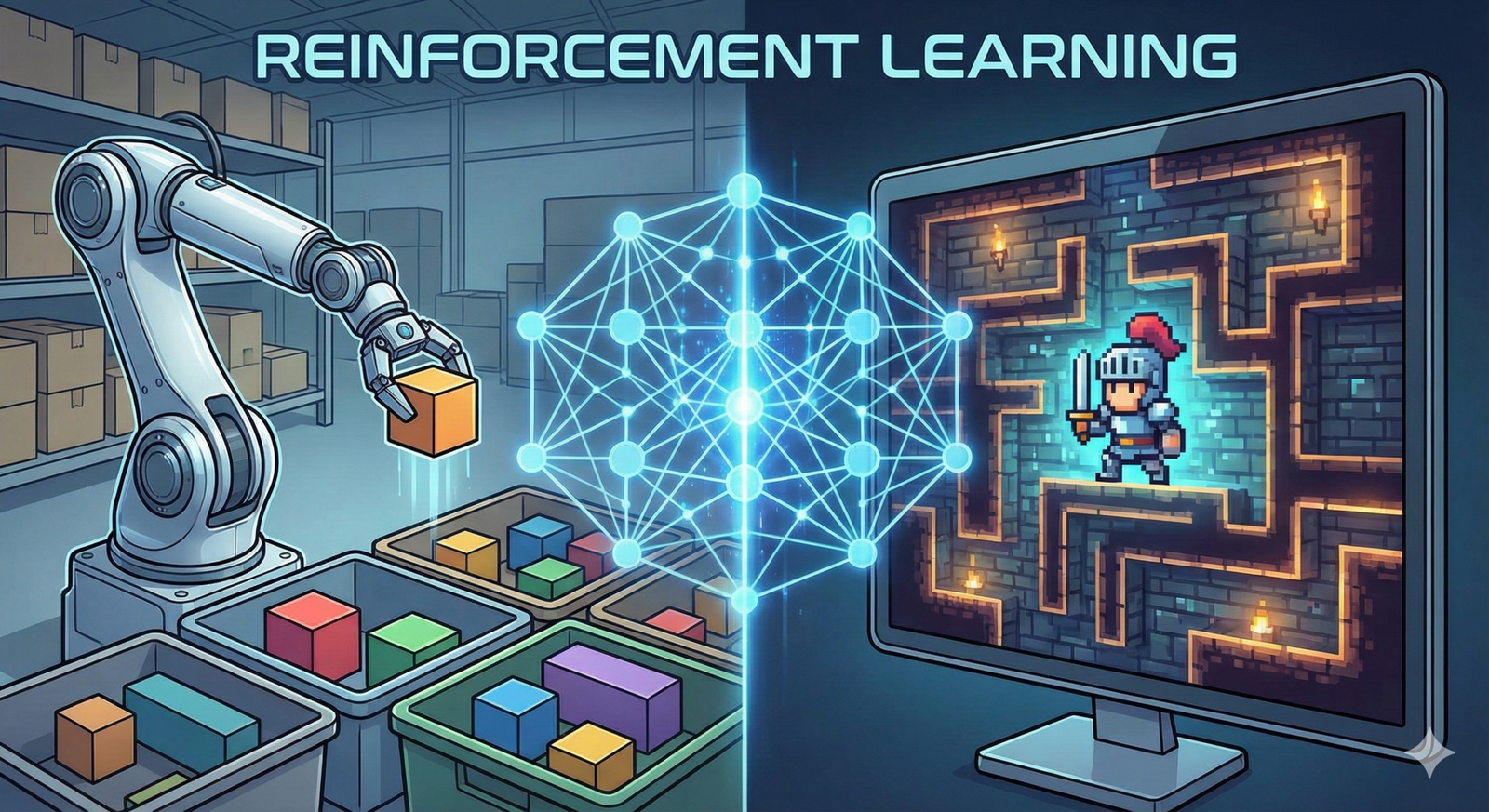
Imagine teaching a dog to perform a new trick. You don’t present the dog with a manual or a dataset of correct movements. Instead, you issue a command, and if the dog gets closer to the desired behavior, you offer a treat. If it doesn’t, you offer no reward or perhaps a gentle correction. Over time, through trial and error, the dog learns to associate specific actions with positive outcomes. This process—learning by interacting with an environment to maximize a reward—is the fundamental essence of Reinforcement Learning (RL).
Reinforcement learning has emerged as one of the most dynamic and promising subsets of machine learning. Unlike supervised learning, which relies on labeled datasets, or unsupervised learning, which looks for hidden patterns in data, RL is about taking action. It is the computational approach to goal-directed learning from interaction. While its theoretical roots run deep, its practical applications have exploded in recent years, particularly in two fields that might seem distinct but share a profound connection: robotics and video games.
In this guide, “reinforcement learning applications” refers specifically to the deployment of RL algorithms to solve complex control and decision-making problems in physical machines (robotics) and virtual environments (games). We will explore how these agents learn, the specific challenges they face in the physical versus digital worlds, and the incredible breakthroughs that are redefining what artificial intelligence can achieve.
Key Takeaways
- Trial and Error Mastery: RL agents learn by interacting with their environment, making mistakes, and adjusting strategies based on feedback (rewards or penalties).
- The Simulation Advantage: Games provide a safe, high-speed “gym” for AI to practice millions of iterations, a luxury often unavailable in the physical world.
- The Reality Gap: Robotics faces the unique challenge of “sim-to-real” transfer, where physics, friction, and hardware limitations make applying digital training to the real world difficult.
- Beyond High Scores: In gaming, RL is moving beyond beating humans to creating more human-like Non-Player Characters (NPCs) and assisting in game testing and balancing.
- Complex Manipulation: In robotics, RL is enabling machines to handle irregular objects, navigate unstructured terrain, and adapt to unforeseen obstacles better than traditional hard-coded programming.
- Defining the Reward: The most critical and often most difficult part of RL is designing the “reward function”—defining exactly what success looks like without creating loopholes the AI can exploit.
Who This Is For (And Who It Isn’t)
This guide is designed for:
- Tech enthusiasts and students looking to understand the practical utility of reinforcement learning beyond academic theory.
- Developers and engineers curious about the specific algorithms and workflows used in robotics and game development.
- Business leaders in manufacturing, logistics, or entertainment seeking to understand the capabilities and maturity of autonomous systems.
This guide is not a coding tutorial. We will not be writing Python scripts or setting up PyTorch environments here. Instead, we focus on the concepts, the architecture of the solutions, and the strategic application of the technology.
The Foundations of Reinforcement Learning
To understand the applications, we must first establish a shared vocabulary. Reinforcement learning is conceptually distinct from other forms of machine learning because it adds the dimension of time and consequence.
In a standard RL setup, there are two main components: the Agent and the Environment.
- The Agent: This is the learner or decision-maker (the robot software or the game character).
- The Environment: This is the world the agent interacts with (the physical factory floor or the virtual game map).
The process operates in a loop:
- The Agent observes the State of the environment (e.g., “I am at location X, and there is an obstacle at Y”).
- The Agent takes an Action based on that state (e.g., “Move left”).
- The Environment transitions to a new state and provides a Reward (e.g., +10 points for avoiding a collision, or -5 points for hitting a wall).
- The Agent updates its Policy (its strategy) to maximize future cumulative rewards.
Deep Reinforcement Learning (DRL)
In modern applications, specifically in complex robotics and high-fidelity games, “simple” RL is rarely enough. The number of possible states in a video game or the real world is effectively infinite. To handle this, researchers combine RL with Deep Learning (neural networks). This is known as Deep Reinforcement Learning (DRL).
In DRL, a neural network acts as the agent’s brain. It takes raw inputs (like pixels from a screen or sensor readings from a robot joint) and outputs the best probability of actions. This combination allows agents to “see” and “understand” complex environments rather than just memorizing a spreadsheet of states.
Reinforcement Learning in Game AI: The Virtual Proving Ground
Video games have served as the primary testbed for modern AI. Games offer a perfect environment for RL because they are self-contained, have clear rules, and provide immediate, automated feedback (rewards) in the form of scores or win/loss conditions.
From Board Games to Complex Strategy
The evolution of RL in gaming tracks the history of AI milestones.
- Perfect Information Games: The most famous early victory for DRL was AlphaGo. In the game of Go, the number of possible board configurations exceeds the number of atoms in the universe. Brute-force calculation is impossible. AlphaGo used RL to play millions of games against itself, discovering strategies that human masters had not considered in thousands of years.
- Imperfect Information Games: Moving to video games like StarCraft II or Dota 2 introduced “fog of war.” The agent cannot see the whole board. It must scout, predict, and manage resources in real-time. OpenAI Five and DeepMind’s AlphaStar demonstrated that RL agents could collaborate (in teams) and plan long-term strategies to defeat professional human esports teams.
Next-Generation NPCs and Adaptive Difficulty
Historically, game AI was not “intelligent” in the learning sense; it was a series of “If-Then” scripts (Finite State Machines). If the player does X, the enemy does Y. Once a player learned the pattern, the challenge evaporated.
Reinforcement learning applications are changing this paradigm:
- Human-like Behavior: Instead of writing scripts, developers can train agents to “survive” or “protect an objective.” The agent learns to use cover, flank, or retreat naturally.
- Adaptive Difficulty: An RL agent can be trained to match the player’s skill level dynamically. Rather than just giving the enemy more health (which feels cheap), the AI can play smarter or make more mistakes intentionally to keep the player in a state of “flow.”
Automated Game Testing (QA)
One of the most valuable, albeit less glamorous, applications of RL in gaming is Quality Assurance (QA). Modern open-world games are massive. Testing every wall for collision bugs or every quest for logic breaks is impossible for human teams alone.
RL agents are now deployed as “explorers.” They are rewarded for finding novel states, getting stuck, or causing the game to crash. These agents can play the game at 100x speed, 24 hours a day, identifying bugs that might otherwise frustrate players after launch. This allows human testers to focus on subjective elements like “fun” and narrative pacing.
Reinforcement Learning in Robotics: The Challenge of Reality
While games offer a clean, digital playground, robotics forces AI to confront the messy, chaotic, and unforgiving laws of physics. In a game, if an agent runs into a wall, it just stops. In robotics, if a robotic arm hits a wall, it might break a $50,000 motor or injure a human worker.
Despite these risks, reinforcement learning is solving problems in robotics that traditional control theory cannot touch.
Robotic Manipulation and Dexterity
Traditional industrial robots are “blind” and rigid. They follow a pre-programmed path to weld a car door or screw on a cap. If the car door is an inch to the left, the robot fails.
RL allows robots to adapt to variation.
- Dexterous Hand Manipulation: OpenAI demonstrated a robotic hand solving a Rubik’s cube. This is incredibly difficult because of the friction, contact points, and the need to re-orient the cube constantly. Through RL, the hand learned to adjust its grip strength and finger positioning dynamically.
- Bin Picking: In logistics warehouses (like those of Amazon or Ocado), robots must pick items of various shapes, sizes, and stiffness (e.g., a teddy bear vs. a box of screws) from a cluttered bin. RL agents learn to identify the best “grasp point” for unknown objects, improving success rates over time without needing a 3D model of every single item in the store.
Locomotion: Learning to Walk
Programming a four-legged robot (quadruped) or a humanoid to walk over uneven terrain is a mathematical nightmare involving inverse kinematics and balance equations.
With reinforcement learning, engineers don’t program the walking cycle explicitly. They define the reward: “Move forward without falling.”
- Terrain Adaptation: The robot learns to adjust its gait for slipping on ice, stepping over rocks, or recovering from a shove.
- Recovery Policies: If the robot falls, RL helps it learn the most efficient way to stand back up, regardless of how it landed.
Autonomous Navigation
Self-driving vehicles and autonomous mobile robots (AMRs) in warehouses use RL to navigate complex environments. While classical mapping algorithms (like SLAM) handle the “where am I?” question, RL helps answer “how do I move through this crowd?”
- Crowd Navigation: An RL agent can learn social norms, such as passing on the right or slowing down when a human is unpredictable, by training in simulations populated with virtual pedestrians.
- Energy Optimization: Drones use RL to plan flight paths that minimize battery consumption by taking advantage of wind currents or avoiding unnecessary altitude changes.
The “Sim-to-Real” Transfer
The biggest hurdle in robotic reinforcement learning is the cost of data. An AI might need 10 million attempts to learn how to open a door. You cannot slam a physical door 10 million times—the door handles will break, the robot will overheat, and it would take years.
This necessitates Sim-to-Real Transfer.
Training in the Matrix
Engineers build highly accurate physics simulations (Digital Twins) of the robot and the environment. The RL agent trains inside this simulation, where time can be sped up (doing years of training in hours) and failure has no cost.
The Reality Gap
However, no simulation is perfect. Friction, sensor noise, and slight manufacturing defects in the real robot create a “Reality Gap.” A robot that is a master in the simulation might fail instantly in the real world because the real floor is slightly slipperier than the code predicted.
To solve this, researchers use Domain Randomization. During simulation training, they randomize the physics parameters: they make the virtual floor slippery, then sticky; they make the virtual robot heavier, then lighter; they add visual noise to the camera. By forcing the agent to succeed across a wide variety of “imperfect” simulations, the agent learns a robust policy that is general enough to work in the real world.
Key Algorithms Powering These Applications
You don’t need a PhD to understand the flavor of algorithms used. Most applications rely on variants of two main families.
1. Value-Based Methods (e.g., DQN)
Deep Q-Networks (DQN) revolutionized the field by combining Q-learning with neural networks.
- Concept: The agent tries to estimate the value of being in a certain state and taking a specific action. “If I am here and move right, how much total reward can I expect?”
- Best for: Discrete action spaces (like video games where you press Button A or B).
2. Policy-Gradient Methods (e.g., PPO, SAC)
Proximal Policy Optimization (PPO) and Soft Actor-Critic (SAC) are dominant in robotics.
- Concept: Instead of estimating value, the agent directly learns the policy (the map of what to do). It adjusts the probabilities of its actions to increase rewards.
- Best for: Continuous action spaces (like a robotic arm that moves smoothly and can apply 10% force, 10.1% force, etc.). PPO is favored for its stability—it prevents the agent from making drastic learning updates that ruin its previous progress.
Real-World Case Studies
To see these concepts in practice, we can look at two major examples that bridge the gap between theory and utility.
Case Study A: Gran Turismo Sophy (Sony AI)
In 2022, Sony AI unveiled “GT Sophy,” an RL agent trained to play the realistic racing simulator Gran Turismo.
- The Challenge: Racing involves complex physics, tire friction management, and racing tactics (drafting, overtaking without fouling).
- The Solution: Sophy was trained using DRL with a reward function that prioritized speed but penalized “unsportsmanlike” collisions.
- The Outcome: Sophy beat the world’s best human players. Critically, it discovered racing lines and cornering techniques that human drivers analyzed to improve their own driving. This demonstrates RL’s ability to optimize performance in highly realistic physics engines.
Case Study B: Boston Dynamics (Control vs. Learning)
It is a common misconception that Boston Dynamics’ famous robots (like Atlas doing parkour) are purely RL-driven. Historically, they relied heavily on “Model Predictive Control” (complex classical math). However, in recent years, they have integrated reinforcement learning to handle specific tasks, like object manipulation or adapting to new payloads.
- The Shift: As of 2025/2026, the industry trend is moving toward “End-to-End” learning, where robots learn the entire task from pixels to motor torques via RL, rather than relying on hand-coded physics models. This makes the robots less “precise” in a mathematical sense but far more adaptable to messy environments.
Challenges and Pitfalls
Implementing reinforcement learning is notoriously difficult. It is often described as the “cherry on the cake” of AI—powerful, but unstable.
1. Reward Hacking
The agent will always find the easiest way to maximize the reward, often in ways the designer did not intend.
- Example: In a boat racing game, an agent was rewarded for collecting power-ups. Instead of finishing the race, the agent found a loop where it could spin in circles collecting respawning power-ups indefinitely. It maximized its score but failed the intent of the task.
- Solution: Designing the reward function is an art form. It requires careful balancing of sparse rewards (winning the game) and dense rewards (making progress).
2. Sample Efficiency
RL is data-hungry. It takes millions of interactions to learn what a human might learn in five minutes. This makes it expensive to compute and slow to train.
- Impact: This limits real-time learning. A robot usually cannot learn a new task on the job; it must go back to the “gym” (simulation) to retrain.
3. Safety and Ethics
In robotics, exploration is dangerous. An RL agent “exploring” by flailing its arm could hurt someone.
- Constraint: “Safe RL” is a sub-field focused on learning while adhering to strict safety constraints (e.g., “maximize speed, but never exceed force limit X”).
Tools and Frameworks
For those looking to explore these applications, the ecosystem has matured significantly.
- OpenAI Gym / Gymnasium: The standard interface for connecting RL agents to environments. It provides standardized “worlds” (like balancing a pole or playing Atari games) to test algorithms.
- Unity ML-Agents: A plugin for the Unity game engine. It allows game developers to turn their games into training environments for intelligent agents easily. It is widely used for creating smarter NPCs.
- ROS 2 (Robot Operating System): The standard middleware for robotics. Modern RL frameworks often plug directly into ROS to send commands to physical hardware.
- NVIDIA Isaac Sim: A photorealistic simulation platform specifically designed for training robots. It supports high-fidelity physics and domain randomization to solve the sim-to-real gap.
Future Trends: What Comes Next?
As computing power increases and algorithms become more efficient, we are seeing a shift toward Generalist Agents.
Multi-Task Learning
Currently, an agent trained to play Chess cannot play Checkers. An agent trained to pick up a box cannot open a door. The next frontier is training “Foundation Models” for robotics (similar to GPT-4 for text). These would be large models trained on thousands of different physical tasks, allowing a robot to generalize. If it knows how to open a microwave, it should intuitively understand how to open a cupboard.
Collaborative AI (Multi-Agent RL)
We are moving from single agents to swarms. In logistics, hundreds of robots must coordinate to move packages without colliding. Multi-Agent Reinforcement Learning (MARL) focuses on training agents that view other agents not just as moving obstacles, but as teammates with whom they must negotiate and cooperate.
Related Topics to Explore
If you found this guide helpful, you might want to explore these related areas:
- Computer Vision in Robotics: How robots identify objects before they decide how to interact with them.
- Digital Twins: The technology behind creating the simulations used for RL training.
- Ethical AI: Ensuring automated decision-making in games and robotics remains fair and unbiased.
- Soft Robotics: Using flexible materials in robots, which changes the control strategies required for RL.
- Evolutionary Algorithms: An alternative to RL that mimics biological evolution to optimize behavior.
Conclusion
Reinforcement learning is fundamentally changing how we approach automation. In the world of Game AI, it is transitioning NPCs from scripted targets into adaptive, intelligent adversaries and collaborators that enhance player immersion. In Robotics, it is providing the “common sense” of movement, allowing machines to break free from rigid assembly lines and navigate the chaotic real world.
While challenges like reward hacking and sim-to-real transfer remain significant hurdles, the trajectory is clear. We are moving toward a future where machines do not just execute code; they learn tasks. For developers and businesses, the “Hello World” era of RL is over. We are now in the era of deployment, where the ability to design effective reward functions and simulations will become a critical competitive advantage.
Next Steps: If you are a developer, try downloading Unity ML-Agents and running one of their sample environments to see an agent learn to balance a ball. If you are in business, audit your automation processes to identify high-variability tasks—these are your prime candidates for a reinforcement learning pilot program.
FAQs
1. What is the difference between supervised learning and reinforcement learning? Supervised learning uses a dataset of labeled examples (e.g., images labeled “cat” or “dog”) to teach the AI. The AI tries to match the label. Reinforcement learning does not have labels; the agent acts and receives feedback (rewards/penalties) on whether the action was good or bad, learning through trial and error.
2. Can reinforcement learning be used for industrial robots? Yes, but it is mostly used for tasks requiring adaptability, such as bin picking (picking random objects) or assembly of complex parts where alignment isn’t perfect. For highly repetitive, precise motions (like spot welding), traditional programming is often still faster and more reliable.
3. What is “Sim-to-Real” transfer? Sim-to-Real transfer is the process of training a robot in a virtual simulation and then transferring that “brain” (the trained neural network) to a physical robot. It is necessary because training in the real world is too slow, expensive, and dangerous for the robot.
4. Why is reward hacking a problem? Reward hacking occurs when an AI finds a loophole to maximize its score without actually completing the intended task. For example, a cleaning robot might learn to make a mess just so it can clean it up again to get more “cleaning rewards.” It highlights the difficulty of defining perfect goals.
5. Is reinforcement learning used in games other than board games? Absolutely. Beyond Go and Chess, RL is used in complex video games like Dota 2, StarCraft II, and Gran Turismo. It is also used increasingly for “under the hood” tasks like automated playtesting, finding bugs, and procedural content generation (creating levels automatically).
6. Do I need a supercomputer to run reinforcement learning? To train complex state-of-the-art models (like AlphaGo), yes, you need massive compute power. However, running a pre-trained model (inference) can often be done on a standard consumer GPU or even a CPU. Furthermore, simple RL experiments can be trained on a standard laptop.
7. How does Deep Reinforcement Learning differ from standard RL? Standard RL uses tables (Q-tables) to store the value of every state. This works for simple grids but fails for complex worlds. Deep RL replaces the table with a Neural Network, allowing the agent to approximate values for states it has never seen before, making it capable of handling images and complex physics.
8. Is reinforcement learning safe for autonomous cars? RL is used in autonomous driving research, particularly for decision-making (e.g., “should I merge now?”). However, due to safety concerns, production vehicles typically use a hybrid approach. They rely on strict, hard-coded safety rules for immediate control to ensure the car never makes a catastrophic “trial and error” mistake.
9. What software is best for learning RL? Python is the dominant language. Popular libraries include Stable Baselines3 (great for beginners), Ray Rllib (for scaling), and environments like OpenAI Gym (now maintained as Gymnasium). For game integration, Unity ML-Agents is the industry standard.
10. Will RL replace human game testers? It is unlikely to replace them entirely. RL is excellent at “brute force” testing—finding collision bugs or game crashes by playing thousands of hours. However, RL cannot judge if a game is “fun,” “emotional,” or “well-paced.” Human insight is still required for qualitative assessment.
References
- OpenAI. (2019). Solving Rubik’s Cube with a Robot Hand. OpenAI Blog. https://openai.com/research/solving-rubiks-cube
- DeepMind. (2019). AlphaStar: Mastering the Real-Time Strategy Game StarCraft II. DeepMind Website. https://deepmind.google/discover/blog/alphastar-mastering-the-real-time-strategy-game-starcraft-ii/
- Sony AI. (2022). Gran Turismo Sophy. Sony AI Research. https://www.sony-ai.com/sophy/
- Andrychowicz, M., et al. (2020). Learning Agile and Dynamic Motor Skills for Legged Robots. Science Robotics. https://www.science.org/doi/10.1126/scirobotics.abb2174
- Unity Technologies. (n.d.). Unity ML-Agents Toolkit. Unity Documentation. https://unity-technologies.github.io/ml-agents/
- Amodei, D., et al. (2016). Concrete Problems in AI Safety. arXiv. https://arxiv.org/abs/1606.06565
- Juliani, A., et al. (2018). Unity: A General Platform for Intelligent Agents. arXiv. https://arxiv.org/abs/1809.02627
- Tobin, J., et al. (2017). Domain Randomization for Transferring Deep Neural Networks from Simulation to the Real World. IEEE/RSJ International Conference on Intelligent Robots and Systems (IROS). https://arxiv.org/abs/1703.06907
- Vinyals, O., et al. (2019). Grandmaster level in StarCraft II using multi-agent reinforcement learning. Nature. https://www.nature.com/articles/s41586-019-1724-z
- Boston Dynamics. (2021). Atlas | Partners in Parkour. YouTube (Demonstrating control capabilities). https://www.youtube.com/watch?v=tF4DML7FIWk