| Myth | Reality |
|---|---|
| RLAIF means removing humans from alignment entirely. | Most RLAIF pipelines still use human-written principles or a small human-labeled seed set to calibrate the AI labeler before it scales up. |
| RLAIF is a lower-quality shortcut compared to RLHF. | Controlled studies found RLAIF achieves comparable performance to RLHF on summarization and dialogue tasks, even when the AI labeler is the same size as the policy being trained. |
| Constitutional AI and RLAIF are the same thing. | Constitutional AI is a specific technique that uses a fixed set of written principles for an AI judge to enforce; RLAIF is the broader category of using AI-generated preference labels, of which Constitutional AI is one implementation. |
| Reward models are required for both approaches. | Direct-RLAIF methods skip reward model training entirely, pulling reward signals straight from an off-the-shelf LLM during the reinforcement learning step. |
Two Ways to Teach a Model What “Good” Means
Reinforcement learning from human feedback, or RLHF, is the technique that took large language models from impressive-but-erratic text completers to assistants that reliably follow instructions and avoid obviously harmful outputs. Its core idea is straightforward: collect pairs of model outputs, have human annotators rank which one is better, train a reward model on those rankings, and then use reinforcement learning — typically Proximal Policy Optimization, or PPO — to nudge the policy model toward outputs the reward model scores highly.
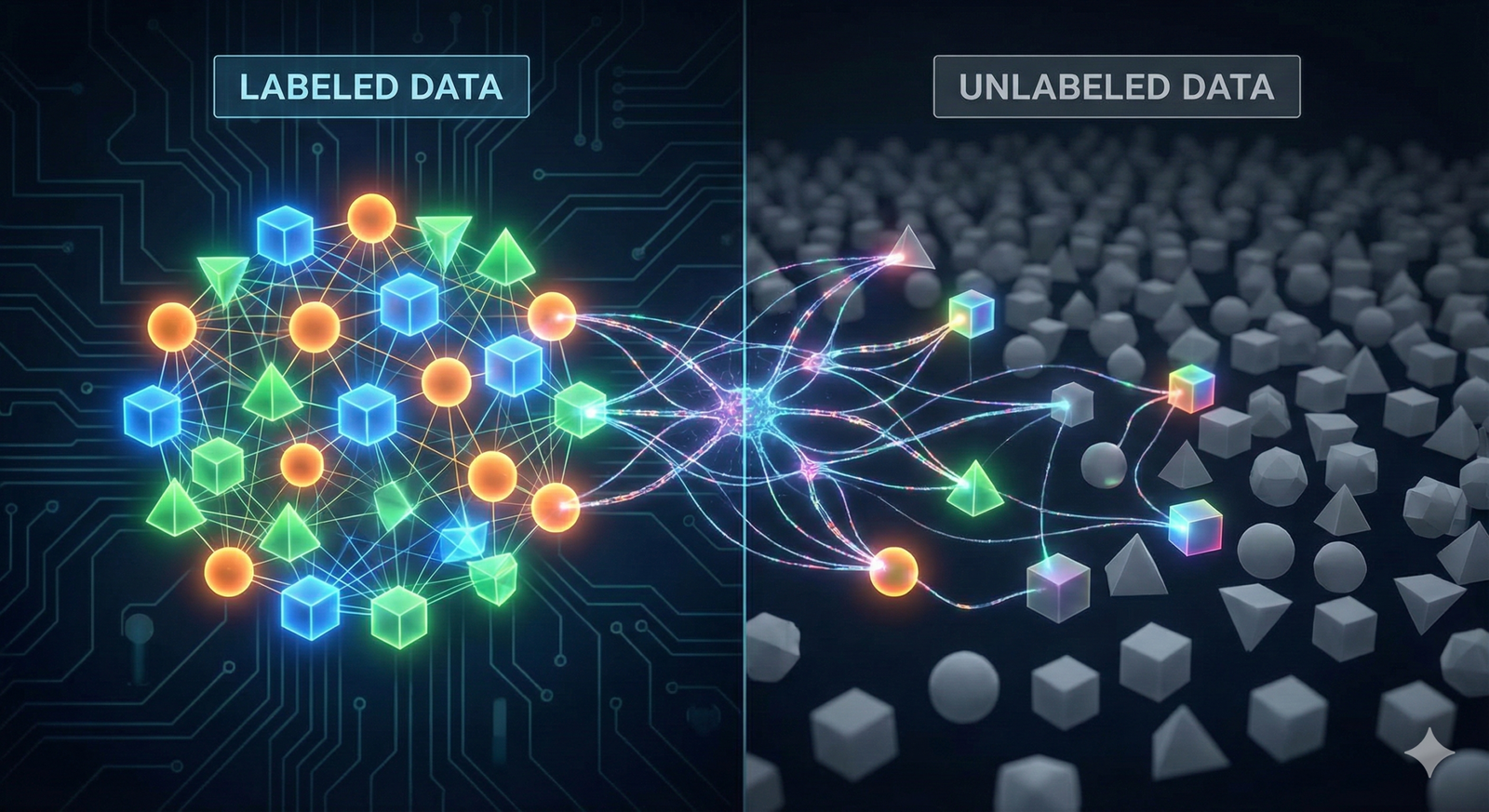
The problem RLHF ran into almost immediately at scale is cost and consistency. Human preference labeling is slow, expensive, and subject to annotator fatigue, disagreement, and drift over long labeling campaigns. Reinforcement learning from AI feedback, or RLAIF, answers this by replacing the human labeler with another large language model that ranks output pairs according to a written rubric or set of principles. The reward model — or in some variants, the policy update itself — is then trained on those AI-generated preferences instead of human ones.
This is not a fringe technique. AI feedback costs less than one cent per data point compared to a dollar or more for human feedback, and that cost differential is the single biggest reason RLAIF has become a default component within modern post-training pipelines rather than a research curiosity.
How RLHF Actually Works
The classic RLHF pipeline has three stages, and understanding each one clarifies exactly where RLAIF diverges.
- Supervised fine-tuning (SFT). The base model is fine-tuned on a curated set of high-quality human-written demonstrations to establish baseline instruction-following behavior.
- Reward model training. Human annotators are shown pairs of model outputs for the same prompt and asked which one they prefer. These pairwise preferences train a separate reward model to predict human preference scores for any given output.
- Reinforcement learning against the reward model. The policy model is updated using PPO or a similar algorithm, optimizing its outputs to score highly according to the trained reward model, typically with a KL-divergence penalty to keep it from drifting too far from the original SFT model.
Every stage of that pipeline depends on human judgment being available, consistent, and affordable at the volume the training run requires. For frontier-scale training runs that need millions of preference comparisons, human-only labeling becomes a genuine bottleneck, both in calendar time and in the recruiting and management overhead of a large annotator workforce.
How RLAIF Changes the Pipeline
RLAIF keeps the same overall shape — SFT, then a reward signal, then reinforcement learning — but swaps out the source of the preference labels. Instead of human annotators, an off-the-shelf LLM is given the same pair of outputs and a rubric or constitution describing what “better” means, and it produces the preference label directly. That label set then trains the reward model exactly as in RLHF, or in the direct-RLAIF variant, feeds straight into the reinforcement learning step without an intermediate reward model at all.
| Stage | RLHF | RLAIF |
|---|---|---|
| Preference labeling | Human annotators rank output pairs | An off-the-shelf LLM ranks output pairs against a rubric or constitution |
| Reward model | Trained on human preference data | Trained on AI-generated preference data, or skipped entirely in direct-RLAIF |
| Cost per label | Roughly $1 or more | Under $0.01 |
| Scaling speed | Bottlenecked by annotator throughput | Bottlenecked only by inference compute |
| Consistency | Subject to annotator fatigue and disagreement | More consistent per rubric, but can inherit the AI labeler’s own biases |
Anthropic’s Constitutional AI is the best-known implementation of this idea. Rather than training a reward model purely from scratch on AI preferences, Constitutional AI has the model critique and revise its own outputs against a fixed written constitution of principles, then trains on the resulting self-corrected outputs, reducing the volume of human-labeled harmful-versus-harmless comparisons needed for safety training specifically. Self-rewarding language models push this further still, using the same model both to generate candidate responses and to judge them, iteratively improving its own reward signal across training rounds without an external judge model at all.
Where the Feedback Loop Closes
In RLHF, the loop runs through a human annotator sitting between the model’s output and the reward signal. In RLAIF, that same position is occupied by a judge LLM, and in the self-rewarding variant, the judge and the policy being trained are literally the same model, checking its own homework and updating from the result.
Quality, Bias, and Cost Tradeoffs
The empirical picture is more nuanced than “RLAIF is just as good and much cheaper.” Across summarization, helpful dialogue, and harmless dialogue tasks, RLAIF achieves comparable performance to RLHF, and RLAIF can even outperform a supervised fine-tuned baseline when the AI labeler is the same size as, or the exact same checkpoint as, the policy being trained. That is a genuinely counter-intuitive result: a model can improve by learning from its own judgments about its own outputs, a self-referential loop that would seem prone to collapse but empirically has not, at least at the scales tested so far.
Where RLHF retains an edge is in judgment calls that require lived human context: subtle cultural nuance, judging tone in emotionally sensitive situations, or evaluating whether an answer would actually satisfy a real person’s underlying need rather than superficially matching a rubric. AI judges can inherit and even amplify biases present in their own training data, and a judge model that shares blind spots with the policy model it is evaluating may systematically fail to penalize a shared weakness, since neither model can see past it. This is the core bias risk unique to RLAIF: the judge and the policy can fail in correlated ways that a genuinely independent human annotator would not.
Cost is the least ambiguous part of the comparison. Because AI feedback labels cost a small fraction of a cent versus a dollar or more for human labels, RLAIF lets teams generate orders of magnitude more preference comparisons for the same budget, which matters enormously for frontier-scale training runs that need millions of comparisons to meaningfully move a reward model’s calibration.
| Dimension | Favors RLHF | Favors RLAIF |
|---|---|---|
| Nuanced human-context judgment | Yes | No |
| Cost per label | No | Yes |
| Scaling to millions of comparisons | No | Yes |
| Avoiding correlated blind spots | Yes | No |
| Consistency across a large labeling campaign | No | Yes |
| Labeling genuinely novel situations outside the judge’s training | Yes | No |
Who Uses Which Approach, and Why
In practice, most major labs use a blend rather than committing exclusively to one method. Anthropic pioneered Constitutional AI specifically to reduce the volume of human-labeled harmful-content comparisons needed for safety alignment, while still using human feedback for helpfulness and quality judgments where nuance matters most. OpenAI’s public descriptions of its post-training pipelines describe a similar mix: human preference data anchors the core reward model, while AI-assisted labeling and self-critique techniques scale up coverage across a much larger volume of prompts and edge cases than human annotators alone could reach in a reasonable timeframe. The general industry pattern that has emerged is to use human feedback as the calibration anchor — a smaller, carefully curated, high-quality set — and AI feedback as the scaling mechanism that extends that anchor’s judgment across orders of magnitude more comparisons.
This hybrid pattern exists because the two approaches fail in different, largely uncorrelated ways. Human feedback fails through inconsistency, fatigue, and cost at scale. AI feedback fails through inherited bias and correlated blind spots with the model being trained. Combining them, with humans anchoring the rubric and periodically auditing a sample of AI-generated labels, captures most of RLAIF’s cost advantage while limiting its bias risk.
Common mistake
Teams sometimes deploy a pure RLAIF pipeline and treat the AI judge’s rubric as fixed and correct from day one, skipping the human calibration and periodic audit step entirely. Since the judge model’s own weaknesses can go undetected when nothing outside the AI-feedback loop ever checks its labels, this quietly propagates the judge’s biases into every subsequent training round without anyone noticing until the resulting model’s behavior surfaces the problem in production.
What worked
Pipelines that used a small, high-quality human-labeled seed set to calibrate the AI judge’s rubric, then periodically re-sampled a subset of AI-generated labels for human spot-checking throughout the training run, caught judge-model drift early and cost only a small fraction of what a fully human-labeled pipeline would have required.
- Reward modelA separate model trained to predict how much a human or AI judge would prefer a given output, used to guide reinforcement learning updates.
- Proximal Policy Optimization (PPO)The reinforcement learning algorithm most commonly used to update a policy model against a reward model’s signal while limiting how far it drifts per update.
- Direct-RLAIFA variant that skips reward model training entirely, pulling reward signals directly from an off-the-shelf LLM judge during the reinforcement learning step.
- Constitutional AIAnthropic’s technique of having a model critique and revise its own outputs against a fixed written set of principles before training on the results.
- Self-rewarding modelA model that generates both its own candidate responses and its own judgments of those responses, iteratively improving its reward signal across training rounds.
Glossary
- RLHF
- Reinforcement learning from human feedback, a post-training technique that uses human-ranked preference pairs to train a reward model that then guides reinforcement learning updates.
- RLAIF
- Reinforcement learning from AI feedback, a variant that substitutes an AI judge model for human annotators when generating the preference labels used to train the reward model.
- Preference pair
- Two model outputs for the same prompt, presented to a human or AI judge so one can be labeled as preferred over the other.
- KL-divergence penalty
- A regularization term added during reinforcement learning to keep the updated policy model from drifting too far from its original supervised fine-tuned behavior.
- Judge model
- The AI model responsible for evaluating and ranking candidate outputs in an RLAIF pipeline, playing the role a human annotator would play in RLHF.
Key Takeaways
- RLHF trains a reward model on human-ranked preference pairs, then uses PPO to update the policy toward higher-scoring outputs.
- RLAIF substitutes an AI judge model for human annotators, cutting preference-labeling costs from roughly a dollar per label to under a cent.
- Controlled studies show RLAIF achieves comparable performance to RLHF on summarization and dialogue tasks, even with a same-size AI judge.
- Direct-RLAIF skips reward model training entirely, pulling reward signals straight from an LLM judge during reinforcement learning.
- Constitutional AI is a specific RLAIF implementation that uses a fixed written constitution for self-critique rather than a generic AI judge.
- RLAIF’s main risk is correlated bias: a judge model that shares blind spots with the policy model may fail to catch shared weaknesses.
- Most major labs now use a hybrid approach, anchoring with human feedback and scaling coverage with AI feedback.
FAQs
What is the main difference between RLHF and RLAIF?
RLHF uses human annotators to rank pairs of model outputs and train a reward model on those rankings. RLAIF replaces the human annotator with an AI judge model that generates the preference labels instead, at a fraction of the cost.
Is RLAIF lower quality than RLHF?
Not necessarily. Controlled studies found RLAIF achieves comparable performance to RLHF on tasks like summarization and dialogue generation, and can even outperform a supervised baseline when the AI judge is the same size as the policy model.
What is Constitutional AI and how does it relate to RLAIF?
Constitutional AI is Anthropic’s specific technique within the broader RLAIF category, where a model critiques and revises its own outputs against a fixed set of written principles, reducing the human labeling needed for safety-related judgments.
What is direct-RLAIF?
Direct-RLAIF is a variant that skips training a separate reward model entirely, obtaining reward signals directly from an off-the-shelf LLM judge during the reinforcement learning step, which research has shown can outperform the canonical RLAIF approach.
Why is RLAIF so much cheaper than RLHF?
AI-generated feedback costs less than one cent per data point, compared to roughly a dollar or more for human-generated preference labels, because AI judges can label at inference speed without the recruiting, training, and management overhead of a human annotator workforce.
What is the biggest risk of using RLAIF instead of RLHF?
The main risk is correlated bias: if the AI judge model shares blind spots or weaknesses with the policy model being trained, it may systematically fail to penalize shared errors, something an independent human annotator would be more likely to catch.
Do major AI labs use RLHF or RLAIF exclusively?
Neither, typically. Most labs use a hybrid approach, anchoring their reward model with a smaller set of high-quality human preference labels and scaling coverage across far more comparisons using AI feedback.
Can a model improve by judging its own outputs, as in self-rewarding models?
Yes, empirically. Self-rewarding models that generate and judge their own candidate responses have shown iterative improvement across training rounds, though this self-referential setup still requires monitoring to catch drift that an external judge might otherwise flag.
For teams building the evaluation infrastructure this comparison depends on, see our guide to LLM evaluation frameworks and how synthetic data pipelines intersect with AI-generated preference labels. Related risks around models training on their own outputs are covered in model collapse, and teams building the data labeling operations behind either approach may find data labelling in the age of synthetic data useful. For the operational side of running these pipelines in production, see MLOps in the LLM era.
- Lee et al., “RLAIF vs. RLHF: Scaling Reinforcement Learning from Human Feedback with AI Feedback,” arXiv:2309.00267
- Bai et al., Anthropic, “Constitutional AI: Harmlessness from AI Feedback”
- “HRLAIF: Improvements in Helpfulness and Harmlessness in Open-domain Reinforcement Learning From AI Feedback,” arXiv:2403.08309
- “A Survey on Post-training of Large Language Models,” arXiv:2503.06072