| Approach | Best Fit | Typical Compute | Interpretability |
|---|---|---|---|
| Classical (ARIMA, ETS, Prophet) | Single series, limited history, need for transparent assumptions | CPU, seconds to minutes | High |
| Deep learning (N-BEATS, TFT, DeepAR) | Hundreds to millions of related series, rich covariates | GPU, hours for training | Low to moderate |
| Foundation models (TimeGPT, Chronos, Moirai, TimesFM) | Zero-shot or few-shot forecasting, new series with little history | GPU for inference only, no training | Low |
The Question Behind the Question
Ask a data science team which forecasting method they should use in 2027 and the honest answer is almost always “it depends on the data you have, not the method that is trending.” That answer disappoints people who want a single winner, but it reflects the actual decision surface that governs forecasting in production. This piece works through that decision surface directly: when classical statistical methods still win, when deep learning approaches earn their extra complexity, and where the new wave of pretrained time-series foundation models genuinely changes the calculus.
To keep the comparison general rather than domain-locked, the examples throughout draw from retail demand planning, server capacity forecasting, and energy load prediction — three domains with very different data characteristics that between them cover most of the tradeoffs practitioners actually face.
Classical Methods: Still the Default for a Reason
ARIMA and its seasonal variant SARIMA, exponential smoothing state-space models (ETS), and Meta’s Prophet remain the default first choice for a large share of real-world forecasting tasks, and not out of inertia. These methods share three properties that matter enormously in production: they are fast to fit, they are transparent about their assumptions, and they perform well on limited historical data where a deep model would simply overfit.
Consider a single retail store forecasting weekly demand for a specific SKU with three years of history. That is roughly 150 data points — nowhere near enough to train a deep sequence model from scratch, but plenty for a seasonal ARIMA model or Prophet to capture trend and weekly or yearly seasonality reliably. The same logic applies to server capacity planning for a single service where only a couple of years of clean utilization data exist: a classical model with explicit trend and seasonal components will often outperform a deep network that has nothing to generalize from.
Interpretability is the other underrated advantage. When a capacity planning team needs to explain to finance why they are requesting a 20 percent budget increase for infrastructure next quarter, “the ETS model’s trend component shows load growing at this rate, and the seasonal component adds this much during month-end batch jobs” is a defensible statement in a way that “the neural network’s attention weights suggest elevated risk” rarely is.
Where Each Approach Wins
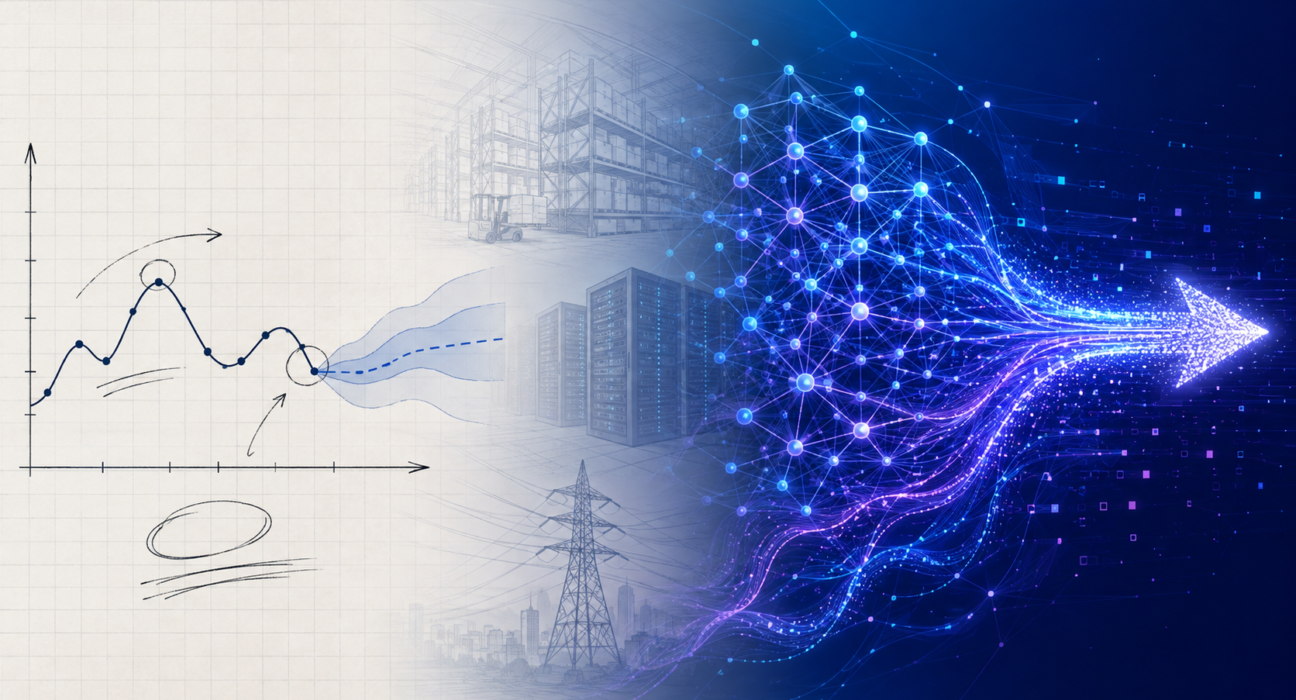
Picture a horizontal axis running from “one series, short history” on the left to “thousands of related series, long history, rich covariates” on the right. Classical methods dominate the left third, deep learning models dominate the right two-thirds when enough training data exists, and foundation models cut across the entire axis for any series with too little history to train a dedicated model, regardless of position.
Deep Learning: Where the Extra Complexity Pays Off
Deep learning forecasting architectures — N-BEATS, N-HiTS, the Temporal Fusion Transformer, and DeepAR — earn their complexity in a specific setting: many related series trained together as one global model, rather than one model per series. This is the single biggest shift in the field over the past several years, moving from “fit one model per series” to “train one model across many related series, with covariates, to generalize and scale.”
A retail chain with thousands of SKUs across hundreds of stores is the canonical example. Training a single DeepAR or Temporal Fusion Transformer model across all of that data lets the network learn shared patterns — how promotions interact with day-of-week effects, how new stores ramp up compared to established ones — that no per-series ARIMA model could ever see, because each individual series simply does not contain enough signal for those patterns to become visible statistically. The deep model borrows strength across series.
Energy load forecasting at the grid level shows the same pattern from a different angle. Grid operators forecast load across thousands of substations simultaneously, and those substations share weather sensitivity, calendar effects, and regional economic cycles. A Temporal Fusion Transformer that ingests weather covariates, calendar features, and substation identifiers as inputs can model those shared effects directly, and its attention mechanism gives some interpretability back by highlighting which past time steps and which covariates drove a given forecast.
The tradeoff is real, though: these models need meaningful engineering investment, GPU training infrastructure, and enough historical data across enough series to justify the setup. A team with only a dozen related series and two years of history is unlikely to see deep learning outperform a well-tuned classical ensemble, no matter how fashionable the architecture.
| Scenario | Series Count | Recommended Family | Why |
|---|---|---|---|
| Single warehouse SKU demand, 2 years history | 1 | Classical (SARIMA or Prophet) | Insufficient data for a deep model to generalize; fast iteration matters more |
| Retail chain demand across 5,000 SKU-store pairs | Thousands | Deep learning (DeepAR, TFT) | Shared promotional and seasonal patterns across series justify a global model |
| New product launch with 6 weeks of data | 1, minimal history | Foundation model (zero-shot) | Not enough history to fit or train anything from scratch |
| Grid-scale energy load, 3,000 substations, rich weather covariates | Thousands | Deep learning (TFT) | Complex covariate interactions and shared regional effects reward attention-based modeling |
Foundation Models: The New Wave and What They Actually Change
Time-series foundation models are large models pretrained on enormous, diverse corpora of time series — spanning retail, energy, web traffic, transport, and more — and then applied to a new series with no task-specific training at all. Amazon’s Chronos tokenizes series through scaling and quantization so a transformer trained the way a language model is trained can forecast almost any numeric sequence handed to it. Google’s TimesFM uses a decoder-only transformer with patching, treating short windows of points as tokens, and was pretrained on around 100 billion real-world time points. Salesforce’s Moirai handles an arbitrary number of input variables through an any-variate attention mechanism and produces mixture-distribution outputs for uncertainty quantification. Nixtla’s TimeGPT was among the first commercial entries in this category, offering a hosted API for zero-shot forecasting.
What these models change is not raw accuracy supremacy — benchmarks consistently show that zero-shot foundation models land between classical methods and the best fully-trained deep models, competitive but not dominant against a model that has actually been trained on the target data. What they change is the cold-start problem. A new server capacity metric with three weeks of history, a newly launched retail SKU with six data points, an energy meter that just came online: these are situations where classical methods have too little data to fit reliable seasonal parameters and deep learning has no time to train a dedicated model at all. A foundation model can produce a usable forecast immediately, with no training step, and that capability did not really exist in a practical form before 2024 and 2025.
The practical pattern emerging in production teams is a hybrid one: use a foundation model as the default forecast for any series with too little history to justify anything else, and graduate a series to a dedicated classical or deep model once enough history accumulates and the forecast is important enough to justify the engineering investment.
Common mistake
Teams often assume that because a foundation model requires zero training, it also requires zero evaluation. In practice, zero-shot foundation model forecasts still need backtesting against holdout data for your specific domain, because pretrained models can carry systematic biases from their training corpus that only show up when checked against your actual series — a retail demand curve does not resemble a web-traffic curve, even if both were in the pretraining mix.
What worked
A hybrid ensembling approach — averaging forecasts from AutoARIMA, ETS, and Theta for stable, data-rich series, while falling back to a foundation model for new or sparse series — consistently outperformed committing to a single method across an entire portfolio of forecasts. Classical ensembling remains “surprisingly strong” on univariate series specifically because averaging cancels out each individual model’s idiosyncratic errors.
Decision Framework: Which Should You Actually Use
Rather than starting from “which architecture is best,” start from three questions about your own data and constraints.
- How much history do you have per series, and how many related series exist? Short history and few series points toward classical methods or a foundation model; long history across many related series points toward deep learning.
- How much does interpretability matter to your stakeholders? Regulatory, financial, or executive-facing forecasts often need transparent, explainable components that classical methods provide more directly than deep architectures.
- What is your forecast horizon? Deep learning’s advantage over classical methods grows most clearly at long horizons, where complex temporal patterns compound and the assumptions behind statistical models start to break down; for short horizons, the gap narrows substantially.
| Question | Leans Classical | Leans Deep Learning | Leans Foundation Model |
|---|---|---|---|
| History per series | Short to moderate | Long, with many related series | Very short or none |
| Number of related series | Few | Hundreds to millions | Any |
| Interpretability need | High | Moderate | Low |
| Forecast horizon | Short to medium | Long (336+ steps) | Any, with wider uncertainty |
| Engineering budget | Low | High (GPU training pipeline) | Low (inference only) |
None of these families is obsolete, and none has fully replaced the others. Classical methods remain the correct default for the majority of low-stakes, low-data forecasting tasks a typical organization runs. Deep learning earns its complexity budget specifically when many related series share exploitable structure. Foundation models fill a real gap for cold-start situations that neither of the older families handled well, and they are increasingly used as a fast baseline against which more expensive, purpose-built models are benchmarked before a team commits engineering time to them.
- Global modelA single model trained across many related series at once, as opposed to fitting one model per series individually.
- Zero-shot forecastingProducing a forecast for a series the model has never seen, with no task-specific fine-tuning or training step.
- CovariateAn external input variable, such as a promotion flag or weather reading, fed into a model alongside the historical series itself.
- BacktestingEvaluating a forecasting method against historical holdout periods to estimate how it would have performed in practice.
- Cold startThe situation where a series has too little history for classical parameter fitting or deep model training, historically the hardest case to forecast well.
Glossary
- ARIMA
- Autoregressive Integrated Moving Average, a classical statistical model that captures trend and autocorrelation in a single time series.
- Exponential smoothing (ETS)
- A family of classical forecasting models that weight recent observations more heavily than older ones, with explicit trend and seasonal components.
- Temporal Fusion Transformer (TFT)
- A deep learning architecture combining recurrent layers and attention mechanisms to forecast across many series with covariates and offer some interpretability.
- DeepAR
- A probabilistic deep learning forecasting model that produces full predictive distributions rather than single-point forecasts, trained across many related series.
- Time-series foundation model
- A large model pretrained on diverse time-series data from many domains, capable of forecasting new series with no additional training.
Key Takeaways
- Classical methods like ARIMA, ETS, and Prophet remain the right default for single series with limited history and a need for interpretability.
- Deep learning architectures such as N-BEATS, the Temporal Fusion Transformer, and DeepAR earn their complexity when many related series can be trained together as one global model.
- Foundation models like TimeGPT, Chronos, Moirai, and TimesFM solve the cold-start problem for series with too little history to fit or train anything else.
- Zero-shot foundation model forecasts are competitive but typically do not beat a properly trained deep model on data-rich series.
- Deep learning’s advantage over classical methods grows largest at long forecast horizons, where compounding temporal patterns break classical assumptions.
- A hybrid approach — classical or ensembled methods for stable series, foundation models for cold starts — consistently outperforms committing to one family across a whole portfolio.
- Always backtest foundation model forecasts against your own domain’s holdout data rather than assuming zero-shot means zero-evaluation.
FAQs
When should I use classical forecasting methods instead of deep learning?
Use classical methods like ARIMA, ETS, or Prophet when you have a single series or few related series, limited historical data, and a need for transparent, explainable forecasts. They are fast to fit and remain competitive on small, clean datasets.
What is the main advantage of deep learning forecasting models?
Deep learning models like N-BEATS, DeepAR, and the Temporal Fusion Transformer can train one global model across thousands of related series, learning shared patterns like promotional effects or seasonal interactions that a per-series classical model cannot detect.
What are time-series foundation models and how are they different?
Foundation models such as TimeGPT, Chronos, Moirai, and TimesFM are pretrained on diverse time-series data across many domains and can forecast a new series with no task-specific training, making them useful for cold-start scenarios with very little history.
Do foundation models outperform trained deep learning models?
Generally no. Benchmarks show zero-shot foundation model forecasts typically land between classical methods and the best fully-trained deep models on data-rich series, competitive but not usually dominant against a model trained specifically on that data.
What forecast horizon favors deep learning over classical methods?
Deep learning’s advantage is largest at long horizons, often cited around 336 or more steps ahead, where complex temporal patterns compound and classical statistical assumptions tend to break down.
Can classical and deep learning methods be combined?
Yes. Ensembling forecasts from AutoARIMA, ETS, and Theta is a well-established classical technique, and hybrid production pipelines increasingly combine classical or ensembled forecasts for stable series with foundation models for new or sparse series.
Is Prophet still relevant for forecasting in 2027?
Yes, particularly for business-facing forecasts with clear calendar-driven seasonality and a need for interpretable trend and holiday components, where its transparency and ease of use still outweigh the benefits of a more complex model.
How should I evaluate a zero-shot foundation model forecast before trusting it?
Backtest it against holdout periods specific to your domain rather than relying on published benchmarks, since pretrained models can carry systematic biases from their training corpus that only surface when tested against your actual data.
For related infrastructure decisions, see how production model monitoring should track forecast drift over time, and how feature stores can standardize the covariates feeding these models. Teams building retail or demand-facing systems may also find recommender systems rebuilt with embeddings and LLMs relevant, while those evaluating model change over time should read about model collapse. For broader platform context, see our companion piece on building an ML platform team and on automated machine learning research.
- Amazon Science, Chronos: Learning the Language of Time Series
- Google Research, TimesFM: A Decoder-Only Foundation Model for Time-Series Forecasting
- Salesforce AI Research, Moirai: A Time Series Foundation Model for Universal Forecasting
- Nixtla, TimeGPT documentation and benchmarks
- MachineLearningMastery.com, “The 2026 Time Series Toolkit: 5 Foundation Models for Autonomous Forecasting”