In the high-stakes world of industrial operations, the difference between profitability and disaster often hangs on the health of a single bearing, motor, or valve. Predictive maintenance (PdM) powered by machine learning has emerged as the definitive solution to the age-old problem of equipment failure. By analyzing data patterns to forecast issues before they occur, organizations are moving beyond simple “fix-it-when-it-breaks” models to intelligent, proactive strategies.
This guide covers the end-to-end landscape of predictive maintenance machine learning, focusing specifically on anomaly detection—the critical capability that allows computers to spot the “needle in the haystack” deviations that signal an impending breakdown.
Key Takeaways
- Proactive vs. Reactive: Predictive maintenance reduces downtime by 30–50% compared to reactive maintenance by fixing issues before they cause stoppages.
- Data is Fuel: Success depends heavily on the quality of time-series data from IoT sensors (vibration, temperature, acoustic).
- The Imbalance Challenge: Most industrial data is “healthy,” making failure data rare; anomaly detection algorithms must be robust enough to handle this imbalance.
- Algorithm Variety: From simple statistical methods to complex Deep Learning models like LSTMs and Autoencoders, the right tool depends on your data complexity.
- Edge Deployment: Modern implementation often happens on-device (Edge AI) to reduce latency and bandwidth costs.
Who this is for (and who it isn’t)
This guide is designed for data scientists, reliability engineers, and technical product managers who want to understand the architectural and algorithmic underpinnings of building a predictive maintenance system.
- It is for you if: You want to understand how to select algorithms, handle sensor data, and deploy models in an industrial setting.
- It is NOT for you if: You are looking for a non-technical sales brochure for a specific SaaS platform, or if you are looking for manual mechanical repair tutorials.
In this guide, “Predictive Maintenance” (PdM) refers specifically to the use of statistical and machine learning techniques to estimate the Remaining Useful Life (RUL) of equipment or detect failure modes, as opposed to “Preventive Maintenance” which is schedule-based.
1. The Core Concept: From Schedule to Strategy
Traditionally, maintenance falls into two buckets:
- Reactive (Run-to-Failure): You fix it when it smokes. This has zero upfront cost but infinite risk of catastrophic downtime.
- Preventive (Schedule-Based): You replace parts every 6 months, regardless of their condition. This avoids downtime but wastes money on replacing perfectly good components.
Predictive Maintenance sits in the optimal middle ground. It uses data to define the condition of the asset. By leveraging predictive maintenance machine learning models, we answer two fundamental questions:
- Anomaly Detection: “Is the machine behaving strangely right now?”
- RUL Estimation: “How much time do we have left before it fails?”
The goal is to intervene only when necessary, maximizing the lifespan of the equipment while minimizing the risk of unplanned outages.
2. How Anomaly Detection Works in Industrial IoT
Anomaly detection is the process of identifying data points, events, or observations that deviate significantly from the dataset’s normal behavior. In an industrial context, “normal” is usually well-defined: the machine running at a steady state. “Abnormal” is rarer and indicates wear, misalignment, or breakage.
The Mechanism of Anomaly Detection
At a high level, the system learns a probability distribution of “normal” data. When new data comes in from sensors, the model calculates the probability that this new data belongs to the “normal” distribution. If the probability is below a certain threshold, an alert is triggered.
This is distinct from standard classification because, in many cases, you effectively have no “failure” data to train on when you start. You only know what a healthy machine looks like. Therefore, the model must learn to recognize “not healthy” without necessarily having seen every specific type of failure before.
Types of Anomalies
- Point Anomalies: A single data point is far off from the rest (e.g., a temperature spike to 500°C when the average is 50°C).
- Contextual Anomalies: A data point is normal in general but abnormal for the specific context. For example, low vibration might be normal during machine startup but abnormal during full-load operation.
- Collective Anomalies: A sequence of data points is anomalous, even if individual points are not. A flat-line signal might be “valid” numbers, but if the machine is running, the lack of variation is an anomaly.
3. The Data Pipeline: Sensors and Acquisition
Before any predictive maintenance machine learning can occur, you need high-fidelity data. The phrase “Garbage in, Garbage out” is never truer than in industrial IoT.
Key Sensor Modalities
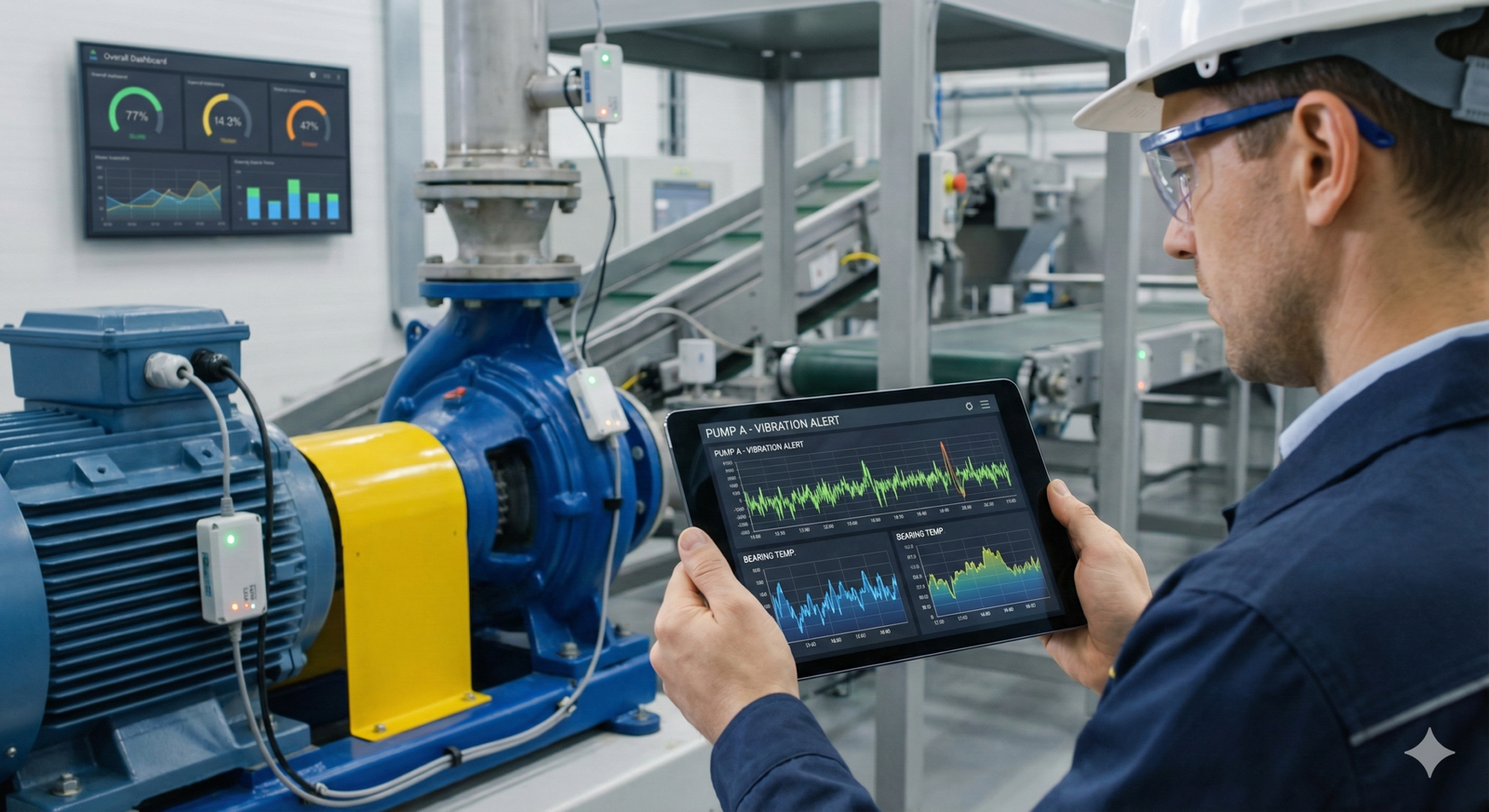
- Vibration Sensors (Accelerometers): The gold standard for rotating machinery (motors, pumps, turbines). They detect misalignment, imbalance, and bearing faults long before they are audible or visible. High-frequency sampling (10kHz+) is often required.
- Temperature Sensors (Thermocouples/RTDs): Heat is a classic symptom of friction (wear) or electrical resistance (short circuits).
- Acoustic/Ultrasonic Sensors: Useful for detecting leaks in pressurized systems or early-stage bearing wear that creates high-frequency noise.
- Current/Voltage Sensors: Monitoring the electrical signature of a motor can reveal mechanical load issues.
Data Acquisition (DAQ) Challenges
- Sampling Rate: You cannot detect a 5kHz bearing fault if you only sample your sensor once per minute. You need high-frequency time-series data.
- Synchronization: If you are correlating temperature with vibration, timestamps must be perfectly aligned.
- Noise: Industrial environments are noisy. Electromagnetic interference (EMI) can corrupt sensor signals.
Preprocessing Strategy
Raw sensor data is rarely ready for a model.
- Resampling: aligning different sensor frequencies.
- Denoising: Moving averages or Fourier transforms to remove signal noise.
- Imputation: Filling in gaps where sensor connectivity was lost.
4. Supervised vs. Unsupervised Learning Strategies
The choice of learning strategy is dictated almost entirely by the data you possess.
Unsupervised Learning (The Common Path)
Scenario: You have terabytes of data from machines running normally, but few or no recorded failures. Approach: The model trains only on healthy data. It learns the complex multidimensional shape of “normalcy.” During inference, if the live data falls outside this learned shape, it is flagged as an anomaly. Algorithms:
- Isolation Forests: Builds random decision trees. Anomalies are easier to isolate (require fewer splits) than normal points.
- One-Class SVM: Fits a boundary around the normal data.
- Autoencoders (Deep Learning): Neural networks that compress input data and try to reconstruct it. If the reconstruction error is high, the input was likely anomalous (since the network only knows how to reconstruct normal data).
Supervised Learning (The Ideal Path)
Scenario: You have a historical dataset rich with labeled failure events (e.g., “Failure Type A occurred at timestamp X”). Approach: Standard classification. The model learns the features that distinguish “Healthy” from “Broken” or “Degrading.” Algorithms:
- Random Forest / XGBoost: Highly effective for structured feature sets.
- Logistic Regression: Good for establishing baselines.
- LSTMs (Long Short-Term Memory): Recurrent neural networks that are excellent at predicting the next step in a time series based on a labeled history.
Semi-Supervised Learning
Scenario: You have a small amount of labeled failure data and a massive amount of unlabeled data. Approach: Use the labeled data to anchor the clusters found in the unlabeled data, improving the boundary decision between normal and anomalous.
5. Feature Engineering for Time-Series
Raw time-series signals (e.g., a stream of vibration voltage values) are usually too noisy and high-dimensional for basic models. Feature engineering transforms this raw stream into meaningful indicators.
Time-Domain Features
These summarize the signal statistics over a rolling window (e.g., the last 10 seconds).
- Root Mean Square (RMS): Indicates the overall energy level of the vibration.
- Peak-to-Peak: The difference between the maximum and minimum values.
- Kurtosis: Measures the “tailedness” of the distribution. A sudden rise in kurtosis often signals early bearing damage (impulsive shocks).
- Crest Factor: The ratio of the peak value to the RMS value.
Frequency-Domain Features
Using Fast Fourier Transform (FFT) to convert time signals into the frequency spectrum.
- Dominant Frequency: The frequency with the highest energy.
- Spectral Energy: Energy within specific frequency bands (e.g., 1x RPM, 2x RPM). Misalignment often shows up at 2x the rotation speed; imbalance at 1x.
Time-Frequency Features
- Wavelet Transform: Decomposes the signal to analyze how frequencies change over time, which is crucial for non-stationary signals (machines that speed up and slow down).
6. Deep Learning Approaches: LSTMs and Autoencoders
When traditional statistical features hit a ceiling, predictive maintenance machine learning turns to deep learning. These models can learn feature representations automatically, often discovering complex patterns that humans miss.
Autoencoders for Anomaly Detection
An Autoencoder is composed of an Encoder and a Decoder.
- Encoder: Compresses the input data (e.g., a 1-second vibration snippet) into a lower-dimensional “latent space.”
- Decoder: Attempts to reconstruct the original input from that latent space.
How it detects anomalies: You train the autoencoder only on healthy data. It becomes an expert at compressing and decompressing healthy signals. When you feed it a signal from a failing bearing, the autoencoder fails to reconstruct it accurately. The difference between the Input and the Output (Reconstruction Error) spikes. A high reconstruction error = Anomaly.
LSTMs for RUL Estimation
Long Short-Term Memory (LSTM) networks are designed for sequence data. They “remember” past states, making them perfect for tracking degradation.
- Use Case: Predicting Remaining Useful Life (RUL).
- Mechanism: The LSTM analyzes the sequence of sensor readings leading up to the present moment and forecasts the future trend. If the trend line crosses a failure threshold in 50 hours, the RUL is 50 hours.
Convolutional Neural Networks (CNNs)
While traditionally used for images, 1D-CNNs are powerful for time-series data. They can slide over vibration signals to extract features like “shock pulses” automatically, often faster than RNNs/LSTMs.
7. Step-by-Step Implementation Guide
Implementing predictive maintenance machine learning is a complex workflow. Here is a practical roadmap.
Step 1: Problem Definition & Scope
- Select the Asset: Don’t start with the whole factory. Pick one critical asset (e.g., the main coolant pump).
- Define Failure: What constitutes a failure? Is it a hard stop, or a drop in efficiency below 80%?
Step 2: Data Collection Strategy
- Install Sensors: Ensure you cover the relevant physics (vibration for bearings, current for loads).
- Connectivity: Establish a pipeline (MQTT/HTTP) to send data to a database (e.g., InfluxDB, TimescaleDB, or AWS Timestream).
- Historical Data Check: Do you have maintenance logs? You need to know when failures happened in the past to validate your model.
Step 3: Exploratory Data Analysis (EDA)
- Visual Inspection: Plot the raw data. Look for gaps, outliers, and drift.
- Correlation Matrix: Check if sensors are redundant. If three temperature sensors always move in lockstep, you might only need one feature.
Step 4: Model Training (The “Cold Start” Strategy)
- Since you likely lack failure data, start with an Unsupervised Anomaly Detection model (e.g., Isolation Forest or Mahalanobis Distance).
- Train it on a known “good” period of operation.
- Set a threshold for alerts.
Step 5: Validation & Tuning
- Backtesting: Run your model against historical data. Did it flag the period right before the last breakdown?
- Human-in-the-loop: When the model flags an anomaly, a technician should inspect it. Their feedback (“True Alarm” vs “False Alarm”) is crucial for re-training and tuning the threshold.
Step 6: Deployment
- Cloud Inference: Data is sent to the cloud, processed, and dashboarded. Good for aggregate analysis but higher latency.
- Edge Inference: The model runs on a microcontroller or gateway right next to the machine (TinyML). This allows for millisecond-level reaction times (e.g., emergency shutoff).
8. Handling Imbalanced Data
The most persistent challenge in predictive maintenance machine learning is the Class Imbalance Problem. A machine might run for 10,000 hours and fail for 1 hour. A model that blindly guesses “Healthy” every time will be 99.99% accurate but 100% useless.
Strategies to Combat Imbalance
- Resampling:
- Undersampling: Discarding some healthy data (risky, lose information).
- Oversampling: Duplicating failure data (can lead to overfitting).
- Synthetic Data Generation:
- SMOTE (Synthetic Minority Over-sampling Technique): Creates new, synthetic examples of failure data by interpolating between existing failure points.
- GANs (Generative Adversarial Networks): Can be trained to generate realistic “fake” failure signals to bulk up the training set.
- Cost-Sensitive Learning: Modify the algorithm’s loss function to penalize missing a failure (False Negative) much more heavily than a false alarm (False Positive).
9. Common Mistakes and Pitfalls
1. The “Magic Box” Fallacy
Treating ML as a black box that will figure it out without physics.
- Correction: Use domain knowledge. If a mechanical engineer says “vibration at 200Hz means bearing looseness,” create a feature for 200Hz energy.
2. Ignoring Context (Operating Modes)
A pump vibrates more when pumping sludge than when pumping water. If your model doesn’t know what is being pumped (context), it will flag the sludge pumping as an anomaly.
- Correction: Include operational variables (load, speed, material type) as inputs to the model.
3. Sensor Drift
Sensors degrade over time. A temperature sensor might slowly drift upwards due to its own aging, not the machine’s.
- Correction: Perform periodic sensor calibration and use “differential” features (Sensor A minus Sensor B) to cancel out environmental drift.
4. Alert Fatigue
Setting thresholds too low results in constant pings. Operators will eventually ignore the system entirely.
- Correction: Focus on high precision. It is often better to miss a minor anomaly than to bombard users with false positives.
10. Tools and Frameworks
Software Libraries
- Scikit-learn: The industry standard for Isolation Forests, SVMs, and PCA.
- TensorFlow / PyTorch: Essential for building LSTMs and Autoencoders.
- PyOD (Python Outlier Detection): A comprehensive library specifically for anomaly detection algorithms.
Cloud Platforms
- AWS Monitron / Lookout for Equipment: Managed services that handle the heavy lifting of PdM.
- Azure IoT Hub / Azure Digital Twins: Strong integration for enterprise-level IoT management.
Edge Hardware
- STMicroelectronics / Arduino (TinyML): Running ultra-light models on microcontrollers.
- NVIDIA Jetson: For heavier processing involving video or high-frequency vibration analysis.
11. ROI and Business Impact
Implementing predictive maintenance machine learning is an investment. Justification usually comes from three metrics:
- Reduced Unplanned Downtime: In industries like automotive or oil & gas, downtime costs can exceed $20,000 per minute. Avoiding a single hour of downtime can pay for the entire PdM project.
- Extended Asset Life: By fixing alignment issues early, you prevent the secondary damage that destroys the whole machine, extending its capital lifespan by years.
- Optimized Spare Parts Inventory: Instead of hoarding parts “just in case,” you order parts only when the model predicts a need (Just-in-Time inventory).
Example Case: A wind farm operator implements anomaly detection on turbine gearboxes. By detecting a bearing fault 3 months in advance, they can schedule the repair for a low-wind day and hoist the crane proactively. Result: $150,000 saved in crane logistics and avoided lost power generation.
Conclusion
Predictive maintenance machine learning represents the convergence of physical reliability engineering and data science. It transforms maintenance from a cost center into a strategic advantage. While the algorithms—LSTMs, Autoencoders, Isolation Forests—are powerful, success lies in the practical application: high-quality sensor data, intelligent feature engineering, and a robust deployment strategy that accounts for the nuances of industrial environments.
As we move forward, the integration of TinyML (running models directly on sensors) and Digital Twins will further reduce latency and increase the fidelity of these predictions. The future of industry is not just automated; it is predictive.
Next Steps
- Audit your data: Do you have historical logs? Do you have high-frequency sensor data?
- Start small: Pick one “bad actor” machine that fails often.
- Establish a baseline: Run a simple anomaly detection algorithm (like Isolation Forest) on that machine’s data for 2 weeks.
- Iterate: Use the insights from that pilot to refine your sensor strategy before scaling to the whole fleet.
FAQs
1. What is the difference between anomaly detection and predictive maintenance? Anomaly detection is a technique used within predictive maintenance. Predictive maintenance is the broader strategy of maintaining equipment based on its condition. Anomaly detection provides the “trigger” for this strategy by identifying when equipment deviates from its normal state.
2. How much historical data do I need to start? For unsupervised anomaly detection, you typically need a few weeks to a few months of “healthy” operational data to train a baseline model. For supervised learning (predicting specific failure modes), you need a history containing multiple examples of those failures, which can take years to accumulate.
3. Can I do predictive maintenance without AI? Yes, utilizing Condition-Based Maintenance (CBM). This uses simple rule-based thresholds (e.g., “If vibration > 5mm/s, alert”). However, ML is superior because it can detect complex, non-linear patterns and multi-variate correlations that simple rules miss.
4. What is the best algorithm for predictive maintenance? There is no single “best” algorithm. For unlabeled data, Isolation Forests and Autoencoders are top choices. For labeled time-series data where RUL estimation is needed, LSTMs and XGBoost are industry favorites.
5. How do I handle data from different operating modes? You must normalize your data or include the operating mode as a feature. Alternatively, you can train separate models for different distinct modes (e.g., one model for “Idle”, one for “Full Load”) and switch between them based on the machine’s state.
6. What is TinyML in the context of predictive maintenance? TinyML refers to running machine learning models on very small, low-power microcontrollers (like those inside a sensor). This allows the sensor to analyze vibration data locally and only transmit a simple “Healthy” or “Warning” signal, saving battery life and bandwidth.
7. How accurate are predictive maintenance models? Accuracy varies by data quality and machine complexity. However, “accuracy” is often the wrong metric due to class imbalance. Metrics like Precision (how many alerts were real?) and Recall (did we catch all the failures?) are more important. A good system might achieve 80-90% recall with manageable false positives.
8. Is cloud computing required for predictive maintenance? Not strictly. While the cloud is excellent for training heavy models and aggregating data across multiple factories, the actual inference (monitoring) is increasingly moving to the Edge (on-premise servers or devices) to ensure security and speed.
References
- NASA Jet Propulsion Laboratory. (2023). Prognostics Center of Excellence Data Repository. NASA. https://www.nasa.gov/intelligent-systems-division/discovery-and-systems-health/pcoe/pcoe-data-set-repository
- Mobley, R. K. (2002). An Introduction to Predictive Maintenance. Butterworth-Heinemann.
- Carvalho, T. P., et al. (2019). “A systematic literature review of machine learning methods applied to predictive maintenance.” Computers & Industrial Engineering, 137, 106024.
- Google Cloud. (2024). Visual Inspection AI and Manufacturing Data Engine Documentation. Google Cloud. https://cloud.google.com/solutions/manufacturing
- Microsoft Azure. (2024). Predictive Maintenance with Azure Machine Learning. Microsoft. https://learn.microsoft.com/en-us/azure/architecture/solution-ideas/articles/predictive-maintenance
- Scikit-learn Developers. (2024). Novelty and Outlier Detection. Scikit-learn Documentation. https://scikit-learn.org/stable/modules/outlier_detection.html
- TensorFlow. (2024). Time series forecasting with TensorFlow. TensorFlow Core. https://www.tensorflow.org/tutorials/structured_data/time_series
- International Society of Automation (ISA). (2022). ISA-95 Enterprise-Control System Integration Standard. ISA. https://www.isa.org/standards-and-publications/isa-standards/isa-standards-committees/isa95