The intersection of generative artificial intelligence (GenAI) and spatial computing—encompassing Augmented Reality (AR) and Virtual Reality (VR)—represents a paradigm shift in how stories are told and experienced. For decades, immersive storytelling has been bound by the constraints of pre-scripted narratives and pre-rendered assets. A developer had to predict every player action, write every line of dialogue, and model every tree in the background. Generative AI shatters these limitations, enabling environments that build themselves in real-time and characters that converse with the depth of improvisational actors.
This guide explores how creators, developers, and brands are combining generative AI with AR/VR to build “living” narratives. We will examine the technical mechanisms behind dynamic storytelling, the tools facilitating this convergence, and the practical challenges of deploying heavy AI models on head-mounted displays.
In this guide, “immersive storytelling” refers to interactive narrative experiences where the user plays an active role within a 3D environment (virtual or augmented), distinct from passive consumption like watching a 3D movie.
Key Takeaways
- From Static to Dynamic: Generative AI allows for non-linear storytelling where the plot, dialogue, and environment react dynamically to user input, creating infinite replayability.
- The “Director” AI: Modern systems use AI not just for assets, but as a “Dungeon Master” or logic engine that manages pacing, tension, and plot progression based on user behavior.
- Asset Velocity: Tools like diffusion models and NeRFs (Neural Radiance Fields) drastically reduce the time-to-production for 3D assets, allowing small teams to build massive worlds.
- The Latency Challenge: Running Large Language Models (LLMs) and image generators in real-time requires balancing cloud computing power with the low-latency requirements of VR to prevent motion sickness and immersion breaking.
- Personalization: Narratives can now adapt to the user’s emotional state (detected via headset sensors) or preferences, tailoring the genre and tone on the fly.
The Convergence of GenAI and Spatial Computing
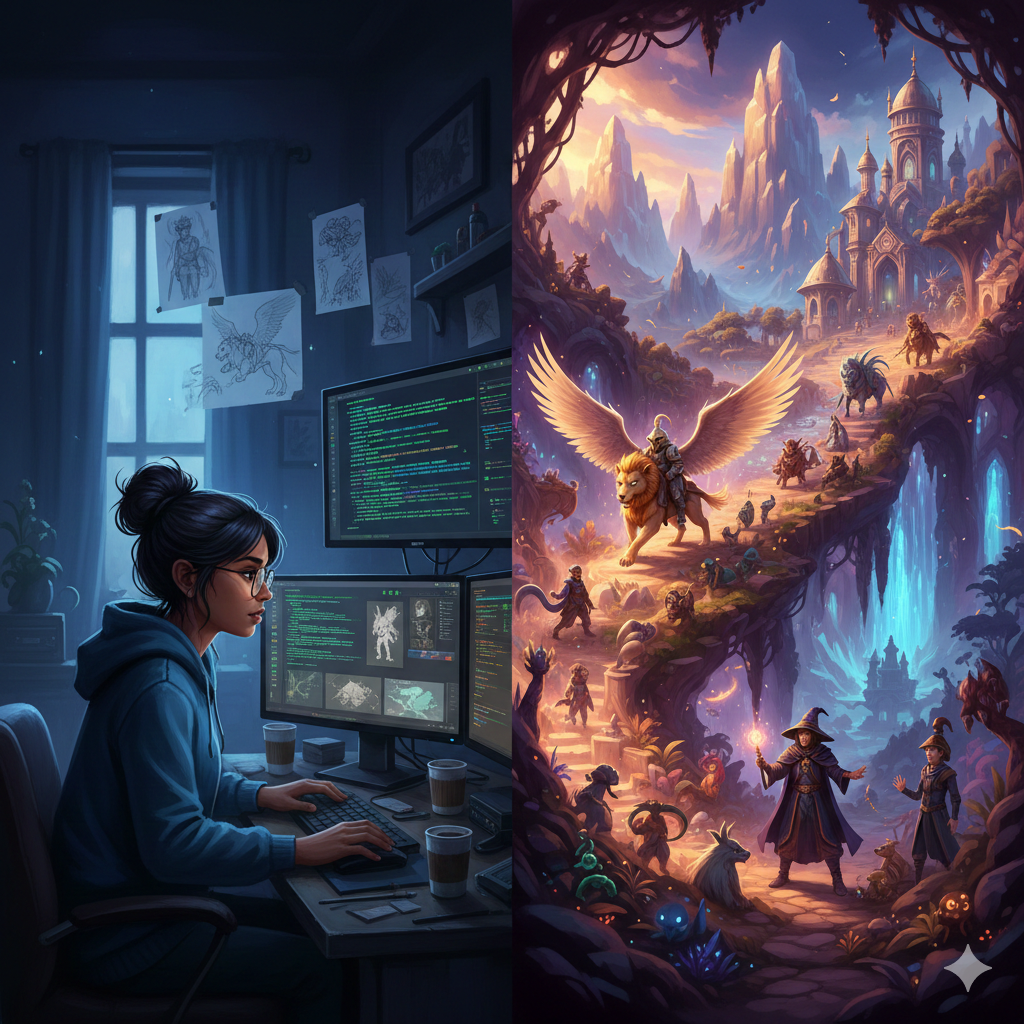
To understand the power of this combination, one must look at the distinct strengths of each technology. AR and VR provide the canvas—a spatial medium where the user feels “present.” Generative AI provides the paint and, increasingly, the artist.
In traditional game development and VR storytelling, the concept of the “magic circle” defines the boundary between the real world and the game world. Generative AI expands this circle by removing the “invisible walls” of dialogue and interaction. When a user asks a non-player character (NPC) a question that wasn’t in the script, traditional logic returns a generic “I don’t understand.” A GenAI-enabled NPC, however, improvises an answer that fits the lore, maintaining the illusion of a living world.
The Shift from Procedural to Generative
It is important to distinguish between procedural generation and generative AI.
- Procedural Generation: Uses mathematical algorithms and noise functions (like Perlin noise) to create randomized terrain or dungeon layouts. It is rule-based and deterministic (the same seed produces the same result).
- Generative AI: Uses probabilistic models trained on vast datasets to create novel content (text, code, images, audio) that mimics human creativity. It can understand context, tone, and semantic meaning, allowing for much richer, less repetitive results.
By combining these, developers can create worlds that are not only structurally varied (procedural) but also narratively deep and culturally rich (generative).
How it Works: The Generative Storytelling Stack
Implementing generative AI in an AR/VR context requires a multi-layered technology stack. This “Generative Storytelling Stack” manages everything from the user’s voice input to the final rendered frame.
1. The Input Layer: Multimodal Perception
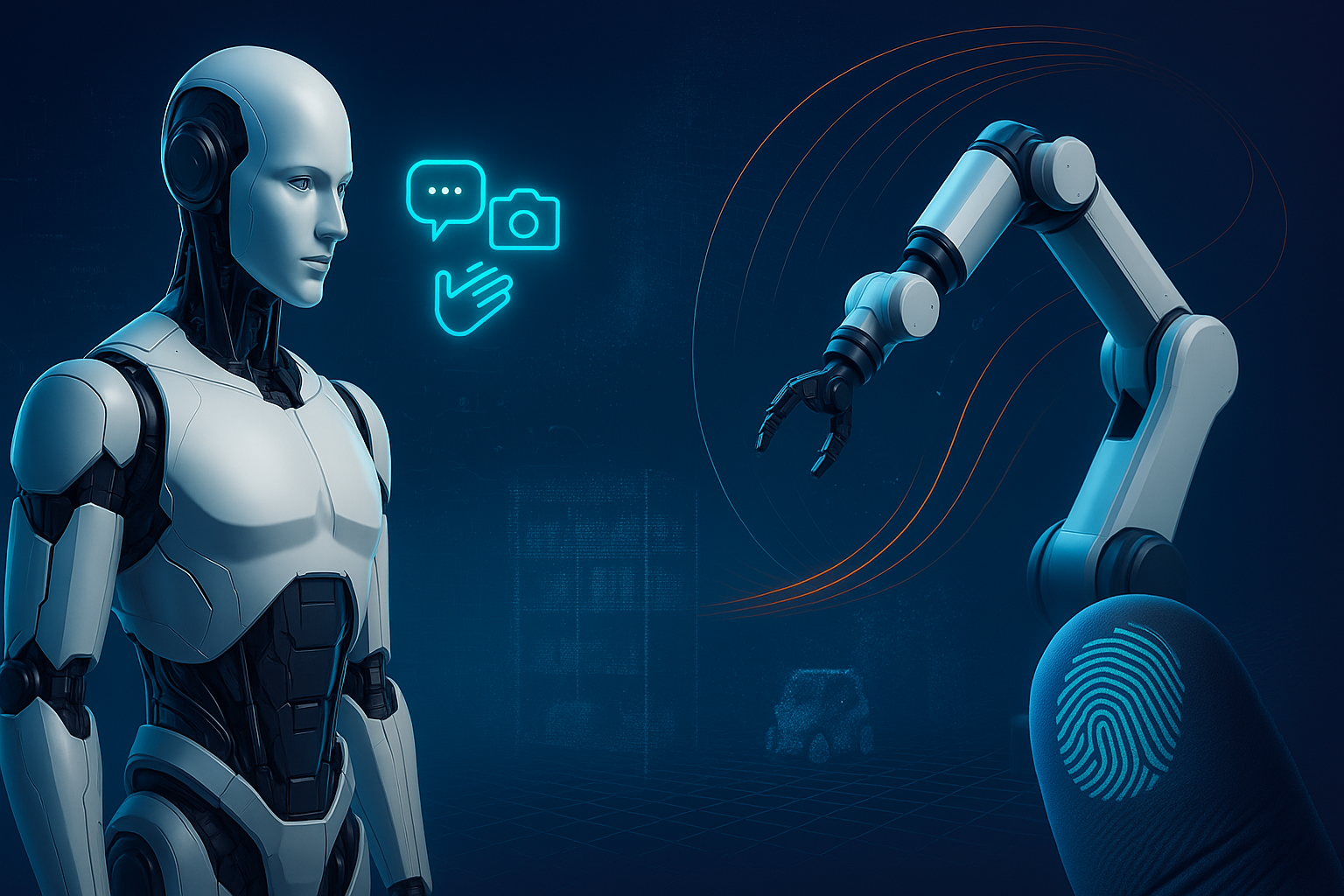
In a truly immersive story, the user shouldn’t have to type on a virtual keyboard. The input layer uses Automatic Speech Recognition (ASR) to transcribe the user’s spoken words into text. Advanced systems also ingest non-verbal cues:
- Gaze Tracking: Where is the user looking? If they are staring at a suspicious object, the AI narrator can comment on it.
- Hand Tracking/Haptics: Is the user acting aggressively or gently?
- Bio-feedback: Some modern headsets measure heart rate or pupil dilation, providing data on the user’s stress levels.
2. The Logic Layer: The AI Game Master
This is the brain of the operation. The text and sensor data are fed into an LLM (like GPT-4, Llama 3, or specialized models). This layer handles:
- Intent Recognition: What is the user trying to do?
- Narrative Management: How should the story react? If the user insults the king, the AI Game Master changes the faction reputation and alters future plot points.
- Safety Rails: Ensuring the generated content remains appropriate and stays within the genre of the story (e.g., preventing a medieval knight from talking about spaceships).
3. The Generation Layer: Real-Time Content Creation
Once the Logic Layer decides what happens, the Generation Layer creates the content to show it.
- Text Generation: The specific dialogue lines for characters.
- Audio Synthesis (TTS): Text-to-Speech engines transform the dialogue into audio with appropriate emotional inflection and accents.
- Visual Generation:
- 2D Textures: Generating unique textures for objects using Stable Diffusion-style models.
- 3D Assets: Creating simple 3D meshes or skyboxes on the fly.
- Animations: Generative motion matching ensures that if a character is “angry,” their body language reflects that without manual keyframing.
4. The Rendering Layer: Spatial Display
Finally, the game engine (Unity, Unreal Engine, Godot) renders these assets into the VR/AR view. This must happen at high frame rates (typically 72fps or 90fps minimum for VR) to maintain comfort.
Dynamic NPCs: The Heart of Immersive Narratives
The most immediate application of generative AI in AR/VR is the evolution of the Non-Player Character (NPC). In traditional storytelling, NPCs are “quest dispensers” with static dialogue trees. In a generative workflow, they become Smart Agents.
Anatomy of a Generative Agent
To create a believable character, developers use an architecture often referred to as the “Perception-Memory-Action” loop.
- Identity Block: A prompt defining the character’s name, backstory, personality traits, and hidden secrets.
- Context Window (Short-term Memory): The character remembers the last few minutes of conversation to maintain coherency.
- Vector Database (Long-term Memory): Important facts (e.g., “The player saved my sister yesterday”) are stored in a database. When the player approaches, the system queries this database to retrieve relevant memories, allowing the relationship to evolve over days or weeks of gameplay.
- Goal-Oriented Action Planning (GOAP): The AI isn’t just chatting; it has goals (e.g., “Protect the castle”). If the player’s conversation helps the goal, the NPC cooperates. If not, they may become hostile.
Example: The Detective Scenario
Imagine a VR murder mystery.
- Traditional: You ask the butler, “Where were you?” He plays a pre-recorded clip: “I was in the kitchen.” You ask, “What were you cooking?” He repeats, “I was in the kitchen.” Immersion breaks.
- Generative: You ask, “What were you cooking?” The AI, knowing the butler is French and it’s 1920, improvises: “A soufflé, monsieur. Tricky business, requires silence. Which is why I heard nothing.” The player feels like they are interrogating a real person.
World-Building: Generating the Environment
While dynamic dialogue is transformative, generative AI also revolutionizes the visual environment of AR/VR. This is often referred to as Runtime Asset Generation.
Generative Skyboxes and Textures
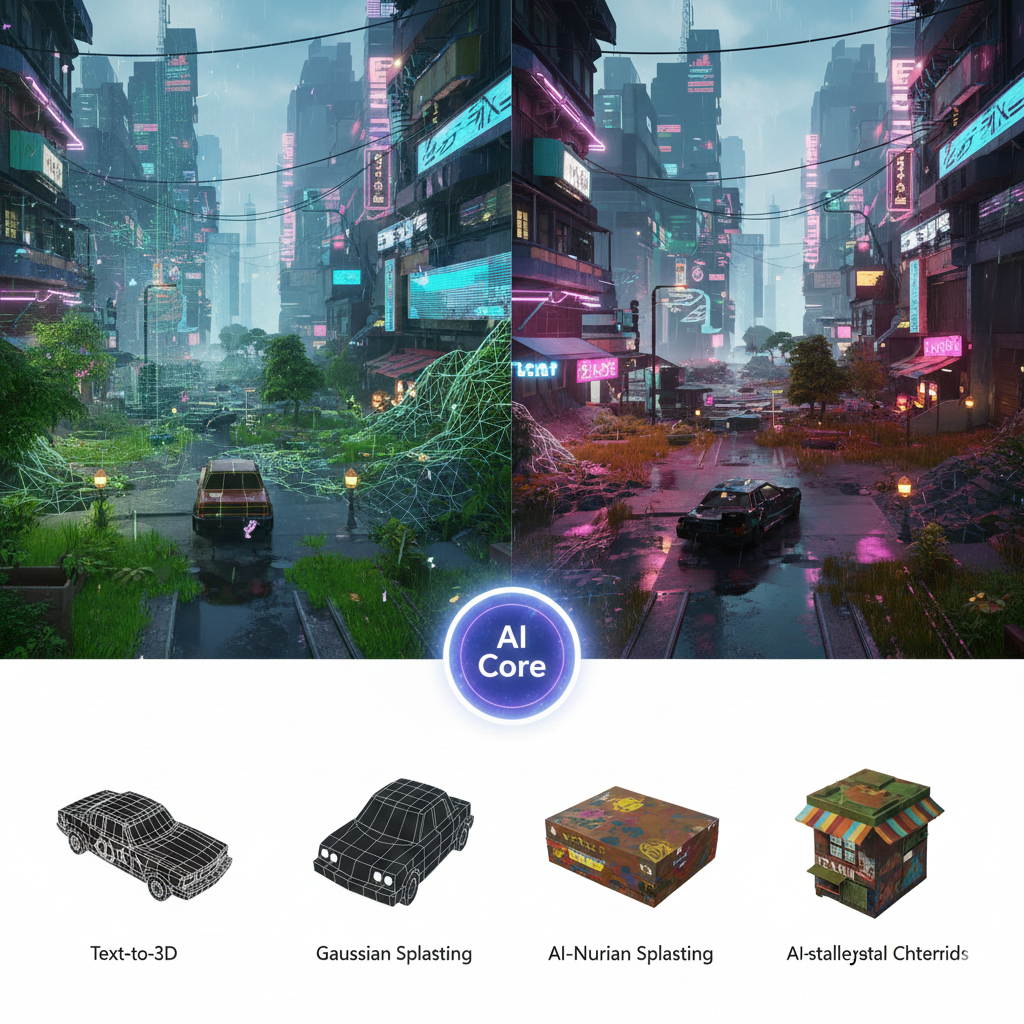
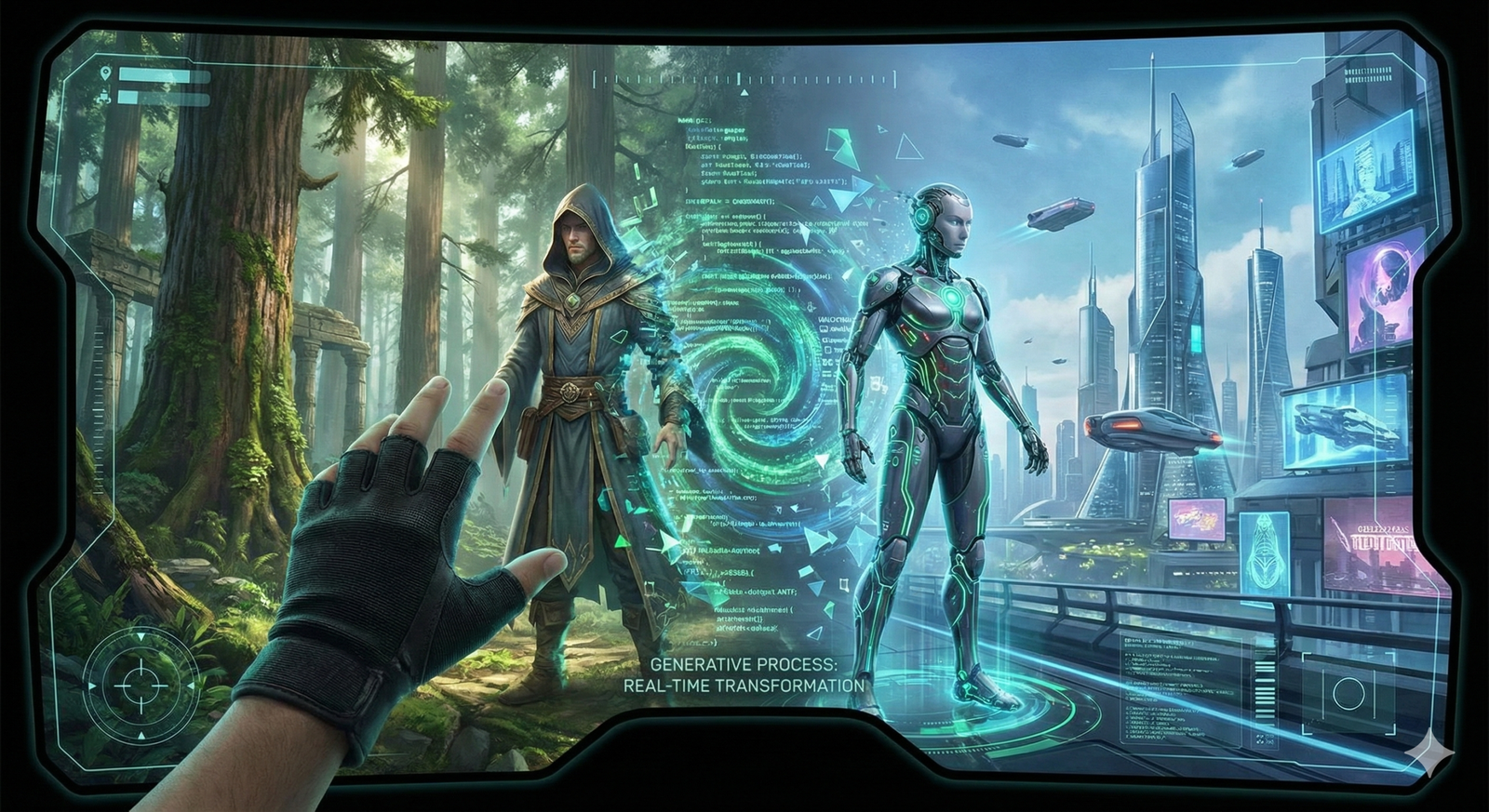
One of the earliest and most successful uses is creating 360-degree panoramic skyboxes. Tools like Blockade Labs allow users to type “cyberpunk city in the rain” and instantly receive a high-resolution spherical image that wraps around the VR environment. This allows for storytelling mechanics where the world shifts instantly—a user steps through a portal, and the AI generates a new alien landscape in real-time.
Text-to-3D and NeRFs
Generating full 3D models in real-time is computationally expensive, but techniques are advancing rapidly.
- Text-to-3D: Models like Shap-E or Point-E can generate simple 3D objects from prompts. In an AR board game, a player might say “summon a fire dragon,” and the system generates a unique dragon miniature instantly.
- NeRFs (Neural Radiance Fields): This technology constructs 3D scenes from 2D images. It allows for photorealistic environments to be captured from the real world and modified by AI, perfect for “digital twin” storytelling in industrial or historical VR apps.
AR-Specific: Room Transformation
In Augmented Reality, the story takes place in the user’s physical room. Generative AI can analyze the room’s mesh (provided by the headset’s LIDAR) and “re-skin” it.
- Scene Understanding: The AI identifies “this is a couch,” “this is a wall.”
- Generative Overlay: The story is a sci-fi thriller. The AI generates a texture that makes the user’s couch look like a cargo crate and the walls look like a spaceship hull, accurately mapping the new textures to the physical geometry.
Practical Use Cases
The combination of these technologies opens doors across various industries beyond just gaming.
1. Education and History
- Interactive History: Students wear VR headsets to visit Ancient Rome. Instead of a scripted tour guide, they meet a generated “Roman Senator” who debates politics with them. The AI ensures historical accuracy while adapting to the student’s age level.
- Language Learning: An AR app spawns virtual characters in the user’s living room who will only converse in the target language, correcting pronunciation and grammar dynamically.
2. Corporate Training and Soft Skills
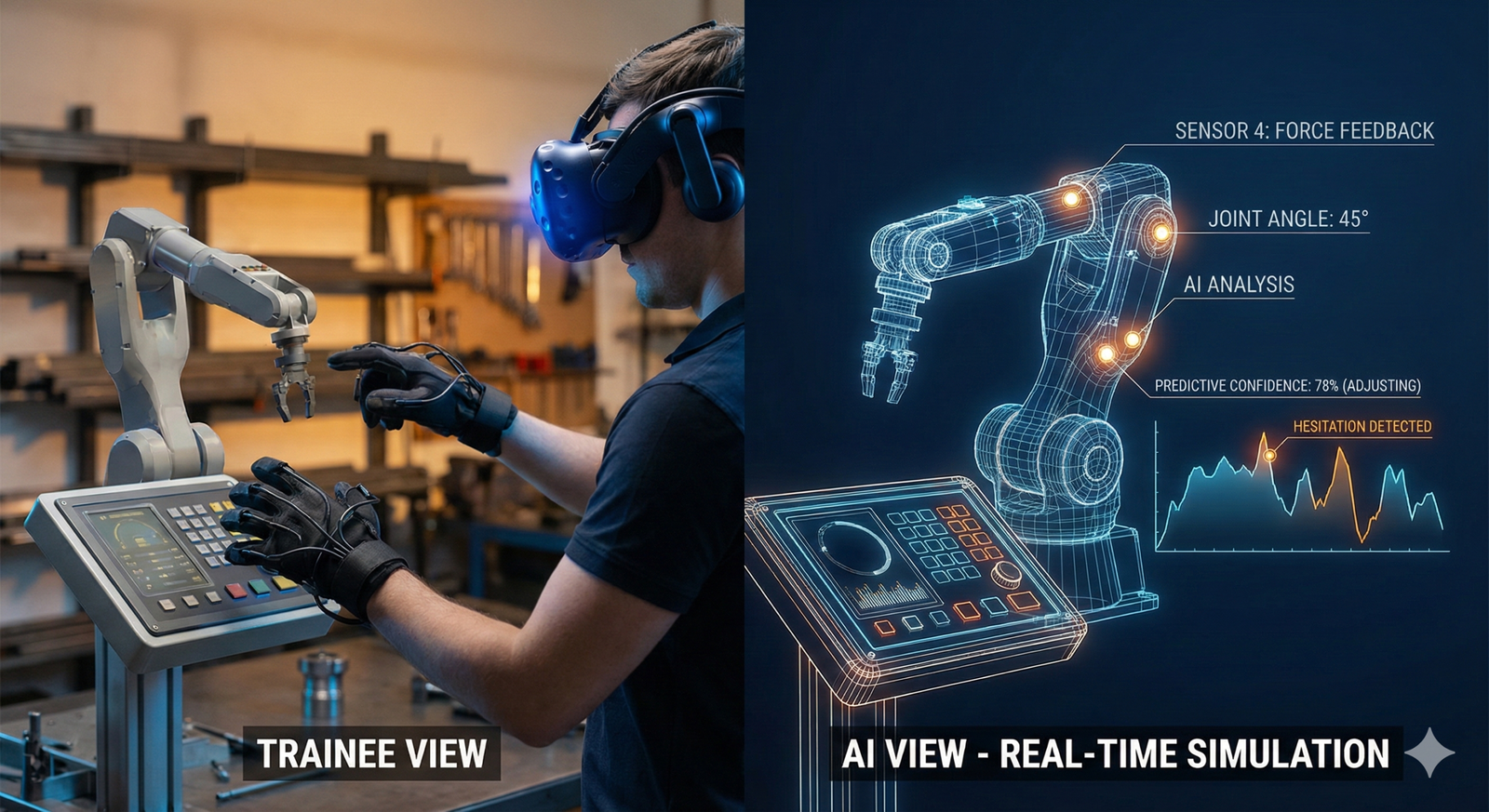
- High-Stakes Simulation: Medical students can practice breaking bad news to patients. The patient (an AI avatar) reacts unpredictably—crying, becoming angry, or going silent—forcing the student to adapt their empathy and communication skills in real-time.
- De-escalation Training: Security personnel can train in VR against AI crowds that react to verbal commands, helping them learn to manage aggressive behavior without violence.
3. Therapy and Mental Health
- Exposure Therapy: For patients with social anxiety, a generative crowd in VR can provide a safe environment to practice social interactions. The therapist can adjust the “friendliness” parameter of the AI crowd in real-time to gradually increase the challenge.
- Personalized Meditation: A VR environment that shifts its visuals and guided audio narration based on the user’s real-time biofeedback (breathing rate), creating a feedback loop of relaxation.
4. Marketing and Retail
- Virtual Showrooms: A car brand uses VR where an AI assistant generates different car configurations and environments (“Show me this SUV on a rainy coast”) instantly, allowing the customer to visualize the product in their desired context.
The Creation Workflow: Tools and Frameworks
For creators looking to build these experiences, a new ecosystem of tools has emerged. This section outlines the current standard workflow as of mid-2025.
Game Engines
- Unity & Unreal Engine: These remain the core platforms. Both have integrated heavy AI support. Unity’s Muse and Sentis allow developers to embed AI models directly into the runtime of the app. Unreal Engine 5’s Procedural Content Generation (PCG) framework couples well with external AI inputs.
AI Middleware
Instead of building LLMs from scratch, developers use middleware APIs that bridge the game engine and the AI model.
- Inworld AI: A leading platform specifically for creating AI NPCs. It handles the personality, memory, and emotional logic, sending the data back to Unity/Unreal to drive animations.
- Convai: Focuses on conversational AI for virtual worlds, offering low-latency voice-to-voice interaction.
- Replica Studios: Specializes in AI voice generation that can be directed (e.g., “say this line with fear”), essential for dramatic storytelling.
Implementation Checklist
- Define the Constraints: AI cannot do everything. Define the “Lore Bible” that restricts what the AI knows.
- Latency Budget: Decide what runs locally (on-device) and what runs in the cloud. Voice recognition should be local for speed; complex reasoning can be cloud-based.
- Fallback Mechanisms: What happens if the internet cuts out? Ensure the experience degrades gracefully to scripted lines rather than freezing.
Challenges and Pitfalls
While the potential is immense, the integration of Generative AI into AR/VR is fraught with technical and design hurdles.
1. The Latency Bottleneck
VR requires extremely low latency (sub-20ms motion-to-photon) to prevent motion sickness. Generative AI, however, is slow. An LLM might take 2-3 seconds to generate a response.
- The “Awkward Pause”: If a player speaks to a VR character and waits 3 seconds for a reply, the immersion is shattered.
- Solution: Developers use “filler animations” (the character thinks, scratches their chin) or “streaming tokens” (the character starts speaking the first part of the sentence before the rest is generated) to mask the delay.
2. Hallucination and Consistency
Generative AI can “hallucinate” facts. In a historical storytelling app, an AI character might confidently claim that Napoleon used an iPhone.
- Solution: Use RAG (Retrieval-Augmented Generation). The AI is forced to check a specific database of facts (the “knowledge base”) before answering, prioritizing that data over its general training data.
3. Compute Power and Battery Life
Standalone VR headsets (like the Meta Quest or Apple Vision Pro) have limited battery and thermal headroom. Running heavy AI models locally drains the battery quickly and generates heat.
- Solution: Hybrid Compute. Light AI tasks run on the headset’s NPU (Neural Processing Unit), while heavy lifting is offloaded to the cloud or a paired PC.
4. Narrative Arc Control
If a story is fully generative, it can meander. Players might convince the villain to give up, bypassing the climactic battle the developer designed.
- Solution: The “AI Director” System. A meta-layer of AI monitors the plot state. If the player deviates too far, the Director prompts the NPCs to steer the conversation back to the main quest, acting as invisible guardrails.
Ethical Considerations in Immersive AI
When storytelling becomes immersive and personalized, ethical stakes rise.
Emotional Manipulation
An AI in VR feels physically present. If an AI character is programmed to be manipulative or emotionally abusive to drive a plot, it can have a genuine psychological impact on the user, far more than reading text on a screen. Developers must implement strict safety guidelines and “opt-out” triggers for intense emotional content.
Data Privacy
To work well, these systems need voice data, eye-tracking data, and behavioral data. This creates a highly detailed profile of the user. “Privacy-preserving AI” and local processing (Edge AI) are critical to ensure user data does not leave the device or is anonymized before cloud processing.
Copyright and Ownership
Who owns the story? If a user interacts with an AI to create a unique narrative branch, does the user own that story, or does the developer? As generative content floods these platforms, clear terms of service regarding user-generated content (UGC) are essential.
Future Outlook: The Era of the Holodeck?
We are moving toward the “Holodeck” ideal popularized in science fiction—a room where any story can be conjured instantly.
Short-term Future (1-3 Years)
We will see widespread adoption of “Hybrid Narratives.” Stories will have a fixed beginning and end, but the middle will be fluid. NPCs will remember user interactions across different gaming sessions. AR glasses will offer “world commentary” layers where AI describes reality in the persona of a fictional character.
Long-term Future (5-10 Years)
As hardware accelerates, we may see “Dream Engines”: systems that generate entire VR games from a single paragraph prompt in real-time. A user could say, “I want to play a noir detective mystery set on Mars,” and the AI generates the geometry, the textures, the characters, the voice acting, and the plot logic instantly.
In this future, the role of the human creator shifts from “builder” to “curator” and “prompt engineer,” defining the constraints and style of the dream rather than placing every brick.
Conclusion
Combining generative AI with AR and VR is not merely a technological upgrade; it is a fundamental reimagining of the relationship between the story and the audience. It transforms the user from a passive observer into an active co-creator of the narrative. While challenges in latency, consistency, and ethics remain, the trajectory is clear: the future of storytelling is spatial, generative, and infinitely personal.
For developers and creators, the time to experiment is now. The tools are accessible, and the rules of this new medium are yet to be written. Start small—integrate a dynamic conversation into a static scene, or generate textures for an AR overlay—and build toward the immersive future.
FAQs
1. What is the difference between scripted and generative storytelling in VR? Scripted storytelling relies on pre-written dialogue and fixed plot points designed by a writer. Generative storytelling uses AI to create dialogue, plot twists, and assets in real-time based on the player’s unique actions, offering a different experience for every user.
2. Can standalone VR headsets run generative AI models? Most current standalone headsets have limited processing power and cannot run large models (like GPT-4) locally. They typically rely on cloud streaming or use smaller, optimized “Edge AI” models (SLMs) that sacrifice some intelligence for speed and privacy.
3. How do developers prevent AI characters from saying inappropriate things? Developers use “guardrails” or content moderation layers. Before the AI’s response is generated or spoken, it passes through a safety filter that checks for toxicity, hate speech, or out-of-character topics, blocking or rewriting the response if necessary.
4. What is Retrieval-Augmented Generation (RAG) in the context of games? RAG is a technique where the AI looks up specific information from a game’s “lore database” before answering a player. This ensures the AI knows the specific history, rules, and secrets of the game world, preventing it from making up false facts (hallucinations).
5. Will generative AI replace human game writers and artists? Unlikely. The role will shift. Instead of writing every line of dialogue, writers will write character “bios” and lore that guide the AI. Artists will define the visual style that the AI mimics. Human creativity is still needed to provide the soul, structure, and intent of the experience.
6. Is generative AI in AR/VR expensive to implement? It can be. Using cloud-based LLM APIs (like OpenAI’s) costs money per interaction (token). For a game with thousands of users chatting constantly, costs can scale quickly. Developers often use hybrid models or subscription tiers to manage these expenses.
7. How does latency affect AI storytelling in VR? High latency (delays) can break immersion and cause frustration. If a character takes too long to reply, it feels unnatural. Developers prioritize low-latency APIs and use tricks like having the character nod or make a sound immediately while the text is being generated.
8. What are Neural Radiance Fields (NeRFs)? NeRF is a technology that uses AI to reconstruct realistic 3D scenes from 2D photos. In VR storytelling, this allows creators to capture real-world locations (like a museum or a forest) and import them into the virtual world with photorealistic lighting and depth.
9. Can AI generate background music for VR experiences? Yes, generative audio tools can create dynamic soundscapes and music that adapt to the game’s tension. If the player enters a combat scenario, the AI can seamlessly shift the tempo and intensity of the music in real-time.
10. What is “asset hallucinations” in generative design? This refers to visual glitches where the AI generates objects that look wrong or defy physics—like a chair floating in mid-air or a hand with six fingers. As models improve, these errors are becoming less frequent, but human oversight is still often required.
References
- Unity. (2023). Unity Muse: Accelerating 3D creation with AI. Unity Technologies. https://unity.com/products/muse
- NVIDIA. (2024). NVIDIA ACE for Games: Bringing Intelligence to NPCs. NVIDIA Corporation. https://developer.nvidia.com/ace
- Inworld AI. (2024). The Future of NPCs: Documentation and Case Studies. Inworld. https://inworld.ai
- Meta. (2023). Introducing Llama 2: The Next Generation of Our Open Source Large Language Model. Meta AI.
- Epic Games. (2023). Procedural Content Generation Framework in Unreal Engine 5. Unreal Engine Documentation. https://docs.unrealengine.com
- Blockade Labs. (2024). Skybox AI: 360° World Generation. Blockade Labs. https://www.blockadelabs.com
- Stanford University. (2023). Generative Agents: Interactive Simulacra of Human Behavior. arXiv preprint. https://arxiv.org/abs/2304.03442
- Bailenson, J. (2018). Experience on Demand: What Virtual Reality Is, How It Works, and What It Can Do. W. W. Norton & Company.
- Seymour, M., et al. (2021). The Ethics of Digital Humans in Virtual Realms. Journal of Business Ethics. https://link.springer.com/article/10.1007/s10551-021-04987-9
- Mildenhall, B., et al. (2020). NeRF: Representing Scenes as Neural Radiance Fields for View Synthesis. ECCV 2020. https://www.matthewtancik.com/nerf