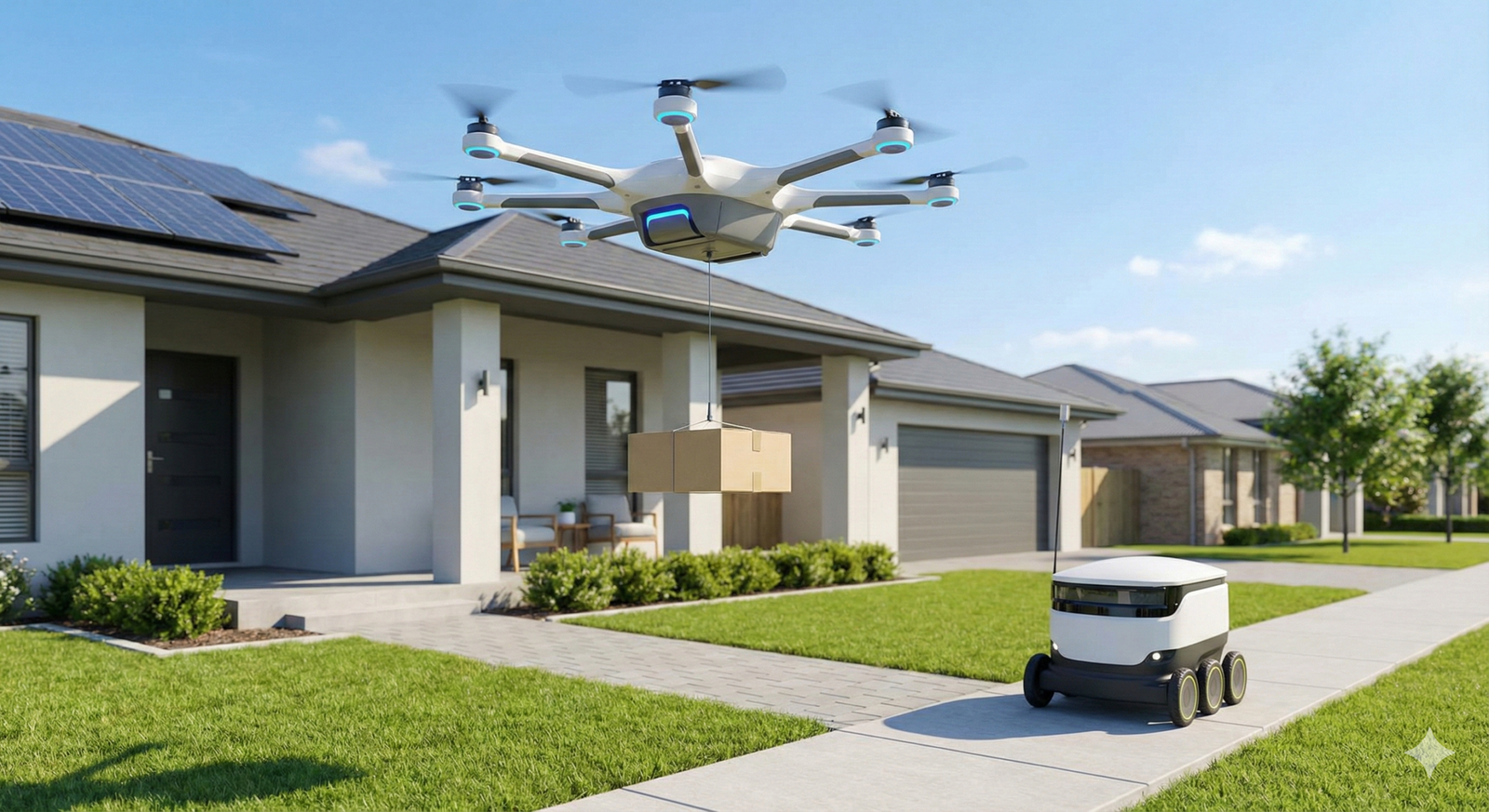
The sight of a six-wheeled cooler rolling autonomously down the street is no longer a scene from a science fiction novel; in many cities and university campuses, it is a mundane Tuesday. Autonomous delivery robots on sidewalks, technically known as Personal Delivery Devices (PDDs), represent a seismic shift in how goods move through the final, most expensive leg of the supply chain: the last mile.
As e-commerce demand continues to skyrocket and consumers increasingly expect same-day or even same-hour delivery, traditional logistics networks are straining under the pressure. Vans and trucks are often too large, inefficient, and polluting for short-distance deliveries of small items like a single burrito or a prescription refill. Enter the sidewalk robot: an electric, compact, and increasingly intelligent solution designed to share pedestrian spaces rather than dominate roadways.
However, the integration of autonomous machines into spaces designed for humans is not without friction. It raises profound questions about urban planning, accessibility for people with disabilities, data privacy, and the legal frameworks that govern our public rights-of-way.
In this guide, “autonomous delivery robots” refers specifically to ground-based Personal Delivery Devices (PDDs) that operate primarily on sidewalks, crosswalks, and pedestrian paths, excluding aerial drones or road-based autonomous trucking.
Key Takeaways
- Cost Efficiency: Sidewalk robots can potentially reduce last-mile delivery costs from dollars to cents per shipment by removing the human driver from the loop.
- Sensor Fusion: These devices rely on a complex stack of LiDAR, cameras, and ultrasonic sensors to map environments in real-time and avoid obstacles.
- Regulatory Patchwork: Laws governing PDDs vary significantly by state and municipality, particularly regarding speed limits, weight, and permitted operational zones.
- Accessibility is Critical: The success of PDDs depends on their ability to coexist safely with vulnerable pedestrians, including wheelchair users and the visually impaired.
- Human-in-the-Loop: While “autonomous,” most current systems still rely on remote human supervisors to intervene in difficult scenarios (edge cases).
Who This Guide Is For (And Who It Isn’t)
This guide is designed for:
- Logistics and Operations Managers exploring automation for local delivery fleets.
- Urban Planners and Municipal Officials needing to understand the impact of PDDs on public infrastructure.
- Tech Enthusiasts and Investors looking for a deep dive into the technology and market viability of PDDs.
- Small Business Owners considering adopting robot delivery services for food or retail.
This guide is not for:
- Readers looking for technical engineering manuals on building a robot from scratch (though we cover the tech stack).
- Those seeking information on long-haul autonomous semi-trucks or aerial drone delivery regulations.
What Are Autonomous Delivery Robots (PDDs)?
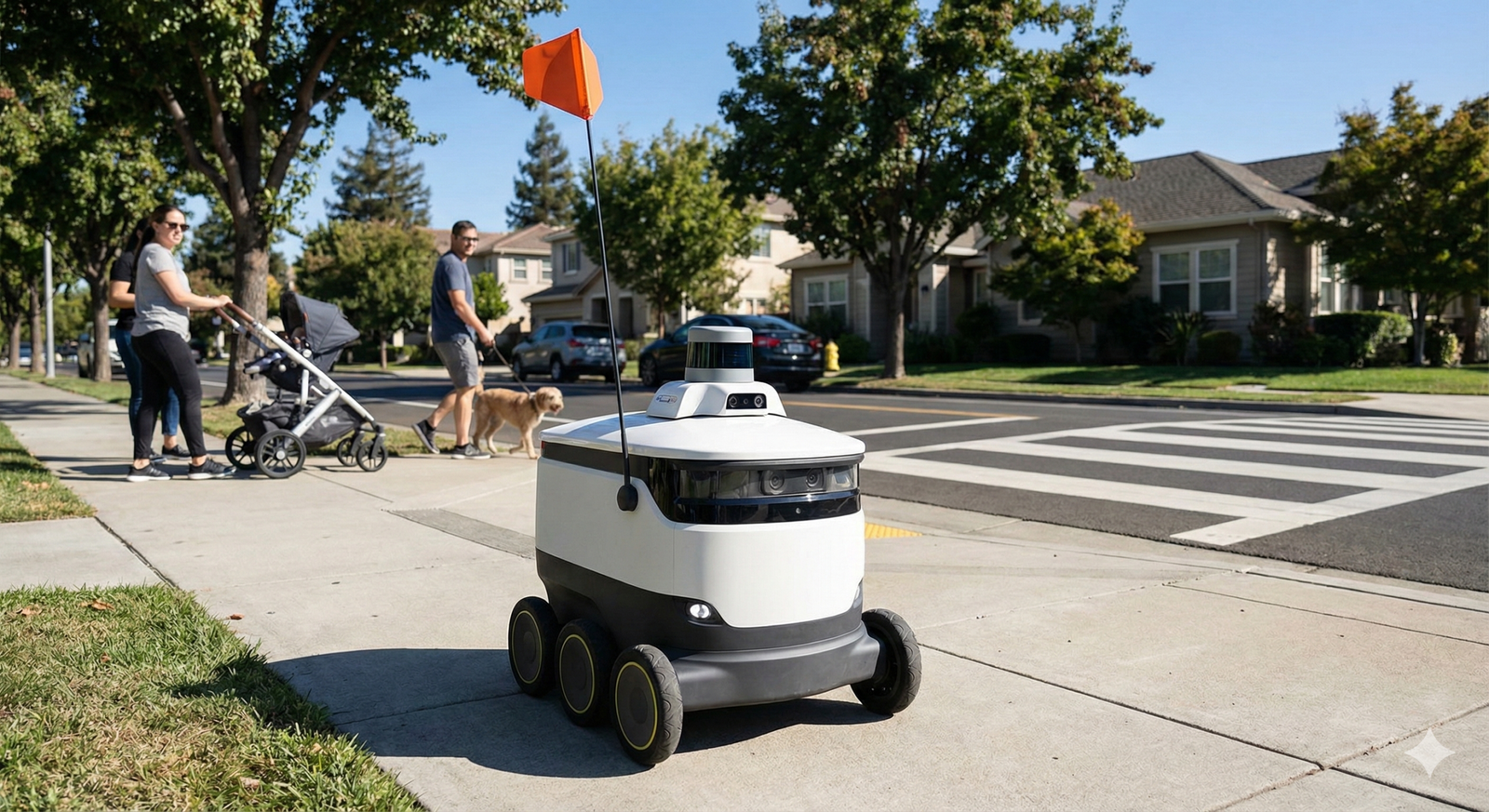
Personal Delivery Devices (PDDs) are ground-based automated vehicles designed to transport cargo over short distances. Unlike autonomous cars, which must navigate high-speed vehicular traffic, PDDs operate at pedestrian speeds—typically between 3 to 6 miles per hour—making them inherently less kinetic and safer in the event of a collision.
Physical Characteristics
Most sidewalk robots share a similar form factor, dictated by the constraints of the sidewalk environment:
- Size: They are usually about the size of a large suitcase or a cooler.
- Weight: Unloaded, they typically weigh between 30 to 100 pounds. Fully loaded, regulation usually caps them at around 500 pounds, though most operate far below this limit.
- Wheels: Six-wheel configurations are common for stability and the ability to mount curbs, though four-wheel variants exist.
- Cargo Capacity: They are designed to hold 2–3 grocery bags or a few takeout orders.
- Signaling: Most are equipped with tall flags for visibility (so they aren’t tripped over), lights for night operation, and sometimes screens or speakers to interact with pedestrians.
Levels of Autonomy
While marketed as “autonomous,” the reality is often a hybrid model.
- High Autonomy: The robot handles 95–99% of the driving, making decisions about pathing, speed, and obstacle avoidance locally.
- Teleoperation (Human-in-the-Loop): When a robot encounters a situation it doesn’t understand (e.g., a construction site with confusing signage, aggressive behavior, or getting stuck in a snowbank), it “calls home.” A remote human operator, who might be managing a fleet of 20+ robots, takes over via a video feed to navigate the tricky section before handing control back to the AI.
The Technology Stack: How Sidewalk Robots See
Navigating a sidewalk is, in some ways, more complex than navigating a highway. Highways have lanes, rules, and predictable flow. Sidewalks are chaotic ecosystems filled with dogs on leashes, children playing, discarded scooters, outdoor dining furniture, and uneven pavement. To handle this, PDDs utilize sophisticated sensor fusion.
Computer Vision for Robots
Cameras are the primary “eyes” of the robot. Multiple high-resolution cameras provide a 360-degree view of the surroundings.
- Object Detection: Using deep learning models (Convolutional Neural Networks), the robot identifies objects: “That is a human,” “That is a fire hydrant,” “That is a moving car.”
- Semantic Segmentation: The AI classifies every pixel in the camera feed to understand the drivable surface vs. grass vs. road.
LiDAR Navigation and Depth Sensing
While cameras provide color and context, they struggle with depth perception, especially in low light. LiDAR (Light Detection and Ranging) spins lasers to create a precise 3D point cloud of the environment.
- Mapping: The robot compares what it “sees” with LiDAR to a pre-built high-definition map (HD Map) of the neighborhood to localize itself within centimeters.
- Obstacle Avoidance: If a person steps in front of the robot, the LiDAR detects the sudden change in distance immediately, triggering the braking system.
V2X (Vehicle-to-Everything) Communication
Advanced PDDs are beginning to integrate with smart city infrastructure. This allows a robot to “talk” to a traffic light (V2I – Vehicle to Infrastructure) to know when the walk signal is active, rather than relying solely on its cameras to see the light change.
The Economic Case: Solving the Last-Mile Problem
The “last mile” refers to the final step of the delivery process—from a distribution hub or a local store to the customer’s doorstep. Despite being the shortest distance, it often accounts for 53% of the total shipping cost.
The High Cost of Human Delivery
In traditional models, a human driver in a 3,000-pound gas-powered vehicle delivers a 2-pound burrito. This is inefficient for several reasons:
- Labor Costs: Drivers must be paid hourly wages or per-delivery fees.
- Vehicle Costs: Fuel, insurance, and maintenance for a car are high.
- Parking: Drivers lose significant time finding parking in dense urban areas.
The Robot Economics
Robots flip this equation.
- Energy Efficiency: PDDs are electric and lightweight, costing pennies in electricity to run all day.
- Labor Multiplier: One remote supervisor can monitor 10–50 robots simultaneously. You are no longer paying one salary per vehicle.
- Predictability: Robots don’t need to park; they pull up to the curb or driveway.
Estimates suggest that while human delivery might cost $6–$10 per drop, mature robot delivery networks could eventually drive this down to $1–$2 per drop, making on-demand delivery economically viable for low-value items.
The Sidewalk Conflict: Accessibility and Safety
The most contentious aspect of deploying autonomous delivery robots on sidewalks is the potential conflict with other sidewalk users. Sidewalks are a public utility, primarily designed for pedestrians.
Accessibility Concerns for the Disabled
Disability rights advocates have raised valid and serious concerns regarding PDDs.
- Wheelchair Users: A robot stalled in the middle of a narrow sidewalk can effectively block a wheelchair user, forcing them to turn around or risk moving into the street.
- Visually Impaired Pedestrians: People who rely on canes or guide dogs navigate by predicting the environment. Silent, moving robots introduce unpredictable obstacles. A cane might miss the low-profile body of a robot, leading to a trip hazard.
- The “Clutter” Problem: In cities already plagued by electric scooters left haphazardly, adding delivery robots increases the “street clutter,” reducing the usable width of the path.
How Companies Are Responding
To address these issues, ethical deployment requires:
- Auditory Signals: Robots now emit hums or polite verbal cues (“Passing on your left”) to alert blind pedestrians.
- Conservative Pathing: Algorithms are tuned to yield aggressively. If a human is detected, the robot stops or moves to the very edge of the path.
- Remote Override: If a robot detects it is blocking a path (e.g., via proximity sensors), it alerts a human operator to move it immediately.
Regulatory Frameworks for PDDs
As of early 2026, the regulatory landscape for sidewalk robots is a patchwork of state laws and municipal ordinances. There is no single federal standard in the US, though bodies like the NHTSA are monitoring the space.
Classification and Rights
Most jurisdictions classify PDDs as pedestrians rather than vehicles. This legal distinction is crucial:
- Right of Way: Like pedestrians, they usually have the right of way over cars at crosswalks, but they must yield to actual human pedestrians on sidewalks.
- Operational Zones: They are permitted on sidewalks and crosswalks but generally banned from traffic lanes unless the sidewalk is impassable.
Speed and Weight Limits
To ensure safety, regulations typically impose strict caps:
- Speed: Most states cap sidewalk speeds at 4 to 6 mph (walking speed). On shoulders or bike lanes, some jurisdictions allow up to 10–12 mph.
- Weight: Limits usually range from 80 lbs to 550 lbs (loaded), depending on the density of the operational area.
Insurance and Liability
Operators are generally required to carry significant liability insurance (often $100,000 to $1 million policies) to cover potential damages to property or injuries to pedestrians.
Operational Challenges: Weather and Infrastructure
While the AI is smart, the physical world is unforgiving.
Battery Life and Range
Most current PDDs have a battery range of 8–12 hours. However, range anxiety applies here too.
- The Constraint: This limits the delivery radius to roughly 2–4 miles from the merchant or the “hive” (charging hub).
- Swapping: Some models utilize battery-swapping stations to minimize downtime, allowing robots to run 24/7.
Navigating Bad Weather
- Snow: Heavy snow is the enemy of LiDAR and cameras. It obscures landmarks and creates physical barriers the robot’s wheels cannot traverse. Most fleets are grounded during snowstorms.
- Rain: Rain droplets on camera lenses can distort computer vision. Advanced robots use heated lenses or wipers, but heavy downpours remain a challenge for sensor reliability.
Anti-Theft Mechanisms
“Will people steal the robots?” is a common question.
- Lid Locks: The cargo area is mechanically locked and can only be opened by the recipient via a smartphone app.
- Cameras: The robots are covered in cameras recording 360 degrees. Vandalizing one is essentially vandalizing a CCTV camera.
- GPS Tracking: They are constantly tracked. Stealing one is difficult because it effectively screams its location to the authorities.
- Alarms: If the robot detects it is being picked up or tampered with, it triggers a loud siren.
Comparison: Sidewalk Robots vs. Other Modalities
To understand where PDDs fit, we must compare them to the alternatives.
| Feature | Sidewalk Robots (PDDs) | Aerial Drones | Autonomous Vans |
| Payload | Medium (20–50 lbs) | Low (5 lbs) | High (1000+ lbs) |
| Range | Short (2–4 miles) | Medium (5–10 miles) | Long (City-wide) |
| Speed | Slow (Walking speed) | Fast (40+ mph) | Traffic speed |
| Regulatory Friction | Medium (Sidewalk clutter) | High (Airspace control) | High (Road safety) |
| Ideal Use Case | Urban/Campus food & grocery | Rural/Suburban urgent meds | Bulk B2B or large grocery |
| Noise | Very Low | High (Buzzing) | Medium |
Common Mistakes and Pitfalls in Deployment
For municipalities or businesses looking to deploy PDDs, several common mistakes can derail a program:
- Ignoring Public Sentiment: Launching without community engagement often leads to backlash. Residents may view robots as “invaders” of their public space. Education campaigns are vital.
- Underestimating Infrastructure Quality: Robots need curb cuts (ramps). If a neighborhood lacks ADA-compliant curb cuts, the robot cannot cross the street. Mapping these physical barriers is a prerequisite.
- Over-reliance on Autonomy: Assuming the robot can handle 100% of cases leads to stranded assets. Robust teleoperation support is non-negotiable for the first few years of operation.
- Neglecting Vandalism Protocols: While rare, vandalism happens. Operators need clear protocols for retrieving damaged units quickly to avoid them becoming litter.
The Future: Urban Planning and Specialized Infrastructure
As adoption grows, urban planning will evolve to accommodate this new traffic flow.
Dedicated Robot Lanes?
Just as bike lanes were carved out of roadways, we may see “slow lanes” on wide sidewalks or dedicated verges for PDDs. This would separate robots from pedestrians, solving the accessibility conflict.
The “Mothership” Concept
We are seeing the emergence of mixed-modal delivery. An autonomous van (the mothership) drives to a neighborhood and deploys a swarm of sidewalk robots to do the final 500 feet of delivery. This combines the range of a van with the precision of a PDD.
Indoor Integration
The next frontier is vertical. Robots that can not only drive down the sidewalk but also interface with elevators and automatic doors to deliver directly to an apartment door are currently in development.
Related Topics to Explore
- LiDAR vs. Radar Technology: A deeper look into the sensors that power autonomy.
- Smart City IoT Infrastructure: How traffic lights and street sensors communicate with autonomous agents.
- The Ethics of AI Automation: The impact of automation on gig economy jobs and driver employment.
- Accessibility in Urban Design: How designing for robots might actually force cities to improve infrastructure for wheelchair users (the “Curb Cut Effect”).
- Battery Technology Innovations: Solid-state batteries and their impact on robot range.
Conclusion
Autonomous delivery robots on sidewalks are more than just a technological novelty; they are a pragmatic response to the logistical and environmental costs of modern e-commerce. By shifting small, short-distance deliveries from gas-guzzling vans to electric, pedestrian-speed devices, we can reduce traffic congestion and carbon emissions.
However, the “sidewalk” is a sacred civic space. The successful integration of PDDs requires a social contract between technology companies and the public. It demands strict adherence to accessibility standards, transparent safety protocols, and a regulatory framework that prioritizes human safety over delivery speed. As of 2026, the technology is mature, but the social integration is just beginning. The future of delivery is here, and it is rolling slowly past your front door.
FAQs
Q: Are autonomous delivery robots safe for pedestrians? A: Generally, yes. They operate at low speeds (walking pace) and are equipped with redundant sensors (LiDAR, cameras) specifically designed to detect and yield to pedestrians. However, accidents can happen, which is why liability insurance and remote monitoring are required.
Q: Can a delivery robot climb stairs? A: Most standard wheeled PDDs cannot climb stairs. They rely on curb cuts and ramps. Some specialized quadruped (legged) robots can climb stairs, but these are less common in commercial delivery due to higher costs and complexity.
Q: What happens if someone steals the robot? A: It is very difficult to successfully steal a delivery robot. They are heavy, equipped with GPS tracking, have multiple cameras recording the thief, and often sound loud alarms when tampered with. The cargo bin is also locked securely.
Q: Do delivery robots work in the snow? A: Current generation robots struggle in deep snow as it can trap the wheels and obscure the sensors used for navigation. Most operators suspend service during heavy snowfall, though winter-optimized tires and sensors are being developed.
Q: How do robots cross the street? A: Robots use computer vision to detect crosswalks and traffic lights. They wait for a clear signal or a gap in traffic. Many advanced models communicate directly with smart traffic signals (V2I) to know exactly when the light is red or green.
Q: Are delivery robots replacing human jobs? A: They are shifting the nature of jobs. While they replace the need for a driver for that specific short trip, they create jobs for fleet managers, remote supervisors, maintenance technicians, and logistics coordinators. They primarily target “gig economy” tasks that are often inefficient for human drivers.
Q: How much weight can a sidewalk robot carry? A: Typical commercial sidewalk robots can carry between 20 to 100 pounds of cargo, roughly equivalent to 2–3 full grocery bags or a crate of beverages.
Q: Do I need an app to open the robot? A: Yes. When the robot arrives at your location, you typically use the delivery service’s mobile app to unlock the cargo lid via Bluetooth or a secure signal to retrieve your items.
References
- National Highway Traffic Safety Administration (NHTSA). “Automated Vehicles for Safety.” United States Department of Transportation. https://www.nhtsa.gov/technology-innovation/automated-vehicles-safety
- Starship Technologies. “Zero Emission Delivery: 2025 Impact Report.” Starship Publications.
- Serve Robotics. “Safety and Autonomy: How We Navigate the Sidewalk.” Official Documentation.
- Urbanism Next Center at the University of Oregon. “New Mobility: Perfecting Policy for Personal Delivery Devices.” Academic Research Paper.
- American Association of State Highway and Transportation Officials (AASHTO). “Connected and Automated Vehicles: Policy Principles.” https://www.transportation.org
- City of Los Angeles Department of Transportation (LADOT). “Personal Delivery Device Pilot Program Rules & Guidelines.” Official Government Document.
- Institute of Electrical and Electronics Engineers (IEEE). “Sensor Fusion for Autonomous Vehicles: A Review.” IEEE Xplore. https://ieeexplore.ieee.org
- International Transport Forum (ITF). “Regulating App-Based Mobility Services.” OECD Publishing. https://www.itf-oecd.org/regulating-app-based-mobility-services