| Deployment Format | Typical Monthly Cost | Payback Range |
|---|---|---|
| Quick-service fry station robot (RaaS) | ~$2,000/month subscription | Under 2.5 to 3 years at $18-22/hr labor rates |
| Enterprise cooking robot pilot | Varies by hardware tier | 24-36 months |
| Table-service / food-running robot | $999-$2,000/month lease | 18-24 months |
| Cooking robot base tier (RaaS) | From $3,000/month | Depends on utilization and labor offset |
Why Unit Economics, Not Novelty, Now Drives Kitchen Robotics
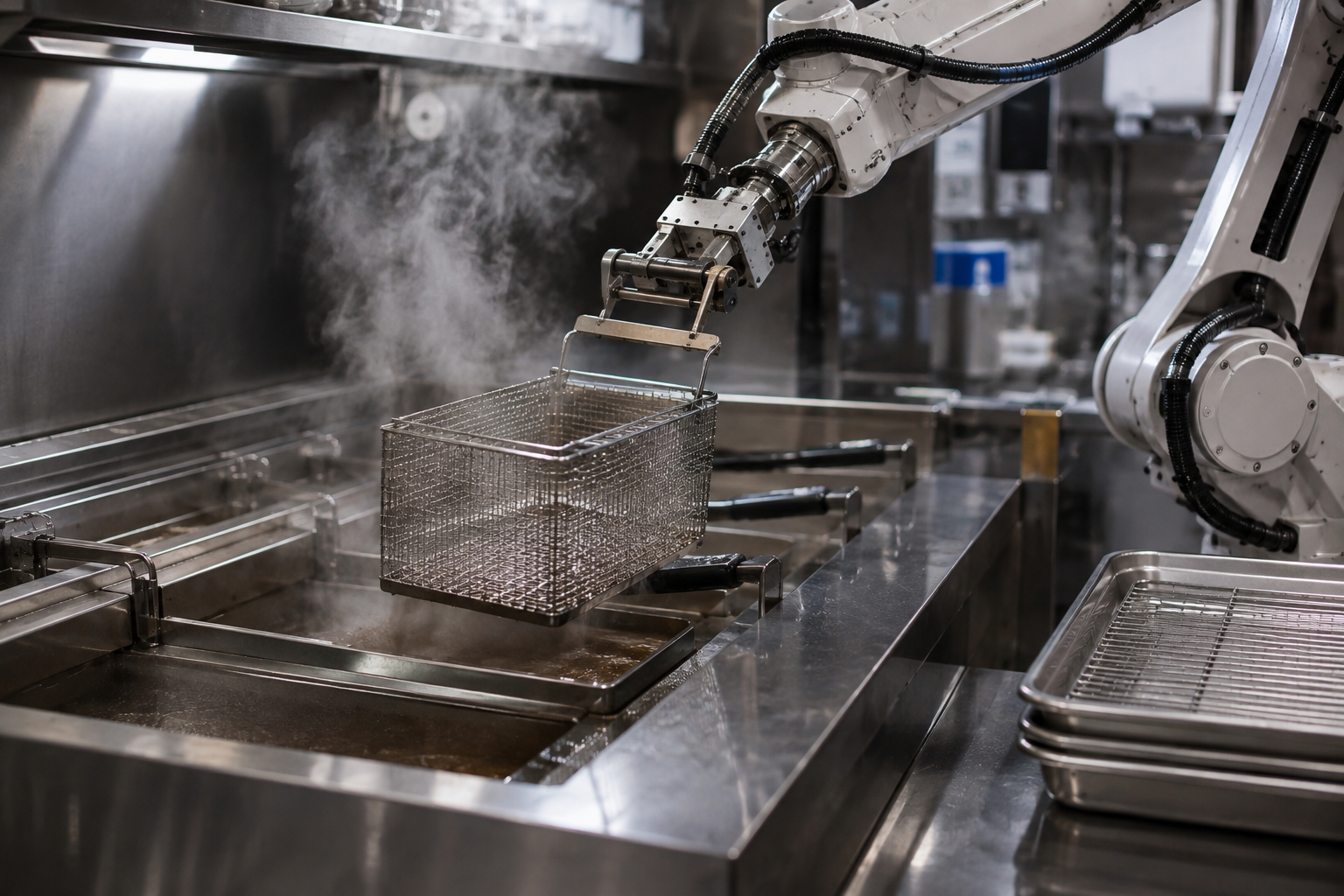
Kitchen robotics coverage tends to focus on the spectacle — a robotic arm flipping a burger, a fry basket lowering itself with nobody standing there. What actually decides whether a restaurant group signs a multi-year robotics contract is much less visual: capital expenditure, throughput measured in meals per hour, labor savings measured in dollars per shift, and a payback period that has to beat whatever else that capital could do for the business. Our broader survey of the food robotics category, linked near the end of this piece, covers the full landscape from prep stations to delivery robots. This article narrows in specifically on the numbers behind automated cooking: what it costs, what it saves, and how fast it pays for itself.
In 2026, that unit-economics case has firmed up considerably. Multi-hundred-million-dollar deployment activity is now underway in the US, and the conversation among operators has shifted from “is this real” to “does the payback math work for my format.”
Capex and Financing Models
Automated cooking hardware is sold through two very different financing structures, and the choice between them changes the unit economics substantially.
- Outright purchase. Table-service and food-running robots typically run $15,000 to $25,000 per unit purchased outright — a large upfront capital commitment that only makes sense for operators confident in long-term utilization.
- Robot-as-a-Service (RaaS) subscription. Cooking robots increasingly ship on a subscription model starting around $3,000 per month, with fry-station-specific units available around $2,000 per month. This converts a capital expenditure into an operating expense, which matters enormously for franchise operators and ghost kitchens that need to model per-location cash flow rather than a balance-sheet asset.
A three-tier pricing structure — premium, standard, and economy — has emerged across the market, separating enterprise cloud-kitchen fleet deals from mid-scale restaurant group contracts and independent single-location operators. The tier an operator lands in shapes both the sticker price and the support and update commitments that come with it.
| Format | Reported Throughput | Comparable Manual Throughput |
|---|---|---|
| Automated fry station | ~100 baskets per hour | Roughly half that on a manual line |
| Automated chip fryer (tortilla chips) | Continuous batch frying and seasoning | Labor-intensive manual batching |
| Food-running / table-service robot | Handles 40-60% of a server’s food-running tasks | 100% manual food-running per server |
Cost Per Meal: Where the Math Actually Lands
Cost per hour is the clearest lens available from current public data. A fry-station robot leased at roughly $2,000 per month works out to about $3 per hour if run continuously, but real-world utilization is rarely continuous. A restaurant running the robot 12 hours a day pays closer to $14.51 per hour of active use, while a location running it a full 24 hours a day brings the effective cost down to about $7.25 per hour — meaning utilization rate, not the subscription price itself, is the single biggest lever operators have over their real cost per meal.
Independent validation of one enterprise fry-station deployment found over $75,000 in annual new profit per location, driven by a combination of labor savings, faster service, and reduced food waste — the three levers that combine into the unit-economics case for automated cooking, rather than labor savings alone.
The Utilization Lever
A subscription-priced cooking robot’s effective hourly cost is almost entirely a function of how many hours a day it actually runs. The same $2,000-per-month unit costs roughly $14.51 an hour at 12 hours of daily use but drops to about $7.25 an hour at 24-hour use — the fixed subscription fee spread across double the operating hours. Ghost kitchens and multi-daypart quick-service locations that can keep a unit running longer capture dramatically better unit economics than single-shift operations from identical hardware.
Payback Period Across Formats
Quick-Service and Fast-Casual
Target payback for enterprise pilots typically runs 24 to 36 months, depending on utilization rate and how much of the labor line the robot actually displaces. Labor cost is the swing factor: at an $18 per hour labor rate, a cooking robot pays back in roughly three years; at $22 per hour, common in markets like California and New York, payback drops to under two and a half years. Because minimum and effective wage floors in major metro markets keep rising, payback periods on the same hardware are shortening year over year without any change to the robot itself.
Ghost Kitchens
Ghost kitchens are structurally the best fit for the utilization-driven economics above: no dining room, no service staff to coordinate around, and often multiple daypart or multi-brand production running through the same physical kitchen. That combination pushes utilization hours up, which is the single biggest driver of a favorable cost-per-meal outcome under the RaaS pricing model.
Full-Service and Table-Service Formats
Food-running and table-service robots operate under a different logic than cooking robots: instead of replacing a cooking task outright, they take over a portion — 40 to 60 percent — of a server’s food-running workload, freeing that server to handle 30 to 50 percent more tables. In venues where a server’s fully loaded monthly cost (wages, benefits, turnover, training) runs $4,000 to $5,500, offloading that much task volume can make the payback effectively immediate rather than a multi-year calculation.
| Labor Rate | Approximate Cooking Robot Payback |
|---|---|
| $18/hour | ~3 years |
| $22/hour (CA, NY and similar markets) | Under 2.5 years |
Common mistake
Modeling payback using the subscription’s advertised monthly rate without accounting for real daily utilization hours. Two locations paying the identical $2,000-a-month fee can see effective hourly costs that differ by a factor of two, simply based on whether the robot runs one shift or around the clock — a gap that swings the entire payback calculation.
What worked
Operators who got the strongest results treated the robot as a multi-daypart asset from day one — scheduling breakfast, lunch, and late-night production through the same unit rather than dedicating it to a single shift — and tracked food waste reduction as a distinct line item alongside labor savings rather than folding it into a single vague “efficiency” number.
Frequently Overlooked Factors
- Utilization hours, not sticker priceThe subscription fee spread across operating hours determines effective cost per meal far more than the headline monthly price does.
- Food waste reductionConsistent robotic portioning and timing reduces overcooked or misportioned waste, a savings line that is easy to overlook next to labor savings.
- Regional labor rate variancePayback periods on identical hardware differ by roughly six months between an $18 and a $22 per hour labor market.
- Multi-daypart schedulingFormats that can run a cooking robot across breakfast, lunch, and dinner service capture materially better unit economics than single-shift deployments.
- RaaS versus outright purchaseSubscription pricing converts capex into opex, which changes how franchise operators model per-location returns even when the total multi-year cost is similar.
- Maintenance and downtimeEffective throughput calculations need to account for scheduled maintenance and unplanned downtime, not just rated meals-per-hour capacity.
- Menu complexity fitCooking robots show the strongest unit economics on high-volume, standardized items like fries rather than highly variable made-to-order menus.
Glossary
- Robot-as-a-Service (RaaS)
- A subscription pricing model where a business pays a recurring monthly fee for robotic hardware rather than purchasing it outright.
- Payback period
- The amount of time required for labor savings and other benefits from a capital investment to equal its total cost.
- Utilization rate
- The proportion of available operating hours that a piece of equipment, such as a cooking robot, is actively running.
- Ghost kitchen
- A food production facility with no dining room or storefront, operating solely to fulfill delivery and pickup orders, often across multiple brands.
- Fully loaded labor cost
- The total monthly cost of an employee including wages, benefits, training, and turnover-related expenses, not just the hourly wage.
Key Takeaways
- Cooking robot payback periods now range from under 2.5 years to 3 years depending on local labor rates and utilization.
- Robot-as-a-Service pricing starting around $2,000 to $3,000 a month is converting cooking robot capex into a per-location operating expense.
- Utilization hours matter more than the subscription’s sticker price — the same fee can produce a two-fold difference in effective hourly cost.
- Fry-station robots report throughput roughly double a comparable manual line, around 100 baskets per hour.
- One independent validation found over $75,000 in annual new profit per location from labor savings, faster service, and reduced waste combined.
- Ghost kitchens and multi-daypart formats capture the best unit economics because they maximize utilization hours.
- Table-service and food-running robots follow a different economic logic, often paying back in 18 to 24 months by increasing server table capacity.
FAQs
How long does it take an automated cooking robot to pay for itself?
Enterprise cooking robot pilots typically target a payback period of 24 to 36 months. At an $18 per hour labor rate payback runs close to three years, while at a $22 per hour rate common in markets like California and New York, payback drops to under two and a half years.
What does an automated cooking robot cost per month?
Fry-station-specific cooking robots are available around $2,000 a month on a Robot-as-a-Service subscription, while broader cooking robot platforms start around $3,000 a month. Table-service and food-running robots run $999 to $2,000 a month on lease, or $15,000 to $25,000 if purchased outright.
Why does utilization rate matter more than the subscription price?
Because the fee is fixed but spread across however many hours the robot actually runs, the effective cost per hour changes dramatically with usage. The same $2,000 monthly fee can equal roughly $14.51 an hour at 12 hours of daily use or about $7.25 an hour at 24-hour use.
How much faster is a robotic fry station than a manual one?
Fry-station robots report throughput of around 100 baskets per hour, roughly double the output of a comparable manual fry line, which is one of the core drivers behind their unit-economics case in quick-service formats.
Do ghost kitchens get better returns from cooking robots than sit-down restaurants?
Generally yes, because ghost kitchens can run multiple dayparts and brands through the same physical kitchen without dining-room service constraints, which maximizes the robot’s utilization hours and improves its effective cost per meal under subscription pricing.
What is the difference between a cooking robot and a food-running robot’s payback logic?
A cooking robot’s payback is driven by labor cost offset and throughput at the fry or prep station itself. A food-running or table-service robot’s payback instead comes from letting existing servers handle 30 to 50 percent more tables, which can make its payback effectively immediate in high fully-loaded-labor-cost venues.
Is buying a cooking robot outright ever better than a subscription?
Outright purchase can make sense for operators with high, stable, long-term utilization who want to avoid an ongoing monthly fee, but it requires a much larger upfront capital commitment. Subscription pricing is generally favored by franchise operators and ghost kitchens that need to model returns on a per-location operating expense basis instead.
What is the biggest hidden cost operators overlook when adopting kitchen robotics?
Food waste reduction and maintenance downtime are the two most commonly underweighted factors. Waste reduction from consistent robotic portioning is a real savings line separate from labor cost, and scheduled or unplanned downtime needs to be subtracted from rated meals-per-hour figures to get an accurate throughput picture.
References
- Jordan Times, “Flippy the Robot Burger Chef Makes 3 Dollars an Hour and Never Goes Home”
- Restaurant Dive, “Miso Robotics Develops Smaller, Faster Flippy”
- QSR Web, “Miso Launches the Newest Flippy: The Fry Station Robot Built From Millions of Baskets of Real-World Data”
- The Hustle, “We Tried a Restaurant Where Robots Cook the Food”
- SVRC Robotics Center, “Restaurant Robots in 2026: What’s Actually Deployed and What’s Hype”
- Hyper Robotics, “The Complete Guide to Fast Food Automation and Robotics in 2026”
For the broader landscape of food robotics beyond cooking economics, see our overview of Robots in the Food Industry: From Prep to Delivery. Readers may also want our companion pieces on retail inventory robots and shelf analytics, our guide to personal robot assistants, our roundup of home robots heading into 2027, and our coverage of healthcare robots for seniors.