| Tool or category | Primary use case | Output type | Production readiness |
|---|---|---|---|
| Meshy (version 6) | Game assets, stylized and hard-surface models | Textured mesh with PBR materials | Near game-ready, watertight meshes suitable for 3D printing |
| Tripo (Smart Mesh P1.0) | Rapid prototyping and concept exploration | Quad-retopologized mesh generated in seconds | Strong for speed, refinement often needed for final assets |
| Rodin (Gen-2) | Game-ready and stylized asset generation | Textured mesh from text or image reference | Competitive with Meshy on production usability |
| CSM Cube 2 | Game-ready assets from text or reference images | Textured, riggable mesh | Among the leading tools for production-usable output |
| Luma AI (Genie and photo-to-3D) | Turning photo sets into textured meshes | Reconstructed 3D mesh from real-world reference photos | Strong for reconstruction, less suited to pure imagination-driven design |
| Text-to-CAD tools (Zoo and similar) | Parametric mechanical components from text | Editable B-Rep solid models, sometimes exported as STEP files | Good for simple brackets and fasteners, weak on complex assemblies |
From curiosity to production pipeline
Text-to-3D generation looked like a party trick as recently as a few years ago: interesting research demos, blocky meshes, textures that fell apart under close inspection. That has changed substantially. Four tools in particular, Meshy, Rodin, Tripo, and CSM, have converged on genuinely usable quality from different technical starting points, and each now produces meshes that can drop into a game engine or a 3D printing pipeline with only modest cleanup. This shift matters because asset creation has historically been one of the slowest, most labor-intensive parts of building games, virtual environments, product visualizations, and increasingly, physical prototypes.
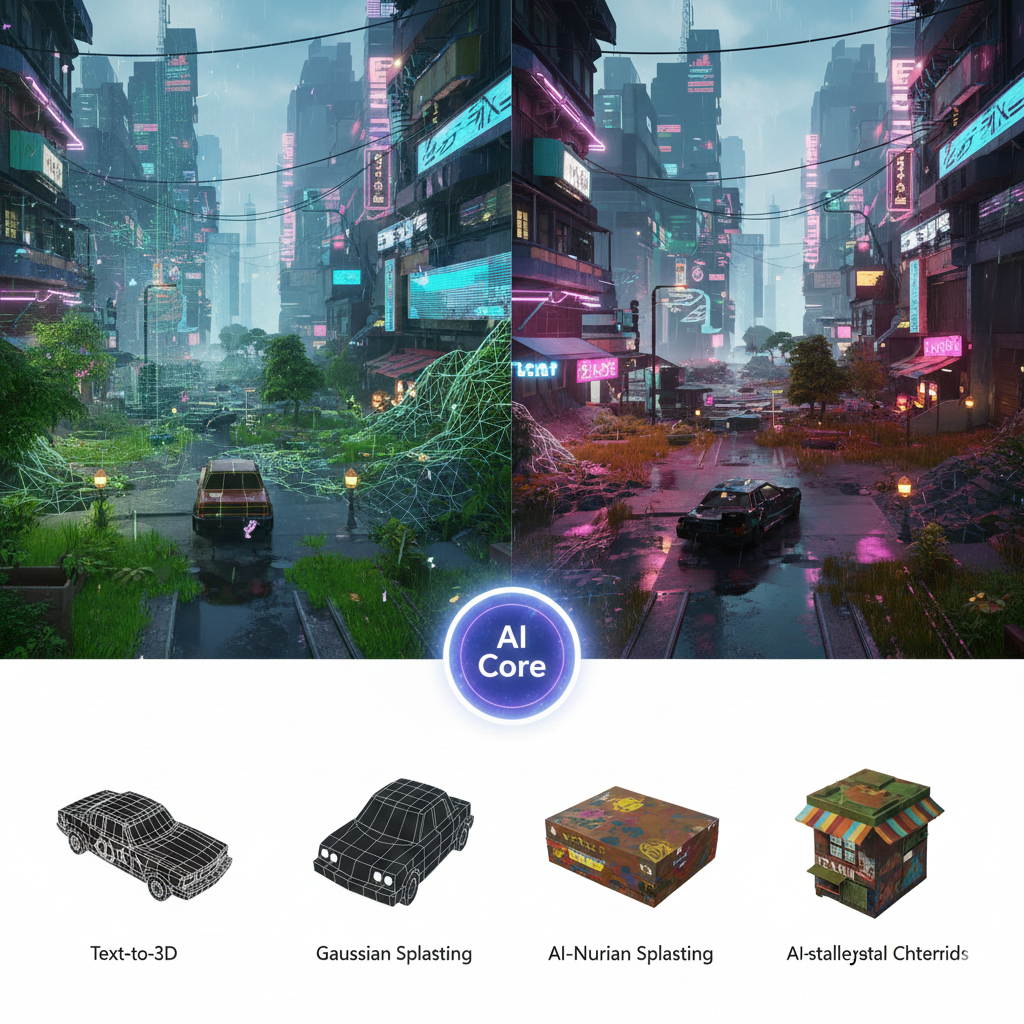
The underlying technical approaches vary. Some tools lean on diffusion-based mesh generation trained directly on 3D data, others build on techniques adapted from neural radiance fields and Gaussian splatting, which reconstruct three-dimensional scenes from 2D images by modeling how light and geometry interact across many viewpoints. Gaussian splatting in particular has become a popular middle step for photo-to-3D pipelines, since it can turn a handful of reference photos into a dense, realistic point-based representation that is then converted into a traditional textured mesh for use in standard 3D software.
The leading text-to-3D and image-to-3D tools
Meshy
Meshy’s sixth version marked what many in the field consider a genuine quality threshold: watertight meshes suitable for 3D printing, sharper hard-surface edges for mechanical and architectural objects, and a low-poly mode aimed specifically at game engines where polygon budgets matter. Meshy also introduced a conversational agent interface, letting users iterate on a generated model through follow-up instructions rather than starting over with a new prompt each time.
Tripo
Tripo has built its reputation on speed. Its Smart Mesh pipeline can produce a quad-retopologized model, meaning the mesh is built from clean, evenly distributed four-sided polygons rather than a messy triangle soup, in around two seconds. That speed makes Tripo a favorite for early-stage concept exploration, where a designer wants to see a dozen variations quickly rather than commit to one detailed generation.
Rodin and CSM
Rodin’s second generation and CSM’s Cube 2 both target game-ready output directly, generating textured, sometimes riggable meshes from either a text prompt or a reference image. These tools compete closely with Meshy on production usability, and studios increasingly treat the choice between them as a matter of house style and pipeline fit rather than a clear quality gap.
Luma AI and photo-based reconstruction
Luma AI’s Genie and similar photo-to-3D pipelines take a different starting point: instead of imagining an object from a text description, they reconstruct one from a set of real photographs. This approach produces highly realistic results for existing physical objects and environments, making it well suited to product visualization, virtual production, and digital twins, though it is less useful when the goal is generating something that does not exist yet.
| Technique | What it does | Typical use case |
|---|---|---|
| Diffusion-based mesh generation | Generates 3D geometry directly from a text or image prompt using models trained on 3D datasets | Text-to-3D tools like Meshy and Rodin producing original imagined objects |
| Neural radiance fields (NeRFs) | Reconstructs a 3D scene by learning how light behaves across many 2D photos of the same subject | High-fidelity scene reconstruction for visual effects and research applications |
| Gaussian splatting | Represents a scene as millions of small colored points that can be rendered in real time from any angle | Fast photo-to-3D reconstruction pipelines like Luma AI’s |
| Quad retopology | Converts a raw generated mesh into clean, evenly spaced four-sided polygons | Preparing generated assets for animation, rigging, and game engines |
| Text-to-CAD parametric generation | Produces editable, dimensioned solid models from text descriptions of mechanical parts | Drafting simple brackets, fasteners, and enclosures for engineering review |
A typical indie studio asset pipeline in 2026
A concept artist generates ten quick variations of a prop in Tripo to explore silhouette options, selects the strongest direction, regenerates a higher-fidelity version in Meshy with low-poly mode enabled for the target game engine, retopologizes and adjusts UVs manually where the automated output falls short, then hand-paints texture touch-ups before the asset goes into the engine’s asset pipeline for lighting and collision setup.
Generative CAD: a slower, more cautious parallel track
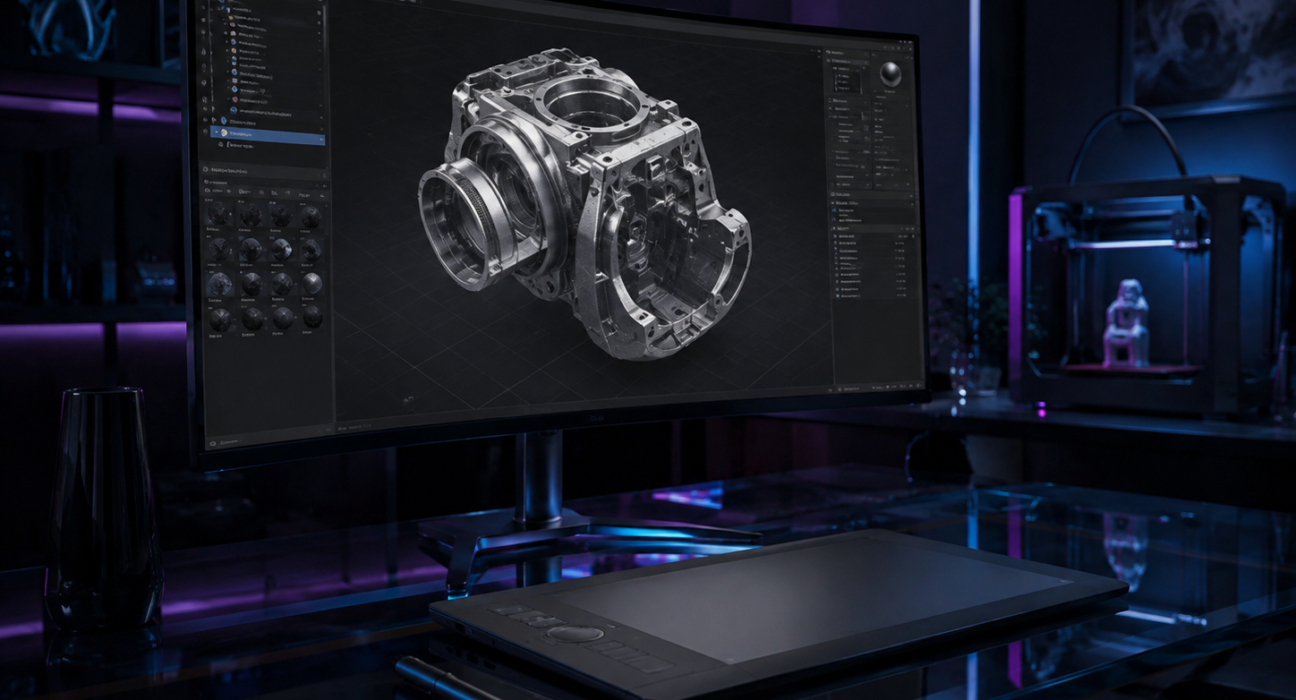
While text-to-3D for games and visualization has moved quickly toward production readiness, generative CAD for engineering and industrial design is progressing more cautiously, for good reason. A game asset that looks slightly wrong is a cosmetic problem. A mechanical part that is dimensionally wrong can fail in the physical world. Text-to-CAD tools such as Zoo specialize in converting plain-language descriptions, like a flange with a specific diameter and a set number of bolt holes, into editable, parametric solid models, sometimes exportable as industry-standard STEP files.
These tools perform well on genuinely simple mechanical components: brackets, pins, standard fasteners, and basic enclosures. They struggle with more complex assemblies, tolerance stacking, material callouts, and manufacturing constraints such as draft angles for injection molding or minimum wall thickness for casting. Most engineering teams currently treat generative CAD output as a fast first draft that still requires a trained engineer to review, adjust, and validate before it moves anywhere near a manufacturing line.
A separate and more mature branch of this space is optimization-based generative design, which uses simulation and topology optimization, rather than a language model, to remove unnecessary material from a part or generate lattice structures optimized for strength-to-weight ratio. This approach has been in use longer than text-to-CAD and has a stronger track record, particularly for aerospace and automotive components where weight reduction directly translates to performance and cost savings.
Major CAD platforms are integrating both approaches. Autodesk has built AI-assisted modeling directly into Fusion, letting engineers describe a feature in plain language and receive geometry suggestions informed by manufacturing constraints, such as recommending shapes suited to five-axis milling versus casting. Dassault Systemes and SolidWorks have introduced their own AI assistants aimed at summarizing design changes, retrieving prior design knowledge, and automating repetitive tasks like fastener recognition and drawing annotation, rather than generating finished parts outright.
Common mistake
Teams sometimes treat a generated 3D asset or CAD model as production-ready simply because it renders cleanly on screen. Generated meshes frequently have hidden topology problems, non-manifold geometry, or texture seams that only surface during animation or physical simulation, and generated CAD models frequently omit tolerances, material specifications, and manufacturing constraints entirely, all of which require a qualified human review before the asset moves further down the pipeline.
What worked
Studios and engineering teams that used generative 3D and CAD tools strictly for the earliest exploration stage, generating many quick variations to find the right direction before committing significant manual labor to one option, got the most value. Treating the AI output as a fast draft rather than a finished deliverable avoided the rework that comes from discovering topology or dimensional problems late in the process.
Where the finishing pipeline still matters most
The clearest trend across both text-to-3D and generative CAD in 2026 is a shift in focus away from raw generation quality and toward the finishing pipeline: retopology, UV unwrapping, format conversion, rigging preparation, and manufacturing validation. Raw mesh or geometry generation has become fast and reasonably reliable across the leading tools, but the steps needed to turn that raw output into something an animator, game engine, or manufacturing line can actually use still require dedicated tooling and human oversight. Vendors that once competed purely on generation speed and visual fidelity are now differentiating on how well their output survives this finishing process with minimal manual rework.
- Watertight meshA 3D model with no gaps or holes in its surface, a requirement for successful 3D printing.
- Non-manifold geometryMesh topology errors, such as edges shared by more than two faces, that can break rendering, simulation, or 3D printing.
- Gaussian splattingA rendering technique representing a scene as millions of colored points, widely used for fast, realistic photo-to-3D reconstruction.
- B-Rep solid modelA boundary representation format used in CAD software that defines a shape through its faces, edges, and vertices, allowing precise editing.
- Topology optimizationA simulation-driven design method that removes unnecessary material from a part while preserving structural performance.
Glossary
- Text-to-3D generation
- The process of producing a three-dimensional mesh directly from a written text description using an AI model.
- Neural radiance field (NeRF)
- A machine learning technique that reconstructs a 3D scene by modeling how light passes through it based on multiple 2D photographs.
- Retopology
- The process of rebuilding a 3D mesh’s polygon structure into a cleaner, more efficient layout suitable for animation or games.
- Generative CAD
- The use of AI models to help create, edit, or suggest computer-aided design geometry from text, sketches, or prior design data.
- STEP file
- A standardized, software-independent file format used to exchange 3D CAD models between different engineering programs.
Key Takeaways
- Text-to-3D tools like Meshy, Rodin, Tripo, and CSM have reached genuinely production-usable quality for game and visualization assets in 2026.
- Meshy’s sixth version introduced watertight, 3D-print-ready meshes and a low-poly mode built specifically for game engine polygon budgets.
- Tripo’s Smart Mesh pipeline prioritizes speed, generating quad-retopologized models in seconds for rapid concept exploration.
- Luma AI and similar photo-to-3D tools reconstruct real objects using techniques like Gaussian splatting rather than imagining new ones.
- Generative CAD tools such as Zoo can draft simple parametric mechanical parts but still struggle with complex assemblies and manufacturing constraints.
- Optimization-based generative design, using simulation and topology optimization, remains more mature than text-to-CAD for engineering-critical parts.
- Industry focus in 2026 has shifted from raw generation quality toward the finishing pipeline: retopology, UV unwrapping, and manufacturing validation.
FAQs
What is the current state of text-to-3D generation in 2026?
Text-to-3D has moved from an experimental novelty to a real part of production asset pipelines. Tools like Meshy, Rodin, Tripo, and CSM now generate near game-ready or print-ready meshes from text prompts or reference images, with most remaining effort focused on finishing steps like retopology.
Which text-to-3D tool is best for game asset creation?
Meshy, Rodin, and CSM are generally considered the strongest for game-ready output, each producing textured meshes suitable for direct use with modest cleanup. Tripo is often preferred for rapid early-stage concept exploration due to its speed.
Can generative CAD tools replace a human engineer?
Not currently for anything beyond simple components. Generative CAD tools like Zoo work well for basic brackets and fasteners but generally lack tolerance data, material specifications, and manufacturing constraint awareness, requiring a trained engineer to review and finalize the design.
What is Gaussian splatting and why does it matter for 3D generation?
Gaussian splatting is a technique that represents a 3D scene as millions of small colored points reconstructed from photographs, allowing fast, realistic rendering from any angle. It has become a popular approach for photo-to-3D tools that reconstruct real objects rather than generate imagined ones.
Are AI-generated 3D meshes ready to use without any editing?
Rarely without at least some review. Generated meshes can contain hidden issues like non-manifold geometry or texture seams that only appear during animation, rigging, or simulation, so most studios treat AI output as a strong first draft rather than a finished asset.
What is the difference between text-to-3D and generative design in engineering?
Text-to-3D typically targets visual and game assets generated from prompts or images. Generative design in engineering more often refers to optimization-based methods using simulation and topology optimization to improve structural performance, a more mature and separate technique from text-to-CAD.
Which industries are adopting text-to-3D generation fastest?
Game development and indie studio asset pipelines have adopted these tools fastest, given the volume of assets needed and lower risk tolerance for cosmetic imperfections. Product visualization and virtual production are close behind, particularly using photo-to-3D reconstruction tools.
Is generative CAD output safe to send directly to manufacturing?
Generally no. Generated CAD models frequently omit critical manufacturing considerations such as draft angles, wall thickness, and tolerance stacking, so engineering teams typically review and adjust output before it moves toward production tooling or 3D printing at scale.
Design teams exploring these workflows may also find our overview of generative AI workflows for design teams useful for building a broader adoption strategy. For related coverage on how generated visual content is tracked and verified, see our piece on AI content provenance. Studios working on virtual characters may want to review synthetic actors and digital likeness rights and interactive narrative engines for adjacent production questions. Readers interested in the technical infrastructure behind AI systems more broadly can also see our explainer on RAG architecture, and those evaluating commercial image licensing alongside 3D assets should read our AI image model licensing comparison.
- StraySpark, “Generative 3D Tools Compared: Meshy, Rodin, Tripo, and CSM in April 2026”
- Meshy, “Best AI Tools for 3D Printing in 2026: Tested and Compared for Print-Ready Output”
- Agentbrisk, “Best AI 3D Modeling Tools in 2026: Meshy, Tripo, Luma Genie, and Scenario Compared”
- RapidDirect, “8 Best AI 3D Model Generators in 2026 We Tested and Compared”
- Leo AI, “Best Text-to-CAD Tools in 2026: Complete Comparison Guide”
- CoLab, “Best Generative Design AI Tools and Software: A Guide for Engineering Managers”