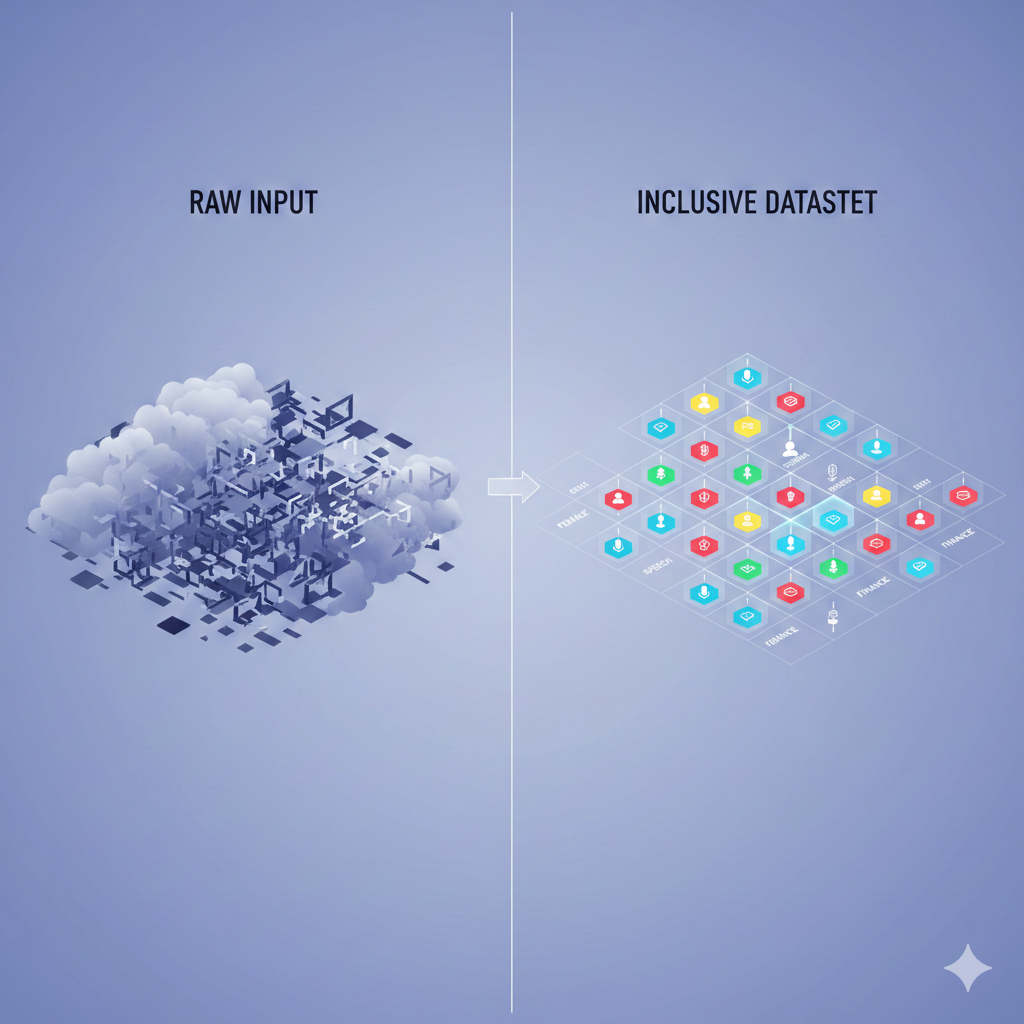
Artificial intelligence systems are only as good as the data that fuels them. For years, the industry adage was “garbage in, garbage out.” In the era of high-stakes automated decision-making—from hiring algorithms to medical diagnostics—this has evolved into a more dangerous reality: “bias in, bias out.”
Building inclusive datasets is no longer just a “nice-to-have” or a theoretical ethical exercise; it is a critical engineering requirement for creating robust, safe, and legally compliant AI systems. As of January 2026, with regulations like the EU AI Act fully operational and global standards shifting toward algorithmic accountability, organizations must prove that their models do not discriminate against protected groups.
This comprehensive guide explores the end-to-end process of building inclusive datasets. We will move beyond high-level platitudes to discuss the practical mechanics of data collection, annotation, and auditing that ensure fairness by design.
In this guide, “inclusive datasets” refers to training and validation data that accurately reflects the diversity of the target population, specifically mitigating historical, sampling, and label biases to prevent representational and allocative harm.
Key Takeaways
- Fairness is a process, not a patch: You cannot “fix” a fundamentally biased dataset with a simple algorithm tweak; fairness must be engineered into the data collection pipeline.
- Representation requires intent: Passive data collection almost always results in exclusion. Building inclusive datasets requires active sampling and, occasionally, synthetic augmentation.
- Metrics vary by context: There is no single mathematical definition of “fairness.” You must choose between metrics like demographic parity and equalized odds based on your specific use case.
- Annotation is a source of bias: Who labels your data matters as much as the raw data itself.
- Compliance is mandatory: Regulatory frameworks in 2026 demand documentation of data governance and bias mitigation strategies for high-risk AI systems.
Who This Is For
This guide is designed for:
- Data Scientists and ML Engineers tasked with training models and curating training data.
- Product Managers responsible for the functional requirements and user impact of AI products.
- AI Ethicists and Policy Officers overseeing compliance and risk management.
- Decision Makers looking to understand the resource requirements for responsible AI development.
1. Understanding Bias in AI Systems
Before we can build inclusive datasets, we must understand exactly what we are fighting against. Bias in AI is not always the result of malicious intent; more often, it is a reflection of structural inequalities or flawed data handling processes.
The Taxonomy of Data Bias
To mitigate bias, you must first identify its source. In the context of machine learning, bias typically manifests in three primary categories:
Historical Bias
This occurs when the data perfectly captures the world as it is (or was), but the world itself is biased. For example, if a company historically hired fewer women for leadership roles, a model trained on past hiring data will learn that “men” are correlated with “leadership.”
- The Inclusion Challenge: The goal here is not just to reflect reality, but to shape a fair future. This often requires normative interventions—modifying the data to reflect how the world should be, rather than how it was.
Sampling (Selection) Bias
This arises when the data collection process itself excludes certain parts of the population. A classic example is training a facial recognition system primarily on lighter-skinned individuals because the scraping script only targeted specific western media sources.
- The Inclusion Challenge: This is a coverage problem. The dataset does not accurately represent the distribution of the user base or the general population.
Measurement and Labeling Bias
This occurs when the features or labels in the dataset are proxies that carry noise or prejudice. For instance, using “arrest records” as a proxy for “crime” introduces bias because certain communities are policed more heavily than others. Similarly, if human annotators hold unconscious biases, they will encode those into the ground truth labels.
- The Inclusion Challenge: This is a definition problem. The variables chosen to represent a concept are flawed.
The Cost of Exclusion
Building inclusive datasets is an investment, but the cost of not doing it is significantly higher.
- Performance Degradation: A model trained on non-inclusive data will fail when deployed in the real world on diverse populations. This is known as “hidden stratification,” where a model has high overall accuracy but performs terribly on specific subgroups.
- Reputational Damage: Public failures of AI systems—such as chatbots spewing hate speech or vision systems failing to recognize specific ethnicities—can destroy brand trust overnight.
- Legal Liability: As of January 2026, discriminatory outcomes in housing, employment, and credit are strictly penalized under various global frameworks.
2. Designing for Inclusion: The Scoping Phase
Building inclusive datasets begins long before the first row of data is collected. It starts with the problem definition.
Defining the Target Population
You cannot assess representation if you do not know who you are trying to represent.
- Identify Protected Groups: explicitly list the demographic attributes relevant to your domain (e.g., age, gender, skin tone, dialect, disability status).
- Analyze Intersectionality: Bias often hides at the intersection of identities (e.g., a system might work well for women generally and Black people generally, but fail for Black women).
- Determine Operational Context: Where will this model be deployed? A speech recognition model trained on American English will fail users in Singapore or Scotland if “English speakers” was the only scope definition.
The “Data Desert” Assessment
Conduct a preliminary audit to identify “data deserts”—areas where data for specific groups is scarce or nonexistent.
- Example: In healthcare AI, there is often a surplus of data for urban populations and a deficit for rural populations.
- Action Plan: If you identify a data desert, you must budget for targeted data acquisition strategies (discussed in Section 3) rather than relying on general scraping.
Privacy vs. Fairness: The Trade-off
To check if a dataset is inclusive, you often need to know the sensitive attributes of the people in it (e.g., race, gender). However, privacy regulations (like GDPR or CCPA) discourage collecting this data.
- The 2026 Approach: Modern privacy-preserving techniques, such as Differential Privacy and Trusted Third Parties, allow organizations to audit datasets for fairness without exposing raw sensitive data to the model developers.
- Proxy Analysis: When sensitive tags are unavailable, organizations sometimes use inferred proxies (e.g., using census data to infer demographics by zip code) to estimate bias, though this method requires careful validation to avoid compounding errors.
3. Strategies for Collecting Inclusive Data
Once the scope is defined, the actual collection begins. Passive collection usually leads to bias; inclusive collection is active and intentional.
Stratified Sampling
Instead of random sampling (which often preserves majority dominance), use stratified sampling to ensure specific subgroups are represented at desired rates.
- How it works: Divide the population into subgroups (strata) based on key demographics. Calculate the number of samples needed from each stratum to achieve statistical significance, regardless of their size in the general population.
- In Practice: If a minority group makes up 5% of the real world, you might intentionally oversample them to make up 20% or even 50% of the training set to ensure the model learns their features effectively. This is often called “re-balancing.”
Participatory Data Collection
For specific domains, the best way to build inclusive datasets is to involve the community.
- Community-Led Initiatives: Partner with organizations that represent the target demographic. Pay contributors fairly for their data.
- Crowdsourcing with Demographics: When using platforms like Amazon Mechanical Turk or specialized labeling services, set strict quotas for demographic participation. Do not launch a task until you have secured diverse contributors.
Synthetic Data Generation (SDG)
As of 2026, synthetic data has become a pillar of inclusive AI development. When real-world data is biased or scarce, we can generate artificial data to fill the gaps.
- Augmentation: If you have 1,000 images of lighter-skinned faces and only 100 of darker-skinned faces, Generative Adversarial Networks (GANs) or Diffusion models can generate photorealistic variations of the underrepresented class.
- Privacy-Safe Sharing: Synthetic data retains the statistical properties of the original dataset without containing the actual personal information of individuals, effectively bypassing some privacy constraints while allowing for robust bias testing.
- Risk Note: Synthetic data is modeled on the original data distribution. If the seed data is fundamentally flawed, the synthetic data will hallucinate the same biases. SDG must be coupled with rigorous validation.
Leveraging Pre-trained Inclusive Datasets
Before collecting from scratch, check if high-quality, open-source inclusive datasets exist.
- Multilingual Text: Datasets like Common Crawl are massive but noisy. Look for curated subsets specifically filtered for linguistic diversity (e.g., portions of the LAION or specialized NLP datasets).
- Visual Data: Look for datasets explicitly designed to counter bias (e.g., Monk Skin Tone Scale datasets) rather than general scraped repositories.
4. Addressing Bias in Annotation
You can collect the most diverse images or text in the world, but if the people labeling that data carry bias, the dataset remains flawed. This is often the “silent killer” of inclusivity.
The Problem of Rater Reliability
If you ask three different annotators to label a comment as “toxic,” their answers will depend on their cultural background, age, and lived experience.
- Cultural Context: A phrase considered slang in one community might be flagged as offensive by an annotator from a different community.
Developing Inclusive Annotation Guidelines
Ambiguity in guidelines breeds bias.
- Definitional Clarity: Do not use vague terms like “offensive” or “professional.” Provide concrete examples and counter-examples for every category.
- Context Awareness: Instruct annotators to consider the context of the data point. (e.g., Is the speaker reclaiming a slur? Is the image from a specific cultural ceremony?)
Diversifying the Annotator Pool
Just as you audit your data subjects, you must audit your data labelers.
- Demographic Matching: For highly subjective tasks (e.g., hate speech detection, sentiment analysis), try to match the demographics of the annotators to the demographics of the content speakers/creators.
- Disagreement as Signal: Do not simply “majority vote” away disagreements. If 80% of annotators say “safe” and 20% say “toxic,” check who the 20% are. If they all belong to a minority group, the content is likely toxic to that group, and the label should reflect that (e.g., using soft labels or probability distributions rather than binary 0/1).
5. Auditing and Measuring Fairness
Once the dataset is built (or during the build process), you must mathematically audit it. However, “fairness” is not a single equation. There are over 20 mathematical definitions of fairness, and some are mutually exclusive.
Common Fairness Metrics
In 2026, the industry has coalesced around a few key metrics for auditing datasets and model outputs.
1. Demographic Parity (Statistical Parity)
This metric requires that the positive outcome rate be equal across groups.
- Example: If 50% of male applicants get a loan interview, 50% of female applicants should also get an interview.
- Pros: Ensures equal representation in outcomes.
- Cons: Can be controversial if it ignores legitimate relevant factors (e.g., if one group happens to be more qualified in the dataset).
2. Equalized Odds (Error Rate Balance)
This metric requires that the model has equal error rates (False Positives and False Negatives) across groups.
- Example: A facial recognition system should not accidentally misidentify Black women more often than it misidentifies White men.
- Pros: Focuses on the quality of the prediction for each group rather than just the raw outcome.
- Cons: Harder to optimize for.
3. Representation Ratios
A simple but effective metric for the dataset itself (pre-training).
- Technique: Compare the percentage of each subgroup in your dataset against their percentage in the target real-world population or the idealized deployment population.
Tools for Fairness Auditing
You do not need to write these metrics from scratch. Several open-source frameworks are standard in the industry:
- Aequitas: An open-source bias audit toolkit for data scientists to audit machine learning models for discrimination and bias.
- Fairlearn (Microsoft): A library that allows you to assess your system’s fairness and mitigate unfairness.
- AI Fairness 360 (IBM): A comprehensive toolkit of metrics to check for unwanted bias in datasets and machine learning models.
- Google What-If Tool: A visualization tool that allows you to inspect the intersection of fairness and performance.
The Impossibility Theorem
It is crucial to understand that you cannot satisfy all fairness metrics simultaneously. For example, in most cases, you cannot have both Demographic Parity and Equalized Odds if the base rates of the target variable differ between groups.
- The Solution: Stakeholders must decide which metric is most important for the specific context. In hiring (Allocative Harm), Demographic Parity might be prioritized. In medical diagnosis (Quality of Service Harm), Equalized Odds is usually critical (you don’t want to miss cancer in one group more than another).
6. Continuous Monitoring and Governance
Building inclusive datasets is not a one-time setup; it is a lifecycle management issue.
Data Drift and Concept Drift
The world changes. A dataset that was inclusive in 2020 might be biased in 2026 because language, demographics, and social norms evolve.
- Temporal Bias: Models trained on pre-COVID behavior data often failed post-COVID.
- Semantic Shift: New slang or terms emerge (especially in Gen Z and Alpha vocabularies) that older datasets might misclassify.
The Feedback Loop Risk
If an AI model is deployed and its outputs are used to generate new training data, bias can be amplified.
- Example: A policing algorithm sends more officers to Neighborhood A. More arrests are made in Neighborhood A (because more police are there). This data is fed back into the model, which then thinks Neighborhood A is even more dangerous.
- Mitigation: Keep “holdout” sets of pristine, human-verified data to test against, rather than relying solely on model-generated logs.
Documentation and Datasheets
Transparency is the enabler of trust. Every inclusive dataset should be accompanied by documentation.
- Datasheets for Datasets: A standard (popularized by researchers like Timnit Gebru et al.) that answers:
- Why was the dataset created?
- Who is in it? Who is missing?
- How was it collected?
- What are the recommended uses?
- Model Cards: If you release a model trained on the data, explicitly state its limitations regarding demographics.
7. Common Pitfalls to Avoid
Even with good intentions, teams often stumble. Here are the most common mistakes in building inclusive datasets.
Tokenism vs. Representation
Adding a few images of underrepresented groups just to “check a box” is not inclusion; it is tokenism. If the minority samples are low-quality, blurry, or stereotypical, the model will learn that these features are “noise” or “outliers” rather than core variations.
- Fix: Ensure minority class samples have the same variance, quality, and richness as majority class samples.
Ignoring “Invisible” Diversity
Focusing only on visible traits (skin tone, gender presentation) while ignoring invisible traits (neurodiversity, socio-economic background, political affiliation) can leave deep biases in text and decision systems.
- Fix: Use metadata and surveys (where privacy allows) to capture broader dimensions of diversity.
The “Colorblind” Fallacy
Removing sensitive attributes (like race or gender) from the dataset does not remove bias. Models are excellent at finding proxies.
- Example: Amazon once built a hiring tool that penalized resumes containing the word “women’s” (as in “women’s chess club”) even though gender was removed, because it correlated with the outcome in historical data.
- Fix: Keep sensitive attributes in the audit phase so you can test for bias, even if you mask them during the final inference.
8. Related Topics to Explore
For teams looking to deepen their expertise in ethical AI, the following topics are natural extensions of building inclusive datasets:
- Explainable AI (XAI): Techniques to understand why a model made a specific prediction, which is essential for debugging bias.
- Federated Learning: Training models across decentralized edge devices to improve privacy and access diverse data sources without centralizing data.
- Adversarial De-biasing: A technique where a “adversary” network tries to guess the sensitive attribute from the model’s prediction; the model is penalized if the adversary succeeds, forcing it to unlearn the bias.
- Human-in-the-Loop (HITL) Workflows: Designing systems where human judgment intervenes in low-confidence or high-risk predictions.
Conclusion
Building inclusive datasets is the foundational challenge of the AI era. It requires a shift in mindset from “big data” to “smart data.” It demands that we view data not as a static resource to be mined, but as a reflection of human complexity that must be carefully curated.
For organizations in 2026, the path forward involves a blend of sociological awareness and engineering rigor. It requires defining the scope of inclusion, actively collecting diverse data (potentially using synthetic augmentation), auditing annotations for rater bias, and rigorously testing against mathematical fairness metrics.
The result of this effort is not just a “fairer” model in an abstract ethical sense. It is a model that works better, for more people, in more real-world scenarios. It is a model that is compliant with emerging laws and robust against reputational risk. Ultimately, an inclusive dataset is simply a higher-quality dataset.
Next Step: Begin by auditing one of your current high-impact datasets using the “Datasheets for Datasets” framework to identify immediate gaps in representation.
FAQs
What is the difference between bias and fairness in AI?
Bias refers to the statistical errors or prejudices in the data or model (e.g., the model performs 10% worse on Group A). Fairness is the social or normative goal we are trying to achieve (e.g., ensuring everyone has an equal chance of getting a loan). Bias is the technical defect; unfairness is the societal harm.
Can synthetic data really fix bias?
Yes, but with caveats. Synthetic data is excellent for “up-sampling” underrepresented groups to balance a dataset mathematically. However, if the synthetic data generator is trained on biased data, it will only create more biased data. It must be carefully engineered to introduce the diversity that is missing from the real world.
Is it illegal to use biased datasets?
As of 2026, under regulations like the EU AI Act and various US state laws (e.g., regarding employment and housing algorithms), using datasets that result in discriminatory outcomes can lead to significant fines and legal action. While the “dataset” itself isn’t illegal, the resulting discriminatory system is.
How big does a dataset need to be to be inclusive?
Size does not equal inclusion. You can have a dataset of 100 million people that is still biased if it excludes a specific demographic. Inclusion is about the distribution and variance of the data, not just the volume. A smaller, balanced dataset is often better than a massive, skewed one.
What is “Disparate Impact”?
Disparate Impact is a legal and statistical term referring to policies or practices that appear neutral but have a disproportionately negative effect on a protected group. In AI, this happens when an algorithm creates different outcomes for different groups (e.g., approving mortgages at a lower rate for a specific ethnicity) without a valid business justification.
Should we remove sensitive data like race from datasets?
Generally, no—at least not during the training and auditing phase. If you remove these labels, you become “blind” to the bias. You cannot measure whether your model is treating different races fairly if you don’t know the race of the data points. You should collect it securely, use it for bias mitigation, and then potentially suppress it during deployment if required.
What tools can I use to check my data for bias?
Top industry tools include Microsoft’s Fairlearn, IBM’s AI Fairness 360, and Google’s What-If Tool. These open-source libraries provide ready-to-use code for calculating metrics like Disparate Impact and Equalized Odds.
What is the difference between allocative harm and representational harm?
Allocative harm occurs when a system withholds an opportunity or resource (like a loan or job) from a specific group. Representational harm occurs when a system reinforces stereotypes or diminishes a group’s standing (like a search engine showing only men when searching for “CEO”), even if no tangible resource is denied.
References
- European Union. (2024). The EU Artificial Intelligence Act. Official Journal of the European Union. https://eur-lex.europa.eu/legal-content/EN/TXT/?uri=CELEX:52021PC0206
- National Institute of Standards and Technology (NIST). (2023). AI Risk Management Framework (AI RMF 1.0). U.S. Department of Commerce. https://www.nist.gov/itl/ai-risk-management-framework
- Gebru, T., Morgenstern, J., Vecchione, B., Vaughan, J. W., Wallach, H., Daumé III, H., & Crawford, K. (2021). Datasheets for Datasets. Communications of the ACM. https://cacm.acm.org/magazines/2021/12/256932-datasheets-for-datasets/fulltext
- Mehrabi, N., Morstatter, F., Saxena, N., Lerman, K., & Galstyan, A. (2021). A Survey on Bias and Fairness in Machine Learning. ACM Computing Surveys. https://dl.acm.org/doi/10.1145/3457607
- Microsoft. (n.d.). Fairlearn: Fairness in Machine Learning. Official Documentation. https://fairlearn.org/
- IBM Research. (n.d.). AI Fairness 360. Open Source Toolkit. https://aif360.res.ibm.com/
- Google. (n.d.). The What-If Tool. People + AI Research (PAIR). https://pair-code.github.io/what-if-tool/
- Buolamwini, J., & Gebru, T. (2018). Gender Shades: Intersectional Accuracy Disparities in Commercial Gender Classification. Proceedings of Machine Learning Research. https://proceedings.mlr.press/v81/buolamwini18a.html
- Algorithmic Justice League. (n.d.). Resources and Research. https://www.ajl.org/
- Information Commissioner’s Office (ICO). (2023). Guidance on AI and Data Protection. https://ico.org.uk/for-organisations/uk-gdpr-guidance-and-resources/artificial-intelligence/