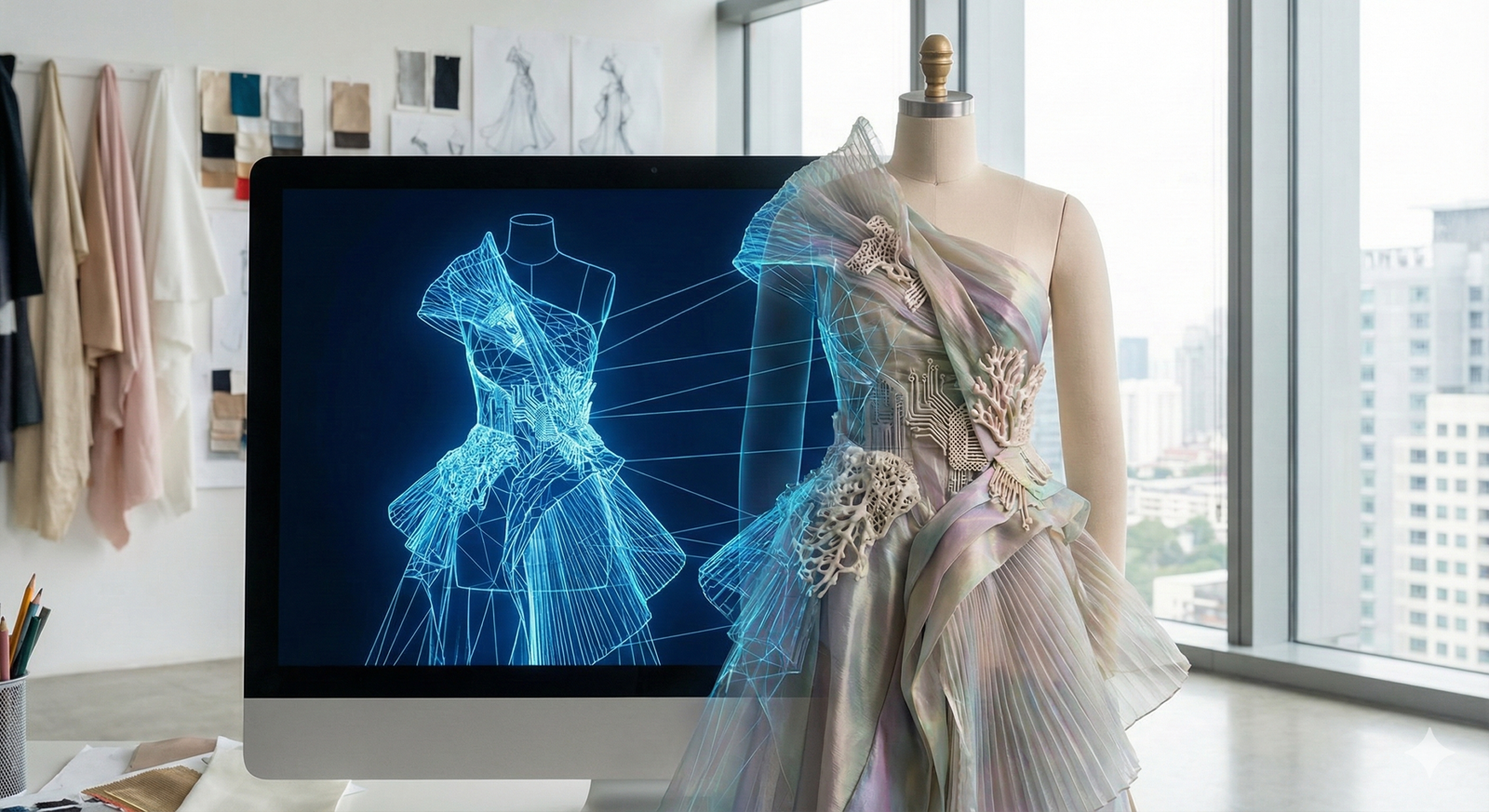
The fashion industry is currently undergoing a seismic shift driven by artificial intelligence. Generative design, once a niche concept reserved for experimental tech demos, has graduated into a core competency for modern fashion brands and independent designers alike. By leveraging generative AI fashion design, creatives are not just automating mundane tasks; they are expanding the boundaries of what is aesthetically and structurally possible.
As of January 2026, generative models are no longer just creating surreal images for social media; they are integrated into the end-to-end production lifecycle, from initial mood boarding to 3D pattern making and virtual try-ons. This guide explores the mechanisms, applications, and profound implications of this technology.
Key Takeaways
- Beyond 2D Images: Generative AI is evolving from creating flat JPEGs to generating 3D assets, textile patterns, and manufacturable sewing patterns.
- Efficiency & Sustainability: AI-driven workflows significantly reduce physical sampling, cutting down on textile waste and accelerating time-to-market.
- Democratization: Advanced design capabilities are becoming accessible to independent creators without formal training in draping or pattern cutting.
- Human-in-the-Loop: The most successful applications rely on “centaur” teams where human intuition guides AI efficiency.
- Ethical Complexity: Issues regarding copyright, data bias, and the definition of authorship remain central challenges.
Who this is for (and who it isn’t)
This guide is designed for fashion designers, digital artists, product managers in retail, and sustainability officers looking to understand the practical application of AI. It is also suitable for students and tech enthusiasts curious about the intersection of style and algorithms.
It is not a coding tutorial for building a neural network from scratch, nor is it a “get rich quick” guide to selling AI art. The focus is on professional application and industry transformation.
Scope of this guide
In this article, “generative models” refers to machine learning algorithms capable of generating new data instances (images, 3D models, text) that resemble training data. We will focus on:
- Diffusion Models: For text-to-image visualization.
- GANs (Generative Adversarial Networks): For creative style transfer and pattern generation.
- NeRFs (Neural Radiance Fields) & 3D Generative AI: For creating volumetric assets.
We will exclude standard automation tools (like basic Excel macros for inventory) that are not “generative” in nature.
1. The Technological Foundations of AI Fashion
To utilize these tools effectively, it is helpful to understand the underlying engines that power generative AI fashion design. Designers do not need to be data scientists, but a conceptual grasp of the “how” aids in better prompting and workflow integration.
Generative Adversarial Networks (GANs)
For much of the last decade, GANs were the standard for creative AI. A GAN consists of two neural networks: a generator that creates an image, and a discriminator that evaluates it against real data. They compete in a zero-sum game—the generator tries to fool the discriminator, and the discriminator tries to catch the fake.
- In Practice: GANs are excellent for “style transfer” (applying the texture of a Van Gogh painting to a dress) and creating variations of a specific item (e.g., generating 50 variations of a sneaker design based on a specific sole shape).
Diffusion Models
Diffusion models (like Stable Diffusion, Midjourney, and DALL-E) have largely superseded GANs for high-fidelity image synthesis. They work by adding noise (static) to an image until it is unrecognizable, and then learning to reverse the process to reconstruct a clear image from pure noise based on a text prompt.
- In Practice: These models allow designers to type “a cyberpunk trench coat made of iridescent sheer fabric, 8k resolution” and receive a high-quality visualization in seconds. They excel at handling complex prompts and combining disparate concepts that have never existed together physically.
Neural Radiance Fields (NeRFs) and 3D Generative AI
While 2D images are useful for mood boards, fashion requires 3D understanding for manufacturing. NeRFs use deep learning to reconstruct 3D scenes from 2D images. Newer generative 3D models can generate meshes and textures directly.
- In Practice: This technology is closing the gap between a 2D AI sketch and a 3D asset that can be imported into software like CLO3D or Browzwear for virtual prototyping.
2. Revolutionizing the Design Workflow
The traditional fashion cycle—sketch, muslin prototype, fitting, sample, revision, final production—is slow, expensive, and wasteful. Generative models intervene at every stage to streamline this process.
Ideation and Mood Boarding
The “blank page” problem is virtually eliminated with AI.
- Rapid Visualization: Designers can generate hundreds of concepts in the time it takes to sketch one. This allows for broader exploration of themes. For instance, a designer can instantly visualize a collection blending “1920s flapper silhouettes” with “utilitarian space wear.”
- Concept Blending: AI excels at merging existing aesthetics. Brands can feed their archival images into a private model (using techniques like LoRA – Low-Rank Adaptation) to generate new designs that remain true to their heritage but feature modern twists.
Textile and Pattern Design
Generative AI is particularly powerful in surface design.
- Seamless Textures: Creating repeat patterns for fabric printing can be tedious. AI can generate intricate, seamless floral, geometric, or abstract patterns instantly.
- Material Innovation: Designers can visualize materials that don’t exist yet, such as “fungal leather with embedded LEDs,” to pitch material innovation concepts to investors or R&D teams.
From 2D Sketch to 3D Prototype
This is the “Holy Grail” of digital fashion. Current workflows often involve using AI to generate a 2D front, back, and side view of a garment.
- Workflow Integration: Designers use tools like Stable Diffusion with ControlNet. ControlNet allows the designer to feed a basic line drawing (the structure) into the AI and ask it to “paint” realistic fabrics and details over that specific structure. This ensures the AI doesn’t hallucinate impossible geometries while still providing photorealistic textures.
- 3D Reconstruction: Startups are developing tools that take these consistent 2D views and inflate them into 3D meshes. While still maturing as of early 2026, this capability allows for immediate import into digital fashion shows or gaming environments.
Virtual Try-On (VTO) and Fit
Generative AI is solving the online return crisis through advanced VTO.
- Generative draping: Instead of just overlaying a 2D image of a shirt onto a photo of a person (which looks flat and fake), generative models predict how the fabric would drape, fold, and cast shadows on different body types.
- Inclusivity: Brands can generate model images across a limitless spectrum of skin tones, body sizes, and ages, allowing customers to see clothes on avatars that actually look like them.
3. Sustainability: The Green Impact of Digital Sampling
One of the most critical drivers for adopting generative AI fashion design is sustainability. The fashion industry is notoriously wasteful, with millions of tons of fabric ending up in landfills from sample rounds alone.
Reducing Physical Samples
In a traditional workflow, a brand might produce 5 to 10 physical samples of a single jacket to get the fit and color right. Each sample requires fabric sourcing, shipping, cutting, and sewing.
- The AI Shift: With high-fidelity generative rendering, the first 8 rounds of sampling can happen digitally. Designers can assess how a velvet texture interacts with light or how a print scales on a garment without cutting a single yard of fabric. Physical production only begins when the digital twin is perfected.
Demand Forecasting and Inventory Control
While primarily analytical, this overlaps with generative design. AI analyzes social media trends and search data to predict upcoming trends. Generative design then allows brands to visualize these trends instantly and “pre-sell” items or gauge interest through social media before manufacturing.
- On-Demand Manufacturing: This moves the industry toward a “pull” model (produce what is sold) rather than a “push” model (sell what is produced), significantly reducing deadstock.
4. Tools and Platforms for AI Fashion
The landscape of tools changes rapidly. As of early 2026, the following categories represent the standard toolkit for the AI-enabled designer.
General Purpose Visualizers
- Midjourney: Known for its artistic flair and high-quality textures. Excellent for editorial campaigns, mood boards, and avant-garde concept art. It is less controllable for precise structural design but unbeatable for inspiration.
- Stable Diffusion (WebUI/ComfyUI): The preferred tool for technical designers. Because it is open-source and supports plugins like ControlNet and LoRA, it allows for precise control over pose, garment outline, and brand-specific style training.
- Adobe Firefly: Integrated into Photoshop, this is vital for “outpainting” (extending an image) or changing specific details (e.g., “change this button to a zipper”) without altering the rest of the image. It is trained on stock data, making it “safe” for commercial use regarding copyright.
Fashion-Specific Generative Tools
- The New Black: A platform specifically tuned for fashion design, allowing for easier generation of clothing-specific assets like tech packs and flat sketches.
- Botika: Specializes in generative models for fashion e-commerce, allowing brands to swap models or generate on-model photography from ghost mannequin shots.
- Cala: An operating system for fashion that integrates generative AI into the supply chain, helping with design, specs, and finding manufacturers.
3D and Digital Fashion Software
- CLO3D / Marvelous Designer: The industry standards for cloth simulation. While not purely “AI” in their core physics engine, they are increasingly integrating generative texture and background features.
- Browzwear: Similar to CLO3D, widely used in enterprise environments for accurate sizing and manufacturing prep.
5. Practical Implementation: A Step-by-Step Workflow
How does a designer actually use these tools? Here is a common workflow for creating a generative AI fashion design collection.
Step 1: The Prompt and the Seed
The process starts with prompt engineering.
- Bad Prompt: “A cool dress.”
- Good Prompt: “Full body shot, sustainable linen maxi dress, terracotta color, frayed hem details, voluminous sleeves, shot in a Mediterranean golden hour setting, photorealistic, 8k, –ar 2:3.” The designer generates hundreds of iterations, refining the prompt to tweak colors and textures.
Step 2: Selection and Refinement (Inpainting)
The designer selects the best output. Perhaps the dress is perfect, but the neckline is wrong. Using “inpainting” (a feature in tools like Stable Diffusion or Photoshop), the designer masks the neckline and prompts “asymmetrical off-shoulder neckline.” The AI regenerates only that specific area.
Step 3: Structural Control (ControlNet)
To ensure the dress is wearable, the designer sketches a rough technical drawing of the silhouette. They upload this sketch to an AI tool using a “Canny edge” or “Scribble” adapter. They prompts the AI to apply the texture and lighting from Step 2 onto this specific line drawing. This ensures the output matches the required construction.
Step 4: Tech Pack Generation
Once the visual is finalized, the designer (or an AI assistant) breaks the image down into a “tech pack”—the instruction manual for the factory. AI tools can now estimate fabric consumption and even suggest standard measurement charts based on the visual proportions.
Step 5: Virtual Sampling
The 2D designs are converted into 3D assets. A virtual avatar walks the runway in the digital garment. This asset is used for marketing, presales, and final fit checks before physical manufacturing.
6. Challenges and Ethical Considerations
While the technology is transformative, it brings significant ethical dilemmas that must be navigated carefully.
Copyright and Intellectual Property
This is the most contentious issue. Generative models are trained on billions of images scraped from the internet, including the work of independent designers and major fashion houses.
- The Problem: If a designer prompts “dress in the style of [Living Designer Name],” is that inspiration or theft?
- Legal Landscape: As of 2026, laws are still catching up. In many jurisdictions, purely AI-generated works cannot be copyrighted. However, work that involves significant human input (editing, painting over, compositing) usually can be.
- Best Practice: Designers should use AI for internal ideation or train models on their own proprietary datasets (their own past collections) to avoid infringing on others’ IP.
Bias and Representation
If the training data is biased, the output will be biased. Early models struggled to generate diverse body types or non-Western fashion styles accurately.
- The Risk: A brand relying solely on default AI outputs might inadvertently whitewash their campaigns or produce culturally insensitive designs.
- Mitigation: Designers must actively prompt for diversity and audit their outputs. “Human-in-the-loop” is essential to catch bias before it reaches the public.
Job Displacement vs. Augmentation
There is a valid fear that AI will replace entry-level design jobs.
- The Reality: AI is unlikely to replace the creative director who sets the vision, but it may reduce the need for junior illustrators or pattern assistants.
- The Shift: The role of the designer is shifting from “drawing” to “curating and directing.” Professionals who learn to wield AI tools will likely replace those who do not.
7. Case Studies: Generative Design in Action
To understand the real-world impact, we can look at how different tiers of the industry are utilizing generative AI fashion design.
High Street Retail
Fast fashion giants use AI to analyze micro-trends on TikTok and Instagram. They use generative models to instantly create variations of trending items (e.g., “that viral cargo pant but in 6 different colors and fabrics”). This reduces the lead time from trend detection to shelf from weeks to days.
Luxury Couture
Luxury brands use AI for “hyper-personalization.” A high-end client might visit a boutique, have their body scanned, and work with a designer to co-create a unique gown using generative visualizations. The client sees the dress on their digital twin before committing to the purchase. Brands like Iris van Herpen have long explored the intersection of technology and couture, and generative AI is the next evolution of this, allowing for organic, bio-mimetic forms that are difficult to conceive manually.
Indie Designers and Digital Fashion
Independent creators are selling “digital-only” fashion—clothing that exists only as a filter or a skin for a gaming avatar. Generative AI allows a single creator to launch a massive collection of virtual goods without the overhead of manufacturing, shipping, or storage.
8. Common Pitfalls in AI Fashion Design
Adopting this technology is not without its stumbling blocks. Here are common mistakes to avoid.
1. Hallucinated Construction
AI can draw a dress that looks beautiful but is physically impossible to sew. It might merge a sleeve into a bodice in a way that restricts all arm movement, or invent fasteners that defy gravity.
- Solution: A human designer with garment construction knowledge must verify the structural integrity of every AI design.
2. Over-Reliance on “Default” Aesthetics
Midjourney and similar tools have a specific “look”—often highly polished, slightly plastic, and dramatic. If designers rely too heavily on raw outputs, all fashion starts to look the same.
- Solution: Heavy editing, specific prompting, and mixing AI outputs with hand-drawing are necessary to maintain a unique brand identity.
3. Ignoring the Supply Chain
Generating a picture of a “glowing, translucent, fur fabric” is easy. Sourcing that fabric in the real world at a viable price point is hard.
- Solution: Design with available materials in mind. Some advanced tools allow you to input your available fabric library so the AI only renders textures you can actually source.
9. The Future: Where is Generative Fashion Heading?
The trajectory of generative AI fashion design points toward deeper integration and interactivity.
Text-to-Manufacturing
The gap between the pixel and the needle is closing. Future models will likely output not just an image, but a DXF file (digital pattern file) ready for a laser cutter. We are moving toward a future where a prompt generates the machine code for a knitting machine.
Interactive Consumer Experience
E-commerce will evolve from static catalogues to generative boutiques. A customer might not search for “red dress”; they will tell the store’s AI agent, “I need an outfit for a summer wedding in Italy, I like breathable fabrics, and I want to hide my arms.” The AI will generate custom options on the fly, visualizing them on the user’s uploaded photo.
Smart Fabrics and AI
Generative design will extend to the microscopic level, designing the weave structures of fabrics to maximize thermal efficiency or durability, leading to a new era of performance wear designed by algorithms.
Conclusion
Fashion has always been a reflection of the times, and our time is defined by artificial intelligence. Generative AI fashion design is not a temporary trend; it is a fundamental retooling of how clothing is conceived, visualized, and produced.
For the designer, the challenge is no longer just technical skill in sketching, but conceptual clarity in directing. The barrier to visualization has lowered, but the bar for creativity has raised. By embracing these tools, the fashion industry can move toward a future that is more efficient, more sustainable, and infinitely more creative.
Next Steps
If you are ready to integrate generative AI into your design workflow, consider these steps:
- Start with Inspiration: Use Midjourney or an equivalent to supercharge your mood boarding process.
- Learn Prompt Engineering: Treat language as your new paintbrush. Experiment with describing textures, lighting, and camera angles.
- Audit Your Workflow: Identify where you spend the most time on repetitive tasks (e.g., colorways, basic sketches) and explore if tools like Stable Diffusion can automate them.
- Stay Human: Remember that AI is a tool, not a replacement. Your taste, your understanding of culture, and your empathy for the wearer remain your most valuable assets.
FAQs
Q: Can generative AI replace human fashion designers? A: It is unlikely to replace designers entirely, but it will replace designers who refuse to use AI. The role is shifting from manual illustration to creative direction and curation. Human oversight is still crucial for fit, comfort, and cultural relevance.
Q: Is AI-generated fashion design copyrightable? A: As of 2026, in many regions like the US and EU, purely AI-generated images are not copyrightable. However, if a human designer significantly modifies the output or uses it as a basis for a physical product, the final physical design can usually be protected.
Q: What is the best AI tool for fashion design? A: It depends on the need. Midjourney is best for high-concept inspiration and mood boards. Stable Diffusion (with ControlNet) is best for controlled, technical design. Adobe Firefly is excellent for editing and integration into existing workflows.
Q: How does generative AI help with sustainability in fashion? A: By allowing designers to create photorealistic digital samples, brands can reduce the number of physical prototypes they manufacture. This reduces fabric waste, shipping emissions, and energy consumption during the development phase.
Q: Can AI create sewing patterns from a picture? A: Emerging tools are beginning to offer “image-to-pattern” capabilities, but they are not yet perfect. Currently, AI is best at visualizing the look; converting that look into a precise, graded sewing pattern usually requires specialized CAD software and human expertise.
Q: What is a “centaur team” in fashion? A: A centaur team combines human intelligence with artificial intelligence. In fashion, this might look like a human designer setting the creative vision and constraints, while the AI generates rapid iterations and variations, which the human then refines and approves.
Q: Does generative AI work for 3D fashion? A: Yes. Technologies like NeRFs and specialized 3D generative models are increasingly able to create 3D meshes and textures suitable for software like CLO3D, reducing the time required to build digital garments from scratch.
Q: How can I learn generative AI for fashion? A: Start by experimenting with user-friendly tools like Midjourney. Then, look for tutorials on “Stable Diffusion for fashion design” to learn about control nets. Many fashion tech academies now offer specific courses on AI-aided design.
References
- McKinsey & Company. (2024). Generative AI: Unlocking the future of fashion. McKinsey.com. https://www.mckinsey.com/industries/retail/our-insights/generative-ai-unlocking-the-future-of-fashion
- BoF (The Business of Fashion). (2025). The State of Fashion 2026: Technology and Innovation. Businessoffashion.com.
- Vogue Business. (2025). How AI is rewriting the rules of the runway. Voguebusiness.com.
- Stability AI. (2024). Stable Diffusion and the future of creative tools. Stability.ai.
- CLO Virtual Fashion. (2025). Integrating AI into the 3D Design Workflow. Clo3d.com.
- Harvard Business Review. (2023). How Generative AI Will Change Creative Work. Hbr.org.
- Adobe. (2025). Adobe Firefly: Ethics and Commercial Safety in Generative AI. Adobe.com. https://www.adobe.com/sensei/generative-ai/firefly.html
- MIT Technology Review. (2024). The messy morality of generative AI. Technologyreview.com. https://www.technologyreview.com/topic/artificial-intelligence/generative-ai