| Fraud type | Identity basis | Typical detection signal | Why it is hard to catch |
|---|---|---|---|
| Stolen identity fraud | Entirely real person’s data used without consent | Victim reports unfamiliar activity; credit bureau alert | Detectable once the real person notices the misuse |
| Synthetic identity fraud | Fabricated identity blending real (often a Social Security number or national ID) and invented data | No matching complaint exists because no real victim is aware | The identity has no natural owner to flag the fraud |
| Account takeover | Existing legitimate account with compromised credentials | Login anomalies, device change, session hijack indicators | Fast-moving but bounded to a known account history |
| First-party fraud | Real person misusing their own genuine identity | Disputes, chargebacks, intentional default patterns | Identity itself is genuine, so proofing alone will not catch it |
What Makes Synthetic Identity Fraud Different
Synthetic identity fraud is the practice of constructing a fictitious identity by combining a piece of real personally identifiable information, most commonly a Social Security number or equivalent national identifier, with fabricated details such as an invented name, date of birth, or address. Because the resulting profile is not a complete match to any single real person, there is frequently no natural victim to notice the account and report fraud. Fraudsters often nurture these fabricated identities for months or years, building a legitimate-looking credit history through small transactions before conducting a large-scale “bust-out,” maxing out credit lines and disappearing.
The broader fintech fraud detection landscape, including AI-driven anomaly detection across payments and lending, is covered in a companion piece linked at the end of this article. This article goes deeper specifically into the identity-proofing and verification layer designed to catch a synthetic identity before it is ever granted an account, credit line, or benefit, rather than the broader real-time transaction monitoring problem.
What has changed the threat calculus recently is generative AI. Fraud rings can now produce photorealistic fake identity documents, deepfake selfies matched to those documents, and fabricated supporting evidence such as utility bills at a scale and speed that manual review teams cannot keep pace with. Industry surveys report that a majority of senior fraud and anti-money-laundering leaders at banks and fintechs now cite AI-generated fraud as a top threat, while a significant share admit their organizations lack the infrastructure to defend against it effectively.
Identity-Proofing Techniques Built for Synthetic Identities
Document Forensics Beyond Surface Checks
Basic document verification checks whether a submitted ID looks superficially valid: correct fonts, holograms, and layout. Modern document forensics goes further, examining pixel-level artifacts consistent with digital manipulation or AI generation, checking security features that are computationally expensive for fraudsters to replicate convincingly, and cross-referencing document data against known issuance patterns, such as whether a claimed document number range was ever issued by that authority.
Biometric Liveness and Selfie-to-Document Matching
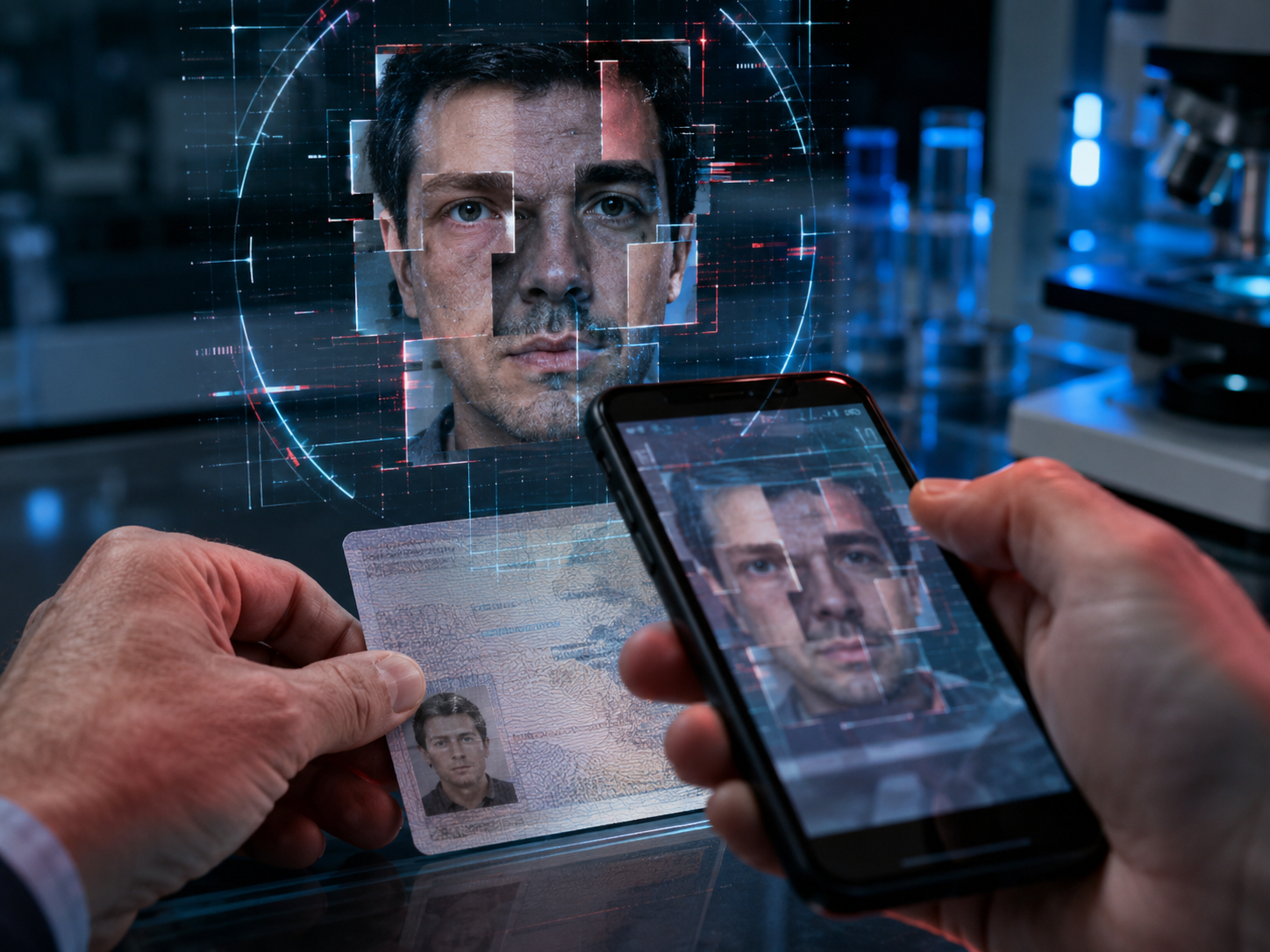
Pairing a live selfie capture with the photo on a submitted identity document is standard practice, but it is only effective if the liveness check can distinguish a genuine live face from a printed photo, a video replay, or an AI-generated deepfake face swap injected into the camera feed. As deepfake generation has become cheap and fast, verification providers have shifted focus toward detecting injection attacks, where a fraudster feeds a fabricated video stream directly into the verification pipeline rather than presenting a physical spoof to a camera.
Device and Network Intelligence
A synthetic identity applying for multiple accounts often reuses the same device, browser fingerprint, or network infrastructure across applications, even when the name, address, and other submitted details differ each time. Device intelligence platforms flag these clusters of applications sharing a device fingerprint, IP reputation signal, or emulator characteristic as a strong synthetic identity indicator, since genuine unrelated individuals rarely share this much technical infrastructure by coincidence.
Behavioral and Velocity Analytics
Synthetic identities frequently exhibit distinctive behavioral patterns during the account nurturing phase: unusually cautious, on-time payment behavior designed specifically to build a credit profile, followed eventually by a sudden spike in credit utilization just before a bust-out. Behavioral analytics models trained to spot this nurture-then-abandon lifecycle pattern can flag accounts for review well before the bust-out event occurs.
Consortium Data Sharing
Because no single institution sees every application a fraud ring submits, cross-institution consortium data sharing has become one of the most effective defenses. Credit bureaus and specialized vendors operate shared databases that let member institutions see when the same combination of identity elements, or the same device and behavioral signals, has appeared across multiple unrelated applications at different banks or lenders, surfacing patterns invisible to any single organization.
Figure: The synthetic identity lifecycle and where defenses intervene
A fraud ring first fabricates an identity blending a real identifier with invented details, then nurtures it for months with small, on-time transactions to build a credit history, before executing a bust-out that maxes out available credit. Document forensics and device intelligence intervene at origination, behavioral analytics intervene during nurturing, and consortium data sharing can flag the identity at any stage by connecting it to other applications across institutions.
| Detection layer | What it examines | Strongest against |
|---|---|---|
| Document forensics | Pixel-level artifacts, security features, issuance pattern matching | Fabricated or AI-generated identity documents |
| Biometric liveness and injection detection | Live presence signals, camera feed integrity, selfie-to-document match | Deepfake selfies and video injection attacks |
| Device and network intelligence | Device fingerprints, IP reputation, emulator or automation signals | Multiple applications from the same fraud infrastructure |
| Behavioral and velocity analytics | Account nurturing patterns, sudden utilization spikes | Long-dwell synthetic identities preparing a bust-out |
| Consortium data sharing | Cross-institution matching of identity elements and device signals | Fraud rings targeting multiple institutions simultaneously |
Building a Layered Verification Program
No single technique above reliably catches synthetic identity fraud on its own; each addresses a different part of the fraud lifecycle and can be individually evaded by a sufficiently resourced fraud ring. Effective identity verification programs layer these signals together, scoring an applicant across document authenticity, biometric liveness, device and network reputation, and consortium match results, then routing borderline scores to human review rather than making a fully automated accept or decline decision.
Risk-based step-up verification is also increasingly common: low-value, low-risk account openings might rely primarily on automated document and biometric checks, while high-value credit lines or government benefit applications trigger additional verification, such as a live video interview or requiring a second independent identity document. This mirrors the layered thinking behind our coverage of age verification technology and privacy trade-offs, where the strength of a check is matched to the sensitivity of what is being verified.
Programs also need a feedback loop: confirmed synthetic identity cases should feed back into model training and consortium databases so that the specific fabricated elements, whether a device fingerprint, invented address, or reused identifier fragment, are flagged for future applications across the organization and, where consortium participation allows, across partner institutions as well.
Common Mistake
Common mistake
Relying solely on Social Security number or national identifier validation as a proxy for identity verification. Because synthetic identities are specifically built by pairing a valid identifier with fabricated surrounding details, a check that only confirms the identifier format or issuance validity will pass a fabricated identity every time, since the one real component is, by design, genuinely valid.
What Worked
What worked
Organizations that meaningfully reduced synthetic identity losses combined document forensics and biometric liveness at the point of origination with ongoing behavioral monitoring throughout the account lifecycle, rather than treating identity verification as a one-time gate at signup. Participating in consortium data-sharing networks so that fabricated identity elements flagged by one institution could be recognized by others produced some of the largest measurable reductions in repeat fraud losses.
Frequently Overlooked Details
- Bust-out fraudThe final phase of a synthetic identity scheme, where a nurtured account rapidly maxes out available credit before the fraudster abandons it.
- Injection attackFeeding a fabricated video or image feed directly into a verification pipeline’s camera input, bypassing the need to fool a physical camera with a printed spoof.
- Identity element reuseThe pattern of a fraud ring reusing the same real identifier, device, or contact detail fragment across many fabricated identities, a key consortium detection signal.
- Nurturing periodThe months-long window during which a synthetic identity builds an apparently legitimate credit or account history before committing large-scale fraud.
- Step-up verificationEscalating the strength of identity checks, such as adding a live video interview, when an application is flagged as higher risk or higher value.
- False accept rateThe rate at which a verification system incorrectly approves a fabricated identity, a key metric that must be balanced against user friction from false declines.
Glossary
- Synthetic identity fraud
- Fraud committed using a fabricated identity that blends genuine personal data, often a valid national identifier, with invented details that do not correspond to any real person.
- Document forensics
- Techniques for detecting manipulated, fabricated, or AI-generated identity documents by examining security features, pixel-level artifacts, and issuance consistency.
- Device fingerprinting
- Collecting technical signals about a browser or device, such as configuration and hardware characteristics, to identify when multiple applications originate from the same underlying infrastructure.
- Consortium data sharing
- A cooperative arrangement in which multiple institutions contribute fraud signals to a shared database, enabling detection of fraud patterns that span more than one organization.
- Presentation attack detection
- The subset of liveness detection focused on identifying spoofed biometric presentations, such as printed photos or masks, shown physically to a camera.
Key Takeaways
- Synthetic identity fraud fabricates a person by blending a real identifier with invented details, leaving no natural victim to report the fraud.
- Document forensics, biometric liveness, device intelligence, behavioral analytics, and consortium data sharing each catch a different phase of the fraud lifecycle.
- Generative AI has made fabricated documents and deepfake selfies cheap and fast to produce, shifting defenses toward injection-attack detection.
- No single verification technique is sufficient on its own; layered, risk-scored verification with human review for borderline cases performs best.
- Consortium participation, sharing fraud signals across institutions, produces some of the largest measurable reductions in repeat synthetic identity losses.
- Checking only the validity of a Social Security number or national identifier is a common and dangerous mistake, since that component is often genuinely valid.
- Effective programs feed confirmed synthetic identity cases back into detection models and shared databases to prevent repeat use of the same fabricated elements.
FAQs
What is synthetic identity fraud?
Synthetic identity fraud is the creation of a fictitious identity that combines a piece of real personal data, commonly a Social Security number or national identifier, with fabricated information such as an invented name or birth date, used to open accounts or obtain credit under an identity that does not belong to any real person.
Why is synthetic identity fraud harder to detect than stolen identity fraud?
Stolen identity fraud eventually gets reported because a real victim notices unfamiliar activity on their credit file or accounts. Synthetic identities have no real owner monitoring for misuse, so the fraud can go undetected for months or years while the fabricated identity builds an apparently legitimate history.
How does document forensics catch fabricated identity documents?
Document forensics examines security features, pixel-level artifacts consistent with digital manipulation, and issuance pattern consistency, such as whether a claimed document number range was ever actually issued, going well beyond a surface check of fonts and layout that basic verification relies on.
Can biometric liveness detection stop deepfake identity fraud?
Liveness detection substantially raises the difficulty for fraudsters, but modern attacks increasingly inject a fabricated video feed directly into the verification pipeline rather than presenting a physical spoof to a camera. Effective defenses combine traditional liveness checks with injection attack detection that verifies the integrity of the camera feed itself.
What role does device fingerprinting play in catching synthetic identities?
Fraud rings often reuse the same device, browser configuration, or network infrastructure across many fabricated identity applications, even though the submitted personal details differ each time. Device fingerprinting flags these shared technical signals as a strong indicator that multiple applications originate from the same fraud operation.
Why is consortium data sharing effective against synthetic identities?
No single institution sees every application a fraud ring submits across the industry. Consortium data sharing lets participating institutions recognize when the same identity elements, device signals, or behavioral patterns have appeared in applications at other member organizations, surfacing fraud rings that would be invisible from any single institution’s data alone.
What is a bust-out and how does it relate to synthetic identities?
A bust-out is the final stage of a synthetic identity fraud scheme, where a fabricated identity that has been nurtured with a seemingly legitimate credit history suddenly maxes out all available credit lines just before the fraudster abandons the identity entirely, leaving the loss uncollectible.
How does synthetic identity fraud differ from the broader AI fraud detection challenges in fintech?
Synthetic identity fraud is specifically about verifying whether an applicant is a real, coherent person at the point of identity proofing, using document, biometric, device, and consortium signals. Broader fintech fraud detection also covers transaction monitoring, account takeover, and payment fraud, which rely more on real-time behavioral and network analysis after an account already exists.
References
- Equifax, “Equifax Introduces Enhanced Synthetic Identity Fraud Detection”
- Experian, “Synthetic Identity Theft and Fraud Detection Solutions”
- Shufti Pro, “Synthetic Identity Fraud in Banking: Detection Guide 2026”
- Persona, “7 Ways Synthetic Identity Fraud Is Changing in 2026”
- Flagright, “How To Detect Synthetic Identity Fraud”
- Fintech Global, “Synthetic Identity Fraud: The Growing Threat in 2026”
For related reading, see our broader look at AI for fraud detection in fintech, how biometric security and liveness detection underpins the selfie-matching step in identity proofing, how these same threats connect to non-human identity sprawl in enterprise environments, why deepfake-generated documents make protecting digital identity from deepfakes essential reading, and how verified credentials support stronger proofing as covered in decentralised identity and verifiable credentials in practice.