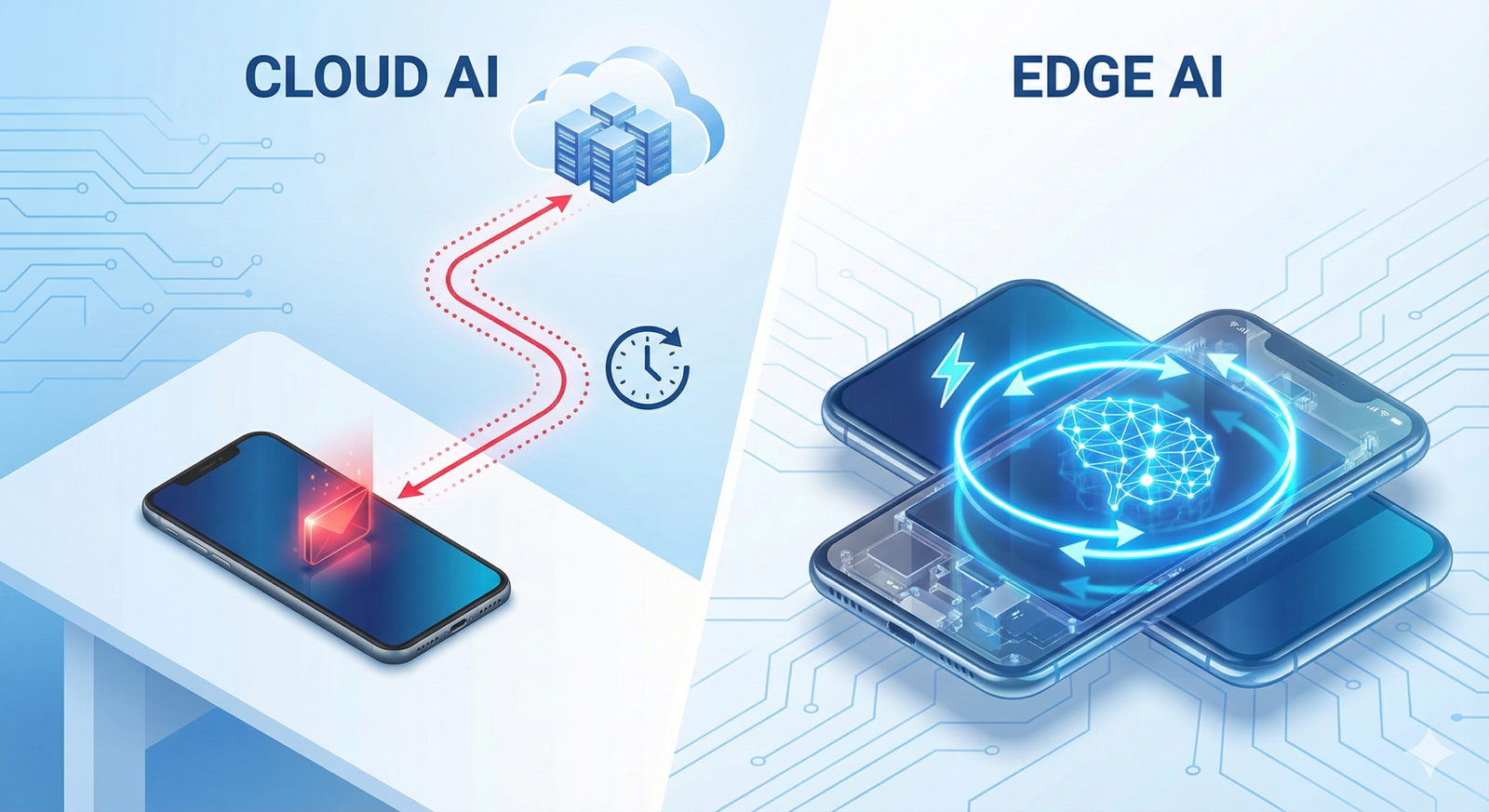
We live in an era where “smart” devices are no longer just connecting to intelligence—they are becoming intelligent themselves. For years, the standard model of artificial intelligence involved sending data to massive data centers (the cloud), processing it there, and sending the answer back. While powerful, this approach has hit physical limits regarding speed, cost, and, most importantly, privacy.
Enter Edge AI. This paradigm shift moves the “brain” of the AI from distant servers directly onto the device in your hand, on your wall, or in your car.
In this guide, Edge AI refers to the deployment of artificial intelligence algorithms and models directly on local devices (edge devices) rather than relying on remote cloud servers for data processing.
Key Takeaways
- Speed is critical: Edge AI eliminates the travel time of data (latency), allowing for real-time reactions in critical scenarios like autonomous driving.
- Privacy is built-in: By processing sensitive data like voice and video locally, Edge AI ensures that personal information never leaves the device.
- Offline capability: Devices can function intelligently without an internet connection, increasing reliability.
- Bandwidth savings: Processing data locally reduces the need to transmit massive video or audio files, lowering data costs and strain on networks.
- Complementary to Cloud: Edge AI doesn’t replace the cloud entirely; it works alongside it, handling immediate tasks while the cloud handles long-term storage and heavy training.
Scope of This Guide
In Scope:
- Definitions and working mechanisms of Edge AI and on-device processing.
- Detailed breakdown of benefits: latency, privacy, bandwidth, and power.
- Comparison between Edge AI and Cloud AI.
- Real-world applications across consumer electronics, automotive, and industry.
- Hardware and software enablers (NPU, TinyML).
- Current challenges and future outlooks.
Out of Scope:
- In-depth coding tutorials for specific microcontrollers.
- Detailed financial stock analysis of specific Edge AI chip manufacturers.
- Generic history of general computing (unless relevant to the edge evolution).
What Is Edge AI?
At its core, Edge AI is the marriage of Edge Computing and Artificial Intelligence.
To understand it, we must first look at the components:
- Artificial Intelligence (AI): The simulation of human intelligence processes by machines, typically involving learning (training models) and reasoning (inference).
- Edge Computing: A distributed computing framework that brings enterprise applications closer to data sources such as IoT devices or local edge servers.
When you combine them, you get AI algorithms running locally on a hardware device. This device could be a smartphone, a smart speaker, a robot, a drone, a security camera, or a sensor in a factory.
The Shift from Cloud to Edge
Traditionally, AI has been “cloud-native.” When you asked a voice assistant a question in 2015, your voice was recorded, compressed, sent hundreds of miles to a server, processed, and the answer was sent back. This worked because early mobile processors weren’t powerful enough to run complex AI models.
Today, thanks to advances in semiconductor technology—specifically the rise of Neural Processing Units (NPUs) and efficient software like TinyML—devices can perform these complex calculations locally. This process is known as Edge Inference.
How Edge AI Works: The Mechanics
Understanding the mechanism of Edge AI requires distinguishing between the two main phases of an AI lifecycle: Training and Inference.
1. Training (The Classroom)
Training is the process where an AI model learns. It requires digesting massive datasets (terabytes of images, years of audio) to recognize patterns. This is computationally exhausting and typically still happens in the cloud or on massive server farms. The edge device usually does not “learn” from scratch; it is not powerful enough to crunch petabytes of data to build a base model.
2. Inference (The Exam)
Inference is where the AI applies what it has learned to new, real-world data. When your camera identifies a face, that is inference. Edge AI is primarily about moving Inference to the device.
Once a model is trained in the cloud, it is “compressed” and sent to the edge device. The device then uses this pre-trained “brain” to process live data.
3. Model Compression Techniques
To fit a massive AI brain into a tiny chip, engineers use several techniques:
- Quantization: Reducing the precision of the numbers used in the model (e.g., moving from 32-bit floating-point numbers to 8-bit integers). This makes the model smaller and faster with minimal loss in accuracy.
- Pruning: Removing “neurons” in the network that contribute little to the output, effectively trimming the fat.
- Knowledge Distillation: Teaching a smaller “student” model to mimic the behavior of a larger “teacher” model.
The Four Pillars of Edge AI Benefits
Why are companies and consumers rushing toward on-device processing? It usually comes down to four critical factors: Latency, Privacy, Bandwidth, and Power.
1. Reducing Latency (Speed)
Latency is the time delay between a request and a response. In the cloud model, data must travel through local networks, ISPs, and the internet backbone to a server and back. This round trip might take 100 to 500 milliseconds.
In many applications, that delay is acceptable. If a webpage takes half a second to load, you might not notice. However, in mission-critical or real-time applications, 500 milliseconds is an eternity.
- Example: An autonomous vehicle traveling at 60 mph covers 88 feet per second. A half-second delay in identifying a pedestrian means the car travels 44 feet before it even begins to brake. Edge AI processes this data locally in milliseconds, allowing for near-instantaneous braking.
2. Protecting Privacy
Privacy is the defining concern of the digital age. With cloud AI, your data (voice, video, health metrics) often leaves your possession and is stored on a third-party server. Even with encryption, this creates a point of vulnerability for hacks, leaks, or misuse.
Edge AI changes the architecture of privacy:
- Data Minimization: Raw data (e.g., the video feed of your living room) never leaves the device. The AI processes it locally and only sends the insight (e.g., “Person detected at 2:00 PM”) to the cloud.
- Compliance: For industries like healthcare (HIPAA) or finance (GDPR), keeping data on the device simplifies compliance because the data crosses fewer borders and passes through fewer hands.
3. Bandwidth Optimization
Transmitting data costs money and clogs networks. A 4K security camera generates massive amounts of footage. Streaming that 24/7 to the cloud is expensive and bandwidth-intensive.
Edge AI filters the noise. The camera can be taught to ignore swinging trees or passing shadows and only record/transmit when it detects a human or a vehicle. This can reduce data transmission by 90% or more, saving significant costs for enterprise operations.
4. Reliability and Offline Access
Cloud AI requires a sturdy internet connection. If the Wi-Fi drops, the intelligence drops. Edge AI devices are self-sufficient. A smart lock using facial recognition must work even if the internet is down. By processing data on-device, Edge AI ensures consistent functionality regardless of network status.
Edge AI vs. Cloud AI: A Comparison
To choose the right approach, it helps to see how they stack up side-by-side.
| Feature | Edge AI | Cloud AI |
| Processing Location | On local device (smartphone, sensor) | Remote data center |
| Latency | Extremely low (Real-time) | Variable (Dependent on network) |
| Privacy | High (Data stays local) | Moderate (Data leaves premise) |
| Internet Required? | No (Works offline) | Yes (Constant connection needed) |
| Computational Power | Limited (Battery/Thermal constraints) | Virtually Unlimited |
| Cost | Higher upfront device cost | Higher recurring data/server cost |
| Best For | Real-time decisions, privacy, remote areas | Heavy training, historical analysis, big data |
Real-World Use Cases
Edge AI is not a futuristic concept; it is already embedded in the fabric of daily technology. Here is how it is being applied across different sectors.
Consumer Electronics & Smart Home
- Smartphones: The most common Edge AI device. Features like FaceID, predictive text, and photo enhancement (Night Mode) happen locally on the phone’s NPU.
- Voice Assistants: Modern smart speakers process common commands (“Turn on the lights,” “Stop timer”) locally to speed up response time and reduce audio uploads.
- Wearables: Smartwatches monitor heart rate anomalies and fall detection in real-time without needing to sync to a phone server first.
Automotive Industry
- Autonomous Driving: As mentioned, cars must make split-second decisions. They use Edge AI to process inputs from LiDAR, radar, and cameras to identify lanes, signs, and obstacles instantly.
- Driver Monitoring: Interior cameras analyze the driver’s eye movements and head position to detect drowsiness or distraction, alerting the driver immediately.
Industrial IoT (IIoT) & Manufacturing
- Predictive Maintenance: Sensors attached to factory machines analyze vibration and sound patterns. Instead of sending terabytes of vibration data to the cloud, the sensor simply listens for the specific pattern of a failing bearing and alerts the operator before the machine breaks.
- Quality Control: Cameras on assembly lines use computer vision to spot microscopic defects in products moving at high speeds, rejecting them instantly without slowing down the line.
Healthcare
- Medical Imaging: Portable ultrasound or X-ray devices can use Edge AI to highlight potential issues (like a collapsed lung or a fracture) instantly on the screen, aiding doctors in triage situations where connectivity might be poor.
- Elderly Care: Privacy-preserving sensors can monitor the gait and movement of elderly patients to detect falls without using intrusive video cameras that stream to the cloud.
Agriculture
- Precision Farming: Drones equipped with Edge AI can fly over fields and identify weeds vs. crops in real-time, triggering targeted herbicide spraying. This reduces chemical use and cost, as the drone doesn’t need to upload maps to be processed elsewhere.
Enablers: The Hardware and Software Behind the Magic
The explosion of Edge AI is driven by specific technological advancements.
Hardware Accelerators
General-purpose CPUs are often too slow or power-hungry for AI math. Specialized chips have emerged:
- GPU (Graphics Processing Unit): Originally for gaming, excellent for parallel processing needed in AI.
- NPU (Neural Processing Unit): Chips designed specifically for deep learning math (tensor operations). Apple’s Neural Engine and Google’s Tensor chip are prime examples.
- DSP (Digital Signal Processor): Highly efficient for audio and image processing.
- FPGA (Field-Programmable Gate Array): Chips that can be reconfigured after manufacturing to run specific AI algorithms very efficiently.
TinyML
TinyML (Tiny Machine Learning) is a field of engineering focused on running ML models on ultra-low-power microcontrollers (devices running on batteries for months or years). This allows AI to run on devices as small as a lightbulb switch or a shoe sensor.
Challenges and Limitations
While Edge AI solves many problems, it introduces new hurdles that engineers and businesses must navigate.
1. Power Consumption
AI computation is energy-intensive. Running a deep neural network on a battery-powered device drains power quickly. Balancing model accuracy with energy efficiency is the primary struggle for hardware designers.
2. Storage and Memory Constraints
Edge devices have limited RAM and storage. A state-of-the-art Natural Language Processing (NLP) model like GPT-4 is gigantic (terabytes in size). It cannot fit on a phone. Edge AI is limited to smaller, more specialized models, which means they may lack the broad “general knowledge” of cloud models.
3. Security Risks (Physical)
While Edge AI improves data privacy (transmission), it introduces physical security risks. If a hacker gains physical access to an edge device (like a security camera), they might be able to extract the model or the data stored on it. Cloud servers are physically secure in bunkers; edge devices are out in the wild.
4. Lifecycle Management (MLOps)
Updating a model in the cloud is easy: you update the server, and everyone gets the new version instantly. Updating millions of edge devices requires “Over-the-Air” (OTA) updates, which can be fragmented, slow, and prone to failure if devices are offline or have different hardware versions.
Future Trends in Edge AI
As of January 2026, several trends are shaping the future of on-device processing.
Federated Learning
This is the next frontier of privacy. In Federated Learning, the training process itself is distributed. Instead of sending data to the cloud to train a central model, the cloud sends the model to your phone. Your phone trains the model locally on your data, improves it, and sends only the mathematical update (not the data) back to the cloud. The cloud averages updates from millions of phones to make the master model smarter. This allows AI to learn from user data without ever seeing the data.
5G and MEC (Multi-Access Edge Computing)
5G is not just about faster phones; it enables MEC. This is a “middle ground” between the device and the cloud. It involves placing small servers at the cellular tower (the edge of the network). Devices can offload heavy AI tasks to the cell tower, which is close enough to keep latency low (under 10ms) but powerful enough to run bigger models than a smartphone can.
Neuromorphic Computing
This is hardware designed to mimic the human brain’s biological structure (neurons and synapses) rather than traditional computer architecture. Neuromorphic chips promise to be orders of magnitude more energy-efficient, potentially allowing complex AI to run on devices powered by energy harvesting (solar, vibration) rather than batteries.
Who is This For (and Who is it Not For)?
Edge AI is for you if:
- You prioritize privacy: You handle sensitive data (video, audio, health) and want to minimize exposure.
- You need speed: Your application requires reaction times under 100ms (drones, robotics, gaming).
- You operate in remote areas: You need intelligence in places with spotty or expensive internet (mines, ships, rural farms).
- You have bandwidth constraints: You cannot afford to stream high-definition video 24/7.
Edge AI might NOT be for you if:
- You need massive computing power: If you are running generative AI to create 4K video or analyzing petabytes of historical genomic data, the cloud is still superior.
- You need a centralized view: If your goal is to aggregate data from millions of sources to see global trends in real-time, a centralized cloud architecture is often simpler.
- Your device is extremely cheap: If you are building a $1 disposable sensor, adding an AI-capable chip might blow the budget.
Common Mistakes and Pitfalls
Adopting Edge AI isn’t just about buying a new chip. Here are common errors to avoid:
- Overestimating Hardware Capabilities: Trying to run a desktop-class model on a microcontroller will result in overheating and system failure. Always size your model to your hardware.
- Ignoring Security: Assuming “local” means “secure” is dangerous. Edge devices can be stolen. Ensure data on the device is encrypted.
- Neglecting the Update Strategy: Deploying a model that you can’t update means your device will become obsolete quickly. Plan your OTA (Over-the-Air) update pipeline before you ship.
- Underestimating Data Drift: The real world changes. A camera trained to recognize products might fail if the factory lighting changes. Edge devices need a way to detect when their model is becoming less accurate.
Related Topics to Explore
- The Internet of Things (IoT): The network of physical objects that Edge AI makes intelligent.
- Computer Vision: The field of AI that deals with how computers can gain high-level understanding from digital images or videos.
- 5G Networks: The connectivity layer that supports high-bandwidth edge applications.
- Cybersecurity for IoT: Strategies for securing distributed devices.
- Green Computing: How optimizing algorithms reduces the carbon footprint of technology.
Conclusion
Edge AI represents a fundamental maturation of technology. We have moved past the phase where dumb devices relied on smart servers. We are entering an era where intelligence is ubiquitous, distributed, and immediate.
By processing data on-device, Edge AI solves the critical bottlenecks of the cloud era: it cuts latency for safer cars and robots, it protects personal privacy in our homes, and it reduces the energy and bandwidth costs of a hyper-connected world. While challenges in power and security remain, the trajectory is clear: the future of AI is not just in the cloud; it is in the palm of your hand.
Next Steps: If you are evaluating technology for your business or personal use, check the specifications for “on-device processing” or NPU capabilities. For developers, begin experimenting with frameworks like TensorFlow Lite or Edge Impulse to see what is possible on the hardware you already own.
FAQs
1. Does Edge AI work without the internet? Yes, this is one of its primary benefits. Because the processing logic (inference) happens locally on the hardware, Edge AI devices can perform their core functions (like face recognition or voice commands) even when offline. However, they may need an internet connection periodically to receive software updates.
2. Is Edge AI safer than Cloud AI? Generally, yes, regarding data privacy. Since raw data (like video footage of your home) does not need to be transmitted over the internet to a third-party server, the attack surface is smaller. However, the physical device itself must be secured against theft or tampering.
3. What is the difference between Edge AI and Fog Computing? Edge AI typically refers to processing on the device itself (e.g., the camera). Fog computing is a layer slightly further out—like a local gateway or router—that processes data from multiple edge devices before sending it to the cloud. Fog is a middle ground between the Edge and the Cloud.
4. Can Edge AI run ChatGPT or other Large Language Models (LLMs)? Full-scale LLMs like GPT-4 are too large for current edge devices. However, “Small Language Models” (SLMs) and optimized versions of LLMs are being developed specifically to run on high-end laptops and phones. As of 2026, on-device generative AI is a rapidly growing field, capable of summarization and basic drafting tasks.
5. How does 5G affect Edge AI? 5G complements Edge AI. While Edge AI reduces the need to send data, 5G allows for massive bandwidth when data does need to be sent. Furthermore, 5G enables Multi-Access Edge Computing (MEC), allowing devices to offload tasks to nearby cell towers for faster-than-cloud processing.
6. What are examples of Edge AI hardware? Common examples include the Apple Neural Engine in iPhones, Google Tensor chips in Pixels, NVIDIA Jetson modules for robotics, and microcontrollers like the Arduino Nano 33 BLE Sense for TinyML applications.
7. Why is latency important in AI? Latency is the delay between input and output. In safety-critical systems like autonomous cars or industrial robotics, a delay of even a few hundred milliseconds can lead to accidents. Edge AI reduces this to near-zero, ensuring instant reaction times.
8. Does Edge AI save energy? It depends on the perspective. For the network, yes—it saves massive energy by not transmitting data. For the device, running AI is power-intensive. However, modern specialized chips (NPUs) are designed to be extremely energy-efficient, often making the trade-off worthwhile for the battery life.
9. What is TinyML? TinyML is a subfield of Edge AI focused on running machine learning models on ultra-low-power microcontrollers (chips that run on batteries/coin cells). It enables simple AI (like keyword spotting or vibration detection) on very cheap, small devices.
10. Will Edge AI replace the Cloud? No. They will coexist. Edge AI will handle immediate, real-time, and private tasks. The cloud will continue to handle massive data aggregation, long-term storage, and the heavy lifting of training the initial AI models.
References
- Arm. “What is Edge AI?” Arm Architecture Resources. https://www.arm.com/glossary/edge-ai
- NVIDIA. “What is Edge Computing?” NVIDIA Blog. https://blogs.nvidia.com/blog/what-is-edge-computing/
- IBM. “Edge Computing vs. Cloud Computing.” IBM Cloud Education. https://www.ibm.com/cloud/learn/edge-computing
- Google AI. “Federated Learning: Collaborative Machine Learning without Centralized Training Data.” Google AI Blog. https://ai.googleblog.com/2017/04/federated-learning-collaborative.html
- TinyML Foundation. “Introduction to Ultra Low Power Machine Learning.” TinyML.org. https://www.tinyml.org/
- STMicroelectronics. “Edge AI Solutions for Industry 4.0.” ST.com.
- Qualcomm. “On-Device AI: The Future of AI is Hybrid.” Qualcomm Research.
- IEEE. “Edge Artificial Intelligence.” IEEE Internet of Things Journal. https://ieeexplore.ieee.org/xpl/RecentIssue.jsp?punumber=6488907
- Amazon Web Services (AWS). “AWS IoT Greengrass – Edge Computing.” Amazon.com. https://aws.amazon.com/greengrass/
- Microsoft Azure. “Azure IoT Edge.” Microsoft.com. https://azure.microsoft.com/en-us/services/iot-edge/
- TensorFlow. “TensorFlow Lite for Mobile and IoT.” TensorFlow.org. https://www.tensorflow.org/lite