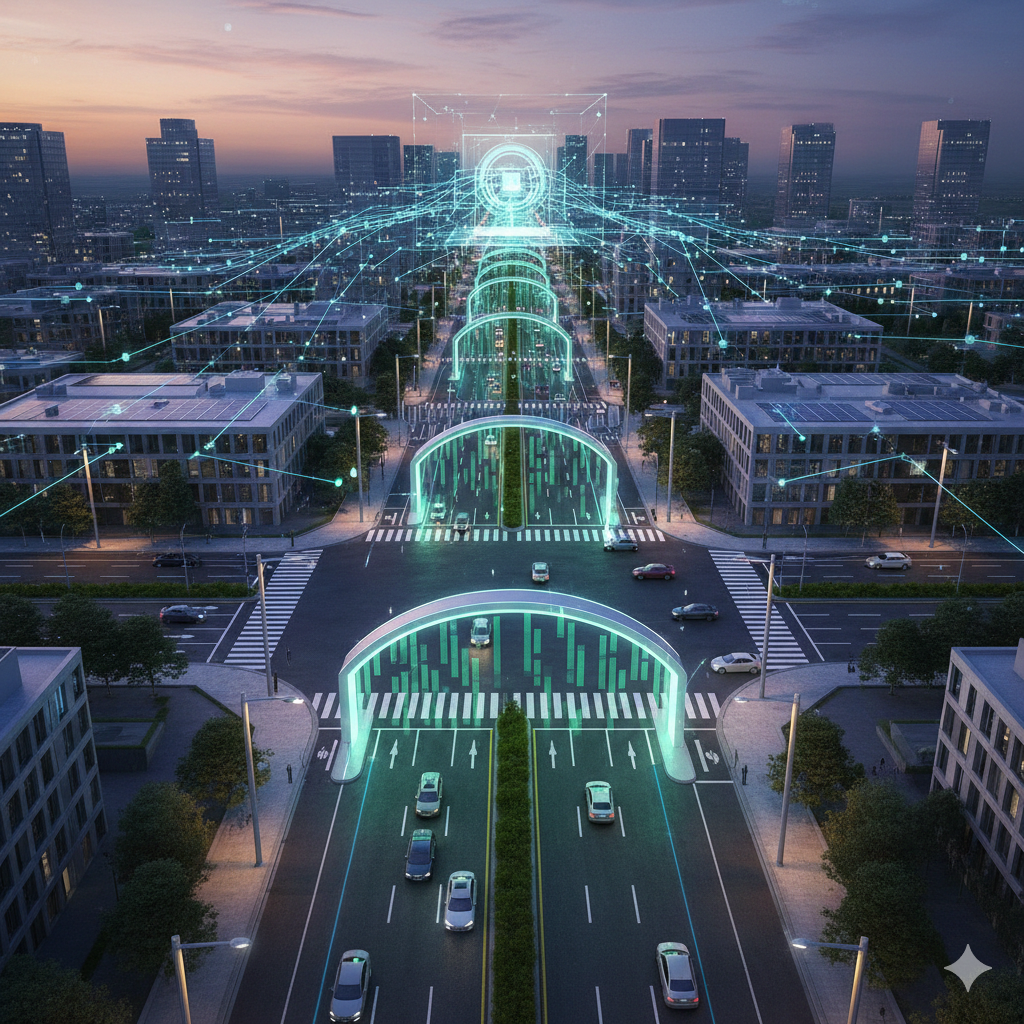
Artificial intelligence is no longer just a buzzword in technology circles; it has become the central nervous system of modern urban development. AI for smart cities refers to the integration of machine learning algorithms, big data analytics, and Internet of Things (IoT) sensors to manage municipal assets and services more efficiently.
In this guide, “smart cities” refers to urban environments that utilize technology to improve the quality of life for citizens, operational efficiency, and sustainability. We will specifically focus on two of the most critical and high-impact areas: traffic management and energy optimization.
As urbanization accelerates, cities face mounting pressure to reduce congestion and carbon footprints. AI offers a way to move from reactive management—fixing problems after they occur—to proactive optimization, where infrastructure anticipates the needs of its inhabitants.
Key Takeaways
- Proactive Traffic Control: AI shifts traffic management from static timers to dynamic, real-time adaptability, reducing wait times by up to 40%.
- Grid Stability: Machine learning balances energy loads by predicting usage spikes and managing renewable energy integration.
- Data-Driven Decisions: Sensors and cameras provide the raw data that AI processes to make split-second decisions for city-wide efficiency.
- Sustainability Focus: Optimizing traffic flow and energy distribution directly correlates to lower greenhouse gas emissions.
- Privacy Is Paramount: The widespread use of surveillance and data collection requires robust ethical frameworks and security measures.
Who This Is For (And Who It Isn’t)
This guide is for:
- Urban Planners and City Officials looking to understand the practical applications and benefits of implementing AI in municipal infrastructure.
- Tech Enthusiasts and Students who want a deep dive into the specific mechanisms of smart city technology.
- Sustainability Advocates interested in how technology intersects with environmental goals.
This guide is not for:
- Readers seeking a tutorial on coding specific AI algorithms (we cover the application, not the code).
- Those looking for a history of urban planning prior to the digital age.
The Core Mechanism: How AI Powers the Modern City
To understand how AI optimizes traffic and energy, it is essential to understand the underlying infrastructure. A smart city functions much like a biological organism, relying on a cycle of sensing, processing, and acting.
1. Sensing (The Eyes and Ears)
The foundation of any AI system is data. In a smart city context, this data is gathered through a vast network of IoT sensors.
- Traffic: Induction loops under the asphalt, LiDAR sensors on poles, and computer vision cameras track vehicle count, speed, and classification.
- Energy: Smart meters in homes and businesses, grid-level phasor measurement units (PMUs), and weather sensors monitor consumption and generation potential.
2. Processing (The Brain)
Raw data is useless without analysis. AI algorithms—specifically machine learning and deep learning models—process this information.
- Edge Computing: Processing data locally on the device (e.g., a smart traffic light) to make instant decisions without latency.
- Cloud Computing: Aggregating vast amounts of data in centralized servers for long-term pattern recognition and predictive modeling.
3. Acting (The Hands)
Once a decision is made, the system takes action.
- Traffic: Changing a traffic light from red to green, updating a digital speed limit sign, or sending a rerouting alert to connected vehicles.
- Energy: Automatically dimming streetlights when no one is around, or dispatching battery storage reserves during peak demand.
Revolutionizing Traffic Management with AI
Congestion is more than just an annoyance; it is a significant economic drain and a major contributor to pollution. Traditional traffic management relies on historical data and fixed schedules (e.g., the light stays green for 30 seconds regardless of traffic). Intelligent traffic management uses AI to adapt to real-time conditions.
Adaptive Traffic Signal Control
The most visible application of AI in traffic is the adaptive traffic signal. Unlike static timers, these systems use reinforcement learning to optimize traffic flow across an entire grid, not just a single intersection.
- How it works: Cameras and sensors detect the length of queues at an intersection. The AI model calculates the optimal timing to clear the queue while minimizing the impact on cross-traffic.
- Network Effect: The true power lies in coordination. If one intersection extends a green light to clear a heavy load, it communicates with downstream intersections to prepare them for the incoming wave of vehicles. This creates a “green wave” that keeps traffic moving.
Predictive Congestion Management
AI does not just react to traffic; it predicts it. By analyzing historical patterns, weather forecasts, and local events (like a sports game or concert), algorithms can forecast congestion hours or even days in advance.
- In Practice: A city’s traffic management center might see a prediction that a rainy Friday afternoon combined with a stadium event will gridlock the downtown core.
- Mitigation: The system can pre-emptively adjust traffic signal timings, update variable message signs to suggest alternate routes, and even incentivize public transport usage through app notifications before the jam forms.
Prioritizing Emergency and Public Transport
AI systems can identify specific types of vehicles using computer vision. This allows for:
- Emergency Signal Preemption: Ambulances and fire trucks communicate with traffic signals to turn lights green as they approach, drastically reducing response times.
- Transit Signal Priority (TSP): Buses running behind schedule can be given extended green lights to help them catch up, making public transit more reliable and attractive to commuters.
Smart Parking Solutions
A significant percentage of urban traffic is caused by drivers circling blocks looking for parking. AI-driven smart parking systems utilize sensors in parking spots or cameras to track occupancy.
- Guidance: Drivers are guided directly to open spots via mobile apps or digital street signage.
- Dynamic Pricing: Cities can adjust parking rates in real-time based on demand, encouraging turnover and reducing cruising time.
Energy Optimization: The Smart Grid and Beyond
As cities electrify transportation and heating, the demand on the power grid increases. AI is the critical tool for balancing this demand with supply, especially as we transition to intermittent renewable energy sources like wind and solar. This is the domain of smart grid technology.
Demand Response and Load Balancing
The hardest challenge for an energy grid is the peak load—those few hours a day when everyone turns on their AC or heats their dinner.
- The AI Solution: AI algorithms analyze consumption patterns to predict peaks with high precision.
- Automated Response: During predicted peaks, the system can automatically lower the energy usage of non-essential systems (like dimming streetlights by 10% or adjusting the thermostat of municipal buildings by one degree) in a process called “demand response.”
- Grid Stability: By smoothing out these peaks, cities avoid the need to fire up expensive and dirty “peaker” power plants.
Integrating Renewable Energy
Solar and wind power are notoriously unpredictable. Clouds block the sun; the wind dies down. This volatility is a nightmare for traditional grid operators.
- Forecasting: AI models use hyper-local weather data to predict renewable generation output minutes and hours ahead.
- Storage Management: If a cloud is approaching a major solar farm, the AI can pre-emptively discharge energy from battery storage systems to ensure the voltage on the grid remains stable, preventing brownouts.
Smart Street Lighting
Street lighting often accounts for a huge portion of a municipality’s energy bill. Traditional lights burn at 100% brightness all night, regardless of necessity.
- Adaptive Lighting: Smart lights equipped with motion sensors and AI controllers dim when streets are empty and brighten only when pedestrians or vehicles are detected.
- Maintenance: These lights also self-diagnose. Instead of waiting for a citizen to report a broken bulb, the light sends a maintenance request automatically, optimizing the route for repair crews.
Building Energy Management Systems (BEMS)
AI extends inside the buildings themselves. In smart cities, large commercial and residential buildings communicate with the grid.
- Optimization: AI analyzes occupancy sensors to heat, cool, and light only the areas of a building currently in use.
- Thermal Inertia: AI can pre-cool a building early in the morning when energy is cheap and let the building “coast” through the expensive afternoon hours, maintaining comfort while slashing costs.
The Role of Digital Twins in Urban Planning
A digital twin is a virtual replica of the physical city—a dynamic software model that uses real-world data to simulate how the city operates. This is a game-changer for AI deployment.
Simulation Before Implementation
Before a city installs a new bus lane or changes the timing of traffic lights, they can test it in the digital twin.
- Scenario Testing: Planners can run thousands of simulations: “What happens to traffic flow if we close Main Street for pedestrians?” or “How will the grid cope if 50% of cars in this neighborhood become electric next year?”
- Risk Reduction: This allows cities to identify bottlenecks and failures in the virtual world, avoiding expensive real-world mistakes.
Real-Time Monitoring
The digital twin is not just for planning; it is a live dashboard. City operators can look at the digital twin to see the real-time status of traffic, air quality, and energy consumption across the entire urban landscape.
Connectivity Standards: IoT and 5G Infrastructure
For AI for smart cities to function, the connection between devices must be fast, reliable, and capable of handling massive device density.
The Necessity of 5G
4G networks simply cannot support the density of devices required for a fully smart city (thousands of sensors per square mile).
- Latency: 5G offers ultra-low latency, which is critical for safety applications. An autonomous vehicle or a smart traffic light needs to react in milliseconds, not seconds.
- Bandwidth: High-bandwidth connections allow for the transmission of high-definition video streams from traffic cameras to central AI processors.
Interoperability
A major hurdle is ensuring that the traffic lights (made by Vendor A) can talk to the connected cars (made by Vendor B) and the energy grid (managed by Vendor C).
- Protocols: Adoption of standard communication protocols (like MQTT, CoAP, or specific smart city standards like FIWARE) is essential to prevent data silos where systems cannot communicate with each other.
Real-World Applications and Case Studies
Singapore: The Gold Standard in Traffic
Singapore is frequently cited as a leader in smart city infrastructure.
- Electronic Road Pricing (ERP): They utilize a dynamic toll system that uses AI to adjust prices based on real-time congestion levels. If traffic builds up, the toll rises instantly to discourage more drivers from entering the zone.
- Outcome: This has resulted in one of the smoothest flowing urban traffic systems in the world, despite high population density.
Copenhagen: Carbon Neutrality through Energy Tech
Copenhagen has set an ambitious goal to be the world’s first carbon-neutral capital.
- EnergyLab Nordhavn: This is a living lab for smart energy technologies. They integrate electric heating, district heating, and electric transport into a flexible, intelligent energy system.
- Result: AI algorithms manage the fluctuating heat and power demands, utilizing waste heat from supermarkets and industry to warm homes.
Pittsburgh, USA: Surtrac
Pittsburgh implemented an AI traffic signal control system called Surtrac (Scalable Urban Traffic Control).
- Mechanism: Each intersection manages its own traffic but communicates its plan to neighbors.
- Stats: Travel times were reduced by 25%, and time spent idling dropped by 40%, directly lowering emissions.
Challenges and Ethical Considerations
While the benefits are clear, the deployment of AI in smart cities raises significant ethical and practical concerns that must be addressed.
Data Privacy and Surveillance
To optimize traffic, you need to know where people are going. To optimize energy, you need to know when they are home.
- The Risk: There is a fine line between optimization and surveillance. Citizens are often wary of “Big Brother” scenarios where their movements are constantly tracked.
- Mitigation: Cities must implement Privacy by Design. Data should be anonymized at the source. For example, a camera should count a “pedestrian” without using facial recognition to identify who the pedestrian is.
Cybersecurity Risks
Connecting critical infrastructure to the internet introduces vulnerability.
- The Threat: A cyberattack on a smart grid could cause a city-wide blackout. Hacking traffic lights could cause accidents or gridlock.
- Defense: Robust encryption, regular penetration testing, and air-gapped backups are non-negotiable requirements for smart city architecture.
The Digital Divide and Equity
Smart city benefits must be distributed equally.
- The Risk: High-tech implementations often start in wealthy neighborhoods, leaving lower-income areas with outdated infrastructure.
- Equity Focus: Urban mobility solutions and air quality monitoring must be prioritized in underserved communities which often suffer the most from pollution and poor transit access.
Best Practices for Implementation
For cities looking to adopt these technologies, a strategic approach is vital.
1. Start with Pilot Projects
Do not attempt to overhaul the entire city at once. Pick one corridor for smart traffic lights or one neighborhood for smart metering. Learn from the deployment, refine the AI models, and then scale up.
2. Focus on Problems, Not Technology
Avoid “solutionism”—buying tech just to have it. Define the problem clearly first (e.g., “The intersection at 5th and Main has a high accident rate”) and then apply the specific AI tool that solves it.
3. Public Engagement
Transparency builds trust. City officials should clearly communicate what data is being collected, how it is used, and how it benefits the public. Open data portals where citizens can see the improvements (e.g., “AI saved 500 hours of commute time this week”) help justify the investment.
Common Pitfalls in Smart City Projects
Even with good intentions, many projects fail.
- Vendor Lock-In: Signing contracts with proprietary systems that cannot integrate with other hardware. Cities should insist on open standards and APIs.
- Underestimating Maintenance: AI systems are not “set and forget.” Sensors get dirty, cameras fail, and models need retraining. Budgets must include long-term maintenance, not just initial installation.
- Ignoring the Human Element: Optimizing purely for math can lead to hostile cities. For example, optimizing traffic flow so aggressively that pedestrians never get enough time to cross the street safely.
The Future of AI in Urban Environments
As we look toward the remainder of the decade, several trends will define the next generation of smart cities.
V2X (Vehicle-to-Everything) Communication
We are moving toward a future where cars talk directly to the city.
- Safety: A traffic light will tell an approaching car that it is about to turn red, and the car will automatically slow down.
- Efficiency: Cars will “platoon” closer together, communicating their braking and acceleration instantly, which drastically increases road capacity.
Self-Healing Grids
AI will evolve from predictive to autonomous. In the event of a storm damage, the grid will automatically isolate the faulted section and reroute power around it to restore service to as many homes as possible instantly, without human intervention.
AI-Driven Policy Making
AI will eventually move upstream from operations to policy. By analyzing years of complex urban data, AI will suggest zoning changes, public transit route alterations, and new infrastructure projects that humans might not have intuitively considered.
Related Topics to Explore
- Autonomous Vehicle Integration: How self-driving cars will interface with smart infrastructure.
- Green Tech and Sustainability: Broader technologies beyond AI that contribute to carbon-neutral cities.
- IoT Security Standards: A technical look at how we secure the billions of devices connecting to our networks.
- Edge Computing in Depth: How processing data locally saves bandwidth and improves privacy.
Conclusion
AI for smart cities represents a fundamental shift in how we inhabit urban spaces. By leveraging intelligent traffic management and urban energy optimization, cities can become more than just concrete jungles; they can become responsive, living ecosystems that care for their citizens.
The technology exists today to banish gridlock and waste. The challenge now lies not in the silicon, but in the policy, the implementation, and the ethical frameworks we build around it. As of early 2026, the cities that succeed will be those that use AI not to replace human decision-making, but to empower it—creating environments that are efficient, sustainable, and equitably livable for all.
Next Step: If you are involved in local governance or community planning, investigate your city’s “Open Data” portal to see what traffic or energy datasets are currently available—this is the first step toward advocating for smarter solutions in your neighborhood.
FAQs
1. How does AI actually reduce traffic congestion? AI reduces congestion by using real-time data from cameras and sensors to adjust traffic signal timings dynamically. Instead of fixed cycles, the lights adapt to current traffic flow, creating “green waves” and preventing bottlenecks before they form.
2. Is my privacy at risk in a smart city? Privacy is a valid concern. However, reputable smart city projects use “Privacy by Design,” ensuring data is anonymized. Cameras process video to count cars or pedestrians without storing identifiable images or tracking individuals.
3. Can smart cities work with old infrastructure? Yes. You do not need to rebuild the city. AI sensors and controllers can often be retrofitted onto existing traffic lights, streetlamps, and power grids, making existing infrastructure “smart” without a complete demolition.
4. What is the biggest challenge in implementing AI in cities? The biggest challenge is often data integration. Cities have data in silos (traffic dept, energy dept, sanitation). Getting these disparate legacy systems to “talk” to a central AI platform requires significant effort and standardization.
5. How does AI help with renewable energy? Renewable energy like solar and wind is variable. AI predicts weather patterns to forecast exactly how much energy will be generated, allowing the grid to balance the load or store excess energy in batteries efficiently.
6. What is a “Digital Twin”? A digital twin is a virtual computer model of the city. Planners use it to simulate traffic changes or new buildings to see the impact on the city’s flow and energy use before spending money on physical construction.
7. Does AI replace human city planners? No. AI provides the data and the simulations, but human planners are essential for setting the goals, making ethical decisions, and ensuring the city remains a culturally vibrant and human-centric place to live.
8. Is 5G required for smart cities? While some smart features work on 4G or Wi-Fi, 5G is crucial for advanced applications like autonomous vehicles and massive sensor networks because it offers the low latency and high device density support that older networks cannot match.
9. How do smart streetlights save money? They save money by dimming when no one is around. Instead of running at 100% brightness all night, they may run at 30% and only brighten when sensors detect a car or pedestrian, reducing energy costs significantly.
10. What happens if the smart city system gets hacked? Cybersecurity is critical. If hacked, systems could be disrupted. This is why smart cities employ military-grade encryption, segmented networks (so a hack in one area doesn’t spread), and manual overrides to ensure safety even if the digital system fails.
References
- Singapore Government Agency. (n.d.). Smart Nation Singapore: Transforming Singapore Through Technology. Smart Nation Singapore. https://www.smartnation.gov.sg
- U.S. Department of Transportation. (2024). Intelligent Transportation Systems (ITS) Joint Program Office. United States Department of Transportation. https://www.its.dot.gov
- European Commission. (n.d.). Smart Cities and Communities. European Commission Energy Strategies. https://energy.ec.europa.eu
- International Energy Agency (IEA). (2025). Digitalisation and Energy. IEA. https://www.iea.org
- IEEE Smart Cities. (n.d.). Global Smart Cities Community and Standards. IEEE. https://smartcities.ieee.org
- National Institute of Standards and Technology (NIST). (2023). IoT-Enabled Smart City Framework. U.S. Department of Commerce. https://www.nist.gov
- C40 Cities. (n.d.). C40 Knowledge Hub: Smart Cities and Climate Change. C40 Cities Climate Leadership Group. https://www.c40knowledgehub.org
- Carnegie Mellon University. (n.d.). Traffic21 Institute: Smart Transportation Applications. Carnegie Mellon University. https://traffic21.heinz.cmu.edu