The promise of self-driving cars has long captured the public imagination, offering a vision of safer roads, reduced congestion, and reclaimed commute time. However, the transition from controlled pilot programs to mass-market deployment is not merely a technological challenge—it is profoundly a legal and regulatory one. As of January 2026, the industry sits at a critical juncture where technology often outpaces the laws designed to govern it.
For policymakers, manufacturers, and the public, understanding autonomous vehicle regulations is no longer optional; it is essential to navigating the future of mobility. The shift from “driver” to “operator” to “passenger” fundamentally alters centuries of legal precedent regarding liability, insurance, and safety certification. While some regions accelerate deployment with permissive frameworks, others adopt a precautionary approach, prioritizing stringent safety benchmarks over speed of market entry.
Key Takeaways
- Fragmentation remains the norm: There is no single global standard for autonomous vehicles (AVs); the US, EU, and China maintain distinct, often competing, regulatory philosophies.
- Liability is shifting: Legal frameworks are gradually moving liability from the human driver to the automated driving system (ADS) provider, particularly for SAE Level 3 and above.
- Adoption is sectoral: Mass adoption timelines differ significantly between robotaxis (MaaS), autonomous trucking, and consumer-owned passenger vehicles.
- Safety over novelty: As of January 2026, regulators are increasingly enforcing “proven safety” metrics (e.g., miles between disengagements, collision rates) rather than self-certification.
- Infrastructure dependencies: New regulations are beginning to address Vehicle-to-Infrastructure (V2I) communication standards, making smart roads a prerequisite for certain autonomous tiers.
Who This Is For (and Who It Isn’t)
This guide is designed for industry stakeholders, policy researchers, investors, and automotive enthusiasts who want a deep, realistic understanding of the legal structures governing AVs. It covers the mechanisms of approval, liability shifts, and projected timelines.
- It is not a technical engineering manual on how LiDAR or neural networks function, nor is it a speculative sci-fi piece about a driverless utopia.
Scope of This Guide
In this guide, autonomous vehicle regulations refer to the laws and standards governing SAE Level 3, 4, and 5 vehicles (conditional, high, and full automation) intended for use on public roadways. This includes passenger cars, robotaxis, and heavy-duty freight trucks. It specifically excludes low-speed sidewalk delivery bots, aerial drones, or off-road industrial automation, which operate under different regulatory regimes.
1. Understanding the Regulatory Foundation: SAE Levels
To discuss regulation effectively, we must first clarify what is being regulated. Regulators globally rely on the Society of Automotive Engineers (SAE) J3016 standard, which defines six levels of driving automation.
The Regulatory Divide: ADAS vs. ADS
Legally, the most significant boundary is not between Level 4 and 5, but between Level 2 and Level 3.
- Levels 0–2 (Driver Support): These systems (like adaptive cruise control or lane-centering) are legally considered “driver assistance.” The human driver is fully responsible for the dynamic driving task (DDT) at all times. Regulations here focus on ensuring the driver stays engaged (e.g., hands-on steering wheel detection).
- Levels 3–5 (Automated Driving Systems – ADS): Here, the system performs the entire dynamic driving task.
- Level 3 (Conditional Automation): The car drives itself, but the human must take over when requested. This “hand-off” is a regulatory nightmare regarding liability.
- Level 4 (High Automation): The car drives itself within a specific operational design domain (ODD)—a specific city, weather condition, or route. No human intervention is required within that ODD.
- Level 5 (Full Automation): The car can drive anywhere a human can, in any condition.
Most autonomous vehicle regulations currently being written target Level 4 deployment (robotaxis and trucking) because Level 3 presents complex human-factors challenges that many manufacturers are choosing to skip.
2. The United States: A Patchwork of Innovation
As of January 2026, the United States remains a leader in AV technology development but continues to struggle with a unified federal regulatory framework. The approach can be characterized as “permissive fragmentation.”
Federal Guidance vs. State Authority
The National Highway Traffic Safety Administration (NHTSA) sets Federal Motor Vehicle Safety Standards (FMVSS). Historically, these standards required vehicles to have human controls (steering wheels, pedals).
- Exemptions and Updates: NHTSA has moved to update FMVSS to allow for vehicles designed without human controls, primarily through the exemption process. This allows companies like Waymo, Zoox, and Cruise to deploy limited fleets of purpose-built vehicles.
- Voluntary Safety Self-Assessments (VSSA): The federal approach has largely relied on voluntary reporting from manufacturers regarding safety cases, operational domains, and crash data. This “self-certification” model encourages innovation but draws criticism for a lack of standardized testing.
The Role of States
Because federal law focuses on vehicle design, state laws govern vehicle operation (licensing, registration, traffic laws). This has created a patchwork landscape:
- California: The Department of Motor Vehicles (DMV) and the Public Utilities Commission (CPUC) have created one of the most rigorous permitting processes in the world. Companies must progress from testing with a driver, to driverless testing, to commercial deployment. California also enforces strict collision reporting and disengagement reporting requirements.
- Arizona and Texas: These states have adopted highly permissive statutes to attract AV testing. They treat AVs largely the same as human drivers, provided they meet basic insurance and registration requirements. This has made them hubs for autonomous trucking and robotaxi expansion.
- Preemption Issues: A major ongoing legal tension is “preemption”—whether federal safety standards override stricter state bans. For now, states retain the right to regulate the operation of AVs on their roads, allowing them to effectively ban or restrict testing if safety concerns arise.
Practical Impact on Adoption
This patchwork means a vehicle that is legal to operate autonomously in Phoenix might be illegal or require different permits in San Francisco or New York. For adoption timelines, this suggests a city-by-city rollout rather than a nationwide “switch flip.”
3. The European Union: The Homologation Model
In contrast to the US self-certification model, the European Union (EU) employs a “type approval” (homologation) system. Before a vehicle can be sold or operated, it must be certified by government authorities that it meets specific technical requirements.
UNECE Regulation 157
The cornerstone of the EU’s approach (and many other nations aligned with UN regulations) is UNECE Regulation 157.
- Automated Lane Keeping Systems (ALKS): Initially, this regulation allowed for Level 3 automated driving only on highways at speeds up to 60 km/h (essentially traffic jam pilot).
- Expansions: As of January 2026, updates have expanded these speed limits and operational domains, allowing for higher-speed highway cruising. However, the requirements for the system to detect imminent collisions and manage “minimum risk maneuvers” (pulling over safely) are incredibly prescriptive.
The EU AI Act
The EU’s broad Artificial Intelligence Act classifies AVs as “high-risk” AI systems. This adds another layer of compliance involving:
- Data Governance: Strict rules on the quality of training data to prevent bias.
- Transparency: Requirements for technical documentation and record-keeping.
- Human Oversight: Ensuring the design allows for effective human supervision (even if remote).
Comparison: US vs. EU Regulatory Philosophies
| Feature | United States Model | European Union Model |
| Core Philosophy | Innovation-first; permissive until proven unsafe. | Precautionary; prove safety before market entry. |
| Certification | Self-certification by manufacturer. | Third-party Type Approval (Homologation). |
| Regulatory Body | NHTSA (Federal) + State DMVs. | European Commission + UNECE. |
| Data Rules | Patchwork privacy laws. | GDPR + AI Act (Strict). |
| Primary Barrier | Liability uncertainty & State fragmentation. | Rigid technical standards slowing deployment. |
4. Asia-Pacific Leaders: Strategic Coordination
The Asia-Pacific region, led primarily by China and Japan, views autonomous vehicle regulations as a matter of national industrial strategy.
China: Top-Down Acceleration
China has designated specific zones for aggressive AV testing and commercialization. The government supports the creation of “smart cities” designed to interact with “smart cars” (Vehicle-to-Infrastructure or V2I).
- Standardization: China creates national standards for AV maps, communication protocols, and cybersecurity, forcing foreign entrants to partner with local entities.
- Robotaxi Licensing: Cities like Beijing and Shanghai issue licenses for fully driverless commercial operations faster than many Western counterparts, driven by a desire to lead the global AI race.
Japan: Aging Population Driver
Japan’s regulatory motivation is demographic. With a rapidly aging population and a shortage of drivers, Japan was one of the first countries to legally allow Level 3 vehicles (Honda Legend) on public roads. Their regulations prioritize practical deployment for public transit and last-mile delivery to service rural elderly populations.
5. The Liability Quagmire: Who Pays When It Crashes?
One of the most complex aspects of autonomous vehicle regulations is the shift in liability.
From Negligence to Product Liability
In traditional driving, if a crash occurs, we ask: “Was the driver negligent?” (Did they speed, text, or drink?). In autonomous driving, if the software makes a mistake, the question becomes a matter of product liability.
- Defective Design: Claiming the algorithm itself was flawed.
- Failure to Warn: Claiming the human user wasn’t properly instructed on the system’s limitations.
The “Moral Crumple Zone”
Legal scholars warn of a “moral crumple zone” where humans are legally blamed for machine errors. This is especially pertinent in Level 3 systems. If a car requests a handover 5 seconds before a crash, and the human fails to react in time, who is at fault?
- Regulatory Solution: Newer regulations, particularly in the UK and Germany, are establishing clear lines. When the ADS is engaged, the manufacturer is liable for moving traffic offenses. The human is only liable if they ignore a clear handover request or fail to maintain the vehicle (e.g., bald tires).
Insurance Evolution
Insurance is shifting from “personal auto policies” to “commercial product lines.” We are seeing a split model:
- Personal Liability: Covers the vehicle when the human is driving.
- Product Liability: Covers the vehicle when the ADS is engaged. Major insurers are developing “hybrid” policies that seamlessly switch coverage based on the vehicle’s mode at the time of an incident.
6. Adoption Timelines: A Realistic Outlook
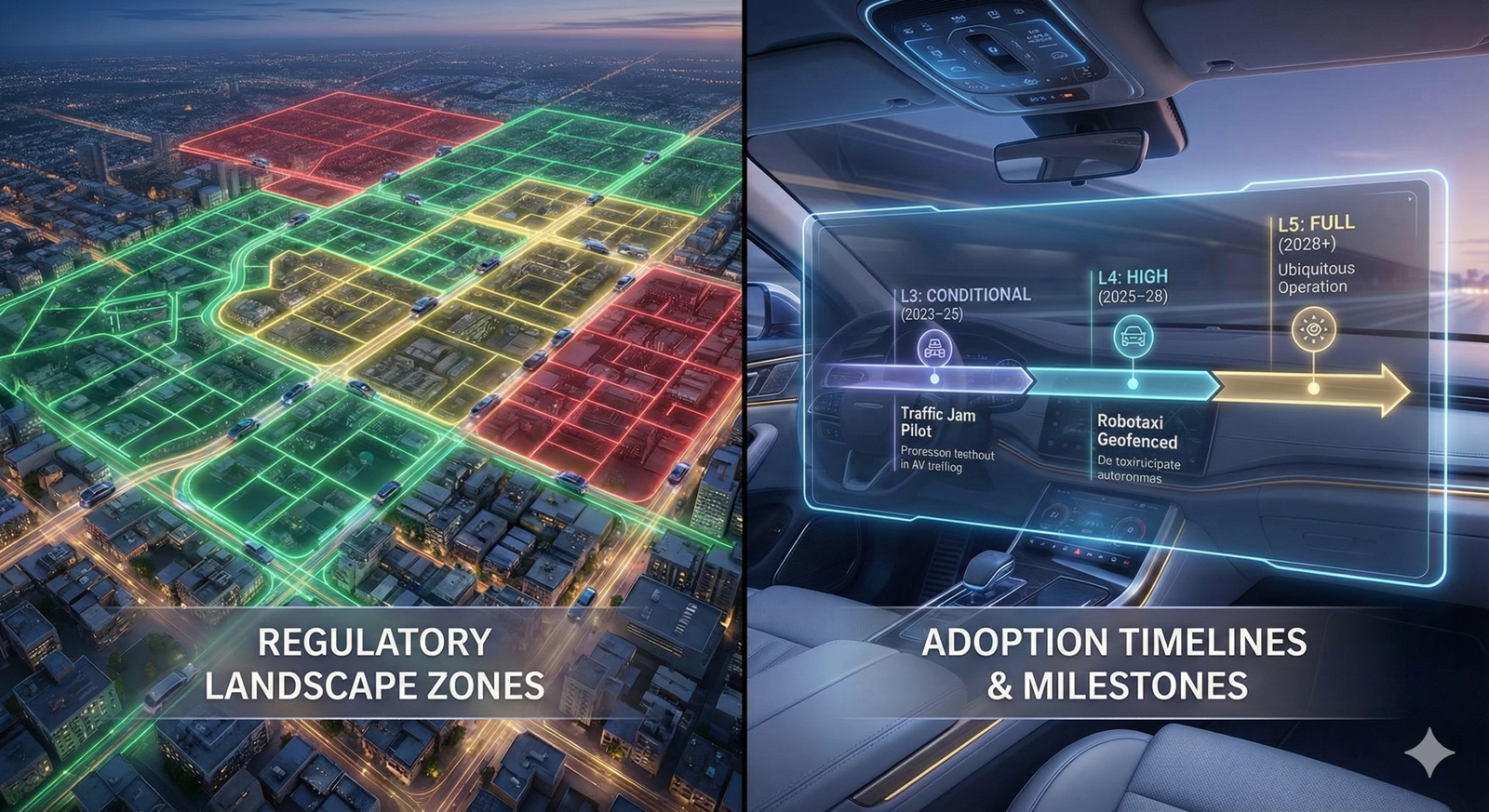
Predicting adoption timelines requires separating the “possible” from the “permissible” and “profitable.” Based on the regulatory landscapes of 2026, here are the projected phases for mass adoption.
Phase 1: Commercial Robotaxis (Current – 2028)
- Status: Active in specific geofenced cities (San Francisco, Phoenix, Shanghai).
- Regulatory Enabler: Local permits and exemptions from FMVSS requirements.
- Constraint: These vehicles operate Level 4 but only in highly mapped, weather-permissive areas. Expansion is slow because every new city requires new mapping and regulatory approval.
- Timeline: Expect “island” adoption—ubiquitous in tech hubs and warm-weather capitals, but nonexistent in rural areas or snowy regions until post-2028.
Phase 2: Autonomous Trucking (2026 – 2030)
- Status: Hub-to-hub highway pilots.
- Regulatory Enabler: Interstate commerce laws. Highway driving is technically simpler (no pedestrians, predictable lanes) but the kinetic energy of a semi-truck raises the safety stakes.
- Constraint: The “transfer” problem. Getting the truck from the highway exit to the warehouse dock often still requires a human or remote assistance.
- Timeline: Significant adoption on major freight corridors (e.g., I-10 in the US) is expected by 2028. This will likely be a “transfer hub” model where human drivers handle the last mile.
Phase 3: Consumer Personal AVs (2030+)
- Status: Limited Level 3 features (traffic jam pilot) available in luxury cars.
- Regulatory Enabler: Standardization of liability laws. Consumers are hesitant to buy a car that might expose them to confusing legal risks.
- Constraint: Cost and Maintenance. Level 4 sensors (LiDAR) are expensive to buy and calibrate. Regulators may require strict annual inspections for sensor calibration, increasing the cost of ownership.
- Timeline: True “sleep in the back seat” Level 4 personal cars are unlikely to be mass-market affordable or legally cleared for general purchase before 2030–2032.
7. Common Mistakes in Understanding AV Regulation
When discussing autonomous vehicle regulations, several misconceptions persist.
Mistake 1: Assuming “Federal Legalization” Means “Everywhere”
Just because a federal government passes a safety standard for AVs does not mean they will be allowed on every street. Cities will retain the right to designate “AV-free zones” (e.g., school zones, historic districts) or “AV-only lanes.” Regulation will be layered: Federal (Safety) -> State (Licensing) -> Municipal (Access).
Mistake 2: The Trolley Problem Obsession
Public discourse often obsesses over the “Trolley Problem” (should the car hit the nun or the child?). In practice, regulators do not codify ethics in this way. Regulations focus on collision avoidance hierarchies: avoid all collisions first; if unavoidable, mitigate energy impact. The law focuses on negligence and safety assurance, not philosophical decision trees.
Mistake 3: Ignoring Cybersecurity
We often think of physical crashes, but cyber-regulation is equally critical. UNECE R155 mandates cybersecurity management systems. If a manufacturer cannot prove they can update the fleet to patch a hack within a set timeframe, they lose their license to operate. This “continuing compliance” is a new regulatory concept for the auto industry.
8. Designing for Accessibility and Inclusion
A critical promise of autonomous vehicles is mobility for those who cannot drive: the elderly, the blind, and people with physical disabilities.
- Regulatory Mandate: Disability advocates are pushing for regulations that mandate inclusive design before mass deployment. This includes wheelchair-accessible robotaxis and audio-haptic interfaces for visually impaired passengers.
- The Service Gap: There is a risk that purely market-driven regulation will result in services that only cater to affluent urbanites. “Universal Service Obligations”—similar to those in telecommunications—may be required to ensure AVs serve rural and underserved communities.
9. Conclusion
The landscape of autonomous vehicle regulations in 2026 is no longer the “Wild West” of the early 2020s. It is maturing into a complex ecosystem of safety certifications, liability frameworks, and operational permits. While the US favors innovation through patchwork experimentation, the EU drives a unified, safety-first homologation process, and China leverages top-down infrastructure integration.
For businesses and consumers, the timeline for adoption is not a single date but a sliding scale dependent on use case. Robotaxis are here (in pockets), trucking is arriving (on highways), and the personal “sleep-while-commuting” car remains a distant horizon, likely post-2030.
Next Steps: If you are a business leader, audit your logistics chain for potential autonomous trucking integration on major corridors. If you are a policy maker, focus on creating clear liability frameworks that encourage safety without stifling the testing required to achieve it.
FAQs
1. Are fully autonomous vehicles legal in the US as of 2026? Fully autonomous vehicles (Level 4/5) are legal to operate in specific states like California, Arizona, and Texas, often under specific permits. There is no federal ban, but vehicles must comply with or get exemptions from Federal Motor Vehicle Safety Standards (FMVSS).
2. Who is responsible if a self-driving car crashes? Liability depends on the automation level. For Level 2, the human driver is responsible. For Level 3 and above, when the system is engaged, liability generally shifts to the manufacturer or software provider, though laws vary by jurisdiction.
3. What is the difference between Level 3 and Level 4 automation? Level 3 requires a human driver to be present and ready to take over when the car requests it. Level 4 does not require human intervention within its specific operational domain (e.g., a specific city or highway), meaning the car can pull itself over safely if something goes wrong.
4. When will autonomous trucks replace human drivers? Complete replacement is unlikely soon. However, “hub-to-hub” autonomous trucking on highways is expected to scale significantly between 2026 and 2030, with human drivers handling the complex urban driving at either end of the route.
5. Do autonomous vehicles require special insurance? Yes. Insurance is evolving towards product liability models for manufacturers and hybrid policies for owners. Fleet operators (robotaxis) carry massive commercial liability policies rather than personal auto insurance.
6. How do EU regulations differ from US regulations for AVs? The EU uses a “type approval” system where vehicles must pass strict government tests before being sold. The US uses a “self-certification” system where manufacturers certify their own compliance, with regulators stepping in primarily when safety defects are found.
7. Can autonomous vehicles operate in snow and rain? This remains a technical and regulatory challenge. Most current Level 4 regulatory permits restrict operation to favorable weather conditions. Heavy snow or rain can obscure sensors (LiDAR/Cameras), often causing the vehicle to pull over or not start.
8. What is UNECE Regulation 157? It is a United Nations regulation adopted by many countries (including the EU, Japan, and UK) that sets the first international safety standards for Automated Lane Keeping Systems (ALKS), initially for low speeds and now expanding to higher speeds.
9. Are there cybersecurity laws for autonomous vehicles? Yes. Regulations like UNECE R155 mandate that manufacturers have a certified Cybersecurity Management System (CSMS) to detect and respond to cyber threats. Without this certification, new vehicle types cannot be approved in participating markets.
10. Will autonomous vehicles make traffic laws obsolete? No, but they will change enforcement. Traffic laws will need to be digitized so AVs can interpret them directly. Enforcement will likely move from roadside stops to digital audits of the vehicle’s data logs after an infraction is detected.
References
- National Highway Traffic Safety Administration (NHTSA). Automated Vehicles for Safety. NHTSA.gov. (Official US federal guidance and FMVSS updates).
- SAE International. Taxonomy and Definitions for Terms Related to Driving Automation Systems for On-Road Motor Vehicles (J3016). (The global standard for automation levels).
- United Nations Economic Commission for Europe (UNECE). UN Regulation No. 157 – Automated Lane Keeping Systems (ALKS). (The primary international standard for Type Approval of Level 3 systems).
- California Department of Motor Vehicles. Autonomous Vehicle Testing and Deployment Permits. DMV.ca.gov. (Source for state-level regulatory data and disengagement reports).
- European Commission. General Safety Regulation (GSR) for Motor Vehicles. (EU safety mandates including intelligent speed assistance and black boxes).
- European Union. Artificial Intelligence Act (AI Act). (Broad regulatory framework classifying AVs as high-risk AI).
- Insurance Institute for Highway Safety (IIHS). Automation and crash avoidance. (Research on safety benefits and limitations of current automation tiers).
- RAND Corporation. Measuring Automated Vehicle Safety. (Academic analysis of statistical reliability required for AV deployment).
- UK Department for Transport. Automated Vehicles Act 2024. (Legislation defining liability for user-in-charge vs. autonomous entity).
- ISO (International Organization for Standardization). ISO 26262 – Road vehicles – Functional safety. (The definitive technical standard for functional safety in automotive electronics).