| Myth | Reality |
|---|---|
| Adversarial attacks on cameras are a theoretical, lab-only concern. | Printed adversarial patches, adversarial clothing, and projected light patterns have been demonstrated repeatedly against real object detectors and face-recognition pipelines deployed in production-like conditions. |
| A higher-resolution camera automatically resists adversarial patterns. | Resolution improves image quality but does not address the underlying model vulnerability; a high-definition camera can still misclassify a patterned patch as easily as a low-resolution one. |
| Adversarial robustness is the same problem as robot sensor spoofing. | Robot-jacking targets a machine’s own navigation and actuation loop; physical-security vision attacks target human-facing surveillance and access-control decisions, a distinct application domain with different failure consequences. |
| Liveness detection alone stops facial-recognition bypass. | Liveness checks catch photo and video replay but are frequently bypassed by physical adversarial accessories such as patterned glasses, hats, or makeup that pass liveness while still corrupting the recognition decision. |
Why Physical Security Cameras Are a Distinct Attack Surface
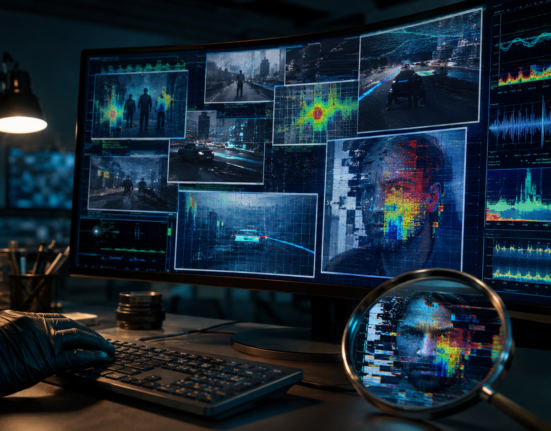
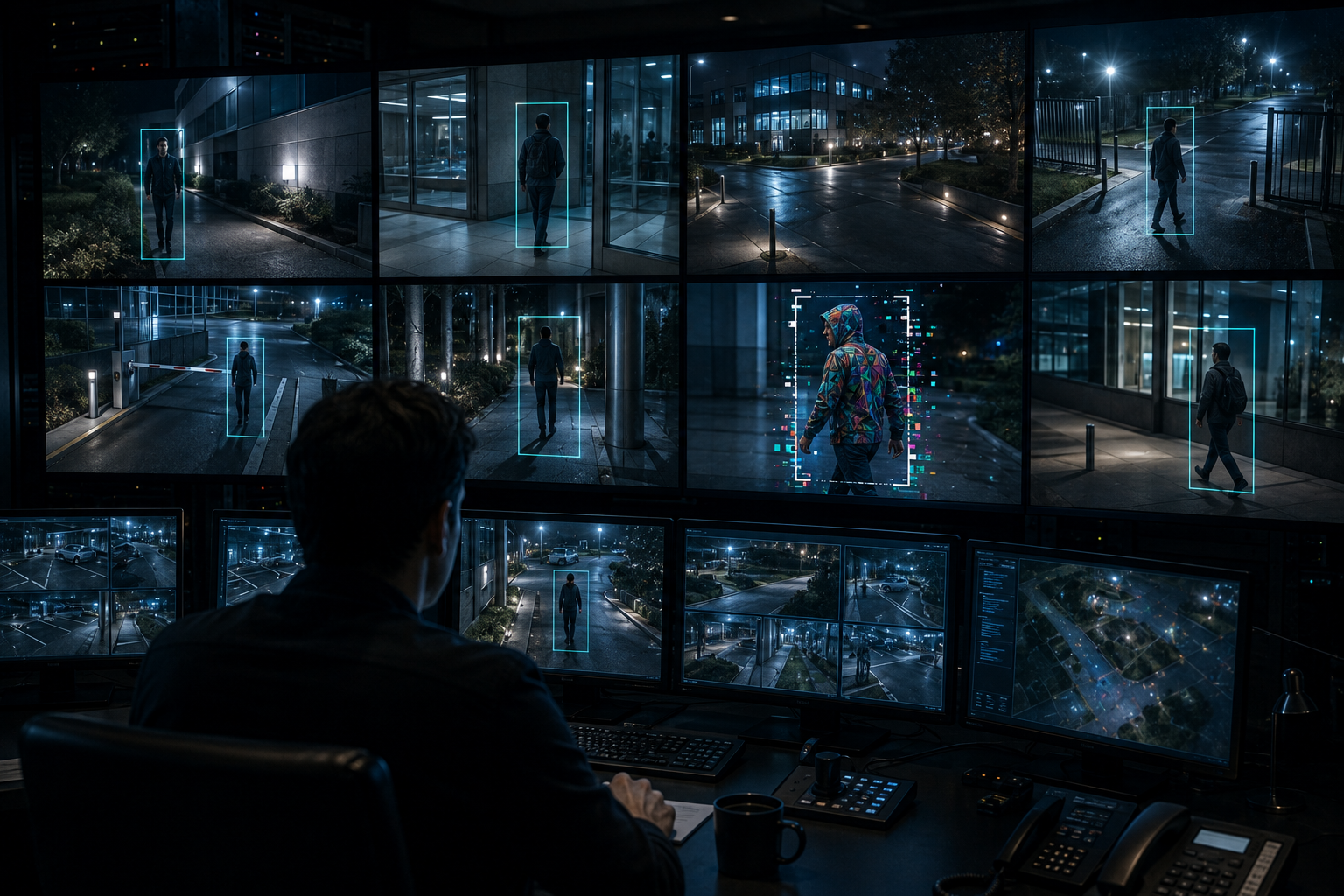
Physical security has quietly become an AI application. Perimeter cameras run object-detection models to flag intruders. Access-control gates run facial-recognition models to admit employees. Retail and campus CCTV networks run analytics models to detect loitering, tailgating, or left-behind objects. Every one of these systems shares a weakness that has nothing to do with lenses, sensors, or bandwidth: the deep-learning models underneath them can be manipulated by carefully crafted visual inputs that a human glancing at the same scene would never notice as unusual.
This is a different problem from the adversarial machine learning risks facing autonomous robots and industrial cobots, where the goal is to corrupt a machine’s own sense-plan-act loop and manipulate its movement or actions. Our companion piece on protecting physical AI against robot-jacking covers that robot-specific angle in depth. Physical security vision systems are consumed by humans and access-control logic, not by a robot’s own motors, so the attack goal is almost always evasion (become invisible to detection) or impersonation (be misclassified as someone else, usually someone with legitimate access).
Security teams that treat cameras purely as an IT asset — patch the firmware, rotate the credentials, encrypt the video stream — miss the layer that actually makes decisions: the vision model itself. A camera can be fully patched, fully encrypted, and still be fooled by a sticker.
Anatomy of an Adversarial Attack on Surveillance Vision
Adversarial examples exploit the fact that deep neural networks make decisions based on statistical patterns in pixel data rather than genuine semantic understanding of a scene. A small, deliberately computed perturbation — invisible or nonsensical to a person — can push a model’s internal representation of an image across a decision boundary, causing a confident misclassification.
Adversarial patches
The most mature and widely reproduced attack class is the adversarial patch: a printed image, often bright and geometric, that is optimized so that when it appears anywhere in a camera’s field of view, it dominates the detector’s attention and either suppresses the correct detection or forces a false one. Patches have been shown to conceal pedestrians from object detectors, to make one person’s face register as another in a facial-recognition pipeline, and to disrupt the detectors used in physical-world object-detection benchmarks. Because the patch is printed and physical, it survives lighting changes, camera angle shifts, and moderate distance, which is what separates a genuine physical-world threat from a purely digital curiosity.
Light-based and acoustic attacks
A newer family of attacks manipulates the light entering a lens rather than an object in the scene. Adversarial neon-beam and catoptric (mirror-reflected) light attacks project carefully shaped colored light onto a target or directly toward a camera, corrupting the image before it ever reaches the detection model, without needing to place a physical patch on the subject. Separately, acoustic adversarial research has shown that carefully tuned sound can induce physical vibration in a camera’s optical stabilization system, degrading frames enough to disrupt detection — a channel security teams rarely consider when they audit “visual” attack surfaces.
Adversarial apparel and evasion wearables
Printed adversarial patterns have moved from static patches to wearable garments. Thermally activated dual-modal adversarial clothing has been demonstrated to defeat both visible-spectrum and thermal-camera detection simultaneously, meaning an intruder wearing the right pattern can walk through a dual-sensor perimeter system undetected by either channel at once. Adversarial eyewear, hats, and printed accessories designed specifically against face-verification systems have also been shown to flip a recognition decision from “unknown” to a specific enrolled identity.
| Attack technique | Target subsystem | Typical goal | Detectability by humans |
|---|---|---|---|
| Printed adversarial patch | Object detectors, perimeter cameras | Evasion (vanish from detection) | Visible but often dismissed as graffiti or clothing print |
| Adversarial glasses/hat/mask | Facial-recognition access control | Impersonation or evasion | Visible, may look like ordinary eyewear or accessory |
| Projected light / catoptric attack | Camera sensor, image pipeline | Evasion, blinding of detection | Low; may appear as reflection or glare |
| Acoustic adversarial vibration | Camera stabilization and optics | Frame degradation, evasion | Very low; no visual cue at all |
| Adversarial clothing (multi-spectrum) | Visible and thermal detection | Evasion across dual-sensor systems | Visible pattern, easily mistaken for fashion print |
Facial Recognition Access Control: A High-Value Target
Access-control gates are more attractive to attackers than general perimeter cameras because a successful bypass does not just avoid detection, it actively grants a privilege: door unlock, turnstile release, or badge-free entry. Two attack goals dominate here.
Impersonation versus evasion attacks
An evasion attack against facial recognition tries to make the system fail to recognize a legitimate enrolled user, useful for denial-of-service style disruption. An impersonation attack is more dangerous operationally: it tries to make the system recognize an unauthorized individual as an enrolled identity, effectively cloning someone’s access rights without stealing a badge or credential. Research on adversarial patches against production-style face-verification architectures has repeatedly shown both effects achievable using printed accessories cheap enough to produce with a consumer printer, and generative adversarial techniques have been used to automate patch design so attackers no longer need deep expertise to generate an effective pattern.
How an adversarial patch defeats an access-control camera
An intruder wears a small printed patch near the jawline. The access-control model’s attention concentrates on the high-contrast patch region rather than the full face geometry, shifting the embedding vector into the enrolled identity’s cluster and triggering a false-accept unlock decision, while a human guard watching the same frame sees only an odd sticker and a face that still looks unfamiliar.
Why liveness detection is necessary but not sufficient
Liveness detection was built to defeat photo and video replay spoofing, and it does that job well. It was not designed to catch a live, physically present adversarial pattern worn by a real human standing in front of the camera. Because the attacker’s own face and body are genuinely present, blink detection, depth sensing, and challenge-response liveness checks all pass normally. The corrupted decision happens purely inside the recognition model’s feature-matching step, a layer liveness detection does not inspect at all.
Perimeter and CCTV Analytics Under Adversarial Pressure
Beyond access control, general CCTV analytics — loitering detection, weapon detection, license-plate recognition, crowd counting — run the same class of object-detection and classification models and inherit the same weaknesses. A perimeter intrusion-detection system relying on a single detection model can be defeated by an adversarial pattern engineered specifically for that model’s architecture, especially when the vendor uses a well-known open-source detector without hardening. Physical adversarial attack surveys covering surveillance-specific deployments consistently find that outdoor, uncontrolled-lighting camera placements are more exploitable than tightly lit indoor access points, because natural light variance already pushes these models closer to their decision boundaries before an attacker adds anything at all.
License-plate recognition systems used for perimeter vehicle access face an analogous risk: adversarially printed plate covers or overlays can shift a scanned plate’s recognized characters, an attack surface that combines the adversarial-vision problem with old-fashioned physical plate tampering.
Defense Architectures for Physical Security Vision Systems
Effective defense treats adversarial robustness as a property of the whole security pipeline, not a single model setting.
Adversarial training and input purification
Adversarial training exposes a model during development to deliberately perturbed images so it learns to resist similar perturbations at inference time. Input purification adds a pre-processing stage that attempts to “clean” an incoming frame — smoothing, patch masking, or ensemble purification — before it reaches the recognition model, and has been validated specifically against eyeglass and patch-style attacks on face verification.
Patch detection and masking defenses
A dedicated detector can scan incoming frames for the statistical signature of an adversarial patch — unnaturally high-frequency, high-contrast regions inconsistent with the rest of the scene — and mask or reject that region before classification. Certified defenses against adversarial patches extend this idea further, providing a mathematical guarantee that a bounded patch size cannot flip the classification, at the cost of some accuracy on clean images.
Sensor fusion and cross-modal verification
The single strongest structural defense is refusing to let any one camera or one model make an unsupervised access decision. Combining visible-spectrum recognition with a second independent modality — thermal imaging, depth sensing, badge or PIN confirmation — forces an attacker to defeat every channel simultaneously. Thermally activated adversarial clothing research exists precisely because attackers know dual-modal systems are harder to beat than single-camera systems, which itself is evidence that fusion works.
Multi-camera cross-validation and temporal consistency checks
Requiring agreement across two or more independently angled cameras before triggering a detection event, and flagging sudden short-duration confidence spikes or drops as suspicious, both raise the cost of an attack that has to work perfectly against every viewpoint and every frame in a sequence rather than a single still image.
| Defense layer | What it addresses | Key limitation |
|---|---|---|
| Adversarial training | Improves model resilience to known perturbation types | Does not generalize well to novel, unseen attack patterns |
| Patch detection and masking | Flags and neutralizes suspicious high-contrast regions | Can be evaded by patches optimized against the detector itself |
| Certified robust defenses | Mathematical guarantee against bounded-size patches | Reduces accuracy on clean, unattacked images |
| Multi-modal sensor fusion | Forces simultaneous defeat of independent channels | Higher hardware and integration cost per access point |
| Multi-camera cross-validation | Requires consistent detection across viewpoints and time | Adds latency and false-reject risk in fast-moving scenes |
Common mistake
Security teams frequently treat an adversarial-robustness upgrade as a one-time model swap: replace the vendor’s default detector with a “hardened” version and consider the project closed. In practice, adversarial patterns are cheap and fast to regenerate against a new target model, so robustness has to be continuously retested, exactly the same way penetration testing revalidates network defenses after every material change rather than once at deployment.
What worked
Sites that paired a patch-detection pre-filter with mandatory dual-modal confirmation (visible camera plus either thermal or badge check) at every unlock-capable access point saw far fewer successful bypass attempts in independent red-team testing than sites relying on a single hardened recognition model, because the attacker was forced to defeat two structurally different systems in the same few seconds rather than one.
Building an Adversarial-Robustness Testing Program
A mature program treats the camera estate the way a red team treats an application: as something to be attacked on a schedule, not just monitored.
- Inventory every AI-driven camera decision point. List every gate, turnstile, and analytics feed that triggers an automated action, not just the ones explicitly labeled “facial recognition.”
- Classify by consequence, not by technology. An access-control impersonation bypass is a higher-severity finding than a perimeter evasion at a low-value fence line, even if both use the same underlying vulnerability class.
- Commission physical adversarial red-teaming. Printed patches, adversarial apparel, and light-projection tests should be run against production hardware in production lighting, not only against a model file in a lab.
- Validate liveness and fusion checks separately from the recognition model. Confirm that a live human wearing an adversarial accessory still triggers the secondary channel, since liveness alone will pass.
- Re-test after every model or firmware update. Vendors frequently retrain or fine-tune detection models, which can silently change which adversarial patterns work and which no longer do.
- Model provenanceKnowing exactly which detection model version and weights are running at each camera, since robustness testing done against one version tells you nothing about another.
- Lighting variabilityOutdoor cameras operating across dawn, dusk, and artificial night lighting present a much wider natural decision-boundary range for attackers to exploit than fixed indoor lighting.
- Firmware update cadenceCamera vendors pushing silent model updates can change what a previously validated adversarial defense actually protects against.
- Cross-vendor inconsistencyMixed camera estates from multiple manufacturers rarely share a common robustness baseline, so one weak link can undermine an otherwise hardened site.
- Human override fatigueGuards who repeatedly see false alarms from robustness defenses start to ignore or override them, quietly reopening the exact gap the defense was meant to close.
Governance, Standards, and Vendor Accountability
Procurement teams increasingly need to ask camera and access-control vendors for evidence of adversarial-robustness testing the same way they already ask for penetration-test reports on network appliances. Contract language should require disclosure of the detection model family in use, a commitment to notify customers before silent model updates, and evidence that the vendor has tested against patch, light-based, and apparel-style attacks specifically, not just against clean-image accuracy benchmarks. Independent red-teaming of AI systems, discussed in more depth in our piece on red-teaming AI systems, applies directly here: physical-security vision models deserve the same adversarial scrutiny before deployment that language models increasingly receive before release. Training-time integrity also matters — if the training data behind a facial-recognition model itself can be manipulated, as explored in our coverage of data poisoning attacks on training pipelines, the resulting model can be shipped with an inherent adversarial weakness before it ever reaches a customer’s gate.
As autonomous defensive systems mature, expect the same speed pressure documented in our analysis of autonomous attack and defense loops to reach physical security: adversarial-pattern generation is already partly automated, and defensive patch-detection and fusion policies will need to update on a similarly fast cycle, ideally validated by hardware-anchored device identity across the camera fleet, an approach covered in our piece on machine identity at scale.
- Adversarial patch
- A printed or displayed image pattern specifically optimized to cause a computer-vision model to misclassify or fail to detect a scene when the pattern is present.
- Evasion attack
- An adversarial technique designed to make a detection or recognition system fail to identify a person or object that is actually present.
- Impersonation attack
- An adversarial technique designed to make a facial-recognition system misidentify an unauthorized person as a different, enrolled identity.
- Liveness detection
- A security check intended to confirm that a biometric input comes from a live, physically present person rather than a photo, video, or mask replay.
- Sensor fusion
- Combining data from two or more independent sensing modalities, such as visible-light and thermal cameras, so that a single-channel attack cannot succeed alone.
- Certified robust defense
- A defense mechanism that provides a provable mathematical guarantee that perturbations below a defined size cannot change a model’s classification output.
Key Takeaways
- Adversarial attacks on physical-security vision systems are a distinct, demonstrated threat separate from adversarial ML aimed at robot sensors and actuation.
- Printed adversarial patches, light-projection attacks, acoustic vibration, and adversarial clothing have all been shown to defeat real-world detection and facial-recognition pipelines.
- Facial-recognition access control is a higher-value target than general perimeter cameras because a successful attack grants an active privilege, not just evasion.
- Liveness detection stops replay spoofing but does not stop live adversarial patterns worn by a genuinely present human.
- No single defense is sufficient; adversarial training, patch detection, certified defenses, and multi-modal sensor fusion should be layered together.
- Adversarial-robustness testing must be continuous and tied to every model or firmware update, not a one-time deployment check.
- Procurement and governance processes should demand vendor evidence of physical adversarial testing, not just clean-image accuracy metrics.
FAQs
What is the difference between an adversarial attack on a robot and one on a security camera?
An attack on a robot targets its own sense-plan-act loop to manipulate movement or actions, while an attack on a physical-security camera targets human-facing surveillance and access-control decisions, aiming to evade detection or impersonate an authorized identity rather than control a machine.
Can a simple printed sticker really bypass a facial-recognition system?
Yes. Research on adversarial patches has repeatedly demonstrated that a small, carefully optimized printed pattern worn as an accessory can shift a facial-recognition model’s output enough to trigger a false accept or evade detection entirely, even though a human viewing the same footage would not be fooled.
Does upgrading to a higher-resolution camera fix adversarial vulnerabilities?
No. Higher resolution improves general image quality but does not change the underlying model’s susceptibility to adversarial perturbation; a sharper image of an adversarial patch is still an adversarial patch to the detection model.
Is liveness detection enough to stop facial-recognition impersonation?
Liveness detection confirms a real, physically present person but does not inspect the recognition model’s internal feature matching, so a genuinely present attacker wearing an adversarial pattern can still pass liveness while triggering a false identity match.
What is the most effective single defense against adversarial camera attacks?
No single defense is fully effective; independent testing suggests multi-modal sensor fusion combined with patch-detection pre-filtering provides the strongest practical protection because it forces an attacker to defeat two structurally different systems at once.
How often should adversarial-robustness testing be repeated?
Testing should be repeated after every model or firmware update and on a recurring schedule regardless of updates, since adversarial patterns can be regenerated quickly against a specific target model and yesterday’s validated defense may not hold against today’s version.
Are outdoor perimeter cameras more vulnerable than indoor access-control cameras?
Outdoor cameras generally face greater natural lighting variance, which pushes detection models closer to their decision boundaries before any adversarial pattern is introduced, making them statistically easier to exploit than tightly controlled indoor lighting environments.
Can adversarial clothing defeat thermal cameras as well as visible-light cameras?
Yes. Thermally activated dual-modal adversarial clothing has been demonstrated to disrupt detection across both visible-spectrum and thermal channels simultaneously, which is why relying on thermal imaging alone as a fusion defense is not automatically sufficient.
References
- arXiv: “Adversarial Camera Patch: An Effective and Robust Physical-World Attack on Object Detectors”
- arXiv: “Adversarial Examples in the Physical World: A Survey”
- arXiv: “Physical Adversarial Attacks for Surveillance: A Survey”
- arXiv: “Thermally Activated Dual-Modal Adversarial Clothing against AI Surveillance Systems”
- arXiv: “Adversarial Neon Beam: A Light-based Physical Attack to DNNs”
- arXiv: “Adversarial Catoptric Light: An Effective, Stealthy and Robust Physical-World Attack to DNNs”
- arXiv: “Giving AI a Headache: Acoustic Adversarial Attacks to Computer Vision Applications”
- arXiv: “RADAP: A Robust and Adaptive Defense Against Diverse Adversarial Patches on Face Recognition”
- arXiv: “On adversarial patches: real-world attack on ArcFace-100 face recognition system”
- Nature Scientific Reports: “A comprehensive survey of deep face verification systems adversarial attacks and defense strategies”