| Myth | Reality |
|---|---|
| A detection tool can give a definitive “AI-generated” verdict investigators can cite as fact. | Commercial detectors that claim 95-99 percent accuracy in lab benchmarks often fall to around 78 percent or lower on real-world, compressed, cross-model content, so results are treated as probabilistic leads, not conclusions. |
| Metadata is the most trustworthy signal because it is technical and hard to fake. | EXIF data, container metadata, and C2PA provenance tags are trivially stripped, edited, or spoofed during export and re-upload, so metadata absence or inconsistency is a starting clue, never standalone proof. |
| If a detector was trained on deepfakes, it will catch new deepfakes. | Detectors trained on one generator’s outputs frequently see accuracy drop below 40 percent against content from a different generation architecture, because synthesis artifacts are model-specific and evolve monthly. |
| Text, images, audio, and video need the same detection approach. | Each modality leaves distinct forensic traces, so investigators need a modality-specific toolkit, not one universal scanner, and must combine several techniques per artifact. |
Why “Is This Real” Has Become a Core Investigative Question
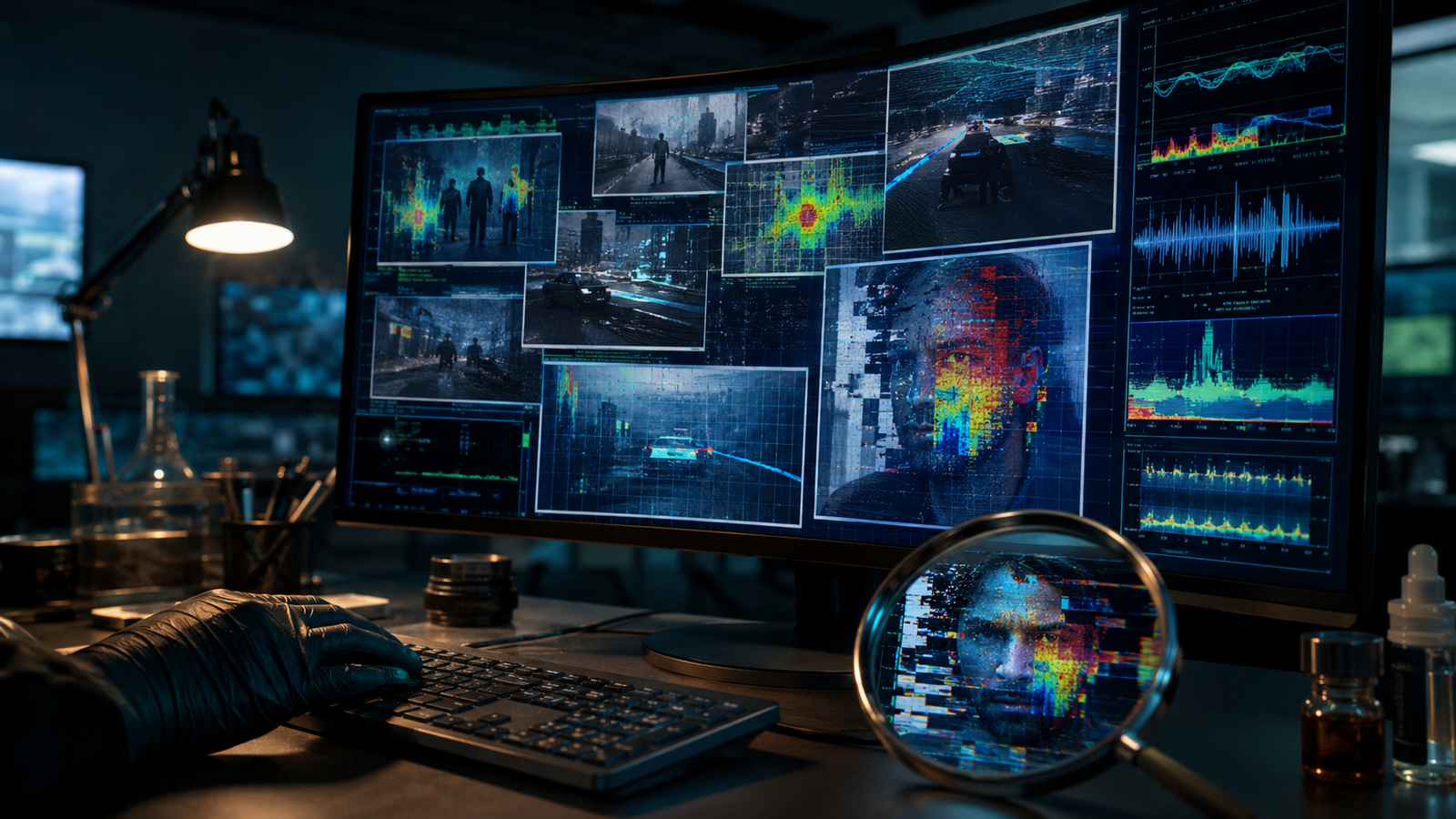
Every category of digital evidence that security investigators once treated as inherently trustworthy, a photograph, a voicemail, a chat transcript, a signed document, can now be fabricated convincingly enough to survive a cursory glance. Generative models produce synthetic images, cloned voices, and machine-written text that pass casual review, and the gap between “looks real” and “is real” has become the central forensic question in incident response, fraud investigation, insider-threat casework, and litigation support.
This shift did not happen gradually. Diffusion-based image generators and modern voice-cloning systems reached a point where even trained experts, working without tools, cannot reliably distinguish synthetic media from camera-captured or human-authored originals. That single fact reorganizes the investigator’s job: detection has moved from a visual judgment call to a forensic discipline that requires instrumentation, statistical reasoning, and a documented chain of analysis.
The stakes are not abstract. Security teams now routinely encounter fabricated screenshots submitted as breach evidence, synthetic voice messages used in business email compromise and vishing follow-up, AI-written phishing lures and internal memos crafted to imitate an executive’s tone, and doctored video used in disinformation or extortion campaigns. Investigators who cannot systematically test for synthetic origin risk building conclusions, and legal exposure, on fabricated foundations.
The Forensic Toolkit: What Detection Actually Looks At
Modern AI content detection forensics rests on three broad families of technique. None is sufficient alone; investigators layer them to build a probabilistic case rather than a binary verdict.
Metadata and Provenance Analysis
The first pass on any digital artifact is metadata: EXIF fields on images, container and codec metadata on video and audio, document revision history and font-embedding data on files, and message headers on communications. Investigators look for missing capture-device fields, metadata that has been stripped entirely (a red flag on its own, since legitimate captures usually carry rich metadata), inconsistent timestamps between creation and modification fields, and the presence or absence of Content Credentials (C2PA) provenance manifests that some generative platforms now attach by default.
Provenance standards such as C2PA are a meaningful improvement because they create a cryptographically signed edit history that travels with the file. But coverage is inconsistent: many generation tools do not embed credentials, credentials can be stripped by re-encoding or by uploading through a platform that recompresses media, and an absent manifest never proves human origin, it only proves the file did not pass through a C2PA-compliant pipeline intact.
Statistical and Model-Based Detection
The second family uses classifiers, usually neural networks, trained to spot statistical fingerprints left behind by generative processes. For text, this means unnatural uniformity in token-level probability distributions, since language models tend to select higher-probability next tokens more consistently than a human writer does. For images, detectors look for frequency-domain irregularities introduced by upsampling and decoder architectures, inconsistent noise patterns across regions of an image, and unnatural regularities in color correlation between channels. For audio, detectors examine spectral artifacts from vocoders, unnatural pitch and formant transitions, and the absence of the micro-variability present in a real human vocal tract and recording environment.
These classifiers work well against content generated by the same architecture and settings they were trained on, and considerably worse against anything else. That model-specificity is the single biggest operational limitation in this category, and it means detection vendors must retrain continuously just to keep pace with new generator releases.
Perceptual and Physical Artifact Review
The third family is manual or semi-automated review for physically implausible details: inconsistent lighting and shadow direction across a scene, reflections that do not match the purported light sources, unnatural blinking or micro-expression patterns in video, lip-sync drift against audio, asymmetric or malformed detail in hands, ears, teeth, and jewelry, and background text or patterns that warp incoherently. These artifacts have become rarer as generators improve, and are now unreliable as a sole method, but they remain useful corroborating evidence, particularly for lower-effort fabrications and for content generated by less sophisticated tools still circulating in fraud and phishing operations.
| Modality | Primary forensic techniques | Known weak points |
|---|---|---|
| Still images | Frequency-domain analysis, noise-pattern consistency, C2PA manifest check, error-level analysis | Recompression destroys frequency artifacts; new diffusion models produce cleaner noise profiles each release |
| Video | Frame-consistency checks, lip-sync and blink-pattern analysis, temporal coherence scoring | Short clips and low resolution starve models of the frames needed for temporal analysis |
| Audio | Spectrogram and vocoder-artifact analysis, prosody and breath-pattern review, voiceprint comparison against known samples | Background noise and phone-line compression mask synthesis artifacts; short samples reduce reliability |
| Text and chat logs | Token-probability and perplexity analysis, stylometric comparison against known author samples, cross-referencing claimed timestamps and platform metadata | Human editing of AI drafts blends signal; short messages carry too little statistical signal to score reliably |
| Documents | Revision-history and font-embedding review, digital-signature validation, metadata timestamp cross-checks | PDF flattening and print-to-PDF re-export strip the revision trail investigators rely on |
Why Accuracy Collapses in Real Investigative Conditions
Vendor accuracy claims are usually measured on curated benchmark datasets under ideal conditions: high resolution, no compression, no adversarial intent, and content generated by the exact model family the detector was trained on. Real investigations violate every one of those assumptions simultaneously. Evidence arrives recompressed through messaging apps, screen-recorded, cropped, downsampled for email attachment limits, and, increasingly, deliberately engineered to defeat detection.
The accuracy cliff between lab and field conditions
Picture two bars side by side. The first, labeled clean benchmark conditions, towers near the top of the chart at roughly 95 to 99 percent detection accuracy. The second, labeled real-world compressed and cross-model content, drops sharply to around 78 percent, and a third bar for adversarially perturbed samples designed specifically to evade the detector falls further still, in some documented tests down toward 40 to 62 percent. The steep staircase illustrates why a single detector score should never be the sole basis for an investigative conclusion.
Three specific failure modes drive this collapse. First, domain shift: a classifier trained on one generator’s output loses most of its discriminative power against a different generator, and new generation architectures ship faster than detection vendors can retrain. NIST evaluation work has demonstrated detectors that catch same-tool morphs nearly every time collapsing to well below 40 percent accuracy against a different generation tool. Second, adversarial evasion: attackers who know detection is likely will deliberately add imperceptible noise, recompress at specific bitrates, or subtly alter frame rates to push content across a classifier’s decision boundary, sometimes cutting detector accuracy from near-perfect scores down near chance. Third, compounding degradation: the compression and re-encoding that happens naturally as content moves through chat apps, social platforms, and email attachments strips exactly the high-frequency artifacts many detectors depend on, independent of any adversarial intent.
The practical implication is that investigators must treat detector output as one input signal with a known, quantifiable failure rate, not a verdict. Reporting a raw confidence score without context, “the tool says 91 percent AI-generated”, without disclosing the tool’s real-world false-positive and false-negative rates on comparable content is professionally negligent and can undermine an otherwise sound investigation if challenged.
Chain of Custody and Admissibility
Detection findings that will support a personnel action, a fraud claim, or litigation need the same evidentiary discipline as any other digital forensic artifact. That means preserving the original file exactly as received, hashing it before any analysis, documenting every tool and version used to analyze it, recording the exact prompts or settings run against any detection API, and retaining raw detector output rather than only a summary judgment. Courts and internal review boards increasingly ask not just “what did the tool conclude” but “how was the tool validated, and what is its known error rate on comparable evidence.” Investigators who cannot answer that question should expect their conclusions to be challenged or excluded.
A second admissibility issue is explainability. Black-box classifier scores are difficult to defend under cross-examination or internal appeal because they cannot point to a specific, describable anomaly. Tools that offer localization, highlighting which region of an image or which segment of an audio file drove the classification, produce evidence that is both more defensible and more useful for follow-up analysis.
| Evidence stage | Required action | Why it matters |
|---|---|---|
| Intake | Hash the original file before any processing; preserve the unmodified original separately from working copies | Establishes an unaltered baseline that later analysis and any opposing review can be measured against |
| Analysis | Record tool name, version, model/classifier version, and exact settings used for every test run | Allows the analysis to be reproduced and defended if the finding is challenged |
| Interpretation | Report confidence scores alongside the tool’s documented error rate on comparable real-world content | Prevents a raw score from being read as certainty it does not represent |
| Corroboration | Cross-check findings against at least one independent method (metadata, stylometry, source verification) | Reduces reliance on any single detector’s known blind spots |
Building a Practical Detection Workflow
A workable investigative workflow treats detection as triage followed by corroboration, not a single-step lookup. In practice this looks like: preserve and hash the artifact, run metadata and provenance checks first since they are fast and cheap, run at least two independent statistical detectors where the modality allows it, apply perceptual review for corroborating physical artifacts, and only then draft a finding that states confidence in probabilistic terms with the supporting evidence enumerated.
Investigators should also maintain a source-verification habit that does not depend on detection tools at all: contacting the purported originator through an independently verified channel, checking whether the same content exists on a known legitimate platform with consistent metadata, and looking for corroborating context such as calendar records, badge logs, or independent witnesses. Detection tooling narrows the question; independent corroboration answers it.
Common mistake
Treating a single detector’s percentage score as a conclusion and writing it into a report or incident timeline without disclosing the tool’s real-world accuracy on comparable content. A 91 percent confidence score from a tool that has been shown to drop to 60-70 percent accuracy on compressed, cross-platform media is not the same as 91 percent certainty, and presenting it that way invites the finding to be discredited the moment someone tests the tool’s actual limitations.
What worked
Investigation teams that paired a fast statistical detector for initial triage with a slower, human-reviewed metadata and provenance check, then required at least one independent corroborating signal before escalating a finding, consistently produced conclusions that held up under internal challenge and external legal review, because no single point of failure carried the entire finding.
Frequently Overlooked Signals
- Re-upload artifactsPlatforms that automatically recompress uploads (messaging apps, social feeds) strip metadata and high-frequency detail, making previously detectable content appear clean; always ask where a copy has traveled before analysis.
- Font and layout embeddingDocuments generated or edited by AI tools often embed unusual font subsets or inconsistent kerning that standard document viewers hide but forensic PDF tools reveal.
- Cross-modal inconsistencyA fabricated video call recording may pass audio detection and image detection separately while still showing lip-sync drift only visible when both channels are analyzed together.
- Prompt residueAI-written text sometimes retains structural fingerprints of instruction-following, like formulaic transitions or unnaturally even paragraph lengths, that stylometric tools catch even when content has been lightly edited.
- Negative evidenceThe complete absence of typical capture artifacts, sensor noise, lens distortion, ambient audio hiss, is itself a signal worth documenting, not just an inconclusive result.
- Detector versioning driftA detector’s accuracy on a given generator degrades over months as that generator updates; findings should record the detector’s model version and training cutoff date alongside the result.
- Social engineering contextSynthetic evidence rarely arrives alone; look for accompanying urgency, unusual request patterns, or channel switching that are hallmarks of a broader fraud or phishing narrative around the artifact itself.
Glossary
- C2PA (Content Credentials)
- An open technical standard that attaches a cryptographically signed manifest recording a file’s origin and edit history, intended to travel with the media through its lifecycle.
- Domain shift
- The drop in a detection model’s accuracy when it is applied to content that differs from what it was trained on, such as a new generator architecture or a different compression profile.
- Deception Success Rate
- A metric describing how often adversarially altered synthetic content successfully evades a specific detector, used to measure real-world robustness beyond clean-benchmark accuracy.
- Error-level analysis
- An image forensic technique that highlights areas of an image with different compression histories, often used to spot regions that were edited or inserted after the original capture or export.
- Stylometry
- The statistical study of writing style, used in text forensics to compare an unknown document’s linguistic fingerprint against known authentic samples from a claimed author.
- Perplexity
- A measure of how predictable a sequence of text is to a language model; unusually low perplexity across a document is a common statistical indicator of machine-generated text.
Key Takeaways
- No single detection method, metadata, statistical classifier, or perceptual review, is reliable alone against modern generative content.
- Vendor accuracy claims measured on clean benchmarks routinely overstate real-world performance by 20 or more percentage points.
- Detectors trained on one generator’s output can lose most of their accuracy against a different generator’s output within months.
- Adversarial evasion techniques, deliberate noise, recompression, and frame-rate changes, can collapse detector accuracy dramatically.
- Provenance standards like C2PA help but are inconsistently adopted and easily stripped by re-encoding or platform recompression.
- Findings intended for legal or disciplinary use require documented chain of custody, tool versioning, and disclosed error rates, not just a confidence score.
- Independent corroboration, verified-channel contact, cross-referencing timelines, and physical records, remains the strongest check against any single detector’s blind spots.
FAQs
Can any single tool definitively confirm content is AI-generated?
No. Even the strongest detectors show significant accuracy drops against real-world compressed, cross-platform, or adversarially altered content. Investigators should treat any single tool’s output as one probabilistic signal that must be corroborated with metadata review, stylometry, or independent source verification before it supports a formal finding.
Why does metadata sometimes look completely normal on fabricated content?
Metadata is easy to preserve, edit, or synthesize convincingly, and many workflows strip it entirely on export regardless of origin. A clean metadata profile is not proof of authenticity; it simply means that particular signal did not raise a flag, and other techniques are still required.
How much does file compression affect detection accuracy?
Significantly. Recompression through messaging apps, social platforms, and email attachments removes high-frequency artifacts that many statistical detectors depend on, which is a major reason lab-benchmark accuracy figures rarely hold up against evidence that has traveled through several platforms before an investigator sees it.
What is domain shift and why does it matter for investigators?
Domain shift is the accuracy loss a detector experiences when analyzing content from a generator different from the one it was trained on. Because new generation tools ship constantly, a detector that performed well last quarter may perform poorly against this quarter’s fabrications, so detector currency needs regular revalidation.
Are AI-written text and chat logs detectable the same way as images?
No. Text detection relies on token-probability and perplexity analysis and stylometric comparison rather than pixel or frequency analysis. Human editing of AI-drafted text blends the statistical signal, and very short messages rarely carry enough content for a reliable score either way.
What should an investigator document when using a detection tool for a formal report?
Record the tool name and version, the exact settings or model used, the raw output alongside any localization data, and the tool’s documented real-world error rate on comparable content. This turns a raw score into defensible evidence rather than an unverifiable claim.
Can adversaries deliberately defeat AI content detectors?
Yes. Documented adversarial techniques, adding imperceptible noise, altering compression settings, or modifying frame rates, have been shown to cut detector accuracy dramatically in controlled tests, which is why investigators should never rely on a detector that has not been evaluated against adversarial conditions relevant to their case type.
What is the single best practice for investigative teams building a detection workflow?
Layer multiple independent methods, metadata and provenance checks, at least two statistical detectors where possible, and perceptual review, then require independent corroboration such as verified-channel contact before a finding is finalized. No single method should ever carry an entire conclusion.
References
- NIST evaluation results on deepfake detection, as summarized by Pindrop
- CameraForensics, “AI image detection for investigators: a quick guide” (2026)
- Reality Defender, “Why Lab Benchmarks Fail Real-World Deepfake Detection”
- Adaptive Security, “How to Evaluate Deepfake Detection Tools: A Complete Framework for Security Leaders”
- ForensicsColleges.com, “How to Detect AI: A Guide to Digital Forensics Tools”
- International AI Safety Report 2026, arXiv preprint
- MDPI Applied Sciences, “Comprehensive Evaluation of Deepfake Detection Models: Accuracy, Generalization, and Resilience to Adversarial Attacks”
- arXiv, “Watermarking across Modalities for Content Tracing and Generative AI”
For related coverage on this site, see how organizations are approaching AI agent security and compliance programs, the mechanics behind deepfake fraud targeting finance teams, how voice cloning attacks are forcing call center verification redesigns, the broader discipline of cognitive security against synthetic influence operations, and how teams are red teaming AI systems to find these weaknesses before attackers do. Investigators securing the infrastructure agents run on may also want our deep dive on agent sandboxing containment patterns.