| Myth | Reality |
|---|---|
| ISRU is still purely theoretical, decades from real hardware. | An oxygen-extraction reactor has already reached Technology Readiness Level 6 after thermal-vacuum cycle testing, and a pneumatic drill has reached roughly one meter depth on the lunar surface. |
| Extracting water ice from the Moon is basically a solved problem. | Polar water prospecting remains one of the least mature ISRU goals; locating and characterizing accessible ice deposits is still an active, unsolved challenge. |
| Only NASA is building lunar excavation and resource robots. | ESA-co-funded rovers, Israeli, Japanese, and multiple US commercial companies are all developing competing or complementary excavation, drilling, and extraction hardware. |
| Lunar construction robots are unrelated to ISRU. | Construction systems are designed to use regolith-derived material directly, making them a downstream application of the same resource-extraction pipeline. |
Why the Moon Needs Its Own Robotics Category
Every kilogram launched from Earth to the lunar surface costs an enormous amount of fuel, time, and money, which is the entire reason In-Situ Resource Utilization exists as a discipline. Rather than shipping oxygen, water, and building material from Earth, ISRU aims to make some or all of those consumables directly from what is already on the Moon: regolith, the loose dusty soil covering the surface, and buried volatile ices in permanently shadowed polar craters. Turning that ambition into working hardware, however, requires a distinct category of robotics built for vacuum, extreme temperature swings, abrasive dust, and low gravity, conditions no terrestrial excavator or drill was ever designed to survive.
This is why lunar surface robotics and ISRU prototypes deserve treatment as their own technical field rather than a footnote inside general space robotics coverage: the rovers, excavators, and drills involved are purpose-engineered around the specific chemistry and mechanics of extracting oxygen from regolith or ice from cold traps, and the last two years have produced measurable, testable progress rather than just concept renderings.
| ISRU Target Resource | Extraction Approach | Maturity Level | Primary Use |
|---|---|---|---|
| Oxygen from regolith | Molten regolith electrolysis and reduction reactors | Reached Technology Readiness Level 6 after thermal-vacuum testing | Breathable air and rocket propellant oxidizer |
| Water ice from polar cold traps | Prospecting rovers and heat-based extraction, still largely unproven | Early prospecting stage, least mature ISRU goal | Drinking water, breathable oxygen, hydrogen fuel |
| Regolith for construction | Robotic excavation and additive/sintering-based building systems | Design conceptualization and prototype testing underway | Landing pads, habitats, radiation shielding |
| Subsurface heat flow and volatile mapping | Pneumatic and rotary drilling systems | Field-tested to roughly one meter depth | Site characterization for future ISRU plants |
Rovers and Excavation Robots Doing the Groundwork
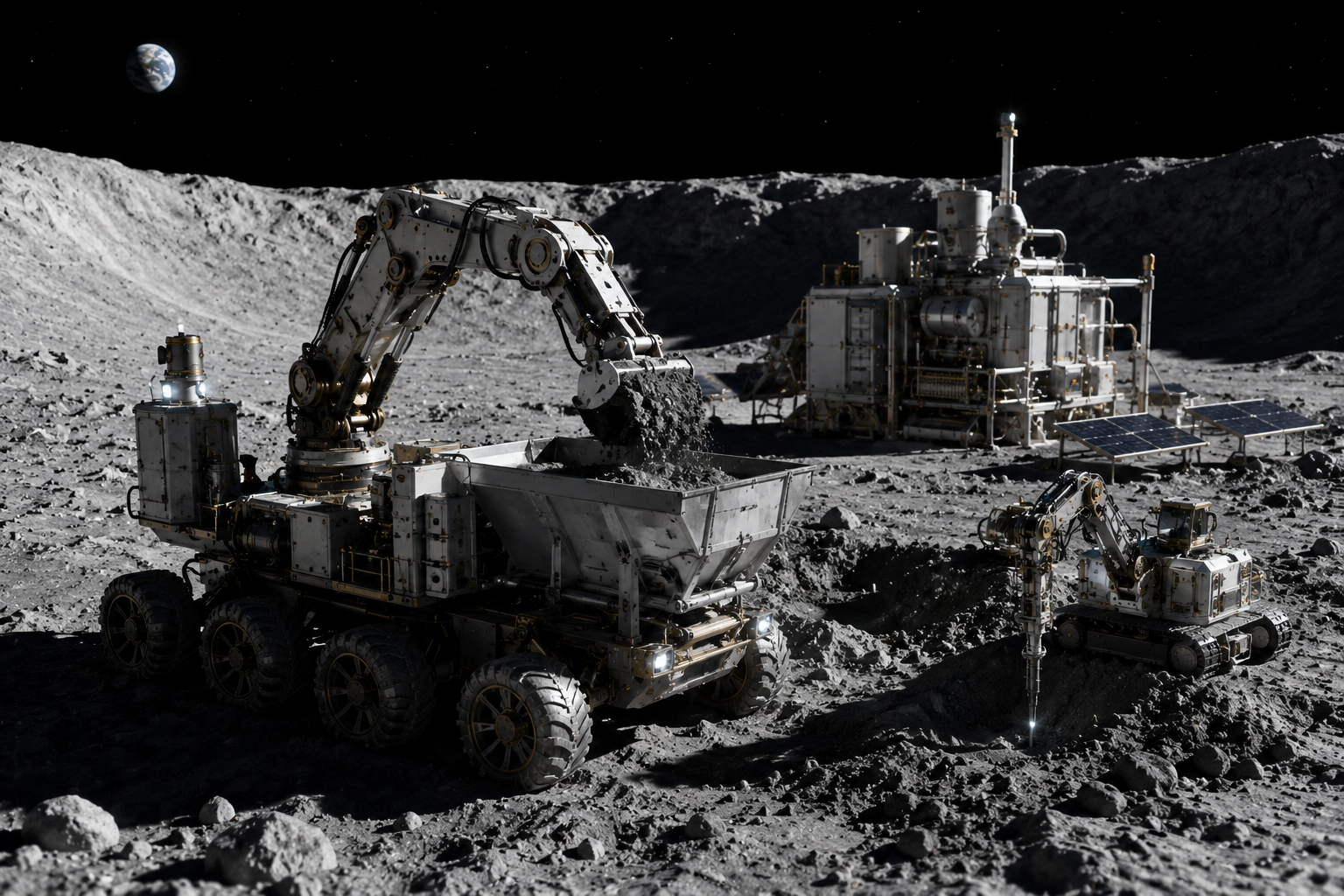
Before any resource can be extracted, it has to be found, characterized, and physically moved, and that groundwork falls to a growing fleet of specialized rovers and excavators. Compact excavation platforms such as the ESA-co-funded LUVMI-X rover, weighing in the 40 to 60 kilogram range, are being paired with dedicated regolith excavation and size-separation hardware designed to scoop, sort, and stage lunar soil for downstream processing rather than simply driving around and taking photographs like earlier generations of lunar rovers.
Drilling systems have made similarly concrete progress. A pneumatic drilling system equipped with a heat flow probe has achieved depths of approximately one meter into the lunar surface, marking one of the deepest robotic drilling efforts ever performed on the Moon and giving scientists direct subsurface data rather than surface-only readings. This kind of drilling and heat-flow data matters enormously for ISRU planning, since it helps engineers understand how deep useful ice or thermally stable material might sit before a full extraction plant is designed around the wrong assumptions.
NASA’s polar rover program has also remained central to this effort. Originally developed to search for volatile resources such as ice at the lunar South Pole, the rover mission was revived after a period of cancellation uncertainty, with a commercial lander now contracted to deliver it to the surface in the late-2027 timeframe, underscoring how central direct polar prospecting remains to the entire ISRU roadmap even amid programmatic turbulence.
From Regolith to Usable Resource: The ISRU Pipeline
A rover or excavator scoops and sorts raw regolith by particle size; sorted material is fed into a reactor that uses molten regolith electrolysis or a similar reduction process to release bound oxygen; the extracted oxygen is stored for breathing air or propellant, while leftover processed regolith becomes feedstock for construction robots building landing pads or habitat shielding.
Oxygen Extraction: The Most Mature ISRU Prototype Category
Of every ISRU pathway currently in development, oxygen extraction from regolith is unambiguously the furthest along. A prototype reactor system designed to pull oxygen directly out of lunar regolith has completed final testing after reaching Technology Readiness Level 6, a significant milestone that means the hardware has survived realistic thermal-vacuum cycling meant to simulate actual lunar surface conditions rather than just a controlled lab bench test. That system was developed by the Israeli company Helios and tested at NASA’s Johnson Space Center, an example of the increasingly international, cross-sector collaboration defining this field.
Multiple companies are now racing toward plant-scale oxygen production rather than small demonstration units. Sierra Space, Blue Origin, and Lunar Resources have all emerged as principal US-based developers pursuing oxygen-from-regolith systems with genuine plant-class ambitions, meaning hardware designed to eventually support continuous production runs rather than one-off technology demonstrations. This shift from single-test prototypes to plant-class thinking is one of the clearest signals that ISRU oxygen extraction has moved past the purely experimental phase.
Oxygen has an outsized strategic value in ISRU planning because it serves two purposes simultaneously: breathable air for crewed missions and, in far larger quantities, oxidizer for rocket propellant. A lander that can refuel its oxidizer tanks on the lunar surface rather than carrying a full return-trip supply from Earth changes the entire mass budget of a mission, which is why oxygen extraction has attracted so much investment relative to other ISRU targets.
| Organization | ISRU or Robotics Focus | Notable Milestone |
|---|---|---|
| Helios (with NASA Johnson Space Center) | Oxygen-from-regolith reactor | Completed thermal-vacuum testing at Technology Readiness Level 6 |
| Sierra Space, Blue Origin, Lunar Resources | Plant-class oxygen extraction systems | Advancing from demonstration units toward continuous production designs |
| ESA / LUVMI-X consortium | Compact excavation rover and regolith size-separation system | 40 to 60 kg rover platform with integrated LES3 excavation hardware |
| ICON | Regolith-based additive construction | Roughly 60 million dollars in NASA funding for lunar construction systems |
| NASA CLPS program (Blue Origin delivery) | Polar volatile-prospecting rover delivery | Commercial lander contracted for a late-2027 South Pole delivery |
Common mistake
Treating all ISRU targets as equally mature. Oxygen-from-regolith extraction has reached genuine hardware-testing milestones including Technology Readiness Level 6, while polar water ice extraction is still largely at the prospecting stage, with no equivalent flight-tested extraction reactor yet demonstrated. Conflating the two leads to unrealistic timeline expectations for water-dependent mission architectures.
Construction Robotics: The Downstream ISRU Application
Extracting oxygen and water is only half the ISRU story; the other half is using leftover processed regolith as a building material. Lunar construction robotics has advanced enough that at least one company has secured roughly 60 million dollars in NASA funding specifically to advance regolith-based additive construction systems capable of building landing pads, habitat shielding, and other structures directly from local material rather than imported concrete or metal. Conceptual designs for lunar robotic construction systems using raw regolith are also being formally published and refined in engineering literature, moving the idea from renderings toward buildable specifications.
The logic here mirrors the oxygen case: any structure built from local regolith is mass that never had to be launched from Earth. Landing pads are a particularly practical early target, since rocket exhaust kicks up abrasive regolith at high velocity during landing and launch, a real hazard to nearby hardware that a regolith-sintered pad can mitigate directly.
What worked
Pursuing oxygen extraction and construction as parallel but separate development tracks rather than waiting for one unified ISRU system to do everything. By letting oxygen-reactor teams and regolith-construction teams each optimize independently for their own narrower engineering problem, both tracks have reached testable hardware milestones faster than a single combined system likely could have.
Remaining Gaps and What Comes Next
Polar water ice remains the clearest gap in the current ISRU picture. Locating accessible, extractable ice deposits inside permanently shadowed craters is still fundamentally a prospecting problem, not a hardware problem, since no team has yet demonstrated a flight-proven system for reliably finding, characterizing, and extracting ice at scale. This is exactly the gap the revived polar rover mission is meant to close, and its delayed but still-planned late-2027 delivery keeps water-based ISRU on a slower track than oxygen extraction.
Looking ahead, expect continued convergence between rover mobility, excavation hardware, and fixed processing plants, with commercial lunar payload delivery missions serving as the recurring test bed for each new generation of hardware. The pattern established over the last two years, in which prototypes move from lab bench to thermal-vacuum testing to an actual lunar surface flight within a few years rather than a decade, appears likely to continue as more CLPS-style commercial delivery missions fly.
- Technology Readiness Level (TRL)A standardized nine-point scale used across NASA and ESA programs to describe how close a piece of hardware is to real flight use; TRL 6 means the system has been tested in a realistic, simulated operational environment.
- Permanently shadowed craterA polar lunar crater floor that never receives direct sunlight, cold enough to trap water ice and other volatiles for potentially billions of years, making it the primary target for water-based ISRU.
- Regolith size separationThe process of sorting excavated lunar soil by particle size before feeding it into a processing reactor, since reactor efficiency depends heavily on consistent input material.
- Commercial Lunar Payload Services (CLPS)NASA’s program for contracting commercial companies to deliver science and technology payloads, including rovers and ISRU prototypes, to the lunar surface.
- Plant-class systemAn ISRU design intended for continuous, scaled-up production rather than a single demonstration run, signaling a shift from proving a concept works to proving it can operate at useful volume.
Glossary
- In-Situ Resource Utilization (ISRU)
- The practice of collecting and processing local materials on a planetary surface, such as lunar regolith or ice, to produce resources like oxygen, water, or construction material instead of shipping them from Earth.
- Regolith
- The layer of loose, fragmented dust, soil, and rock fragments covering the solid bedrock of the lunar surface, and the primary raw material for most ISRU processes.
- Molten regolith electrolysis
- A process that melts regolith and passes an electric current through it to separate out oxygen and metal byproducts, one of the leading approaches to oxygen extraction.
- Volatile
- A chemical compound, such as water ice or certain gases, that vaporizes at relatively low temperatures and can be trapped in cold lunar polar craters.
- Excavation rover
- A mobile robotic platform equipped with scoops, blades, or similar tools designed to dig, gather, and transport regolith for processing rather than purely for scientific observation.
Key Takeaways
- Lunar ISRU aims to produce oxygen, water, and construction material directly from regolith and polar ice rather than shipping them from Earth.
- Oxygen extraction from regolith is the most mature ISRU pathway, with a prototype reactor reaching Technology Readiness Level 6 after thermal-vacuum testing.
- Sierra Space, Blue Origin, and Lunar Resources are among the principal developers pushing oxygen extraction toward plant-class, continuous-production systems.
- Compact rovers like the ESA-co-funded LUVMI-X, paired with dedicated excavation and size-separation hardware, handle the physical groundwork of gathering and sorting regolith.
- A pneumatic drilling system has reached roughly one meter depth on the Moon, among the deepest robotic lunar drilling efforts to date.
- Polar water ice extraction remains the least mature ISRU goal, still largely at the prospecting stage rather than the tested-hardware stage.
- Construction robotics, including regolith-based additive building systems, represent a growing downstream application of the same ISRU material pipeline.
FAQs
What is ISRU and why does it matter for lunar missions?
In-Situ Resource Utilization means producing resources like oxygen, water, and building material directly from lunar regolith and ice rather than launching them from Earth, which dramatically reduces mission mass and cost for sustained lunar operations.
How mature is oxygen extraction from lunar regolith right now?
It is the most advanced ISRU pathway currently in development; a prototype reactor developed by Helios and tested at NASA’s Johnson Space Center has reached Technology Readiness Level 6 after surviving thermal-vacuum cycle testing that simulates real lunar conditions.
Which companies are building plant-scale oxygen extraction systems?
Sierra Space, Blue Origin, and Lunar Resources are the three principal US-based developers pursuing oxygen-from-regolith systems designed for continuous, plant-class production rather than single demonstration units.
What is the LUVMI-X rover and what does it do?
LUVMI-X is a compact, 40 to 60 kilogram excavation rover co-funded by ESA, integrated with the Lunar Excavation and Size Separation System to scoop, sort, and stage lunar regolith for downstream ISRU processing.
How deep have robotic drilling systems reached on the Moon?
A pneumatic drilling system equipped with a heat flow probe has reached depths of approximately one meter, making it one of the deepest robotic drilling efforts performed on the lunar surface to date.
Why is water ice extraction less developed than oxygen extraction?
Water ice sits in permanently shadowed polar craters that are difficult to access and characterize, so most current work remains at the prospecting stage; no team has yet demonstrated a flight-proven system for reliably extracting ice at scale.
What role does lunar construction robotics play in ISRU?
Construction robots use regolith-derived material, including additive and sintering-based building methods, to construct landing pads and habitat shielding directly on-site, making them a practical downstream application of the same resource-extraction pipeline.
What happened with NASA’s polar prospecting rover mission?
The rover mission faced cancellation due to cost overruns and delays before being revived, with a commercial lander now contracted to deliver it to the Moon’s South Pole region in the late-2027 timeframe to search for water ice and other volatiles.
For related coverage in this same robotics cluster, see our deep dives on wildfire detection and response robotics and deep-sea mining robotics. Readers interested in other automation topics may also want to review inspection drones for energy infrastructure and robotic harvesting systems. For a broader restoration-focused robotics story, see swarm robotics for reforestation and restoration.
- Space Robotics Workshop, “Space Robotics Workshop @ IROS 2026”
- Lunar Surface Innovation Consortium, “In-Situ Resource Utilization Focus Area”
- NASA, “NASA Fosters Development of Lunar Resource-Seeking Technologies”
- Lyon Industries, “ISRU 2026: Lunar Oxygen Is Ready, Lunar Water Is Not”
- PatSnap Eureka, “Lunar Resource Extraction 2026”
- MDPI Aerospace, “Lunar Robotic Construction System Using Raw Regolith: Design Conceptualization”
- Orbysa Aerospace and Defense News, “Lunar Mining: Pioneering the Future of Resource Extraction on the Moon”
- Astronomy.com, “VIPER moon rover mission revived by NASA”
- National Space Society, “NSS Applauds NASA’s Selection of Blue Origin to Deliver VIPER to the Moon”
- NASA, “NASA Selects Blue Origin to Deliver VIPER Rover to Moon’s South Pole”
- NASA Science, “VIPER In Depth”